Next weekend, I’ll participate in a discussion at a famous liberal arts college about the various crises facing such institutions.
All the other participants will be liberal arts college professors. Although my institution is a research university, the intersection of the liberal arts and civic learning also matters to me.
First, the crises that confront the liberal arts (from the cost of college to the rise of AI; from Donald Trump to cultural challenges within the academy) also threaten the parts of a university where I work.
Second, we face an important conceptual question whenever we try, at universities like mine and many others that I visit (and in k-12 education) to strengthen civic learning. Are the liberal arts automatically “civic”? In other words, is saving the liberal arts a way to accomplish “education for citizenship” (which will be the title of my talk next weekend)? In practical terms, can we say that a student who has a good basis in the liberal arts is also educated for citizenship? Or is there a distinction between civic and liberal education?
In short, my answer would be that the liberal arts provide education for a good individual life. But the specific question for citizens is how to do good things together. Citizens need collective agency.
Most or perhaps all of the liberal arts are useful for collective agency. A group of people concerned with the condition of their community can benefit from understanding economics, the carbon cycle, liberalism and its critics, and the origins of their language, to name just four examples. However, a mass of such knowledge may not sufficiently inform them about how to act well together. They also need the Tocquevillian art and science of association, the “mother science” in a democracy.
We can learn how to associate effectively and wisely from experience. If one grows up amid functioning voluntary associations and participatory democratic institutions, one may learn how to make them work well without having to study that topic extensively. However, most modern Americans lack such opportunities.
Besides, since the challenges of forming and sustaining effective groups have grown and changed in the 21st century, accumulated experience may not suffice. Civic education requires the explicit study of collective agency, often based on texts.
Note that the scale of collective action ranges from pairs of collaborators to the whole human species. A nation is one “we” among many others.
The precise topics of civic education may vary depending on students’ interests and needs. However, as illustrative examples, it can be very useful to understand how the grassroots leaders of the American Civil Rights Movement formed effective nonviolent organizations, or how a 21st century nonprofit should develop a strategic plan, or how to analyze an argument about values, or how to collect relevant environmental data, or (indeed) what James Madison advises about the problem of factionalism in Federalist #10.
These are classic topics in the liberal arts, likely offered in departments from history and biology to philosophy. What matters is the spirit and purpose of the inquiry, which must involve collective agency. The primary question is not how things work, or how things should be, or what someone thought, but what we (a group to which a person belongs) should do.
Both pedagogy and content are relevant. To learn to govern things together, it is valuable to practice discussing and writing about texts and data. These are forms of pedagogy. But it is also valuable to understand the difference between a labor union and a corporation–that is content, which can be conveyed in a lecture. Both matter.
Three quick historical illustrations may help to convey this ideal.
The earliest attested use of the phrase “liberal arts” occurs in an early and minor work by Cicero, De Inventione (1.35). He is not discussing the liberal arts. The phrase occurs in a long list of ways that people differ. A person can be male or female, strong or weak, Greek or barbarian. (I would like to ask a classicist whether Cicero, a Roman writing in Latin, considered himself a barbarian on account of his country or a Greek because of his education.) A man’s character also depends on “who he had as teachers of the liberal arts” and “who has instructed him in living.”
This brief mention is hardly a theory of the liberal arts. However, Cicero opens the book with this problem: wisdom is moot without eloquence (no one will act wisely unless persuaded), yet eloquence is morally neutral and can be used for evil. His stated objective is to serve “our republic” by uniting wisdom with eloquence. In that context, the liberal arts appear, along with moral exhortation, as ways of making men lead good lives–men who are not only individuals but also citizens of a republic.
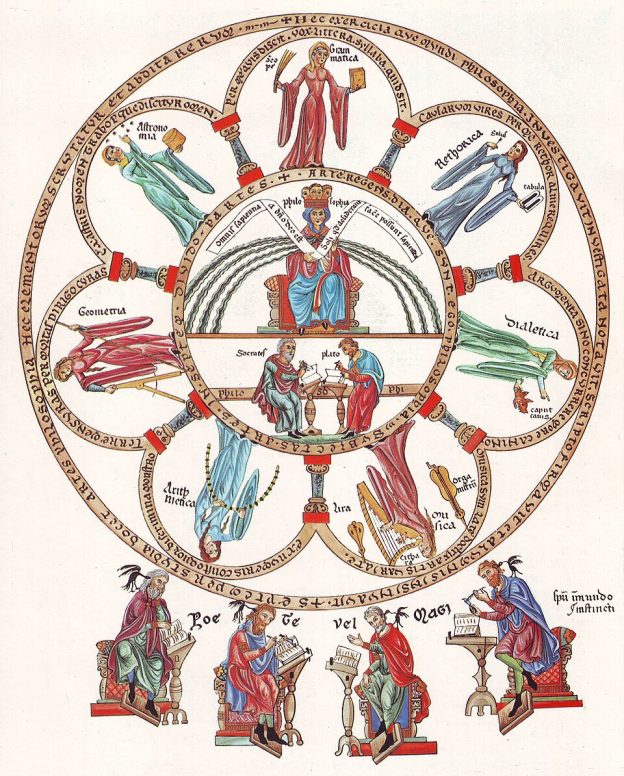
Now compare the image of Philosophy and the Seven Liberal Arts by the remarkable woman Herrad of Landsberg (ca. 1185), which accompanies this post. Here Philosophy is the Queen. Philosophy says that the liberal arts flow from her as seven streams of wisdom, and she gets her wisdom from God. At the bottom of the picture are four bad men (listening to black birds instead of Philosophy) who violate the liberal arts. One of those is a Magician, and another is a Poet, consigned to the bottom because he makes up false stories.
Herrad may have been an exemplary participant and leader of a group–the abbey whose nuns elected her as their abbess in 1167. Nevertheless, her conception of intellectual life is religious as opposed to republican. For her, knowledge is abstract and divine, discovered not created by people. Education leads one up and out of human affairs.
Finally, Hannah Arendt aimed to recover the republican ideals that animated the young Cicero but for modern times. In 1958, she wrote:
There may be truths beyond speech, and they may be of great relevance to man in the singular, that is, to man in so far as he is not a political being, whatever else he may be. Men in the plural, that is, men in so far as they live and move and act in this world, can experience meaningfulness only because they can talk with and make sense to each other and to themselves.(The Human Condition, p. 4).
Herrad of Landsberg’s truths are definitely beyond speech and relevant to the individual soul, because they are truths about God. But I think the ordinary modern liberal arts also pursue truths beyond “speech” (in Arendt’s idiosyncratic terminology). For example, pure mathematics belongs to the liberal arts. One might think that any science which relies on impersonal methods pursues truths without intrinsically requiring “speech,” and its truths can matter to people. But the liberal arts also involve truths that we make together by talking and acting. That is where the liberal arts and civic education intersect.
See also: love of the world; is Black Studies Civic Studies?; A Defense of Higher Education and its Civic Mission (2013); the humanities as civic education etc.