“The feeling that the world is a bounded whole–that is the mystical.” — Wittgenstein
The Spanish word quedar can be translated as to remain, to stay, to meet, to fit, to suit (as in Ese color te queda bien), to be located, to end up, to agree, or to be left with (as in Me quedan 20 euros).
One of those meanings is “to agree.” That English verb can be translated back into Spanish as estar de acuerdo, acordar, convenir, coincidir, aceptar, or, again, quedar.
One of those meanings is acordar. Rendered back in English, that verb can mean to agree, decide, or make an arrangement, or–if it’s in a reflexive form–to remember. In turn, “to decide” could be conveyed in Spanish by decidir (or decidirse), resolver, acordar or determinar.
I chose quedar because it has a famously wide range of meanings, a bit like rendre or tenir in French. But notice that each of the words that I’ve mentioned connects to a unique list of words in the other language. This is typical. Putting two languages together creates a pattern of intertwined connections, like an arabesque design.
When you study a language, you memorize foreign words as sets of distinct words in your home language. In a given context, quedar means one thing, such as “to stay” or else “to agree.” A translator should know–or look up–the full list of meanings for each word and must pick the best one for each sentence. Sometimes there is no single best choice.
But once you know the language reasonably well, a word no longer decomposes into several words in a different language. Now it covers its own space. Presumably (I don’t have good enough Spanish to know) each use of quedar carries an implicit trace of its whole range of meanings.
Todo pasa y todo queda,
pero lo nuestro es pasar,
pasar haciendo caminos,
caminos sobre el mar.

Everything passes and everything stays,
But ours is to cease to be.
As we go, we make a highway,
A highway on the sea.

Antonio Machado, Proverbios y Cantares (1912): XLIV
Here I’ve rendered the first line with the verbs “to pass” and “to stay,” but I had other choices. Pasar could mean to go through, to happen (¿que pasa?), to spend time, etc. And we have already seen the range of meanings for quedar. Its other senses are missing in the English word “stay,” but that verb has its own range of meanings, including to visit and to prevent something from happening. Those are absent in Machado’s original.
I chose “to pass” for several reasons, including the sonic resemblance to pasar as well as some vague sense of English allusions, such as “One generation passeth away, and another generation cometh” (Ecclesiastes). I chose “to stay” as a single syllable that was a near-rhyme for “ways.” Translation is not only about matching words but also about syntax, rhythm, and sound.
Artificial Intelligence is good at translating prose. It generally chooses an appropriate equivalent for each word. Thanks to AI tools, I have been able to read articles in languages, such as Japanese, of which I know nothing. I have also developed a careful practice of asking Claude to list all the dictionary definitions of words in languages, such as Sanskrit and Pali, that interest me. I hope that viewing these lists gives me some sense of how the words work in their original languages, although I must look through that glass darkly.
What AI cannot do is give a person the experience of parsing the whole world a bit differently by beginning to think in a different language. In turn, that experience teaches us that anyone’s model of the world is limited and contingent, and much always remains beyond anyone’s grasp.
A language is a whole system of meanings. It allows us to work with the world, yet it coexists with other systems that present the world differently. Those other systems include not only human languages (which are, after all, rather similar and interconnected), but also other consciousnesses. To glimpse this plurality is to see our own world as if from beyond it.
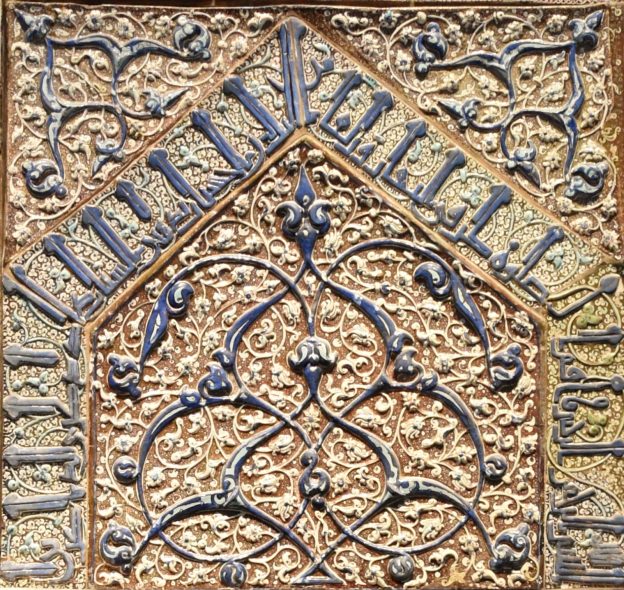
In the detail from a 13th-century Persian mihrab that accompanies this post, each arabesque field could stand for a pair of intertwined human languages, but there are also fields across the boundaries formed by the Quranic calligraphy. And the whole mihrab is a threshold to the beyond.
Wittgenstein writes, “Das Gefühl der Welt als begrenztes Ganzes ist das mystische” (Tractatus 6:45). Acknowledging that this sentence could be translated in many ways, I will render it: “The feeling that the world is a bounded whole–that is the mystical.”
It’s another way of saying that we make our highways on the sea.
See also: Machado’s Glory is Never What I’ve Sought and Highways on the Sea; paradigms of attention; why the humanities could never be automated; and thinking both sides of the limits of human cognition. Photo credit: detail of a mihrab from Kashan (1226) in the Pergamon Museum, Berlin, via Wikimedia Commons.
