Whether the current war in the Persian Gulf will push the world away from carbon depends on many factors, including the trajectory of the war and the policy responses of many countries. David Wallace-Wells offers a roundup of recent news, which generally paints an optimistic picture about the rapid recent shift to renewables. I’d also note that Ukraine has developed the capacity to hit Russian oil infrastructure at long range, which could take another batch of oil off the world market.
Meanwhile, it’s worth taking stock of the energy transition so far. I don’t think the basic patterns are well known. Here I will make some observations based on two datasets that have limitations:
- The World Bank presents data on carbon use from 2022, which is now significantly dated. However, it covers almost all countries.
- The Energy Institute has data through 2024 but only for 75 countries, omitting most of the Global South.
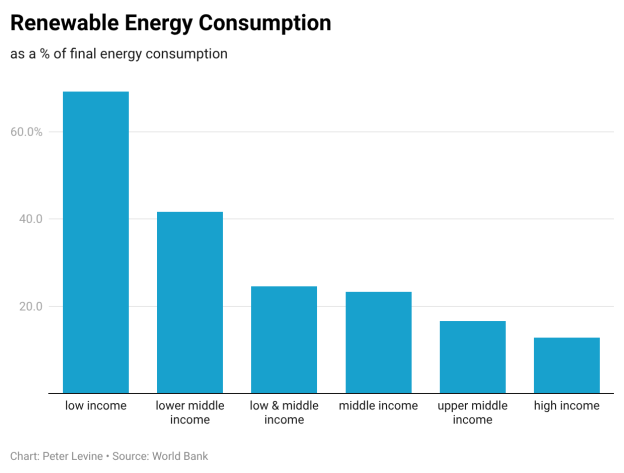
The World Bank’s 2022 data show that the countries that used the highest proportions of renewables were very poor, such as the DRC at 96.3% and Somalia at 95.4%. All of Sub-Saharan Africa used 70.3% renewables, and all of the world’s low-income countries used 69.2%–compared to 10.9% in the USA. (The Energy Institute puts the US share even lower, at 7.2%.)
Poor countries use too little total energy per capita, but their people cannot afford to import oil, and the energy that they do use is mostly renewable. I presume that as the price of oil rises and the cost of solar panels and electric vehicles continues to fall, many poor countries will move almost entirely off oil. Tankers will virtually stop visiting them.
Rich countries will continue to have the option to buy oil and gas. As shown in the graph above this post, the relationship between a country’s wealth and its dependence on carbon energy was strong and monotonic in 2022, although the countries with the very lowest proportions of renewables were mostly petro-states. Bahrain and Qatar were at zero renewables, and Iran was at 0.9%. The Russian Federation got 2.6% of its energy from renewables, mostly hydroelectrics.
For 2024, I show the per capita income (from the IMF) and the share of renewable energy (from the Energy Institute) for each of 75 countries in 2024. The OECD countries–which are wealthier–are shown with x’s. Some outliers are labeled.
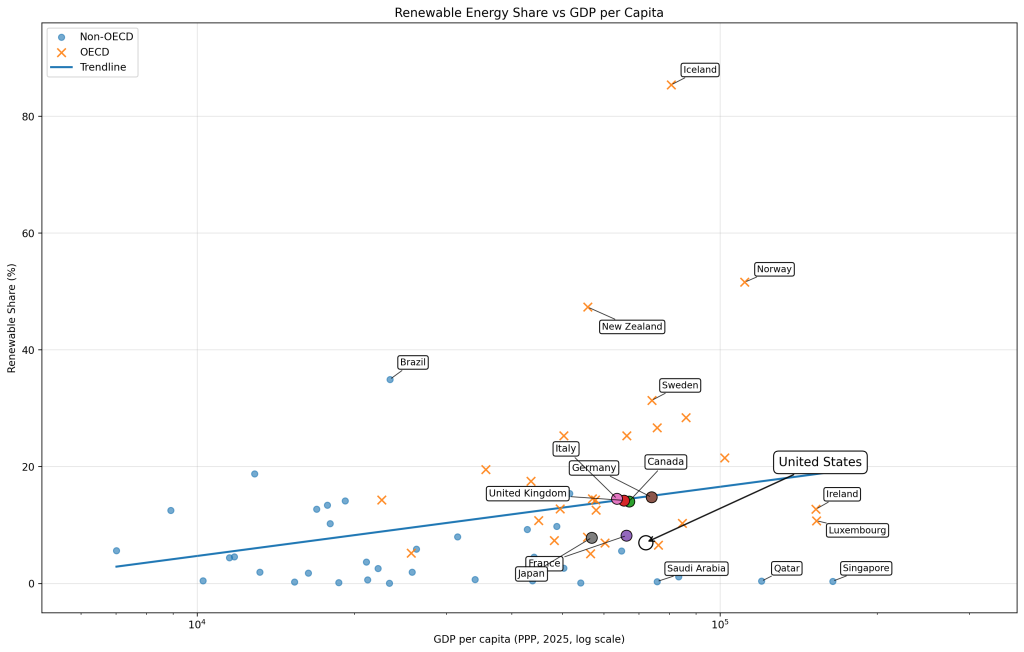
For this smaller set of more affluent countries, dependence on carbon is weakly related to income, and other factors evidently matter more. The highest performing wealthy countries are in Scandinavia, where policy and nature (mainly hydroelectrics) help.
The best performing large market is Brazil, at 35% renewables. Brazil is classified as upper-middle-income but has no oil and lots of hydropower (55% of the energy that it generates instead of importing). The USA is below the regression line.
In the Energy Institute data, the countries that had achieved the best improvements in carbon intensity by 2024 were Bulgaria and Chile. (Carbon intensity is the amount of carbon used to generate a unit of energy.)
I suppose the conclusion is that poor countries will virtually stop using oil, and petro-states will probably keep using it. Those with abundant hydropower will be more likely to wean off oil. The USA is a bit of a petro-state but also a dynamic and diversified economy, so we could go either way.