Category Archives: philosophy

on the moral dangers of cliché

Here are five brief studies of people who made heavy use of clichés: Francesca da Rimini, Madame Bovary, Adolf Eichmann, W.H. Auden, and Don Gately from David Foster Wallace’s novel Infinite Jest. I offer these portraits to explore the moral pitfalls of cliché and to investigate how our postmodern situation differs from the medieval, Romantic, and high-modern contexts of the first four examples. I end with the suggestion that in our time, the desire to shun cliché can also be a moral hazard.

In the days of moveable type, printers cast common phrases as single units of type to save laying them out one letter at a time. In France, typesetters called those units clichés. When we assign a phrase to a word processor’s keyboard command because we use it frequently, that is a modern version of the original printer’s cliché.

There is nothing wrong with repeating functional phrases: “To whom it may concern”; “On the other hand.” We skim over these formulas without cost. But the word “cliché” now has a pejorative sense, implying a fault in writing. A cliché is an expression that has been used so often that it has lost its impact. Using a recycled phrase can undermine the aesthetic value of a work. It can also be a moral failure, if the writer or speaker uses it to avoid a serious issue or problem.

Francesca da Rimini

Francesca is a favorite character from Dante’s Inferno, represented countless times in Romantic and modern literature and art. A particularly famous example is Rodin’s sculpture of “The Kiss,” which shows Francesca embracing her lover Paolo. In Romantic versions, she is depicted as a heroine who suffers because her authentic and natural impulse to love outside of her marriage is forbidden by artificial and conventional rules. As a character in his own book, Dante is so moved by her plight that he faints.

But Dante (the author) put her in hell. A careful reading of her two short speeches reveals, first, that she talks entirely in quotations or summaries of previous writing about love, and, second, that all of her references contain errors. Indeed, Barbara Vinken has claimed that every quote by a damned soul in the whole Inferno is in error.

For example, Francesca says (in my translation)

When we read that ‘the desired
Smile then was kissed by the ardent lover,’
he who ‘can never be torn away’ kissed
me, all atremble. A Gallehaut was the author
of that book, and seductive was his fancy.
On that day, we read no farther.
(Inf., v, 130-136)

Francesca is quoting here from the French prose romance Lancelot. But in the known versions of the roman, Lancelot never initiates the kiss. He is bashful and passive to the point of foolishness, and Queen Guinevere makes all the advances. Yet the ardent lover in Francesca’s quotation is male. She has confused this text with other episodes from the courtly love tradition, such as the one in which Tristan kisses Iseult while they play chess together. The details of the Lancelot story fade in her mind, to be replaced with a generic formula: damsel taken by ardent knight. Perhaps this is because she wants to shift the blame from Guinivere (the woman) to Lancelot (the man). Or perhaps it is because she reads literature as a set of clichés.

A cliché is that it is portable and recyclable—a ready-made scenario or sentiment that shows up in many contexts. When we employ clichés, we often commit what Alfred North Whitehead called the “fallacy of misplaced concreteness.” This is the fallacy of taking something specific that belongs in one context and applying it elsewhere. Francesca treats the love scene between Lancelot and Guinivere that way, and to do so, she must ignore its peculiarities.

Continue reading

the place of argument in moral reasoning

Here’s an everyday moral issue. As she heads to your cousin’s wedding, your great aunt Sallie asks whether you like her hat. You find it strikingly ugly, yet you choose to say that you love it.

Here is an argument that you made the wrong decision: “All lies are morally wrong. Your statement was a lie. Therefore, your statement was morally wrong.” This line of thinking should be taken seriously. It is tight logically. Morally, it is weighty as well. Your statement was a lie by standard definitions, and lying is problematic.

If you need a reason that lying is wrong, several are available: We don’t want to be lied to, so we shouldn’t lie to others. Lying makes a convenient exception to the rule that we would want to apply in general: Tell the truth. Lying manipulates. If we view Aunt Sallie as a fully rational person, then we should assume that she can handle a truthful reply to her question. Lying is a vice, likely to form a habit and corrode virtues.

But I picked this example because the statement “I love your hat” can fit within other persuasive arguments as well. For instance, “Act so as to maximize the happiness of other people. Your statement made Aunt Sallie happy. Therefore, your statement was morally right.” Or “Express authentic and benign emotions. Your statement expressed your love for Auntie Sallie. Therefore, your statement was morally right.” Or “Be a good nephew and be nice to your aunt. Your statement was nice, coming from a nephew. Therefore, you did the right thing.”

To make matters even more complicated, your words were not just a statement about her hat (although they were that). They were also a step in a conventional conversation, a contribution to an ongoing relationship with your great aunt, and part of the flow of a day that was important to your cousin. In turn, your family relationships and events such as weddings are components of communities that give meaning to life.

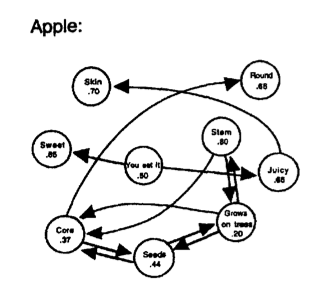
I propose that we think about a case like this as a node in a network. It has many links: to abstractions such as lying and love, and to concrete realities such as your aunt’s feelings and your cousin’s wedding. In turn, each of those nodes is linked to many others, producing a complex network.

In reviewing the moral network that we perceive around us, I think we should avoid two common errors.

Continue reading

a technique for measuring the quality of deliberation

(Ann Arbor, MI) I’ve proposed that we can map an individual’s thinking about moral and political issues as a set of beliefs and connections. For instance, if a person says that she favors abortion rights because she is committed to individual freedom, she is linking two nodes in a mental map. Because her overall epistemic framework is a network, it will have formal properties, such as density and centrality.

When two or more individuals interact on moral or political issues (talking and/or working together), their respective network maps will come into contact and change. The community formed by people who so interact can be viewed as a larger network of beliefs and connections that also has formal properties.

Certain network structures are better than others for deliberation and interaction. If you are a good deliberator, you enrich other people’s network maps and learn from theirs; you are not rigid. In the context of a liberal democracy, you must be able to “route around” your own faith commitments. You don’t have to drop them, but you must be able to make an argument that doesn’t depend on them. Likewise, your various ideas should be connected rather than isolated, so that you can give reasons for each of your beliefs.

We should be able to observe a moral network map evolve as one person interacts with others, and we should be able to rate individuals and conversations for moral excellence (by asking independent observers to assess them) and then see whether what we posit as the formal criteria of good moral networks are actually found in the best deliberators.

For example, Bloggingheads TV organized a discussion between columnists Bryce Covert (liberal) and Ramesh Ponnuru (conservative) on the topic of why women are paid less than men and what to do about it. I assert that this is a good discussion because I think it is, but also because in a study led by my colleague Felicia Sullivan, this video and several others were shown to representative samples of Americans. Most viewers liked this particular discussion, and they tended to move toward less ideologically consistent views after they watched it–evidence that it had complicated their opinions.

In the slide show below, I begin to diagram the discussion as two interlocked networks of ideas.

[slideonline id=6828]

I didn’t finish mapping the discussion, but I got far enough to conclude that we should be looking for:

  • The number of nodes and connections. (A higher number implies a richer discussion.)
  • The density of connections. People should tie together more, rather than fewer, of their points.
  • The overlap in the two people’s networks (They need not agree but they should address each others’ views)
  • Change in their respective networks in response to the other’s.

epistemic network analysis and morality: applying David Williamson Shaffer’s methods to ethics

David Williamson Shaffer and his colleagues are developing an influential approach to education and assessment that relies on the notion of “Epistemic Network Analysis.” They posit that a “profession or other socially valued practice” (e.g., engineering) has an “epistemic frame” that is composed of many facts, skills, values, identities, and other concepts that advanced practitioners link together in various ways. Thus you can diagram a professional’s epistemic frame as a network and measure it using tools that have been developed for measuring social networks. What nodes are most central? How dense is the whole network? How many clusters does it have?

One way to collect the data necessary for this kind of analysis is to ask a practitioner to write or talk about her work. Many of her sentences will invoke concepts and link them together. (“I did A because I knew that B.” “I recommend C because I believe in ethical norm D.”) By coding the text, one can produce a dataset that can be displayed and analyzed in network terms. As Shaffer and colleagues note, the graph is not the actual epistemic network; it is a representation of how the engineer’s mentality works under specific practical circumstances (Shaffer et al, 2009, p. 14).

If a profession is worthy, then learning its epistemic frame is desirable. As students experience a course, a project, or an internship, their epistemic frames can be diagrammed and quantified at regular intervals. The learners’ networks should grow more similar to those of advanced professionals. Measures of network structure can be used for “formative assessment” (giving feedback on what the student should study) and “summative assessment” (awarding a grade or credential).

I have posited that moral thinking is also an epistemic frame (to use Shaffer’s terminology). We hold many morally relevant ideas that we connect by various kinds of links, not just logical inferences but also causal theories, generalizations, analogies, etc. We can graph our own moral mentality as a network of ideas and connections. Moral learning means building a moral network map that resembles that of a good moral thinker. (I leave aside for now the question of whether good moral reasoning is related to good moral behavior.)

One can easily see that the moral network map of an average adult is more complex than that of a 2-year-old. It is uncontroversial that a toddler needs to learn to reason more maturely, in which case his network map will look more like yours and mine. But that leaves a lot of room for debate about what an ideal map looks like. Defining good moral thought is a normative, not an empirical, question.

To some extent, that is also true of engineering. It is not self-evident what makes a “good” engineer. However, as long as we assume that the profession is working reasonably well and fulfilling its social purposes adequately, then a “good” engineer is presumably a respected and successful one. We can identify such people empirically: they have high grades, awards, and responsible positions. Then we can diagram their epistemic frames and compare novices to exemplary professionals to assess their learning.

The situation is much harder with morality. We debate what specific moral concepts and relationships should be found on a person’s epistemic frame. For instance, should everyone’s graph show the existence of God, linked to a set of commandments? We also debate what formal properties any moral network should display. Should it be highly centralized around one fundamental truth? Classical utilitarians and some religious fundamentalists would say so. Or should it be very flat and complex, as certain liberals have held?

Here I would introduce a controversial–but not original–premise that makes the identification of good moral networks somewhat more empirical. No human being can have a fully adequate moral theory in place before she faces the various situations of life. The moral world is far too complex for that. It involves countless differently situated people interacting in countless situations in relation to institutions (like education, romance, politics, and punishment, to name a few) that have evolved to have manifold purposes and meanings. So to think well morally is not to apply a theory to each new case, but rather to learn constantly. Learning results from interactions with other people (whether face-to-face or vicariously). By “interaction,” I do not mean only communication, or the exchange of ideas. Groups of people can agree on thoroughly foolish ideas unless they try to put them into practice. So “interaction” means a combination of exchanging ideas, trying to work together, and reflecting on the results–what Dewey often called “conjoint activity.”

Who is good at that? This is not strictly an empirical question, because we might disagree about how to assess various styles of interaction. Should we admire the persuasive ideologue? The follower of fads? But although value-judgments are inescapable, I think it is partly an empirical question who participates constructively in conjoint activity. Good participants do not impose preexisting ideas and do not merely adopt the majority’s view, but shape the group’s beliefs while adjusting their own.

As I have written before, my own unsystematic observation suggests that people who are better at moral interaction have epistemic networks with these features:

  1. Lots of nodes and links, because each idea is an entry point for dialogue, and each reflects some prior learning.
  2. A degree of centrality, because some moral ideas are genuinely more important than others; and also because one should develop a set of prized values that constitute your character. Yet:
  3. No outright dependence on a small set of nodes to hold the whole network together, because then disagreement about those nodes must end a conversation, and doubt about them will plunge you into nihilism. You may believe in fundamental principles, but you should be able to reason around them. The network should be robust in that sense.

We might try to identify the actual epistemic frames of people who are good at collaboration and deliberation and see if they manifest the three features I listed above. We could then map the networks of children and other moral learners to see if they are developing to resemble the exemplary cases. Again, this would not be a value-neutral research program, but it would have a strong empirical component.

We can, in fact, pursue three levels of analysis.

  1. Each individual has an evolving and not-fully-conscious epistemic frame composed of many ideas and connections.
  2. The individual belongs to a community of other people who all have networks of their own. Their networks overlap and influence each other because moral learning is social. (Even a recluse got his ideas from someone else). Within a community, individuals’ maps intersect in a second way as well. If one person has a moral commitment to a specific other person, that other will appear on her map.
  3. Finally, the world is composed of many moral communities. But these are never fully separate and distinct. They are always complex, overlapping, and vaguely-bordered networks. Given two entities that we call “cultures,” no matter how remote, we will likely find common nodes and connections in their respective moral networks. I leave aside the possibility that all human beings share a set of ideas as our biological inheritance. That may be the case, but I do not rely on it. Rather, all communities interact (even the so-called “uncontacted peoples” who live deep in rain forests), and so the members of community A always share some nodes with members of community B nearby as a result of their “conjoint activity.”

At the individual, community, and global level, the process of moral reasoning is fundamentally the same. It is always a matter of developing a more satisfactory network of ideas and connections. This is not easy, conflict-free, or pretty. Individuals face deep internal conflicts among incompatible ideas, and people and communities often actually kill each other on account of such disagreements. Nevertheless, we can point to individuals and groups that are better at constructive engagement, and moral learning means becoming more like them.

Reference: David Williamson Shaffer, David Hatfield, Gina Navoa Svarovsky, Padraig Nash, Aran Nulty, Elizabeth Bagley, Ken Frank, Andre A. Rupp, and Robert Mislevy, “Epistemic Network Analysis: A Prototype for 21st Century Assessment of Learning,” International Journal of Learning and Media, vol. 1, no. 2 (2009), pp. 1-22.

six types of freedom

(Ft. Lauderdale, FL, en route to Austin, TX) Here are six types of freedom. Isaiah Berlin cited the first two as part of his argument for pluralism. He believed that genuine goods were distinct and incommensurable. For instance, a reasonable person could value two types of freedom, but no social order could maximize both simultaneously. We would have to choose, not only between the two types of freedom that he described, but also among freedom, happiness, equality, and other worthy goods.

Much in the spirit of his work, I extend the list of freedoms to six:

1. Negative liberty: freedom from constraint in the form of tangible action against the person or her property or (much more commonly) the threat or fear of such. Because fellow human beings can threaten violence, anarchy poses dangers to negative liberty. (Think of failed states flooded with AK-47s.) Although parents must constrain the negative liberty of their children, they can abuse that power. To combat anarchy, intra-family abuse, and other forms of violence among citizens, states are probably necessary. Yet in most of the world, it is the state that can threaten violence most effectively and pervasively. It must be curtailed in the interest of negative liberty.

2. Positive liberty: the freedom to do something. You are not free to travel, for example, unless you can afford a fare. Positive liberty is a matter of degree, since human beings are simply not able to do everything we want. But there may be a list of fundamental capabilities that everyone should be able to exhibit, and they require external support. You can’t learn to read unless someone teaches you. If one has a meaningful right to a positive liberty (e.g., the right to read), then some other person or community has a duty to provide it; and the state may be the best means to enforce that duty. But if I must pay taxes for your kid’s education or face imprisonment, then my negative liberty has been curbed in the interest of her positive liberty.

3. Individuality: the freedom to develop and express a unique personality and life-story in both the public and private spheres. Individuality may require a degree of negative and positive liberty, but it also faces threats not yet mentioned. The social norms that are strongest in tight, traditional communities and the mass culture that dominates today’s global society both inhibit individuality. Mass culture already worried de Tocqueville, but it has been hypercharged by advertising and technology. The global mass exercises its power less through majority rule at the ballot box than through search algorithms, trendy catchphrases, and addictive tunes.

4. Freedom from manipulation: I am treated as a means to someone else’s ends when the other person sways, threatens, or pays me to do what he wants. I am treated as an end when the other person tries to decide with me what we should do. States and markets arrange people as means to each others’ ends, perhaps unavoidably. Freedom (in this fourth sense) exists in ethical communities whose members treat each other as ends in themselves. Neither positive nor negative liberty guarantees such communities.

5. Freedom to make the world (or to live in a world that we make). Society is an artifact. We are born into the society of our ancestors, with all its flaws. But we are not compelled to replicate it. We become freer in this fifth sense the more that we design and fashion the world that we inhabit. That is a collaborative task, so it requires some limitations on negative liberty. But it is also not the positive liberty of being given an education or an airplane ticket. It is a matter of active co-creation.

6. Equanimity: freedom from the dread, doubt, disquiet, and sorrow that are consequences of being vulnerable and mortal creatures who care about other fragile living things. Although it is harder to achieve equanimity under conditions of extreme duress (e.g., given a complete lack of negative or positive liberty), and although mass culture threatens equanimity, inner peace seems to have different conditions. Indeed, when positive liberty means incessantly choosing consumer goods, it is incompatible with equanimity, as is individuality when it turns into narcissism, or co-creation when it becomes a vain yearning to build wholly new and permanent things.