Category Archives: philosophy

what is privilege?

What do we mean when we say “privilege,” in a political or social context?

Here are some valid everyday uses of the word: “It is a real privilege to be here tonight.” “Playing football is a privilege, not a right.” “I feel privileged and grateful to be enrolled at this college.”

A privilege seems to be some kind of benefit or desirable standing that not everyone has. Some privileges are perfectly appropriate. They create meaningful and worthy categories, such as membership in a given organization or the right to practice a particular profession. According to Elinor Ostrom’s hugely valuable research on how people manage common pool resources (such as fisheries and forests), one of the general principles is the need for clear boundaries between insiders and outsiders. The insiders have the privilege to, for example, fish in a common pond. If everyone has that right, all the fish will be taken.

The problem is unjust privilege. Teaching Tolerance says, for example:

white skin privilege is a transparent preference for whiteness that saturates our society. White skin privilege serves several functions. First, it provides white people with “perks” that we do not earn and that people of color do not enjoy. Second, it creates real advantages for us. White people are immune to a lot of challenges. Finally, white privilege shapes the world in which we live — the way that we navigate and interact with one another and with the world.

Several empirical claims are implicit here: (1) certain advantages accompany whiteness in the US; (2) these advantages persist even when no one deliberately endorses them; and (3) whites tend not to acknowledge their privileges.

Built into those claims are moral premises: (1) It is OK to make distinctions, but not on the basis of race; (2) earned advantages are justifiable but unearned ones are not; (3) it is better to be conscious of privilege.

I happen to share these six propositions–on the whole–but they are controversial. From the left, Bill Mullen writes in Socialist Worker that the concept of white skin privilege divides working-class coalitions, makes racial identity look fixed and inevitable, conceals the underlying cause of racism, and blocks the only path that he believes in, which is economic revolution. A left critic might also reject the assumption that earned privileges are acceptable because they come from talent or hard work. Although there’s a big debate about what this statement implies, John Rawls insists that “no one deserves his place in the distribution of natural endowments” (Theory of Justice, 17).

From the opposite end of the spectrum, David Horowitz asserts that white skin privilege is a radical leftist myth, and “black skin privilege” is the real problem today because official policies that acknowledge race favor people of color.

Meanwhile, people who endorse the use of the phrase tend to talk about other forms of privilege as well. Race is said to “intersect” with gender, sexual orientation, citizenship status, and social class to create webs of privilege.

We will not soon conclude these debates; but some conceptual clarity may help. I think “privilege” is being used to mean unjust advantage, and that raises the question of what constitutes justice. Distributive justice is a whole topic unto itself. Allowing skin color to predict social outcomes is unjust, but preventing that does not fully satisfy justice. Getting what you earn (and only that) would be one definition of justice–not mine. Getting all that you need to meet your potential would be another definition–but I don’t think it’s possible, since human potential is unlimited. Having an equal share of the society’s rights and goods would also not be my definition, for a variety of reasons, including the fact that I don’t mind if other people have much more than I do (for I have plenty). Assuring everyone a reasonable minimum sounds good, but that it is compatible with profound and invidious inequality above the line.

Despite the difficulty, I’d argue that one must first develop a theory of justice before one can identify “privilege” in the negative sense of that word.

mapping a class as a moral community

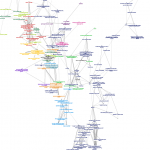
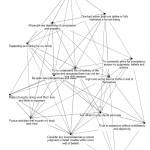
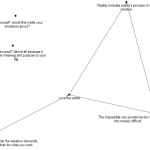
On the first day of the spring semester, I asked members of a small philosophy seminar to reflect on their own core moral ideas–meaning not only their abstract principles but also their concrete commitments and role models–and how those interconnect. They gave me their data (concealing any ideas that they wanted to keep private), and I mapped the results as one network for the class as a whole.

In general, the ideas cluster by student (each colored differently in this map); but when two or more people share an idea, the borders among individuals begin to break down.

class map 1.17
I hope that over the course of the semester, the map will become more integrated and denser as the students add ideas and connections among ideas and begin to hold more ideas in common. Their thinking should be influenced, in part, by the readings and by me; therefore, ideas discussed in class should pop onto the map. Agreement is not the goal, but members of a discursive community should share reference points. One student actually predicted increased polarization as new ideas are thrown into the mix, and that is certainly possible.

Why did I ask them to give me networks? I could have asked for lists of ideas (perhaps ordered by importance); for structures (with fundamental ideas implying consequences); or for bodies of text that explained each students’ views.

A list seems problematic because one cannot tell whether each item belongs on it. For instance, if it is true that one should maximize the happiness of the greatest number, then that concept should appear on your list. But if not, it should not be there. How can one tell? In contrast, you can ask questions about your network independent of the content of each node. Is the network dense? Does it cover a wide range of ideas? Are the ideas that turn out to be central worthy of their importance? Is the network connected to other people’s networks?

For elaborate reasons, I am skeptical of ordered structures for moral reasoning. But a network is actually a flexible form that can encompass a hierarchical structure. A utilitarian could give me a network that centered around the utilitarian principle. A network model simply does not presume that a moral worldview must be highly centralized or ordered.

Finally, a body of text would be valuable–but it would have to be very long, and I would be inclined to analyze it by looking for the ideas and connections that it implied. Thus the network is an efficient representation of the text, albeit one that leaves unexplained the individual nodes and the reasons for their connections.

(see also: the place of argument in moral reasoning; epistemic network analysis and morality: applying David Williamson Shaffer’s methods to ethics; Emerson’s mistake; character understood in network terms; and envisioning morality as a network)

horizon as a metaphor for culture

(Chicago) The philosophers Edmund Husserl, Hans-Georg Gadamer, and Jürgen Habermas use the metaphor of a horizon to describe the background or framework of experience. Without addressing thorny questions of interpretation involving these three disparate and difficult authors, I’d like to defend the metaphor in general terms:

Any person at any given moment has a unique visible horizon–the line that divides the objects on the earth from the sky. Yet if I stand right next to you, or stand where you were a minute ago, my horizon will closely resemble yours. Thus the metaphor captures the uniqueness of individual experience while making difference a matter of degree that is somewhat within our control.

It’s possible for two people to have entirely different horizons–they cannot see any of the same objects. Yet those two people could move until their horizons overlapped. A person could stand between two individuals whose horizons did not overlap and be seen by each. Or a whole chain of people could connect two remote individuals, allowing them to share vicarious experiences.

Your horizon is a function of the way the world is and how you see things. To a degree, you can change how you look and where you stand, but you must start from somewhere that you did not choose.

You have the capacity to see anything within your horizon. But you cannot see it all at once. You can describe and communicate anything within your horizon, but you cannot ever describe it all. You are aware of the horizon as a whole, but your attention focuses on objects within it.

I think if you replace “horizon” with “culture,” most of these sentences will ring true. At any rate, ever since my first book, I have been criticizing theories of culture that presume that everyone who belongs to Culture A shares the same structure of beliefs, which must be different from the structure that defines Culture B. That kind of model promotes unwarranted relativism and skepticism.

when east and west were one

(Washington, DC) I am highly skeptical of distinctions between “eastern” and “western” thought, considering the enormous diversity within both domains, the thousands of years of interaction between the two, and the arbitrariness of any border. (Why, for example, should a body of water less than 2,000 feet across be considered to divide two continents, Europe from Asia?)

But if you are committed to the distinction, it’s worth taking a look at the Milinda Pandha.  This is a dialogue written originally in Sanskrit or Pali before the year 200 CE. It describes a dialogue between a Greek king of India named Milinda (who is probably Menander I) and a Buddhist sage named Nagasena.

Menander I is well attested in Greek and Indian texts and archaeological evidence as a Greek king who converted to, and patronized, Buddhism. Here he is on a silver coin that reads “King Menander the Just” in Greek on one side and “Great King Menander, follower of the Dharma” in the Kharosthi script of South Asia on the other.

Nagasena is not known outside of this dialogue, wherein he is described as the son of a Brahmin who, having quickly exhausted the Vedic scriptures, studied Buddhism under a Greek monk named Dhammarakkhita (“Protected by the Dharma”).

Compared to a Platonic dialogue, the Milinda Pandha includes more fantastical details. The gods, for example, are directly involved. But it paints appealing portraits of the human characters. Menander goes around stumping sages with metaphysical paradoxes until he meets Nagasena, who bests him on a couple of those exchanges. Then the King simply asks questions about Buddhist doctrine and Nagasena answers with illustrative similes. The King replies after each one, “Very good, Nagasena!”

I can read the text only through the 19th century English translation of T. W. Rhys Davids. As far as I can tell, the perspective of the original document is orthodox Theravada Buddhism. Thus I am glimpsing Menander I through layers of interpretation, Asian and English; and it is hard to imagine how this European-born king of ancient India might actually have thought. But he and Nagasena seem to share the same social and cultural horizon, and the differences between them stem only from their respective roles as monarch and sage:

The king said: ‘Reverend Sir, will you discuss with me again?’

‘If your Majesty will discuss as a scholar (pandit), well; but if you will discuss as a king, no.’

‘How is it then that scholars discuss?’

‘When scholars talk a matter over one with another then is there a winding up, an unravelling; one or other is convicted of error, and he then acknowledges his mistake; distinctions are drawn, and contra-distinctions; and yet thereby they are not angered. Thus do scholars, O king, discuss.’

‘And how do kings discuss?’

‘When a king, your Majesty, discusses a matter, and he advances a point, if any one differ from him on that point, he is apt to fine him, saying: “Inflict such and such a punishment upon that fellow!” Thus, your Majesty, do kings discuss.

‘Very well. It is as a scholar, not as a king, that I will discuss. Let your reverence talk unrestrainedly, as you would with a brother, or a novice, or a lay disciple, or even with a servant. Be not afraid!’

what defines conservatism?

Popular political words like “liberalism” and “conservatism” often name disparate ideas and movements. No one controls their definitions, and therefore no one can complain if they are used for incompatible phenomena. For instance, “liberalism” can mean government interventionism or pro-market critiques of the state; and “conservatism” may be equally ambiguous. Yet we ought to be able to say something about the central tendencies of conservative thought. A helpful generalization should have three features:

1) It should be trans-historical and global, not limited to current US terminology.

In the US today, conservatives often present themselves as being critical of the nation-state and bureaucracy. But that has not been true of, for example, Christian Democrats in Europe.

2) It should be reasonably encompassing of the movements that have actually called themselves “conservative.”

For instance, if one defines conservatism as libertarianism, that omits traditionalist and communitarian conservative movements. If one defines conservatives as people who want to return to the past, that omits Newt Gingrich types who are utopians about technology and markets.

3) It should be charitable.

You should define a political idea in a way that a proponent would accept before you debate his or her views. For instance, although I have not read Corey Robin’s The Reactionary Mind, I am highly skeptical of Robin’s definition of “conservatism” as “animus against the agency of the subordinate classes.” According to Robin, “conservatism “provides the most consistent and profound argument as to why the lower orders should not be allowed to exercise their independent will, why they should not be allowed to govern themselves or the polity. Submission is their first duty, agency, the prerogative of the elite.” But what conservative would accept this characterization?

I would propose that the heart of conservative thought is resistance to intellectual arrogance. A conservative is highly conscious of the limitations of human cognition and virtue. From a conservative perspective, human arrogance may take several forms:

  • the ambition to plan a society from the center;
  • the willingness to scrap inherited norms and values in favor of ideas that have been conceived by theorists;
  • the preference for any given social outcome over the aggregate choices of free individuals;
  • the assertion that one may take property or rights away from another to serve any ideal; and/or
  • the elevation of human reasoning over God’s.

Now, these are separable claims. You can be an atheist conservative who has no objection to elevating human reason but deep concerns about state-planning. That is why conservatism is a field of debate, not a uniform movement. But it’s also possible to build coalitions, since, for example, Christian conservatives and market fundamentalists can unite against secular bureaucracies. Their reasons differ, but it is not only their practical objective that unites them. They also share a critique of the bureaucracy as arrogant.

If this is a fair description of conservatism, it should roughly describe the main tendencies of thinkers who have called themselves “conservative” over a broad sweep of time. I think it does. And some aspects of this definition are still visible in today’s Tea Party Republican Party. But our whole ideological spectrum is confused and atypical. If my definition of conservatism generally fails to describe the Republican Party, that may be because the GOP is not conservative in a deep sense. Meanwhile, as I argued in “Edmund Burke would vote Democratic,” it is sometimes the left in the US that seems most appreciative of local norms and traditions, most concerned about “sustainability” and fearful of human arrogance, and most resistant to planning and social control.