Category Archives: philosophy

are religions comprehensive doctrines?

John Rawls saw a “plurality of reasonable but incompatible comprehensive doctrines” as a “fact” about the world, or at least about the modern world. He explained: “a reasonable doctrine is an exercise of theoretical reason: it covers the major religious, philosophical, and moral aspects of human life in a more or less consistent and coherent manner. It organizes and characterizes recognized values to that they are compatible with each other and express an intelligible view of the world” (Political Liberalism, New York: Columbia University Press, 1993, pp. xvii, 59).

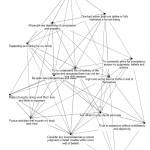
Since my first book, I have been criticizing this assumption that the world is divided into separate, internally coherent worldviews. It’s certainly not Rawls’ assumption alone. I would define “modernism” as the premise that there is a plurality of incompatible comprehensive views. And I would assert that modernism is a mistake, driven by certain confusing metaphors: culture as a perspective, culture as a structure built on a foundation, culture as a table of values. I’d prefer a metaphor of overlapping horizons or a model of cultures as interconnected networks of ideas.

If anyone holds a “comprehensive doctrine” that is incompatible with other views, it would be a religious authority in one of the Abrahamic faiths. For instance, in 2011, during the turmoil of the Egyptian revolution, the most senior cleric who had been appointed under the old regime of Hosni Mubarak, the Grand Mufti of al-Azhar University, gave a sermon against political “extremists”:

They preferred to learn in their own beds at home from The Book with neither a methodology nor a master, so they stopped at the outer shell of Islam without realizing its goals and meanings. They stopped at the surface and they failed to realize the truth behind matters and the truth behind rules. They stopped at the partial and failed to see the whole. They favored the specific over the general. They favored their own interest over the interest of the ummah [nation or community].

Here a theologian and jurist asserts that his religion is fully coherent and centralized. This cleric, Ali Gomaa, goes on to address particular issues; for example, he opposes destroying the idols of other faiths, which he calls  an act of extremism. He argues that to make such judgments correctly, one must apprehend the core of the true faith—or else follow a master who possesses such knowledge.

This is a familiar rhetorical move within any faith tradition. For an outsider, it may seem obvious that the faith is a “comprehensive doctrine,” uniting all believers into the same structure of reasoning. But a learned member of the faith always knows that almost every element of it is contested within the tradition. Certainly, Gomaa would be aware that the Islamic Brotherhood and Salafi sheiks were preaching different messages in Egypt at the same time.

Gomaa did not actually specify how the core truths of Islam led to his particular judgments. He wanted his listeners to picture a chain of reasoning that flowed from the core of the faith to the particular cases, but he did not spell it out. That is because his purpose was to assert authority, not to offer reasons. One can offer reasons within a faith tradition, but that will be a matter of picking a path through a complex web. And many of the nodes and connections in that web will be shared with other faiths, so much so that the borders between faith traditions are often blurred.

The problem for liberalism is not that citizens hold strong and controversial metaphysical commitments. Citizens in a liberal regime may believe that Jesus is their personal savior or that science delivers the only valid truths. The problem is a moral network that is overly dependent on a few central ideas. And that is not intrinsic to a religion. To put it a different way: It is not a fact that the world is divided into comprehensive and incompatible doctrines. It is a choice to view it that way.

a different take on coherence in ethics

There have traditionally been two families of answers to the question: How can a moral belief be justified? Foundationalists think that beliefs are justified if they follow from beliefs that are somehow “foundational.” As Geoffrey Sayre-McCord writes, “traditionally, foundational beliefs have been credited with all sorts of wonderful properties, with being, for instance, infallible, or indubitable, or incorrigible, or certain” (p. 154). Foundational beliefs are also frequently assumed to be big: very general in scope and application. So the belief that all humans are created equal may be considered a worthy candidate to be foundational. Skepticism about foundationalism usually takes the form of asking: How can you tell that such beliefs are true? What justifies them?

Sayre-McCord divides the turf a bit differently, so that a foundationalist is simply someone who holds that some moral beliefs have a special status. They are “privileged.” They may nevertheless be fallible and modest in scope. They may, for example, be concrete judgments that we draw from experience. But they are privileged because their justification is not the support that they receive from other moral reasons. A foundationalist thinks that a given moral belief is justified only if it is foundational or it follows from foundational beliefs.

Coherentists say, instead, that all moral beliefs are on par. There is no privileged class. Any moral belief is justified by the other beliefs that relate to it. The reasons we give for a belief take the form of connections to other beliefs. By the way, the fact that a moral worldview (such as utilitarianism, or Judaism) coheres is not a reason to hold each of its component beliefs. Rather, the reason for each belief just is the support it gets from other beliefs. The more such support exists, the more we say that the whole coheres (p. 170). But we shouldn’t believe something just because it belongs to some coherent system.

Continue reading

introducing the Capabilities Approach

(DeLand, Florida) In Creating Capabilities: The Human Development Approach, Martha Nussbaum proposes that human beings have ten “Central Capabilities.” The first one is: “Life. Being able to live to the end of a human life of normal length …” The remaining nine all have a similar grammar: an abstract noun or noun phrase followed by a verb in the form “being able to …” The rest of the Capabilities are: bodily health; bodily integrity; senses, imagination, and thought; emotions; practical reason; affiliation; other species; play; and control over one’s environment.

I have criticized Nussbaum for making the state ultimately (and sometimes solely) responsible for the Capabilities. She is explicit about this on p. 64, and throughout the book, she writes sentences in which the government is the subject and people are the object. For instance, immediately before she offers the list of Capabilities on p. 33, she writes, “government has the job of making people able to pursue a dignified and minimally flourishing life.”

She does, of course, support human freedom: the government must enable people to pursue their own Capabilities as they wish. Yet I would assign the government a very different role than she does in her overall theory. I would say that we the people have the obligation to ensure one another’s Capabilities. We may decide to use the government as a tool for that; it has strengths and limitations. In any case, we make the government—not in some imaginary moment of signing a social contract, but every day, in how we vote, advocate, pay taxes, educate future leaders, and generate information. In similar ways, we also make churches, neighborhoods, and families. The government is us: a subgroup of us chosen or tolerated to influence the rest of the population by the means of laws and law-enforcement. I would put the state clearly in a subsidiary position and ask pointed questions about how we are supposed to get good governments in the first place. Those questions vanish in Nussbaum’s account.

That said, there is much to recommend in the Capabilities approach. For my colleagues concerned about youth development and civic education, it provides an impressive normative framework.

Why propose a list? Nussbaum does not imagine that she can dictate policies or that her moral assumptions are necessarily right. But her list starts a conversation that we must have if we are to assess policies and communities. If you disagree with her list, you should be able to respond with objections to the components, or add extra items, and give reasons for those changes. Not making a list just ducks the central moral questions.

Why many Capabilities instead of one ultimate good, such as happiness or freedom? Because there are many dimensions of human life and they cannot be measured on a single scale.

Why Capabilities instead of goods, rights, processes, or outcomes? The argument is complex and multifaceted, but in short, Capabilities recognize individual freedom and diversity while also acknowledging the human need for tangible support. If you have a Capability of imagination, you are not obliged to use it in any particular way–or at all. But you will not develop that Capability just by being left alone: you need education, access to public art and nature, leisure time, and other supports that cost money. And nothing (such as cash or pleasure) will substitute for your using your own imagination. Thus imagination is a Capability rather than a right, a good, or a choice. (A strong argument against the Capabilities Approach would take the form of a defense of one of these other keywords.)

Why one list for every nation and culture? I’d answer  just as I did the question “Why a list?” Like individuals, members of whole cultures may dispute the contents of Nussbaum’s list. If they do, they should speak on behalf of alternatives. The deliberation about what Capabilities humans should have is a global one, and there will be disagreements. But they are disagreements about the human good. It makes no sense to say, “Bodily integrity is a Capability for you, but not for us.” That means it is not a human Capability.

See also: Putting Philosophy Back in Developmental Psychology.

Dewey and the current toward democracy

Nevertheless, the current has set steadily in one direction: toward democratic forms. That government exists to serve its community, and that this purpose cannot be achieved unless the community itself shares in selecting its governors and determining their policies, are a deposit of fact left, as far as we can see, permanently in the wake of doctrines and forms, however transitory the latter. They are not the whole of the democratic idea, but they express it in its political phase. Belief in this political aspect … marks a well-attested conclusion from historic facts.

— John Dewey, The Public and its Problems, chapter v

This passage connects at least three ideas: 1) a principle: government exists to serve its community; 2) a mechanism: public selection of office-holders; and 3) a factual generalization about history: it is moving toward democracy.

The usual way to connect these would be to say that people have discovered or created the moral principle of equal political power. To make this principle influential in the world, they have invented and advocated certain “doctrines and forms,” such as regular elections. As a result of their efforts, some communities are now governed by means of these mechanisms. We can use the democratic principle to the assess the actual governments of the world and will conclude that some regimes serve their communities, while others do not.

Dewey puts the elements together in a different way. He detects an underlying current, a tide in the affairs of humankind, that throws up both concrete procedures (such as regular elections) and ideals consistent with those procedures. The importance of the procedures and ideals is a fact that we can observe in the world around us. The deeper explanation is some kind of natural process of human development. I think it has a basically Hegelian form: We homo sapiens naturally associate. Because we have language, we can reflect on the forms that our association takes. Because we have huge potential, we strive to reform our associations so that they give us more scope for creativity and flourishing. Our striving makes the current flow steadily toward democratic forms.

Dewey does not want to separate ideals [“mystic faith”] from facts; and, above all, he does not want to attribute causal power to ideas.

[We] must protest against the assumption that the [democratic] idea itself has produced the the governmental practices which obtain in democratic states: General suffrage, elected representatives, majority rule, and so on. … The forms to which we are accustomed in democratic governments represent the cumulative effect of a multitude of events, unpremeditated as far as political effects were concerned and having unpredictable consequences.

Problems with this method:

1. The current is hardly steady. Indeed, when Dewey wrote these passages, most of the world was under colonial domination; and soon thereafter, most of the colonial powers fell under evil tyrannies. Why should we be confident that the current will generally or ultimately flow in a democratic direction?

2. Many ideals are facts, in the sense that they motivate and inspire human beings. That is true not only of democracy and freedom but also of nationalism, greed, and religious fanaticism. We could substitute nationalism for democracy in Dewey’s argument (above) and conclude: “That government exists to lift its own people over all the other peoples of the world, and that this purpose cannot be achieved unless a government builds a powerful and aggressive military, are a deposit of fact.  …” We must be able to use independent reason or judgment to conclude that democratic ideals are desirable, or else they are just some of the ideals that exist in the world.

on the moral peril of cliché and what to do about it

1. It’s likely that the moral beliefs and precepts that should guide us are unoriginal. Billions of people have already thought about the same matters; it’s unlikely that any of us will hit a new theme that has merit.

2. To shun moral ideas that are clichés would mean putting oneself above duty and justice for aesthetic reasons. That is immoral. It is a form of aesthetic immoralism common in modernism and post-modernism.

3. But clichés have moral drawbacks. Because they are well-known and well-worn, they lose their psychological force; we can ignore them. (Think of a phrase like “war is hell,” and how little it influences us.) Because they sound right and are easily portable, we can apply them where they do not belong, committing Whitehead’s Fallacy of Misplaced Concreteness. We are especially likely to misuse them to excuse and justify ourselves, because we are fierce advocates for own cause. As George Eliot’s narrator remarks in Middlemarch, “the use of wide phrases for narrow motives” is a common human frailty. Eliot adds, “There is no general doctrine which is not capable of eating out our morality if unchecked by the deep-seated habit of direct fellow-feeling with individual fellow-men.”

4. The solution, I think, is to regard one’s own moral worldview not as a list of precepts (each of which will be a cliché), but as an intricate network of ideas and implications, some general and some concrete, many in tension with each other. Only the most concrete and particular elements will be original–coming directly from your own experience. The general ones will be, for the most part, clichés. But the overall structure will be unique to you and should demand your attention.

(I treat these issues at probably excessive length in Reforming the Humanities and in a longer post “on the moral dangers of cliché.”)