Category Archives: philosophy

Jonathan Haidt’s six foundations of morality

Jonathan Haidt and colleagues propose that human beings have six different areas of moral concern: care, fairness, liberty, loyalty, authority, and purity. They argue that individuals and cultures differ in how they define and value these six areas, which they call “Foundations.” For instance, secular Westerners are unusual in giving very heavy weight to the first three. Within the USA, conservatives care about all six and realize that liberals are only concerned about the first three; but liberals fail to grasp conservatives’ concerns for loyalty, authority, and purity. Therefore, conservatives can predict liberals’ answers to specific questions quite accurately, but liberals do not understand conservatives–with consequences for elections and public debates.

I find these results illuminating. For example, it rings true that liberals are pretty immune to traditional concerns about purity; and even when we oppose something because it’s impure (such as completely consensual incest), we refuse to invoke concepts of purity in our reasons. At the same time, we liberals may actually have our own purity concerns. For example, I would never leave a glass bottle in the woods, and I would be at least mildly upset to see one there. I suspect the damage caused by an inert glass bottle is minimal; producing my breakfast probably hurt nature much more than a little littering. But I regard the woods as pure, and a human deposit there as a pollutant–in the moral sense.

We could call my reaction “irrational,” but that would presume that only care, fairness, and liberty are rational concerns. Haidt, who is explicitly Humean, would say that reason is and ought to be the slave of the passions. We human beings happen to have six (not just three) bases for our moral passions. Liberals are just odd; we are not distinctively rational.

The main method is factor analysis influenced by conceptual categories. Factor analysis, which is used very widely, takes people’s actual responses to surveys and looks for clusters that suggest an unobserved “factor.” For example, people may not know that they are driven by a concern for care, but their answers to a range of more concrete questions may cluster together empirically, and “care” may be a good label for this cluster. Since “Individuals are often unable to access the causes of their moral judgments,” the real causes must be unconscious and instinctive. We may not know that care is one of our Moral Foundations; that is an empirical finding.

For Haidt et al., moral factors must have two characteristics in addition to statistical clustering: 1) they must be found empirically in many cultures across the world–although it is to be expected that some cultures will miss some factors–and 2) there must be a Darwinian evolutionary explanation for why human beings would have developed these concerns.  Darwinian explanations are supposed to be not mere stories that illustrate evolutionary theory but findings of biology or archaeology.

Finally, Haidt’s method is cumulative and falsifiable. He and his colleagues propose six “Foundations” right now, but they expect to add more.

A lot of assumptions are built into these methods. Arguably, the assumptions are vindicating themselves pragmatically by yielding valuable insights; but it may also be the case that the assumptions drive the methods, which determine the results. Either way, I see these premises:

1. Haidt et al. are interested in very broad categories (“Foundations”) and will even sacrifice tighter correlations if necessary to bring more survey response under broad headings. One could instead investigate the pervasive but subtle differences that arise between two people of the same cultural and ideological background, or within one person’s thinking about one moral concern. For example, I may think about care in five different ways in respect to one complex interpersonal situation.

2. Haidt et al. broaden the definition of morality to include matters–such as authority and purity–that are viewed as extra-moral by, for example, Kant. But they still name six domains as moral and exclude other psychological constructs that may explain our judgments (e.g., competition, lust, and hatred) from the list. This seems to imply a substantive theory of what counts as “moral,” despite Haidt’s repeated claims that he is a naturalist who seeks to describe, not prescribe. What if I insist that authority is not moral or that Will to Power is?

3. Haidt acknowledges that moral norms and beliefs change, but the Foundations Theory does not seem useful for explaining such changes. Haidt is a liberal who argues that liberals are rhetorically hobbled by our inability to invoke loyalty, authority, and purity. Nevertheless, the country has moved dramatically in a liberal direction on social issues that are entwined with purity and authority (e.g., gender roles). How could that happen so quickly?

4. This stream of research is concerned with the often unconscious causes of our moral judgments. It is not concerned with the way that we articulate reasons and arguments to justify our conclusions. This is because Haidt et al.–like most empirical psychologists–find that our explicit reasons are poor predictors of our concrete judgments. Our reasons are not causal.

And yet I would maintain that our reasons can be good or bad, and it matters that they are good. We are morally accountable for the quality of our reasons. It is not only important to judge and do right, but to think right. Besides, we sometimes form judgments contrary to affect because of our reasons, or we decide what to do when our instincts conflict by considering the applicable reasons, or we persuade other people by citing reasons, or we construct institutions on the basis of reasons that then constrain our behavior. Thus the ways we connect our ideas have at least some significance.

Ultimately, I think that the Foundations Theory is a form of science. It is a cumulative and falsifiable body of research, generating useful findings. Yet one can start in other places and also make progress.

I would start with the assumption that human beings are evolved animals whose brains are the product of Darwinian design. But I would also note that we human beings live and think in immensely complicated social settings that have emerged from the uncoordinated choices and actions of billions of people over thousands of years. Emergent phenomena, such as actual languages, religions, governments, and communities, are at the heart of our moral concerns. Although human beings with evolved characteristics have made these institutions, they take on lives of their own and influence us profoundly while also structuring the decisions we make. For instance, our institutions officially embody norms that we may find onerous and undesirable once applied. Although we may not be psychologically influenced by the abstract ideas that we endorse, we are politically influenced by the abstract ideas that we have written into our constitutions and catechisms. I think most of the action is at this level–in how we navigate complex and emergent systems rather than how we apply very basic biological drives.

Although people from different backgrounds hold contrasting values, there are some commonalities across time and culture. Haidt et al. and many other empirical psychologists assume that these commonalities came first and are morally fundamental, and the differences are relatively superficial. Michael Walzer summarizes this view: “Men and women everywhere begin with some common idea or principle or set of ideas and principles, which they then work up in many different ways. They start thin, as it were, and thicken with age.” “But our intuition is wrong here,” Walzer writes. “Morality is thick from the beginning, culturally integrated, fully resonant.” When we find commonalities in distant places, these  are simply “reiterated features of particular thick and maximal moralities.”

[Sources: Jonathan Haidt, The Righteous Mind: Why Good People are Divided by Politics and Religion (New York: Pantheon, 2012); Jesse Graham, Brian Nosek, Jonathan Haidt, Ravi Iyer, Spassena Koleva, and Peter H.Ditto, “Mapping the Moral Domain,” Journal of Personality and Social Psychology, Vol 101(2), Aug 2011, 366-385; and Michael Walzer, Thick and Thin: Moral Argument at Home and Abroad (Notre Dame: University of Notre Dame Press, 1994), p. 4, 10.]

was Montaigne a relativist?

The most interestingly radical form of cultural relativism has three elements, I think:

  1. People’s norms, habits, values, and ways of thinking are pervasively diverse.
  2. The variation is not so much among individuals as among large groups; or (to put it another way) beliefs and values cluster into composites that we call “cultures.”
  3. Since our perceptions and assessments of any culture are shaped by our own, we cannot know or judge objectively.

I do not necessarily share these premises but believe they are essential to the history of thought. Modernism and postmodernism (in all their varieties) are basically responses to these three ideas. I am open to the possibility that cultural relativism was discovered/invented several times in human history–e.g., in India in the 15th century–yet I have long believed that the rise of cultural relativism in Europe around 1800 was epochal; it prompted entirely new ways of thinking that spread with European power around the world.

But what about Montaigne (1533-92)? A case can be made that he was already a thoroughgoing cultural relativist during the Renaissance. Unlike the later figure of Giambattista Vico (1668-1744), who has also been called a relativist, Montaigne was hardly obscure in his own time. He had a profound and direct influence on thinkers as important as Shakespeare, Bacon, Pascal, and Descartes. Thus I can see three possible theses:

  1. Montaigne was a cultural relativist, and these other figures understood that. They were exposed to cultural relativism far before the modern era and either endorsed it privately or deliberately rejected it–but in either case, it was in their worldview.
  2. The major thinkers whom Montaigne influenced did not understand the idea of cultural relativism. They read the relevant passages in his Essais without seeing their radical implications, as we do.
  3. Montaigne did not conceive of cultural relativism. Neither he nor his early readers understood his writing as relativistic, in the modern sense. Nor should we.

Key passages to consider come from the essays “On Habit” and “On the Cannibals” (translated here by M. A. Screech). In “On Habit,” Montaigne first catalogs many of the bizarre ways in which behaviors and norms vary across history and geography. He lists nations where sons are supposed to beat their fathers, where people grow hair only on the left sides of their bodies, where women are the only warriors, where it is honorable to have as many lovers as possible, and where, over 700 years, no woman ever had sex outside of wedlock because it was unthinkable.

Apparently, Montaigne believes the first premise of cultural relativism that I summarized above–that manners are “infinite in matter and infinite in diversity”:

To sum up, then, the impression I have is that there is nothing that custom may not do and cannot do. … The laws of conscience which we say are born of Nature are born of custom; since many inwardly venerates the opinions of the manners approved and received about him, he cannot without remorse free himself from them nor apply himself to them without self-approbation.

Further, Montaigne seems to endorse the second principle of cultural relativism, that beliefs and values come together in whole structures that we might (today) call “cultures”:

It is greatly to be doubted whether any obvious good can come from changing any traditional law, whatever it may be, compared with the evil of changing it; for a polity is like a building made of diverse pieces interlocked together, joined in such a way that it is impossible to move one without the whole structure feeling it [emphasis added].

But I am not so sure that Montaigne believes the third premise of true relativism: that our understanding and assessment of cultures are determined by our own cultures. I think he rather argues that proper understanding and evaluation are more difficult than we assume because we are biased in favor of the familiar.

…. But the principal activity of custom is so to seize us and grip us in her claws that it is hardly in our power to struggle free and come back into ourselves, and reason and argue about her ordinances [emphasis added.]

“Hardly in our power” does not mean impossible or undesirable; on the contrary, our main duty is to “struggle free” from custom so that we can “reason and argue” better.

For instance, when Montaigne was disgusted by a French nobleman who blew his nose with his bare hands, he forgot to ask whether that might not actually be a good idea. “I considered that what he said [in his own defense] was not totally unreasonable, but habit had prevented me from noticing just that strangeness [about our own habits, such a blowing our noses into cloths] which we find hideous in similar customs in another country.”

In “On the cannibals” the main point is that we recoil at eating human flesh because it is not our custom, but we ignore the closer-to-hand horrors of torturing people on account of their religious faith. If we paid more attention to the strangeness and indefensibility of our own nation’s norms, we would discover the greatest (and most objective or universal) virtues, which include gentleness and tolerance. As Montaigne writes in “On Habit”:

The Barbarians are in no wise more of a wonder to us than we are to them, nor with better reason–as anyone would admit if, after running through examples from the New World, he concentrated on his own and then with good sense compared them. Human reason is a dye spread more or less equally through all the opinions and all the manners of us humans, which are infinite in matter and infinite in diversity [emphasis added].

Thus Montaigne is not skeptical about our duty–or our ultimate ability–to understand and judge the diverse ideals of human beings. He just thinks that this is harder than we assume. He is trying to shake our naivety in order to improve our reasoning, much like the Hellenistic philosophers when they taught paradoxes of logic and perception in order to strengthen our intellectual discipline and dissuade us from arrogance.

If this is not only what Montaigne meant, but also how his first readers understood him, then they did not derive cultural relativism from his texts. Instead, they drew conclusions reminiscent of Epicurean philosophy: it is hard to know what is right, foolish to set oneself above other people, and wise to focus on the inner life.

One more problem arises. If we detach ourselves as much as possible from our own local customs in order to attain objectivity, won’t we become critical of “traditional law” and then damage society by striving to undermine its norms? The solution to that problem is to live a contemplative and not an active life, to withdraw to one’s chateau and write introspective essais instead of trying to influence the world. For …

it is his soul that the wise man should withdraw from the crowd, maintaining its power and freedom to freely to make judgements, whilst externally accepting all received forms and fashions.

I conclude that Montaigne was not quite a relativist, nor was anyone for another century after him. Because he shunned politics, he was not the most helpful guide to the design of societies; but he was an excellent theorist of moderation, modesty, and introspection.

avoiding the labels of East and West

(Hartford, CT) Between the 320s and the 130s BCE, there were kingdoms in what is now Pakistan, India, Afghanistan, and Turkmenistan that had monarchs with Greek names who communicated in both Greek and Pali, who honored both Olympian gods and Buddha, and who had diplomatic relationships, marriages, and wars with both Mediterranean and South Asian neighbors. Here, for example, is a coin of king Strato I and his consort Agathokleia. They are named on one side in Greek. On the other side, in the Kharosthi script, it says, “King Strato, Savior and of the Dharma.” The figure is Athena, but other coins from the Greco-Bactrian kingdoms show the Buddhist wheel.

These kingdoms are fascinating because they may have influenced the ideas and art of Mahayana Buddhism, on one side, and Hellenistic philosophy and Judeo-Christian monasticism, on the other. Discussing them, however, can be politically sensitive. Ever since they were rediscovered, scholars–both Indian and European–have identified the Greek aspects of these communities with Europe, with colonialism, and with whiteness, and the Indian aspects of these communities with Asia, with independence, and with darker skin. Thus proponents of the British empire have accentuated the Greeks’ contribution to “Hellenistic India,” whereas anti-colonial scholars have either dismissed it or viewed it critically. This is a helpful overview of the historiography by Rachel Mairs.

I’m no expert, but I have a strong instinct that these categories are false and misleading. I happen to be white (of European extraction) and I studied some Greek. But the Greek cultural aspect of the Greco-Bactrian kingdoms is deeply alien to me. In their militarism, monarchism, paganism, misogyny, and peculiar metaphysics, the ancient Hellenes are far more remote than modern Indians are. If I had to choose between the ethics of a Greek circa 200 BC and a Buddhist of the same time, I would select the latter as both more persuasive and more familiar. The British imperialists who came to dominate South Asia in the late 1700s were not much more similar to ancient Greeks than I am, although they thought they belonged to the “classical tradition.”

The Greeks themselves distinguished between Europe and Asia and named “India” as that part of Asia that lay beyond the Indus River. But those are arbitrary distinctions, as my family and I recalled when we stood on either side of the Europe/Asia border in Turkey several times this summer. Ancient Indians tended to call the Greeks “Yona,” which refers to the Ionian Sea. It lies between Italy and Greece, but if Indians had called the Greeks “Aegeans” instead, that name would have encompassed both Asia and Europe (per the Greeks’ own distinction.)

Race is a hugely influential category today, but ancients did not divide people up that way. When the Greek emperor Seleukos and the Indian emperor Chandragupta sealed a peace treaty by arranging a marriage between their children, no one thought that a white person was marrying a person of color. Some Greeks may have thought that the marriage involved a barbarian, but that meant someone who couldn’t speak Greek. Barbarians were people who said “bar bar bar”: unintelligible foreign words. The important divisions involved language, not skin color.

If you can drop the association of Greeks with Europe and Mauryans with India, what really jumps out is the continuity of culture and history from North India to southern Italy in that era. The philosophical milieu of Siddhartha Gautama resembled that of Socrates. Both men lived in city-states that would be overrun in the late 4th century BCE by monarchical empires. In both cases, a polytheistic background culture allowed reflection on abstract fundamentals that yielded agnostic and atheist ideas. In both circumstances, the essential question was how to achieve equanimity despite the intrinsic cruelty of life. And both regions traded intensively with each other. Once we drop the division between East and West, we can learn to read Sextus Empiricus and Marcus Aurelius as guides to meditation and Nagarjuna as a systematic metaphysician much like Aristotle.

[See also when east and west were one; Jesus was a person of color, and strange lives (last paragraph)].

is a network a good representation of a person’s moral worldview?

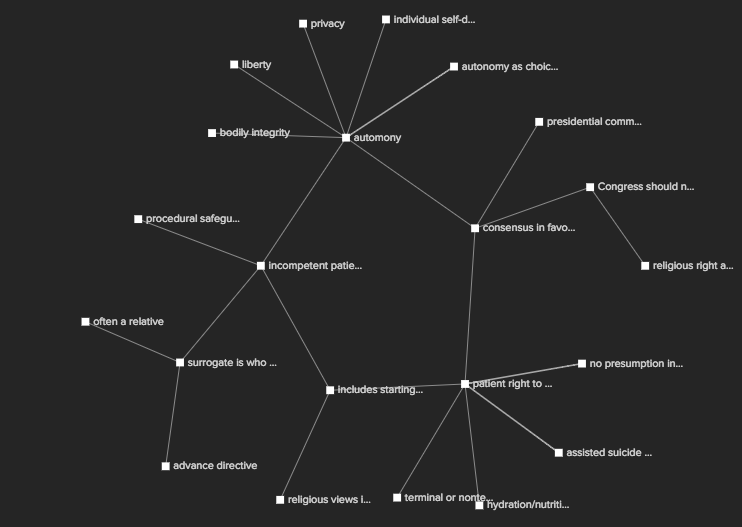
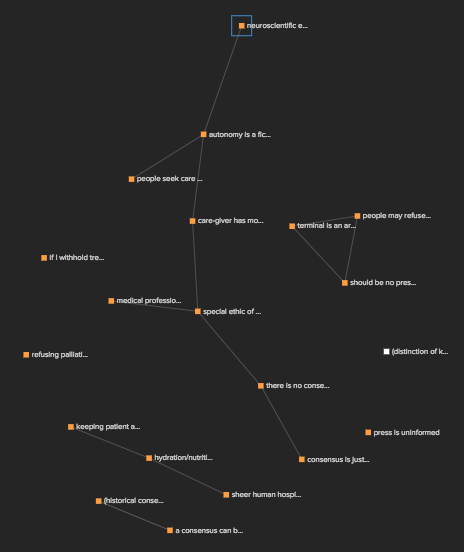
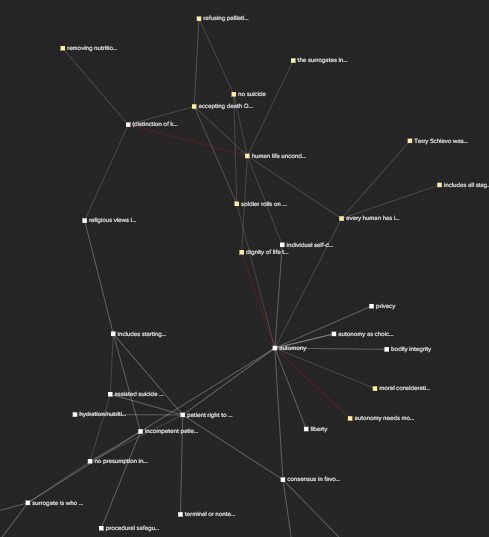
Here is a method that I and some colleagues have been using to model the moral worldview of individuals and of groups. First, pose questions about individuals’ principles, beliefs, and methods and ask them to respond with ideas that they endorse. Then show them their own ideas in a table and ask them to identify pairs that they consider closely related. That will allow you to generate a network diagram of their ideas. Give the diagram back to them and ask them to explain their ideas and connections to their peers. As they do so, ask them to modify their own networks.

This method will generate network graphs for each individual at each time-point during the discussion. All of their networks can be placed on the same plane to produce a map of the group; and to the extent that they have chosen the same ideas, the group will have a connected network. See, for example, these maps of the Summer Institute of Civic Studies and two of its members:

subject3subject2subject1

Of course, you will get networks because you have asked for networks. You could instead ask people to give you lists of moral ideas, in which case you would receive lists back. People’s lists could be shown as sets that would overlap when two or more individuals chose the same ideas. Respondents could also be asked for ranked or weighted lists or for lists of ideas that trump other ideas, just as all the diamonds may trump all the clubs in a card game. In the “5 Whys?” technique, individuals propose a basic idea, answer the question “Why?” about it, then ask “Why?” about the reason they have given, and so on. That method will produce a chain or ladder of ideas, instead of a network.

On what grounds is the network model preferable?

We could treat it as a method for modeling the moral psychology of research subjects. In that case, it would be an empirical psychological model and we would want to know whether it was reliable and valid. Reliability would be assessed as follows. Do individuals and groups give substantially similar responses when studied at different times and when the questions and instructions have been changed in superficial ways that should not alter the results? Validity would be assessed by asking whether the results for individuals and groups correlate with other reliable measures of moral thinking, such as how people respond to dilemmas or how they express moral views in narrative form. Both reliability and validity would have to be tested with samples of people who varied by culture, age, religion, language, etc. Regardless of the results that came back from initial studies, the method could be tightened. For instance, this summer I gave extremely vague instructions about what should count as a link between two ideas. Clarifying those instructions should improve reliability.

This suggests a whole empirical research agenda, which I consider valuable and have just begun to pursue. I’ve also argued that the model is consistent with and explains empirical results by Ann Swidler and Stephen Valsey, who do not use a network model. That is a modest claim of validity. Using the network concept to reinterpret previous empirical work in moral psychology would be another part of the research agenda.

However, there are two other ways to use the model that I find more significant. The first is normative. I want to argue that certain network forms are morally preferable–quite apart from how many people hold those forms. For example, networks should be relatively flat and dense. Making distinctions among network forms only becomes possible if we think of moral ideas as networks. If we model moral psychology using lists, then we will be restricted to asking how many items are on people’s lists, whether they are consistent, how they are ranked, and whether the right ideas are listed. Network models open up additional questions about how ideas are structured. To pursue this line of inquiry, we would not hypothesize that people think with networks of ideas. We would posit that their ideas can be so modeled and inquire into the differences among network forms.

The other (related) use is conceptual. A network is a picture, and I want us to shift our picture of morality. At the beginning of the Philosophical Investigations, Wittgenstein quotes St. Augustine and asserts that the quoted “words give a particular picture [Bild] of the essence of human language” (PI, 1). Wittgenstein suggests other pictures, starting with the metaphor of a game and going on to families and woven fibers. He wants to shake our confidence in the standard picture and argue that certain questions that it provokes are pointless. “What is your aim in philosophy? To show the fly the way out of the fly bottle” (PI, 308).

In a similar spirit, I would like to shake our confidence in a set of standard pictures of morality that generate false questions. For example, Rawls thought that we live in a world of many “reasonable but incompatible comprehensive doctrines.” That “fact” about the world posed difficult problems. How could we construct a political system that was fair to all the comprehensive doctrines? Would that system not also require its own comprehensive doctrine? His picture was not an idiosyncratic one. It arose from a widespread assumption that people hold rival but internally coherent moral worldviews. In my Nietszche and the Modern Crisis of the Humanities (1995) and Reforming the Humanities (2009), I assemble evidence that this assumption was fundamental for a whole range of modernist authors, from Hegel and Nietzsche to Leo Strauss and Jacques Derrida. For instance, Nietzsche’s Zarathustra says: “A table of values hangs over every people. Behold, it is the table of their overcomings; behold, it is the voice of their will to power.” Note: one table for each people, and every table different. “Never did one neighbor understand another: his soul always wandered at his neighbor’s madness and evil.” 

We do not need this picture. If you map many people’s worldviews as networks, you will not ask the question: “How many comprehensive doctrines do we see here, and on what grounds do they conflict?” You will see diversity and disagreement, but not plural systems of thought. And so some of the dilemmas of modernism and of liberalism will vanish.

The debate about foundationalism in ethics should also end. Traditionally, we call moral views “foundationalist” if all their ideas derive from a few that are large and indubitable. Basically, no one wants to be called a foundationalist these days, because a dependence on indubitable ideas is problematic. Geoffrey Sayre-McCord redefines the issue by calling any ideas, no matter how modest and fallible, “foundationalist” if they have some kind of epistemic advantage over one’s other ideas.* But then why talk about “foundations” at all? This is a metaphor, alluding to a building with a large, strong base on which the rest of the edifice is constructed. The metaphor produces an infinite regress: on what does the “foundation” of morality rest? If we switch to a network model, the paradox disappears. Moral ideas are linked, and some have stronger reasons than others. Some have non-moral reasons. A persuasive position includes lots of ideas that are reasonably well founded and well connected to each other. 

*Geoffrey Sayre-McCord, “Coherentist Epistemology and Moral Theory,” in Walter Sinnott-Armstrong and Mark Timmons, eds., Moral Knowledge? New Readings in Moral Epistemology (New York: Oxford, 1996), pp. 137-189.

explaining Dewey’s pragmatism

In the Summer Institute of Civic Studies, we read chapter 5 of John Dewey’s The Public and its Problems, which exemplifies pragmatism as a method or as a theory of knowledge and value. This year, we are also reading a lecture by Hilary Putnam entitled “The Three Enlightenments” (from “Ethics without Ontology”), which I find helpful for elucidating Dewey’s method.

Putnam distinguishes three stages of enlightenment, of which the last is the “pragmatic” stage inaugurated by Dewey. We can consider Putnam’s three stages using an example–voting–that he does not use himself.

1. The Greek stage of enlightenment is exemplified by Socrates’ going around Athens, asking “why?” Socrates won’t do or endorse anything until his “why?” question is answered. As Putnam says, Socrates seeks “reflective transcendence” as he tries to throw off both “conventional opinion” and “revelation” and make his own reason the only judge.

If Socrates encountered our practice of regularly voting for our leaders (which, of course, originated in his culture), he would say, “Why do you do that?” We could not reply: “Because it’s in the Constitution.” Or “Because it is our custom.” We would have to give a reason that could overcome his skepticism.

2. The Age of Enlightenment stage repeats this skepticism but adds two big ideas capable of offering answers: the social contract and natural science. Actually, each offers a potential justification of voting. If society is and ought to be a social contract, then giving everyone a vote to select their leaders is a means of renewing the contract. Or one could say that voting is a right that people would demand before they entered the contract in the first place. Further, we can study whether voting leads to good outcomes, such as social welfare. That kind of investigation employs the tools of natural science to study a social phenomenon.

3. The third stage is Deweyan and pragmatic. It is a “criticism of criticisms.” It rejects enlightenment reason. For instance, the concept of a social contract is an invention. Even if we accept it, it does not answer all the “Why?” questions. Why should there be a social contract? Why should persons be equal? Further, no empirical study of voting can vindicate it by demonstrating its positive outcomes. Why, after all, should we value those outcomes? Why did we decide to measure them as we do?

In contrast, Dewey would say that he was formed by a society in which voting is a norm. He does not have a vantage point completely independent of that society. That is the basic reason that he and the rest of us vote. It is not appropriate to ask the “Why?” question as if one could stand apart from this society. That kind of skepticism leads nowhere. As Dewey puts it (p.158), “philosophy [once] held that ideas and knowledge were functions of a mind or consciousness that originated in individuals by means of isolated contact with objects. But in fact, knowledge is a function of association and communication; it depends upon tradition, upon tools and methods socially transmitted, developed, and sanctioned.”

However, we do not have to continue doing what we have done. It is appropriate to ask whether we should change our political system. The evidence we need to make that decision is much more than data about causes and effects.

As Putnam says, Dewey is “simultaneously fallibilist and anti-skeptical.” To be fallibilist is to presume that what you believe today may be wrong. To be anti-skeptical is to believe that you ought to go forward even if you cannot answer every “Why?” question adequately. Putnam adds that “traditional empiricism is seen by pragmatists as oscillating between being too skeptical, in one moment, and insufficiently fallibilist in another of its moments.” For instance (a pragmatist might argue), empirical political science is too skeptical when it treats value-judgments about matters like democracy as mere matters of subjective opinion; but it is insufficiently fallibilist when it treats data about things like voting as reliable bases for deciding what to do. And political philosophy is insufficiently fallibilist when it strives for permanent answers to questions like, “Should we vote?” The answer will be different a century from now.

Putnam writes:

For Dewey, the problem is not to justify the existence of communities, or to show that people ought to make the interests of others their own [that much is natural and unavoidable]; the problem is to justify the claim that morally decent communities should be democratically organized. This Dewey does by appealing to the need to deal intelligently rather than unintelligently with the ethical and practical problems that we confront.

So what about voting (as an example of a social practice that we should assess)? It is what we have inherited, so we must start with it. It has arisen as a tool for making our social life more intelligent–or it is useful for that purpose, regardless of its original reasons. But it is merely a tool, and there may be better ones.

[We] must protest against the assumption that the [democratic] idea itself has produced the the governmental practices which obtain in democratic states: General suffrage, elected representatives, majority rule, and so on. … The forms to which we are accustomed in democratic governments represent the cumulative effect of a multitude of events, unpremeditated as far as political effects were concerned and having unpredictable consequences. …

The strongest point to be made in behalf of even such rudimentary political forms as democracy has already attained, popular voting, majority rule and so on, is that to some extent they involve a consultation and discussion which uncover social needs and troubles.

See also “Dewey and the current toward democracy.”