Category Archives: philosophy

sorting out human welfare, equity and mobility

Here are three distinct goals that you might pursue if you see education as a means to improve a society. All three are plausible, but they can conflict, and I think we should sort out where we stand on them.

  1. Improving lives. What constitutes a better life is contested, as is the question of how a population’s welfare should be aggregated to produce a score for a whole society. The Human Development Index includes such components as mean life expectancy at birth and “mean of years of schooling for adults.” You might think that what counts is not these averages but the minima: how much life, education, safety, health (etc.) does the worst-off stratum get? Their circumstances can improve with balanced and humane economic development. Arguably, the worst-off 20 percent of Americans are better off than Queen Elizabeth I was in 1600, because you’d rather have clean running water in your house than any number of smelly and disease-carrying servants. But our minimum is still not very good, since some Americans sleep on grates or are warehoused in pretrial detention facilities because they can’t afford bail.
  2. Equity. By this I just mean the difference between the top and the bottom, e.g., the GINI coefficient, although one might consider more factors besides income. Algeria and Sweden have almost identical levels of equity (GINI coefficients of 27.2 and 27.6, respectively), but Sweden is much wealthier, with 3.3 times as much GNP per capita as Algeria has.
  3. Mobility. This means the chance that someone born at a relatively low level in the socioeconomic distribution will rise to a relatively high level. By definition, that means that someone else must fall. (Or one person could fall halfway as far, and a second person could fall the other half way, to make room for the person who rises all the way up.) By definition, mobility is zero-sum, being measured as the odds of moving up or down percentile ranks. If everyone moves up, that’s #1 (an increase in aggregate welfare), not a sign of mobility.

These three goals can come apart. For example, equity coincides with very poor human development when everyone is starving together. Sweden has high human development and high equity but not much mobility: Swedish families who had noble surnames in the 17th century still predominate among the top income percentiles. It’s just that it doesn’t matter as much that you’re at the bottom in Sweden, because the least off do OK there.

To be sure, the best-off countries in the world tend to be more equitable and prosperous, and there’s a long list of very poor countries that are also highly unequal and (I guess) have little mobility. That pattern could suggest that the path to higher development requires equity. But that’s a contingent, empirical hypothesis, unlikely to be true across the board, and the goals are not the same.

For proponents and analysts of education, the difference matters. Presume that you are concerned with improving human lives. One way to do that is to expand the availability of education. More people reach higher levels of education today than did in 1930–and more people lead safer, longer, lives. This strategy won’t produce equity, however. As educational attainment has risen in the United States, the most educated people have increased the wage gap.

Another way to enhance human welfare is to yield outputs that benefit everyone: skillful doctors and engineers who have great new technologies, medicines, training, etc. To get the best results, it might be smart to concentrate resources at very high-status institutions. The universities that produce the most scientific advances tend to be highly competitive institutions in inequitable systems like the US.

Presume that you want to promote mobility. Then you must reduce the correlation between parents’ and children’s educational attainment. That means admitting and advancing more students whose parents were disadvantaged. It also means, by definition, admitting fewer students from advantaged homes. Increasing the number of total slots is an inefficient way to enhance mobility. Mobility requires competitiveness: when people can compete better, newcomers can more easily knock off incumbents. When individuals are protected against failure, mobility is hampered.

Mobility also operates at the level of communities. In a system of Schumpeterian “creative destruction,” Detroit can fall while Phoenix rises. European countries intervene much more effectively than we do to protect their deindustrializing cities. That is better for human flourishing, but it may also hamper mobility.

Finally, presume that you really want to improve equity. One way to do that would be to improve the education of the least advantaged while holding the top constant. Another way would be to lower the quality and value of the education received by the top tier. Very few people would support doing that, even if it improved equity. That’s because most people think that welfare and mobility are at least as important as equity. (I leave aside liberty, although that is also a valid and important principle.)

Hybrid goals are possible. Perhaps what we want is to maximize the welfare of the least advantaged while not allowing inequality to get out of hand or mobility to vanish. That’s arguably the outcome in Denmark and Sweden. The US may under-perform regardless of how you weigh the three goals. We have vast inequality, limited mobility, and not much safety or health for a large swath of our people. But even if we can make progress on all three fronts at once, they are still different directions.

See also: to what extent can colleges promote upward mobility?when social advantage persists for millennia, and the Nordic model

a college class on equality

This is an outline of a class discussion that seemed to work pretty well this morning. The reading is T.M. Scanlon’s “When Does Equality Matter?” Scanlon offers five reasons that a given difference among people may be unjust, and I add a sixth:

  1. The difference reflects suffering by the less advantaged–suffering that could be remedied.
  2. It is humiliating, conveying disrespect.
  3. It allows, or reflects, “dominance”: one person’s being able to control the other without giving reasons or being accountable.
  4. It shows that people lack equal opportunity.
  5. An institution is violating an implicit or explicit promise to treat its members alike.
  6. The difference reflects a past injustice that must be remedied.

For each of the following differences among people, debate: 1) Is it an injustice? 2) If so, for which of the six reasons listed above, or for other reasons? 3) What is unequal? (For instance, a measured outcome, a good, a right?) Who or what is responsible for remedying the injustice?

  • Men in the US live 37 years longer than men in Malawi (from Scanlon).
  • White men in the healthiest US counties live 15 years longer longer than African American men in the least healthy counties (from Scanlon).
  • American CEOs are paid 341 times more than average workers (Scanlon example; updated stats).
  • Kids from households in the 99th income percentile have a 94% chance of completing college. Kids in the lowest percentile have a 22% chance (Raj Chetty).
  • Amish kids are much less likely to go to college (from Scanlon).
  • Tufts faculty are 2.7% African American; 12.1% of the US population are Black.
  • Ninety percent of Tufts students come from the USA. Four percent of the world population is American.
  • A (hypothetical) teacher treats one of his students better than others.
  • A (hypothetical) teacher treats all of his students better than people not in his class.
  • In a doctor’s office, everyone calls the physician “doctor”; the nurses are called by their first names.
  • Among young Americans, roughly 75% of those with BAs vote, versus 25% of those without high school diplomas (CIRCLE).
  • One in four Americans say they have no one with whom they can discuss “important matters” (GSS). They are lonelier than the other 75% of Americans.
  • There aren’t enough good jobs for all the people. Today 62.7% of Americans are in the labor force (BLS); that could fall with automation and AI.

The truth in Hayek

(Washington, DC) You are reading English; I am writing it. English has elaborate rules and conventions. You can break the rules, but that has consequences beyond your control. Mess up your grammar in a job interview and you may not get the position. On the other hand, talk very formally in a dorm hallway and you may come across as a geek.

English also has many limitations. There are things for which we lack words. There are words without rhymes. There are words that sound awkward together. Using the language can be a struggle for people at any level of proficiency. It was a struggle for Shakespeare, as you can sense when you see him trying to convey ideas that had never been said before in his language.

Yet hardly anyone experiences the rules and limitations of English as an infringement on liberty. Why not?

  1. No individual or committee designed the language. Its limitations, therefore, are not the result of anyone’s will. Not being able to express something in English is like not being able to run at 60 miles/hour: a constraint, but not an example of coercion, because no one is coercing you.
  2. No one can change the language wholesale. We can work to change it, one piece at a time. In my lifetime, “man” has ceased to mean “human being.” That change is a result of deliberate argument and advocacy. But it’s a change of one word, and it required lots of voluntary agreement to become a new norm.
  3. Language is predicable. Within any linguistic context, the rules-in-use (not necessarily the official rules written down in grammar books) are quite stable. Change is gradual. Therefore, we can usually predict how a listener will understand a given phrase. Its predictability makes language a tool for intentional agents, something that we can plan to use for our own ends.

Friedrich von Hayek admires emergent systems. They are “complex and orderly and, in a very definite sense, purposive institutions [that] owe very little to design” (Constitution of Liberty, p. 58). Each system is a “self -maintaining whole which is kept going by forces which we cannot replace.” (p. 70). It is “not invented but arose from the actions of many men who did not know what they are doing.” (pp. 58-9). It demonstrates “organic, slow, half-conscious growth” versus “intelligent men coming together for deliberation about how to make the world anew” (pp. 56-7).

Hayek sees an intrinsic link between emergent systems and liberty, for the three reasons numbered above. Another advantage of emergent systems is that they avoid human cognitive limitations. They create complexity without relying on anyone’s brainpower to design the whole system well.

Hayek thinks of markets as emergent systems, and that is why he is associated with the political right. He opposes the idea of “social justice” (p. 65), arguing that to assess a complex system according to your own idea of justice is actually antisocial. You are substituting your opinion for what a whole society has created through emergent processes, such as market exchange.

I disagree with this important strand in Hayek. I view markets as substantially the products of political power and intentional design, in the form of laws that create and structure economic activity. I also view modern markets as the domain of large corporations that are run by (more or less) “intelligent men coming together for deliberation.” For instance, the online marketplace is not just an emergent system but an archipelago of designed islands (Amazon, Google, Facebook, the App Store). Finally, I don’t think that liberty, in Hayek’s sense, is the only important good. So even when markets do meet Hayek’s criteria of emergence and thus generate liberty (in his sense), I’m not satisfied if they are also deeply unequal, destructive, or inhumane. Note that Hayek may agree on this point (p. 18).

Having noted my disagreement with Hayek on the question of markets, I would like to underline the value of his overall view. Even with respect to economics, it is important to recognize the link between markets and liberty in the specifically Hayekian sense. His argument is not that markets offer negative liberty (freedom to do what you want), nor that they guarantee happiness or prosperity. His argument is that markets allow you to form and implement your own plans, which is a form of liberty. There is considerable truth to this position.

Besides, markets are not the only examples of emergent systems, and not the purest or best ones. Consider indigenous human cultures that are deeply embedded in natural ecosystems. The people who admire such examples and want to conserve them against the imperialistic forces of science and the state are typically on the left. Here I am not only talking about hunter-gatherer societies in distant rainforests. Plenty of leftish Americans will regard an elaborate but fragile community, like Boston’s Chinatown, as a valuable emergent system and will strongly oppose planning that disrupts it. So you can be a left-Hayekian.

Another example is the Internet. Today it is dominated by such large designed platforms as Amazon. But I remember when it emerged with very simple, very stable protocols that allowed maximum scope for creativity. The result was beautifully Hayekian, in contrast to the planned network of the telephone company. The fact that it has evolved to be dominated by multi-billion-dollar companies with centrally planned algorithms is an argument against Hayek’s pro-market complacency. The market has undermined Hayekian values. Still, the best response is to make the Internet more of an emergent system through rules like net-neutrality—not to try to design the content of the World Wide Web.

Finally, I tend to agree with Hayek’s view of ethics. Moral rules are, “next to language … the most important instance of an undesigned growth.” We observe them because of their consequences even though we do not know what their consequences will be (p. 67). That makes sense given human fallibility. Hayek rejects the Socratic ideal of questioning everything. “This givenness of the value framework implies that, although we must always strive to improve our institutions, we can never aim to remake them as a whole and that, in our efforts to improve them, we must take for granted much that we do not understand” (p. 63). Habermas uses the word “givenness” in exactly the same way when he also argues for criticizing values one at a time, never wholesale. Here the Austrian School and the Frankfurt School coincide.

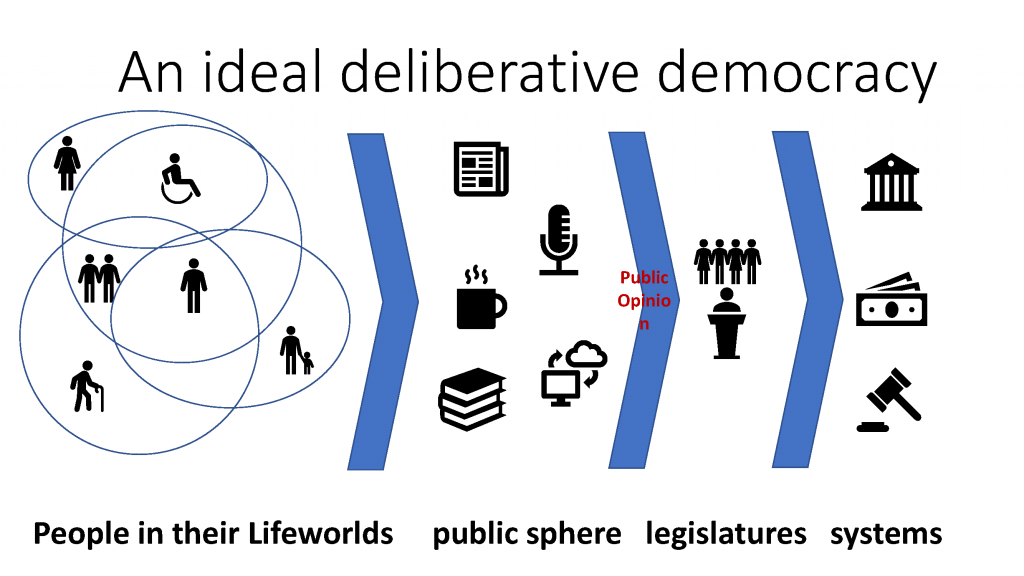
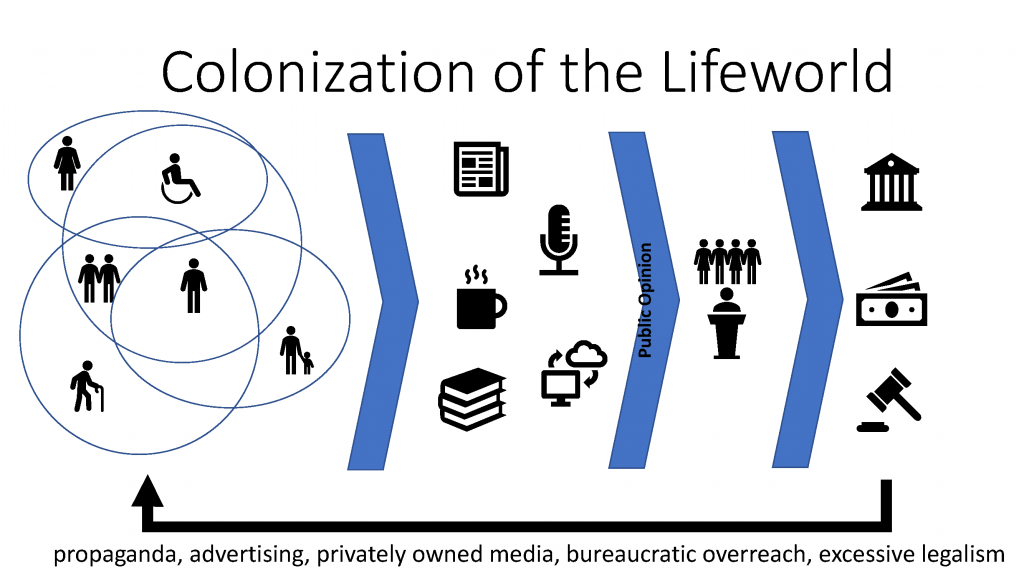
[See also:  Lifeworld and System: a primerit’s not just what you think, but how your thoughts are organizedFoucault and neoliberalism]

Kieran Setiya on midlife: reviving philosophy as a way of life

I read Kieran Setiya’s Midlife (Princeton, 2017) not only because I have that condition and am sometimes troubled by its complaints, but also because I appreciate the style of thought that Pierre Hadot named “philosophy as a way of life.” Practitioners of this style acknowledge that it is important to develop and test arguments. The philosophical life is one of critical reason. However, arguments should have a purpose: to improve a life. And we must remember that people are habitual and affective creatures. Therefore, arguments—no matter how valid and rigorous—will not change us. We also need practices or mental disciplines to accompany our arguments. But a mental habit or practice can lead us away from the findings of our critical reason. We may train ourselves to be foolish or selfish. So we need habits that are at least consistent with the best arguments, and, ideally, habits that actually include argumentation.

That is exactly the combination offered by the Hellenistic Schools (Stoicism, Epicureanism, Skepticism) and by the classical Indian traditions. It has been relatively weak in the modern West. Setiya shows that it can be practiced today.

He is a professional philosopher in the Anglophone, analytic tradition. A clue that he is trying something different in Midlife is the book’s grammar. Setiya often writes in the second-person singular: “You should …” (as in “You should not prefer to rewind time, erase your son, and try again.”) He also sometimes uses the first-person singular or plural: “I wish …”; “We think …” Midlife reads like a conversation that reports Setiya’s real efforts to combat his ennui in order to improve your life, too.

Midlife is almost free of jargon. But one person’s jargon is another’s helpful terminology, and Setiya makes occasional use of specialized words. His distinctive stylistic move is not his informal vocabulary but his shift to the second-person, which implies a stringent test that can be applied to each sentence and chapter: would an actual “you” find this text useful?

Another clue that Setiya is working in the tradition of philosophy as a way of life is that he recommends repeated practices, habits, or meditative exercises at the conclusion of each chapter. These are meant to turn the arguments of the chapter into therapies that might change our mental habits.

Many of Setiya’s recommendations are drawn from the history of ethics, not original to Midlife. Of course, that is fine; it is useful to review and revive others’ points. But some of his arguments are novel, and I will mention two.

Continue reading

Social Ontology 2018: The 11th Biennial Collective Intentionality Conference

On August 22-25, 2018, Tufts University will host the biennial Collective Intentionality conference, with the Tisch College of Civic Life as a co-sponsor. This interdisciplinary and international conference will bring together people who study the nature of the social world and how to improve our models of it.

Topics include:

  • Approaches to the metaphysics of the social world
  • Collective intentionality and group cognition
  • The nature of institutions, firms, and organizations
  • The metaphysics of race and gender
  • The nature of law and legal applications of social ontology
  • Collective responsibility

Interdisciplinary contributions are encouraged.

Keynotes by:

  • Sally Haslanger, Ford Professor of Philosophy, MIT
  • Kit Fine, Silver Professor of Philosophy, NYU
  • Daron Acemoglu, Killian Professor of Economics, MIT
  • Scott Shapiro, Southmayd Professor of Law and Philosophy, Yale
  • Edwin Etieyibo, Associate Professor of Philosophy, Univ. of Witswatersrand
  • Amie Thomasson, Professor of Philosophy, Dartmouth (tentative)

More information about the organizers, how to submit abstracts, and even an essay prize are all here.