Category Archives: revitalizing the left

the different logics of class and race

It’s common to list racism, classism, sexism, homophobia, and xenophobia together. These are all important and bad phenomena, but they have different logics, and I’m not sure it’s helpful to put them in a single category. Here I explore the differences by focusing on racism and classism.

Older meanings of racism were, I think, always attitudinal. To be a racist was to have negative attitudes toward a racial group, even if those attitudes were unconscious. We now speak of structural racism, which can exist even in the absence of racist attitudes. I sort of wish that we just called that problem “racial injustice,” because the “-ism” suffix connotes an attitude or mindset. But I can accept the linguistic evolution, and I certainly believe that both interpersonal racism and structural racial injustice persist and are destructive.

Classism can be made analogous to the older meaning of racism. You’re a classist if you hold someone in lower regard because of the status of her job, her working-class accent, her neighborhood of birth, or her parents’ social role. Classism of that kind is evident and harmful.

Structural classism would then mean some kind of advantage enjoyed by people due to their class. But this is where the analogy breaks down. Classes are differences in status, power, and advantage. If a society has classes at all, then it gives people different advantages. Put a different way: if a society differentiates among social roles, then it has classes, and that’s structural classism.

Racism is never justifiable, and it’s possible to envision a society that has racial diversity yet no racism. Indeed, I hope that’s where we are headed. In contrast, it’s impossible to imagine a society with classes that doesn’t have “structural classism,” if that means different levels of status, power, or money for different social roles. In theory, we could pay everyone the same salaries, but I’m not sure that would work in practice, and even if it did, it wouldn’t eliminate differences in the quality of work or the status of professions.

Further, classes may be justifiable or even good. Some argue that a classless society is the ideal. We haven’t seen one, however: communist societies produced powerful, detached social strata–the nomenklatura, etc. John Rawls argued that it’s right to pay heart surgeons more than carpenters if (and only if) that is necessary to serve the interests of cardiac patients–who would want highly skilled doctors. Rawls was not perfectly egalitarian, but he was more egalitarian than many Americans, who would make principled and sincere arguments in favor of different pay and status for jobs of different difficulty and complexity.

To say that structural racism exists is to make a critique. To say that classes exist raises the question of whether they are good or bad, and that is worthy of discussion.

One can see the analogy break down in educational settings. A university, for example, ought to be free of both interpersonal and structural racism. It should strive to be a place where your race doesn’t affect how well anyone else treats you or how you flourish. A university cannot, however, be free of class if it exists to provide the education that people need to enter certain desirable professions. If a university prepares people to be teachers, doctors, accountants, and poets, then it is producing a certain class. They could theoretically be paid the same as domestic workers and laborers; they would nevertheless form an advantaged group. A university can strive to reduce interpersonal classism, in the form of prejudice against first-generation students and its own blue-collar employees. But as long as it has blue-collar employees at all, it has classes; and as long as it promises good jobs for its graduates, it generates the class structure. Again, this may be necessary, justifiable, or even good–but it’s no use pretending that an advanced educational institution could be class-free.

Ending racism is theoretically possible and compatible with everyone’s legitimate best interests. You have no right to any advantage conferred by your race, and the very existence of such differences is caustic for all. In contrast, ending class differences might be just, if it’s possible, but it is not compatible with everyone’s interests. We like to talk about “social mobility,” because then we can focus on happy upward trajectories from poor to rich. But for everyone who moves up, someone else must go down. For instance, if the children of domestic workers have a decent chance of growing up to be doctors, then the children of doctors must have a good chance of cleaning houses for a living. Again, we could reduce the disparities in after-tax income and political power, but there will still be winners and losers as long as some people diagnose patients while others clean homes for a living.

Finally, the causation seems to be different. Presumably, interpersonal racism was an original cause (although maybe not the only original cause) of structural racism. We wouldn’t have had slavery, Jim Crow, or redlining if most white people had held most black people in high regard. But today the causal link may be weakened, for structural racism can persist even in the absence of interpersonal racism. For instance, assume that white college grads come to feel benignly and respectfully toward all other races. Still, if each college grad succeeds in getting his own children into a desirable college, those colleges will enroll mostly white students. As long as the distribution of goods in a society is racially unjust, you don’t need interpersonal racism to replicate the inequality; you just need unequal resources plus self-interest.

Meanwhile, interpersonal classism is mainly a consequence of objective differences in income, status, and power. It’s not that middle-class people are prejudiced against working-class people and give them bad jobs. It’s rather that people with bad jobs get treated worse. That pattern can turn into class prejudice, as when a person who has a working-class accent but plenty of money gets treated rudely at a snooty restaurant. But classism of that sort is not the main problem. The main problem is the real distribution of status, wealth, and power in the society. To change that is not a matter of improving attitudes but of redesigning institutions.

why the white working class must organize

It is inexcusable to vote for Donald Trump, a cruel and incompetent charlatan. To imply that anyone is justified in voting for him sets a patronizingly low standard. Our fellow Americans can do better than that.

At the same time, Trump’s demographic base consists of people–predominantly, white working-class Americans–who must be active, enthusiastic members of a progressive coalition. If they fall outside that coalition, real progress is impossible. I think the solution lies not in developing policies that would benefit the white working class, nor in devising new messages to attract them, but in strategies that allow them to win genuine power. I interpret the Trump phenomenon, in part, as a symptom of their powerlessness.

Class and the current partisan alignment

It is normal for partisan support to reflect demographics. What is unprecedented is the precise way that the US population has split in this decade. Basically, the Obama/Clinton coalition is the upper end of the economic scale plus people of color. The Trump coalition is the working class minus people of color.

College attainment is both a precondition and an indicator of middle-class status in contemporary America. In a poll taken between the conventions, Hillary Clinton led college-educated whites by 5 points, but she trailed Trump among whites who don’t have college degrees by 39 points: 62% to 23%. That gap must have set a record, but it was not wildly out of line with other recent results. Peter Beinart has assembled much more evidence for what he calls a “class inversion.” Note that Clinton also leads Trump by 16 points among Fortune 500 CEOs. In Silicon Valley, she led Trump by 64% to 20% in a poll last spring. Meanwhile, she leads by huge margins among all racial/ethnic groups other than Whites.

Chris Arnade reports from two parts of metro Cleveland, OH: white working-class Parma and African American Central Cleveland, which is one of the poorest communities in the nation. In Parma, Arnade writes,

Trump voters want respect. They want respect for their long hours of work that risks their bodies, for the hands caught in vices, backs wrenched by weights, and knees torn. They want respect because they are doing dangerous work, but their pay has been flat for decades.

They want respect because they haven’t just lost economically, but also socially. When they turn on the TV, they see their way of life being mocked and made fun of as nothing but uneducated white trash.

With Trump, they are finding someone who gives them respect. He talks their language, addresses their concerns

In Central, “the need for respect, the feeling of being left behind, is [also] well-understood.” But everyone there favors Clinton, and Arnade thinks that’s because “people feel they do have a political voice. They believe the Democrats are working for them, they might not like everything about the party, they might not fully like the results, but the party is respecting their concerns. [The] overwhelming political concern I heard had little to do with anything other than electing Hillary, and stopping Trump.”

I think this passage overstates African Americans’ satisfaction with the Democrats. Peniel Joseph describes “multiple strategic and substantive displays of multiracial unity” inside the Democratic National Convention. But “outside the convention hall Black Lives Matter demonstrators begged to differ, protesting the Democratic Party as an entity held corporate hostage to financial institutions whose candidate Hillary Clinton they say backed criminal justice and welfare reform that have had a devastating impact on poor black communities.” Jordie Davies writes that 2016 presents the choice between “a demagogue [Trump] and more of the same complacent, anti-black policies [from Clinton].”

But to the extent that the African American voters of Central Cleveland trust the Democratic Party, it may be because they observe Black people wielding actual power within the party. The President is African American. One in four delegates to the DNC was Black, and more than half were people of color. This is not because the party has given African Americans anything, but because Black people have won elections at all levels from local party officers to the presidency. So African Americans are at the table, even if they are often outgunned by wealthier interests and outnumbered.

Meanwhile, if you identify as working class, you will see virtually no one like you wielding power in either party. You may notice a few politicians of working-class origins, but almost everyone who influences either party is now a white-collar professional. Michael Podhorzer, the AFL-CIO’s political director, says, “We would argue that most of the political class comes from the same background whether it is Democrats or Republicans and that all politicians lack a kind of authenticity with working-class voters.”

Of course, union staff are also professionals, but they owe their jobs to rank-and-file members. Unfortunately, their place is increasingly marginal. Although five union leaders spoke on the first day of the DNC, none spoke in prime time, and two of them represented college-educated public employees. It would be easy to overlook industrial unions in the Democratic Party coalition, and this is why:
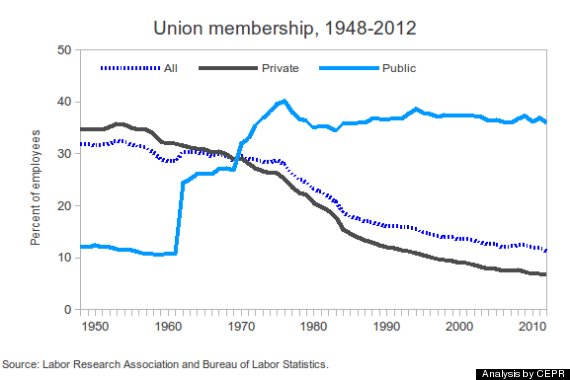
Private sector workers simply aren’t in unions anymore. Andrade begins his depiction of white working class Parma with the key point. It is “defined by auto factories: massive edifices to another era that now sit mostly idle. Scattered throughout are union halls, like UAW Local 1005, which is mostly empty, holding only a few cars.” I think the UAW’s empty parking lot is an image of political powerlessness; and powerlessness breeds Trumpism.

The new demographic split influences cultural institutions as well politics. For instance, Tufts University has always had, and must have, conservative students and faculty. It should be a place for productive debate between liberals and conservatives (and others). But I have not personally encountered anyone here who supports Trump. That makes sense, because Tufts is a college; its purpose is to produce college graduates. We admit students from working-class homes, but we strive to prepare them all for adulthood in the middle class. That’s what they pay us for. We also strive–albeit imperfectly–for racial, ethnic, religious, and cultural diversity. Consequently, everyone who graduates from Tufts enters the demographic categories that are currently lined up behind Clinton.

The need for organizing

The New Deal/Great Society coalition–always highly imperfect, unequal, and fractious–consisted of the working class (of all races/ethnicities) plus wealthier people who saw themselves as minorities, including religious minorities. In settings like national political campaigns, the various elements of the progressive coalition had to learn from and negotiate with each other. Together, they achieved some progress.

Today’s Democrats are typically stronger than Republicans on civil rights, especially rhetorically and in cases when addressing injustice won’t cost upper-income whites anything. For instance, as a white man with a PhD, I gain nothing from unjust policing or mass incarceration; I’d be better off without both. Racial diversity also improves my life, as long as I retain my own place in my job and neighborhood. Further, Democrats are prone to fund education, partly because they endorse principles (like equality and freedom) that education may advance; partly because today’s Democrats are often meritocrats and technocrats who treat success in school as an indicator of a good life; and partly because their coalition includes teachers and professors, who are paid to educate.

But Democrats won’t make more than marginal commitments to addressing the profound destruction of de-industrialization, rising deference to wealth and capital, or the economic situation of working class people (trends summarized here). That is because the working class is outnumbered in the Democratic coalition. Meanwhile, the Trump coalition could support policies that benefited the working class–note his embrace of a higher minimum wage and his opposition to trade liberalization–but since his coalition has been built to exclude people of color, it is terrible on civil rights and diversity issues. And Trump offers no real solutions even for working-class white people.

Democrats should enact policies for working class communities suffering from declining real income, falling life-expectancy, opioid addiction, and fragmenting families. At this moment, I think their policies are much better than the Republicans’, and it’s worth emphasizing that contrast. But beneath policy is politics, and there is no reason to believe that a coalition dependent on the upper class will consistently support policies that make a real difference to people in the lower class, especially when a majority of the lower class is voting for the other party. I’ve shown (here and here) that today’s most educated Americans are liberal but not egalitarian. The Democrats can obtain a majority coalition by offering neoliberalism plus diversity, and that is the likely long-term outcome.

An even deeper problem is that you cannot confer respect on someone else by giving him a better deal. So even if the Democrats enacted stronger policies to benefit the working class–infrastructure spending would be a good example–that wouldn’t make working-class people feel that they had a genuine seat at the table. They must design and enact policies to feel empowered. In turn, that requires organizations that can compel attention.

Solutions

Unions are one essential form of organization. The Democratic Party Platform says, “A major factor in the 40-year decline in the middle class is that the rights of workers to bargain collectively for better wages and benefits have been under attack at all levels.” The Platform promises: “Democrats will make it easier for workers, public and private, to exercise their right to organize and join unions. We will fight to pass laws that direct the National Labor Relations Board to certify a union if a simple majority of eligible workers sign valid authorization cards, as well as laws that bring companies to the negotiating table.”

I am not sure to what extent such reforms would restore the fortunes of organized labor, because another major obstacle is the changing nature of work; but we should certainly demand that the Democrats honor this promise.

In addition to unions, there are also community organizing groups that have genuine roots in white working class communities. Check out Kentuckians for the Commonwealth or the Maine People’s Alliance, among many others.

There is also cultural work to be done: the creation of stories, images, music, and other media that inspire working people politically. It’s striking that the Great Recession of 2007-8 never produced a cultural response comparable to the 1930s: no iconic images or anthems. I think a satisfactory narrative must address racism, because that is both morally important and necessary for building a coalition that spans races. However, the main rhetorical emphasis cannot be the privilege of being white, because “privileged” is a poor description of people who are being made superfluous in the 21st century labor market. Besides, I can’t think of any case when people have given up advantages because someone has drawn their attention to them. Told that they are privileged, people are much more likely to realize what they ought to protect.

Nor can the main tone be resentment, a sense of victimhood, or reactionary nostalgia, because nothing good comes of that. The story must evoke genuine pride and must look forward rather than back.

Since an identity as “white” is deeply problematic, we should be looking for alternatives: pride in local geographical communities or specific subcultures, plus a definition of “American” that is proudly inclusive rather than fearfully divisive.

Leonard Cohen probably isn’t the guy to reach a big enough audience, but we might take hints from his song “Democracy” (brilliantly analyzed by Laura Grattan). For instance, here he juxtaposes Otis Redding with a Chevy ad, goes inside a home and over to the Middle East with our troops:

It’s coming from the silence
on the dock of the bay,
from the brave, the bold, the battered
heart of Chevrolet:
Democracy is coming to the U.S.A.

It’s coming from the sorrow in the street,
the holy places where the races meet;
from the homicidal bitchin’
that goes down in every kitchen
to determine who will serve and who will eat.
From the wells of disappointment
where the women kneel to pray
for the grace of God in the desert here
and the desert far away:
Democracy is coming to the U.S.A.

This is a version of progressive democratic patriotism. The Democrats didn’t do a bad job of evoking such ideas at their Convention. I think the issue is the credibility of Democratic politicians as messengers.

In any event, messages and narratives must rest on real organizations, and the working class needs more of those. Otherwise, to quote Hannah Arendt’s Origins of Totalitarianism (h/t Josh Miller), we will face a combination of “superfluous wealth”–think of Donald Trump– and “superfluous men” (working class people without capital or advanced skills). As in the early 1900s, the superfluous could again form “a mass of people … free of all principles and so large numerically that they [can] be used only by imperialist politicians and inspired only by racist doctrines” (pp. 156-7). We know how that story ends.
what is the political economy that people are revolting against?

(Hartford, CT) One interpretation of Trump, Brexit, and related phenomena is that people fear losing their privileges and are reacting with prejudice against immigrants and racial and religious minorities. That thesis must contain a lot of truth. But a different–and compatible–interpretation is that large elements of the working class are revolting against an unjust but dominant political economy.

For instance, Harvard Professor Richard Tuck makes the leftist case for Brexit. Britain needed to leave the EU because “the essence of the EU is neoliberal. … The policies that are enshrined in its treaties and in its administrative structures are essentially those of the neoliberals.” Meanwhile, in the US, Trump holds a double-digit lead over Clinton among the working class as a whole, while he trails by similar margins among college-educated people–and the US Chamber of Commerce denounces his position on trade.

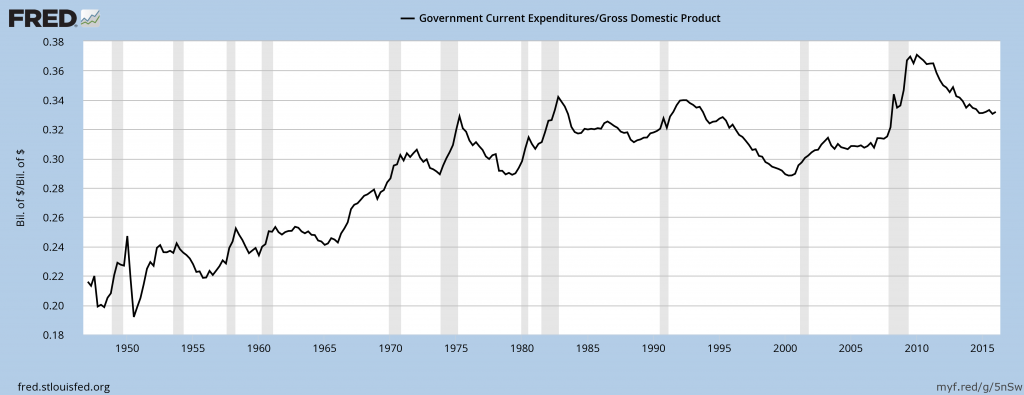
If the working class is rising up, what are they rising against? Hardly anyone calls himself a “neoliberal,” and critics load a lot of diverse ideas into that term. It presumably doesn’t mean libertarianism or laissez-faire, because then we could just use those words (dropping the “neo-“). What’s more, the US and EU have not moved in a libertarian direction. Here, for instance, is the trend in government spending as a percentage of GDP in the USA. It’s basically up, albeit with declines in the last six years of both the Clinton and Obama administrations.

fredgraph

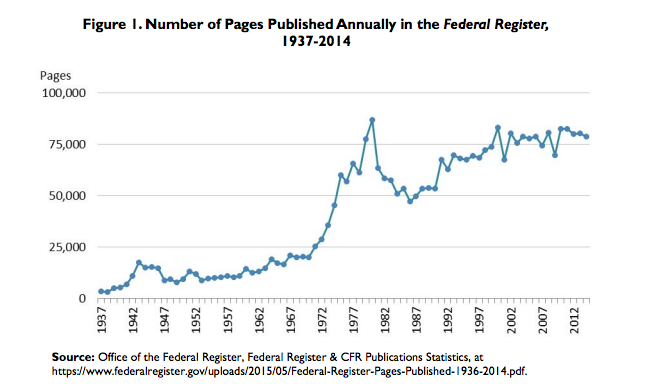
The volume of government regulation is also up, although that’s harder to measure. This is the size of the annual federal compendium of new regulations, measured in pages. A libertarian regime would not issue 80,000 pages of new rules per year.

Screen Shot 2016-07-16 at 11.02.19 AM


There are many good things about regimes like the US and the EU member states. In broad, historical context, they are relatively free, prosperous, safe, and democratic. Nevertheless, I will emphasize the negatives, for much the same reason that your doctor wants to talk about your hypertension and family history of cancer, not how wonderfully well your liver and kidneys are working. In other words, I’ll offer a critical assessment even though there would also be many positive to points to make.

In brief, I think that states are increasingly powerful, but they are accountable to capital, not to citizens. That’s what critics mean by “neoliberalism,” although “state corporatism” might be a better phrase. I’ll break the diagnosis into six parts.

1. Deindustrialization

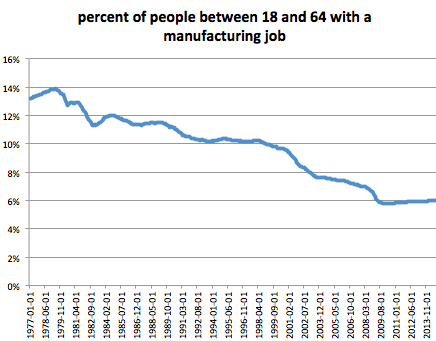
We call the wealthiest countries of the world the “industrialized” nations, but that description is becoming obsolete. These countries did industrialize after 1800 but have shed most of their manufacturing jobs. Below is the trend for the US since 1977. The graph understates the decline, because many more than 14% of households had at least one manufacturing worker, usually a man, in 1978. Also, the rate was higher in 1950, but I can’t find a longer time series. In any case, the decline since 1977 has been steep.
Screen Shot 2016-07-10 at 8.27.17 PM

Manufacturing jobs are rarely enviable, but they give their workers political leverage because they require expensive, fixed investments. Ford’s River Rouge plant in Detroit employed 100,000 men at its peak (versus 6,000 people today). Autoworkers could organize and strike. They voted in city and state elections. It was expensive for Ford to move its investments out of Detroit, although that gradually happened, and the city has lost 61% of its population. But in the heyday of industrialization, Ford needed those men to be reasonably happy. In return, manufacturing workers benefitted from their political leverage–including Black workers, whose civil rights improved with their concentrated market power in factories.

By contrast, Google, which is worth about half a trillion dollars, employs some 50,000 people, worldwide. They are well paid, but they remain at Google for a median of 1.1 years. They have market value–far above the average market value of average Americans, let alone average human beings–but they have little or no political leverage. Even the best-paid are dispersed, transient, and eminently replaceable.

2. Mobile capital

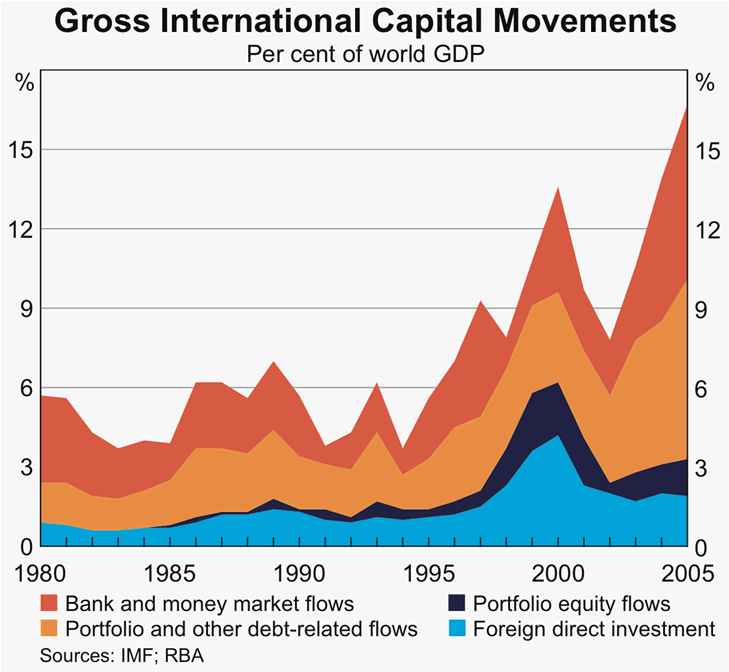
The fact that you can now make more money by investing in intellectual property and networks rather than rooted industries is one reason that capital moves faster than ever before. Capital mobility is also encouraged by favorable laws and treaties and by financial instruments, analytics, and other tools that assist investors.

The result is a substantial increase in the leverage of capital even as the leverage of labor has weakened. Businesses gain their “privileged position“–even in democracies with free and fair elections–from two major sources. First, since a business is organized, it can deliberately advocate for its interests by lobbying or advertising, whereas diffuse interests (like consumers or workers) have much more trouble acting politically. Second, investments are essential for prosperity, and a business can move its investments. Thus, even without lobbying at all, a business–or an individual investor–gains leverage over governments. Its ability to invest and or disinvest gives it power. That power has rapidly increased. It also reinforces …

3. Deference to wealth

This point is harder to quantify, but I perceive that we live at a time when billionaires, celebrities, and CEOs are given extraordinary deference, especially in comparison to run-of-the-mill elected officials, civil servants, union leaders, and grassroots organizers. Politicians, for instance, are constantly in contact with their wealthiest constituents. First-year Democratic Members of the House are advised to spend four hours per day of every day calling donors. Meanwhile, many advocacy groups are funded by rich individuals, not sustained by membership dues, so their leaders are also constantly on the phone or at conferences and meetings with wealthy people. The conversations in these settings tend to be deeply deferential, and they occur behind closed doors. Of course, these habits are abetted by laws and policies–especially, laws governing campaign finance in the US. But we observe somewhat similar deference in other countries with better laws. I think the deeper cause is the shift of leverage to economic elites.

4. The market colonizes the public sphere 

“Commonwealth” is a translation of “republic,” which could be more literally rendered as “the public’s thing.” In a republic, the government is supposed to be distinct from the private sector. As the custodian of the common wealth, it operates on different principles from a market. These principles are not simply majoritarian, for the commonwealth belongs to our unborn children as well to us. We have no right to waste it by voting for the wrong policies. A republic strives to define and implement something worthy of the title “public good.”

That distinct ethic has been lost, as governments are almost universally seen simply as service-providers, constantly compared to businesses on the grounds of efficiency, and expected to compete in a market for popularity and influence. In a 1870 case, the Supreme Court declared a lobbyist’s contract void on the ground that it would be “steeped in corruption” and “infamous” for any business to hire someone “to procure the passage of a general law with a view to the promotion of their private interests.” The Court added:

The foundation of a republic is the virtue of its citizens. They are at once sovereigns and subjects. As the foundation is undermined, the structure is weakened. When it is destroyed, the fabric must fall. Such is the voice of universal history. The theory of our government is that all public stations are trusts, and that those clothed with them are to be animated in the discharge of their duties solely by considerations of right, justice, and the public good.

We certainly didn’t live up to those words in 1870s, when government was in many ways more corrupt than it is now. But the animating philosophy of a public good was still alive then. In contrast, Buckley v Valeo (1976) defines political money as constitutionally protected speech, and Citizens United (2010) equates businesses with civic associations. These are examples of a general erosion of a distinction between public good and private interests.

5. States have increasing power

If we lived in a neo-“liberal” or laissez-faire era, states would be constrained. In some ways, they are, but they also have more access to data about people than ever before; they have an easier time surveilling, influencing, punishing, and even killing individuals; and they operate increasingly powerful systems for enforcing discipline, headlined by the vast prison system of the USA. Their ability to see, count, and act also extends far beyond their borders, making people in most parts of the world subject to more than one government at once.

6. But states need their citizens less

On the other hand, states don’t need their own citizens. They don’t need us as military conscripts, because they can fight using small numbers of highly equipped experts, and they don’t need most of us as taxpayers, because they can finance their operations on international markets.

Mitt Romney did himself no favors by accusing 53% of Americans of being “takers” instead of “makers.” (Also, his numbers were off, since he omitted people who pay payroll taxes.) But he was right that a small minority can finance a modern government, which means that the state really doesn’t have to pay much attention to the rest of its people.

Put those six premises together, and you would predict a political regime in which investors use an expansive and intrusive state to promote their own interests. This seems almost precisely accurate as a description of regime like China’s, and all too apt when applied to the US, the UK, or the EU as well. It doesn’t excuse voting for Donald Trump, who offers no alternative and threatens fundamental rights. I don’t think it offers a very good rationale for Brexit, either. But it does explain why a political class wedded to this status quo would face an electoral insurrection.

how national policies sucked the power out of local government and disempowered citizens

Phillip Longman makes an extraordinarily important argument in an Atlantic article entitled “Why the Economic Fates of America’s Cities Diverged” (although I would be very curious what economic historians and other relevant experts think about it). Here is my restatement:

  1. When businesses are mostly local, local governments can regulate them. Citizens can also influence them directly by applying social pressure.
  2. When citizens have the experience of influencing economic institutions directly or through representative local governments, they feel empowered and want to act at the state and national levels as well.
  3. Between 1788 and about 1970, federal and state governments and courts instituted a remarkable series of policies explicitly designed to favor local firms. An economic outcome of these policies was a strong convergence of income and prices across the US, as each community captured a lot of its own wealth. Firms were also accountable to local governments, and business owners were highly active in local civic affairs.
  4. Since 1970s, all branches of government have removed those policies. Income and prices have diverged dramatically. Wealth has flowed to the big coastal cities.
  5. Local and state governments have become less capable of regulating businesses. Firms also receive less social pressure because they tend to locate in culturally friendly cities and do their business nationally. Big business leaders are uninvolved in local civic life but increasingly focused on Washington.

Carolyn Bouchard, a diabetic with a slowly healing shoulder fracture, hurried to see her doctor after Matt Bevin was elected governor here this month. Ms. Bouchard, 60, said she was sick of politics and had not bothered voting. But she knew enough about Mr. Bevin, a conservative Republican who rails against the Affordable Care Act, to be nervous about the coverage she gained under the law last year.

“I thought, ‘Before my insurance changes, I’d better go in,’ ” she said as she waited at Family Health Centers, a community clinic here.

Longman summarizes policies enacted to increase local control over business until 1970s–and their repeal since then. Consider, for example, the US Postal Service monopoly (which guaranteed equal prices and service for all addresses), heavy regulation of railroad, telegraph, and television companies, the Clayton Antitrust Act, the Robinson-Patman Act (against chain retail stores), the Miller-Tydings Act (against retail discounting), the Celler-Kefauver Act (antitrust provisions), Brown Shoe Co., Inc. v. United States (blocking a retail merger), and FCC regulations that mandated airline service to smaller markets and equal ticket prices per mile.

These were all policies that restrained national business competition but allowed geographical communities to compete against the big cities of the coasts. Once these rules were gone, capital became more mobile and consumers probably got the benefits of lower prices–but it became impossible to govern at the local level, and citizens were taught to be “sick of politics” because the politicians who were closest to them could no longer achieve much on their behalf.

See also: the Democrats’ problem is social capital; the European city as site of citizenship; and wealth-building strategies for communities.

the Democrats’ problem is social capital

Notwithstanding the fiasco that is the GOP presidential primary so far, Matthew Yglesias warns, “The Democratic Party is in much greater peril than its leaders or supporters recognize, and it has no plan to save itself. … The vast majority — 70 percent of state legislatures, more than 60 percent of governors, 55 percent of attorneys general and secretaries of state — are in Republicans hands. And, of course, Republicans control both chambers of Congress.”

A major factor is the turnout gap. That is worse for Democrats in local and off-year elections but will persist in 2016. Today, the pollsters Greenberg/Quinlan/Rosner report that “unmarried women, minorities, and particularly millennials are less interested in next year’s voting than seniors, conservatives, and white non-college men are.”

Why do we see these gaps? On the whole, we engage in politics when we are brought into networks where political issues are regularly discussed and where people encourage each other to participate. This is a consistent finding of our own research on youth as well as much research on adults. Yglesias uses that theory to explain why unionized teachers vote in local elections:

Teachers talk to one another (they work together, after all) about questions of public policy (everyone talks at work about work, but public school teachers’ work ispublic policy), and they also have hierarchical channels of information dissemination (the union itself) through which this work talk can connect to practical politics.

(Yglesias is expanding on Eitan Hersh’s argument that “scheduling local elections at odd times appears to be a deliberate strategy aimed at keeping turnout low, which gives more influence to groups like teachers unions that have a direct stake in the election’s outcome.” Yglesias is contributing an explanation of why the union members vote.)

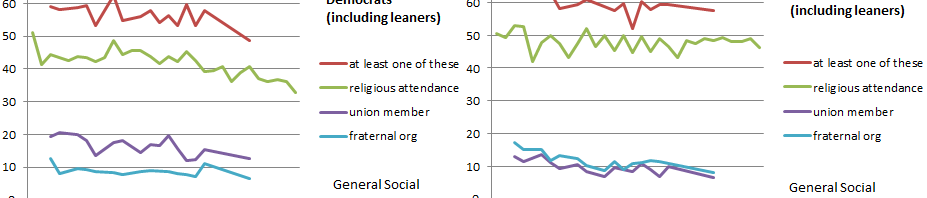
Let’s call participation in networks “social capital.” Since the 1970s, Democrats have lost social capital (of a politically relevant kind) and Republicans have not. The parties used to be on par, but the Republicans now have a meaningful advantage.

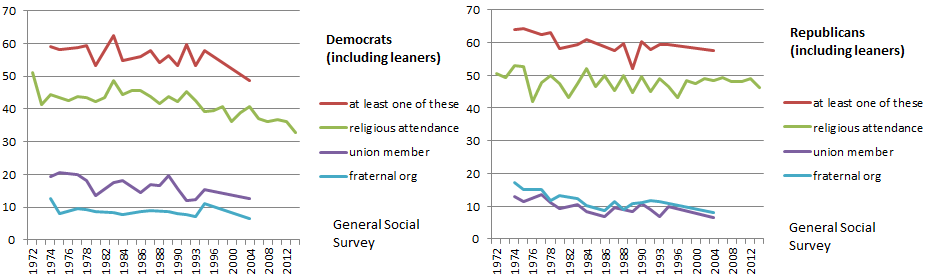
To illustrate, I show rates of regular religious attendance, membership in unions, membership in fraternal organizations, and a composite (defined as belonging to at least one of the three). The data come from the General Social Survey, which hasn’t asked about unions or fraternal associations since 2004. But in some ways, that’s OK, because I think the trend from 1970-2004 is the significant one, and the subsequent period has been unsettled because of social media and two high-profile presidential elections.

politics and social capital

Observations:

  • Democrats have become less likely to attend religious services regularly; Republicans have not.
  • Democrats have always been more likely than Republicans to belong to unions, but their membership rate was considerably higher in the 2000’s than in the 1970s. (Of course, union membership for Americans as a whole has fallen more steeply.)
  • Republicans have lost some ground with fraternal associations, but those never provided a huge component of their social capital.
  • The Democrats show an overall decline; the Republicans do not.

Caveats: 1) These are only three measures of social capital, plus a composite of the three. There are certainly other varieties of engagement–but I selected the ones I thought were most important. 2) Democrats and Republicans are not fixed demographic groups with persistent members. It is not the case that people have remained Democrats but have become less likely to join unions or attend church. Rather, the American people have changed in various ways, and the subset that consists of Democrats who have social capital has shrunk. The trends shown above only tell part of the story, but I think an important part.