Category Archives: revitalizing the left

Democrats as technocrats

This web search takes you to a whole stack of good recent writing about the Democratic Party as the technocratic party, with headlines ranging from Twilight of the Technocrats? to The Triumph of the Technocrats. In lieu of a critical review, I’d pose these questions:

  1. What would a technocrat support and do in our context? It’s possible to be a socialist technocrat or a technocrat who works for a huge, for-profit company. I presume that a technocratic Democrat today is someone who believes in optimizing GDP growth, environmental sustainability, and reductions in tangible human distress (e.g., disease, homicide) through efficient governmental policies. These desired outcomes often conflict, and then technocrats are fine with compromise. To qualify as a technocrat, you can’t be too enthusiastic about working with ordinary citizens on public issues, and you can’t base your agenda on controversial, challenging moral ideals.
  2. Do Democrats present themselves as technocrats, in this sense? Some do and some don’t. It seems fair to read the positive agenda of Hillary Clinton’s 2016 campaign as largely technocratic (she promised to govern competently and continue the balanced progress of her predecessor), although her critique of Donald Trump was ethical rather than technical. I also think that Clinton was in a tough spot because she didn’t believe that she could accomplish transformative change with a Republican Congress; thus managerial competence seemed a workable alternative. The 2016 campaign does not demonstrate that she–let alone all Democrats–are fully technocratic. However, consider a different case that is pretty revealing: the Josiah Bartlet Administration. This is an informative example just because it is idealized and fictional, free of any necessary constraints. The Bartlet White House is staffed with hard-working, highly-educated, unrealistically competent, smartest-guy-in-the-room, ethical people who strive to balance the budget while making incremental progress on social issues. Hollywood’s idealized Democrats are technocrats in full.
  3. Do Democrats choose technocratic policies? Again, I’d say “sometimes.” Both the Clinton and Obama Administrations definitely showed some predilection for measurable, testable outcomes; for behavioral economics; and for models that were consistent with academic research about the economy and the climate. They weren’t particularly good at empowering citizens to govern themselves or collaborating with social movements. On the other hand, the Affordable Care Act has a moral core (aiming to cover people without health insurance), even if many of its tools and strategies are best defined as technocratic.
  4. Are Democrats good technocrats? There has been more economic growth under Democratic than Republican presidents. But the sample is small, several Democratic presidents faced conservative congresses, and any correlation with a small “n” can easily be spurious. A deeper point is that Democrats are currently more committed to the mainstream findings of climate science, social policy research, and academic economics than Republicans are. Their accomplishments may be affected by sheer chance, but their strategies tend to be consistent with positivist, empirical research.
  5. Is Democratic technocracy consistent with justice? No. Almost any theory of justice, from libertarian to strongly egalitarian, would demand fundamental shifts from the status quo. Certainly, I would favor deeper changes in our basic social contract. On the other hand, compared to what? Managing our existing social policies in a competent way delivers substantial, if inadequate, justice. It beats incompetence or deliberate assaults on existing social institutions. In a multi-party parliamentary democracy, a center-left technocratic party would play an important role. I would be open to voting for it, depending on the circumstances and the alternatives. In our two-party system, a technocratic and centrist component competes for control of the Democratic Party. It shouldn’t be surprising that this component receives constant criticism from within the Party, because the Democrats represent a broader coalition, and there is plenty of room to the left of someone like Hillary Clinton. Whatever you think of her, I don’t think you can complain that she was criticized from her left.
  6. Is Democratic technocracy good politics? That’s not a question that will be settled to everyone’s satisfaction any time soon. Clinton lost to Trump but also won the popular vote. She was technocratic but not completely so. She faced many contingencies, from Fox News to Bernie to Comey, and handled them in ways that we can debate for the next decade. Again, the answer has to be: Compared to what? A compelling new vision of America’s social contract would beat competent management at the polls. But competent management may beat incompetence or a deeply unpopular vision (from either right or left).
  7. What’s driving the Democratic Party’s drift to technocracy? One could explain it in class terms: the Democratic coalition is now highly educated, including many people who make a living by demonstrating expertise. But I would propose a deeper thesis. Modernity itself is defined by constant increases in specialization and differentiation, plus radical doubts about our ability to know which ends are moral or just. In that context, people prosper who are good at applying technical reasoning to complex problems without worrying too much about whether the ultimate ends are right. Modernity has generated a white-collar governing class that is currently aligned with the Democrats, but more than that, it has generated a very high estimation of expertise combined with a leeriness about moral discourse. Religious conservatives monopolize the opposition to both of these trends. Getting out of this trap requires more than new messages and policies. It is a fundamental cultural problem.

See also: the rise of an expert class and its implications for democracyvarieties of neoliberalismthe big lessons of Obamacarethe new manipulative politics: behavioral economics, microtargeting, and the choice confronting Organizing for Action; and why the white working class must organize.

assessing the congressional town meeting protests, 2009 and 2017

In 2009, when Democratic House members went home to discuss the Affordable Care Act with their constituents, they faced disruptive questions and protests, often from people loosely affiliated with the Tea Party. The protesters cited such supposed evils as Death Panels. This year, when Republican House members go home to discuss repealing the same legislation, they face disruptive questions and protests from supporters of the ACA. In at least one case, a Member of Congress decried the Death Panels that are supposedly now in existence and was hooted down as a liar by his constituents. In both 2009 and 2017, many Members of Congress have decided not to hold so-called Town Meetings at all because of the prospect of protests that would be covered on mass media.

2009

2017


I was prone to lament the protests in 2009 but welcome them in 2017. That sounds like hypocrisy, but the comparison is more complicated. First, the same behavior can be appropriate or inappropriate depending on its purpose and content. Making such distinctions requires judgment, but judgment is essential in politics and is not merely a form of bias. In other words, the right judgment may be that the protests of 2017 are helpful even though those of 2009 were harmful. One reason may be that the protesters of 2017 are speaking truth, and those of 2009 were repeating lies. I acknowledge that’s a simplification, but it may be roughly correct.

Second, if we treat a political act (such as organizing or disrupting a public meeting) as a general category, without reference to its purpose or outcome, we still must weigh several values. Disrupting a meeting is bad for civility but may enhance free speech and agency. Only a purist about civil dialogue would automatically oppose any form of disruption.

I took a somewhat unusual position in ’09. I argued that deliberation–i.e., genuinely listening and being open to changing one’s mind–plays an important role in a democracy. When protesters shut down events sponsored by Democrats, or when Democrats stopped holding open meetings in fear of protests, deliberation suffered. This was a shame because we are all badly limited, morally and cognitively, and we need opportunities to hear from the other side.

However, I said then, a major cause of the disruption was the design of these events. In a truly deliberative event, such as a classic New England Town Meeting, the participants make a collective decision that is not pre-determined by the organizer. To make such a discussion go well requires rules that give people and arguments equal time and organize the debate. An event that is billed as a “Town Meeting” is a fake deliberation if the politician-organizer has already made up his or her mind and just wants to persuade the audience. Giving members of the public a chance to react for a minute at the mic. is a recipe for angry responses. Such meetings are so predictably bad that they provide frequent moments of comedy on Parks & Rec:

The solution would be to reserve events that are billed as deliberative for genuine deliberations. Citizens would be invited to discuss and design solutions, and the organizers would be open to any outcomes. An example is our successful recent experiment with a Citizens Initiative Review in Massachusetts.

When, on the other hand, a representative already holds a position on an issue and wants to persuade the public, she or he is entitled to screen the audience, to talk only through the media, or otherwise to control the format. At the same time, opponents are entitled to exercise their rights of assembly and petition to argue the opposite position. If the politician chooses to speak in an open room, then she should expect disruptions. If the politician screens the audience, she should expect people outside with signs.

Several additional issues arise for me:

  1. What should matter to protesters is winning. You win if you get more than 50% of the public to support you actively, e.g., by voting in 2018. A protest that may inspire your side and even encourage more participation may also alienate the undecided. Everyone involved in a social movement should read Bayard Rustin’s 1965 article “From Protest to Politics” to remember the difference between moral purity and political effectiveness. Perhaps “What would the median voter think about this?” is not the only important question, but it is always one question to consider explicitly.
  2. The number of people who are present at these events is trivially small in a nation of almost 320 million. The protests matter because they are covered by mass and social media. Controversy and outrage are profitable for media companies. That means that moments of disruption will receive disproportionate attention, and most moments of actual dialogue will be lost. An effective protest may have at least two mediated audiences: supporters whom it inspires, and opponents whom it outrages. They will see the same event in different media contexts. Smart political activists think their way through to the media coverage in all channels.
  3. Listening is a political virtue, even if it’s not the only virtue. Speaking out of turn at a meeting, or drowning out the main speaker, may be the right thing to do. It allows other people to hear you and it honors your right to a voice. But it does have a cost: the audience can’t hear the person you have drowned out or preempted. It’s appropriate to reduce that cost by (for example) interrupting briefly and then yielding back the floor.
  4. Politicians who appear at open public meetings before hostile audiences to defend their settled positions are not strictly deliberating. They have made up their minds and they seek to use their influence to affect public opinion. However, by physically appearing before their critics, they demonstrate vulnerability. As Danielle Allen argues in Talking to Strangers, democracy requires vulnerability. It is a necessary (but not sufficient) condition for valuable interactions between people who are strong and weak. Therefore, Republican Members of Congress who continue to face protesters in open meetings deserve some credit–which takes nothing away from the protesters who challenge them.
  5. A protest is a moment of potential, but only if the protesters find other ways of acting together politically. In turn, that requires members of the protest movement to form durable relationships and to develop and extend their skills, usually in the context of organizations to which they belong. In a very important recent interview, Marshall Ganz says, “Many Democrats confuse messaging with educating, marketing with organizing. They think it is all about branding when it is really about relational work. You engage people with each other, creating collective capacity. That’s how you sustain and grow and get leadership.”

responding to the deep story of Trump voters

(Washington, DC) This is Arlie Russell Hochschild’s now-famous “deep story” of Louisiana Tea Party supporters, their “account of life as it feels to them.” It’s become famous because it’s also the “deep story” of at least some Trump voters:

You are patiently standing in the middle of a long line stretching toward the horizon, where the American Dream awaits. But as you wait, you see people cutting in line ahead of you. Many of these line-cutters are black—beneficiaries of affirmative action or welfare. Some are career-driven women pushing into jobs they never had before. Then you see immigrants, Mexicans, Somalis, the Syrian refugees yet to come. As you wait in this unmoving line, you’re being asked to feel sorry for them all. You have a good heart. But who is deciding who you should feel compassion for? Then you see President Barack Hussein Obama waving the line-cutters forward. He’s on their side. In fact, isn’t he a line-cutter too? How did this fatherless black guy pay for Harvard? As you wait your turn, Obama is using the money in your pocket to help the line-cutters. He and his liberal backers have removed the shame from taking. The government has become an instrument for redistributing your money to the undeserving. It’s not your government anymore; it’s theirs.

One response to anyone who holds this story is basically: Drop it. The people you believe have moved ahead of you on line are actually still behind, in the sense that they still face unfair disadvantages. For example, an applicant with an identical resume is much less likely to receive a job interview if his name sounds African American rather than White. (My own team is replicating this finding now, as part of a larger study to be released later.) To the extent that some people are moving forward on line, it’s because the most blatant inequalities are being to some extent remedied.

This is true, but I don’t believe it will work politically. I can’t think of any group in history that, upon being informed of its unfair advantages, has responded by yielding them willingly.* The standard response to being told you are privileged is to realize that you have something to defend. And I think that’s an especially likely response if you actually face hardships and disadvantages–which is true of White working-class rural Louisianans.

Waiting in line is a perfect example of a zero-sum situation. Literally, to move one space forward in a queue is to move everyone else one space back. As long as people see themselves in zero-sum relations with others, politics will be ugly. Of course, people don’t have to see the competition in racial terms. If, for instance, White rural Louisianans saw themselves as part of the same group as African-American rural Louisianans, they wouldn’t count successful Black people as winning against them. As Jamelle Bouie wrote yesterday, “many white Americans hold (and have held) a zero-sum view of politics, where gains and benefits for nonwhites are necessarily an imposition on their status.” He adds that how to “fix this white voter problem … is a separate and difficult question.” Telling the people whom Hochschild interviewed that they are racists does not seem to me a likely solution (nor does Bouie suggest it).

A different approach is to attack the zero-sum framing of the situation. People should be asking why anyone must wait so long for the American Dream. White Americans have voted for progressive policies when they have come to think that maybe everyone could achieve a good, secure, prosperous life. The underlying rules could be changed so that everyone wins.

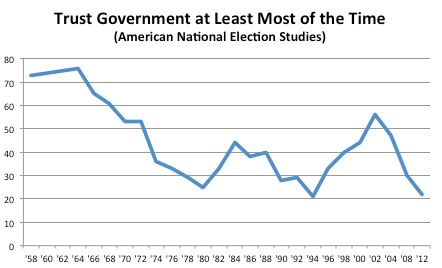
The immediate barrier to that kind of solution is distrust in government. If you don’t believe that government can be trusted to improve the social contract, then the existing contract may seem inevitable. Then your struggle with other people is zero-sum.

And people no longer trust the government much …

Perhaps the most common way to change this trend is to try to “sell” people on the government again– to persuade them that it offers solutions by outlining the policies that it can achieve and by using more effective rhetoric to defend it as an institution.

I dissent in part. People should not trust governments. As Jean Cohen writes, “One can only trust people, because only people can fulfill obligations.” Trust in the US government, as displayed by the American public ca. 1958, was naive. It often involved viewing presidents and other national leaders as friendly personalities, which reflected poor judgment. When it comes to governments and other large institutions, we ought to use one of these substitutes for trust:

  1. A sober assessment that the incentives are aligned to make the people who run the government also look out for our interests. I don’t think rural White Louisianans have much reason to make that assessment, even though, in my view, they would have been much better off with Clinton than with Trump.
  2. Personal connections to people who work in or closely with government. Because politics and government service are now the preserves of white-collar professionals, working-class people have few such connections. Consider, for example, the almost total absence of actual, current working-class people at both the Democratic and Republican National Conventions.
  3. Intermediary organizations that tangibly answer to us and (in turn) influence governments. Unions [and grassroots-based political parties] were prime examples, but they are shattered.

I’d support anything that makes White Americans less likely to see zero-sum situations in racial terms. But I believe it’s most promising to reduce the zero-sum situation more generally. Improving the social contract requires large institutions. Governments are strong candidates, although unions, co-ops, and other nongovernmental structures can be effective as well. Any large institution must, in turn, have direct, human connections to the people whose support it seeks. That means that even if the government is our main tool for social change, we need more than the state by itself; it must come with a panoply of social movements and organizations that link people to it. The hollowing out of these movements and organizations is thus at the root of our problems.

See also why the white working class must organizeto beat Trump, invest in organizingbuilding grassroots power in and beyond the election.

*Partial exception: the French nobility voted on August 4, 1789 to abolish the privileges of feudalism, spending all night eliminating one major privilege at a time by majority vote. It was a heady spectacle, but many of them lost their actual heads in 1793-4. Besides, they were voting for a new regime that promised all kinds of glories, not just moving themselves down the social hierarchy.

the Democrats and religious Americans

In The Atlantic just before the New Year, Michael Wear–an evangelical who helped Barack Obama with “faith outreach”–offered a critical assessment of the Democrats’ relationships with Evangelicals, 81% of whom supported Trump in 2016. Wear argued that it is a civic obligation to strive to engage all sectors of the society, and it’s a political necessity to engage religious Christians, given their large numbers. Wear wouldn’t expect Democrats to compromise on the substance of abortion, but he suggested that they could acknowledge the moral motivations of abortion’s opponents and look for common ground where it exists. He also decried a certain tone-deafness or ignorance about religious values and traditions, which sometimes verges implicitly on contempt. For instance:

[Wear] once drafted a faith-outreach fact sheet describing Obama’s views on poverty, titling it “Economic Fairness and the Least of These,” a reference to a famous teaching from Jesus in the Bible. Another staffer repeatedly deleted “the least of these,” commenting, “Is this a typo? It doesn’t make any sense to me. Who/what are ‘these’?”

Wear’s remarks are a bit anecdotal and could give a misleading overall impression. However, in The New Republic, Sarah Jones responded in a way that I thought vindicated Wear’s point. She argued that the Democrats should “frame abortion access as a moral good”; women suffer from any wavering on that topic. (Note that an outright majority of women have been against abortion in several recent years.) She added, “The country is becoming increasingly secular and increasingly liberal on issues like marriage equality. The Democratic party won’t win by catering to social conservatives, and it shouldn’t try.”

Leaving aside Wear’s point that national leaders should always try to engage any significant group, Jones is also wrong empirically. It’s true that the proportion of Americans who do not believe in God has risen–to 10% in 2016. Still, 89% say they believe in God, 64% believe in Hell, 54% believe that “religion can answer all or most of today’s problems,” 53% say that religion is very important in their own lives, and 55% claim to belong to a church or synagogue. The secularization trend is subtle and modest. I also fail to see a trend in the pro-choice direction:

Ed Kilgore offers a more interesting response to the Wear interview. He notes that whenever Democrats become concerned about losing “religious” voters, the conversation turns to White Evangelicals (see the Wear interview) or to “cultural conservatives” (as in Jones’ reply), with sometimes a passing reference to Jews. The discussion overlooks Catholics of all backgrounds, Protestants of color, Mainline Protestants (who number 36 million, mostly Whites), Muslims, Hindus, and other religious minorities.

Many of these constituencies see politics through religious lenses, at least in part. They are prone to be alienated by an aggressive secularist agenda, and they are likely to see issues like abortion as morally complicated, wherever they land. Often enough they vote for reasons other than religious ones. For instance, a majority of Mainline Protestants supported Trump, which I would attribute mainly to their race and class rather than their faith. Still, there are powerful faith-based reasons that they might oppose not only Trump but also Paul Ryan’s economics. Meanwhile, religious congregations remain sources of social capital and bottom-up political power that progressives ignore at their peril.

See also the political advantages of organized religion.

what activist movements will look like in the Trump era

Dave Karpf has a great piece entitled, “Cyclical patterns in activist politics: what do we know about the politics of opposition”? Karpf argues that opposing a government looks very different from the “politics of articulation” (trying to develop and promote an agenda). These are some key differences:

  1. Opposition unites. As Karpf notes, the Tea Party formed to oppose Obama before he had made any policy decisions. Its original rhetoric–and its very name–implied opposition to tax increases. But Obama mainly cut taxes. That was no problem for the Tea Party, which shifted to opposing the Affordable Care Act. It was nimble about policies because its raison d’etre was opposition to a person, his core values, and the institution he controlled.
  2. Rapid response becomes more valuable. Especially in the age of social media, activist networks are good at getting people out quickly. They are much worse at sustaining pressure, negotiating, and achieving new policies. When your side shares formal power, rapid response is relatively unimportant. But when the main goal is to block policies coming from the other side, rapid response pays.
  3. By the same token, it becomes harder to advance a positive agenda when a movement must spend all its time blocking new initiatives from the government.

I would add two hypotheses:

  1. I think activists on the left will shift from soft, proximate targets to confront their main ideological opponents. The global justice movement of the Clinton era criticized transnational corporations and the governments that supported them, yet it gained attention for protests outside the World Bank, which funds development projects. Occupy Wall Street claimed to target Wall Street, yet it got the most traction in conflicts with Democratic big city mayors and state universities that were simultaneously facing budget cuts from conservative legislatures. The environmental movement focuses on massive destruction caused by fossil fuels but achieved a notable victory by pressuring a Democratic president to block a specific pipeline that could be easily bypassed. The left tends to confront near-allies for showing hypocrisy or weakness, but that impulse fades when explicit opponents take control. (See Bayard Rustin’s absolutely indispensable and totally timely 1965 article “From Protest to Politics” for a similar point.)
  2. Maintaining political discipline will be an enormous challenge. As Rustin reminded his fellow Civil Rights leaders in 1965, the point is to win. That requires mobilizing and inspiring a majority of Americans, not just fellow travelers. National Review’s Jim Geraghty tweeted earlier today, “Anti-Trump protesters are gonna take the bait, aren’t they? They’re gonna burn flags, thinking they’re irking him, but alienating majority.” It’s very hard for any large, loose network to remember what the majority of people value, let alone maintain message-discipline. Whether anti-Trump movements can manage that task is enormously important.

See also: we need SPUD (scale, pluralism, unity, depth)to beat Trump, invest in organizingbuilding grassroots power in and beyond the election; and democracy in the digital age.