Category Archives: revitalizing the left

the weakening bond between millennials and the middle class

(New York City) In lieu of a substantive post here today, I’ll link to a post of mine on the Biden Forum (the blog of the Biden Foundation), entitled “the weakening bond between millennials and the middle class.”

I begin:

Americans born between 1985 and 2004, known as “millennials,” are numerous enough that their generation will dominate the electorate for decades to come. Political commentators often depict millennials as egalitarian, activist, and relatively well-educated, and thus poised to support a middle-class economic agenda. But that portrait describes just a minority of the generation. In truth, many millennials are far from reaching the middle class, are skeptical about government, and are disengaged as citizens.

At the Biden Forum, I reflect on what that may mean for politics and policy.

timely quotes from Bayard Rustin (1965)

Two years after organizing the March on Washington, Bayard Rustin made the following arguments in “From Protest to Politics: The Future of the Civil Rights Movement” (Commentary, 2/39, Feb. 1965). By calling these points “timely,” I don’t mean that they are necessarily correct; I mean that they are usefully provocative in our moment.

1. Racial justice is impossible without a new economy, because the current economy is too unequal and too limited to accommodate many newly enfranchised people. For example, there are too few decent jobs, and the people who have them will hold onto them unless the supply is expanded.

My quarrel with … moderates is that they do not even envision radical changes; their admonitions of moderation are, for all practical purposes, admonitions to the Negro to adjust to the status quo, and are therefore immoral.

2. The goal is not to confront racist attitudes (which would assume that, deep down, racists and hypocrites can have benign motives). The goal is to change institutions; attitudinal change will follow from that.

[Meanwhile, a second group] pursues what I call a ‘no-win’ policy. Sharing with many moderates a recognition of the magnitude of the obstacles to freedom, spokesmen for this tendency survey the American scene and find no forces prepared to move toward radical solutions. From this they conclude that the only viable strategy is shock; above all, the hypocrisy of white liberals must be exposed. These spokesmen are often described as the radicals of the movement, but they are really its moralists. They seek to change white hearts–by traumatizing them. Frequently abetted by white self-flaggelants, they may gleefully applaud (though not really agreeing with) Malcolm X because, while they admit he has no program, they think he can frighten white people into doing the right thing. To believe this, of course, you must be convinced, even unconsciously, that at the core of the white man’s heart lies a buried affection for Negroes–a proposition one may be permitted to doubt. But in any case, hearts are not relevant to the issue; neither racial affinities nor racial hostilities are rooted there. It is institutions–social, political, and economic institutions–which are the ultimate molders of collective sentiments. Let those institutions be reconstructed today, and let the ineluctable gradualism of history govern the formation of a new psychology.

3. Radical change does not require violence.

[The] term revolutionary, as I have been using it, does not connote violence; it refers to the qualitative transformation of fundamental institutions, more or less rapidly, to the point where the social and political structure which they comprised can no longer be said to be the same.

4. But to change institutions does require power.

There is a strong moralistic strain in the civil rights movement which would remind us that power corrupts, forgetting that the absence of power also corrupts.

5. In a democracy, power requires numbers–indeed, a majority of the whole electorate.

A handful of Negroes, acting alone, could integrate a lunch counter by strategically locating their bodies so as directly to interrupt the operation of a proprietor’s will; their numbers were relatively unimportant. … But in arriving at a political decision, numbers and organizations are crucial, especially for the economically disenfranchised.

6. Coalition politics is inevitable, and it implies the right kind of compromise.

[The] effectiveness of a swing vote depends solely on ‘other’ votes. It derives its power from them. … Thus coalitions are inescapable, no matter how tentative they may be. … The issue is which coalition to join and how to make it responsive to your program. Necessarily there will be compromise. But the difference between expediency and morality in politics is the difference between selling out a principle and making smaller concessions to win larger ones. The leader who shrinks from this task reveals not his purity but his lack of political sense.

7. The coalition must include everyone with reasonably aligned interests so that they can marginalize their real opponents, the Donald Trumps of the day.

It has become fashionable in some no-win Negro circles to decry the white liberal as the main enemy (his hypocrisy is what sustains racism). [Thus] the Negro is left in majestic isolation, except for a tiny band of fervent white initiates. But the objective fact is that [Dixecrat Mississippi Senator James] Eastland and [GOP Presidential nominee Barry] Goldwater are the main enemies–they and opponents of civil rights, of the war on poverty, of medicare, of social security, of federal aid to education, of unions, and so forth.

tools for the #resistance

I was in Eau Claire, WI, on Sunday and honored to present to a large group of active citizens convened by a local Indivisible chapter and other parts of the #resistance. I offered five tools for thinking about political movements. My presentation went into somewhat more detail, but this is the gist.
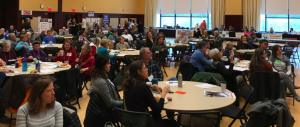
First, the question for citizens is “What we should do?” — where “we” means a concrete group of people like the folks convened in a room in Eau Claire on Sunday.
The hard part is to avoid a shift into “What should be done?” or “How should things be?” Those questions evade responsibility. They are also excessively easy. Carbon should be taxed; Trump should resign. Those points may be correct but they don’t tell us what we should do.

Second, any functioning political group, network, or movement should combine deliberation, collaboration, and civic relationships. Deliberation means discussing what to do in diverse groups. That makes us wiser. Collaboration means actually getting work done together, coordinating voluntary action. And civic relationships are the reasons that people participate.
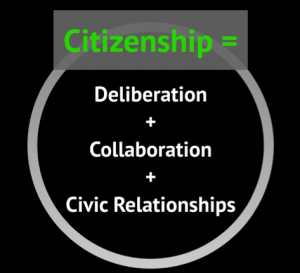
That framework is central to my book We Are the Ones We Have Been Waiting For, which I wrote while Barack Obama was president. I have considered whether this framework is obsolete when a man who threatens the republic occupies the White House. I still believe it applies. For one thing, people learn to value deliberative and collaborative styles of leadership by participating personally in decent groups. When only 28 percent of Americans report belonging to any group that is inclusive and accountable, no wonder many tolerate Trump’s style of leadership. Besides, every large-scale social movement, no matter how adversarial, needs deliberation, collaboration, and civic relationships to move forward. These are scarce but renewable sources of power.

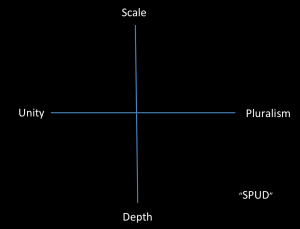
Third, try to maximize four goods that are often in tension. “Scale” means involving a lot of people. You can’t win without numbers. “Depth” means transforming people, building their skills, confidence, wisdom, and leadership. That’s necessary because we must all grow to be effective. “Pluralism” means encompassing a diversity of ideas and identities. Groups that fail to be pluralist get stupid and are unable to appeal to outsiders. “Unity” means coming together for one cause. Together they spell “SPUD,” which is a handy acronym. The challenge is that Depth trades off against Scale, and Pluralism against Unity. But the best movements achieve a bit of all four.
Fourth, work at several levels of power. The discussion of  “faces” or “levels” of power goes back at least to Stephen Lukes and John Gaventa in the 1970s; I borrow from the recent version by Archon Fung. The basic idea is that you can challenge a particular wrong, or a rule or policy, or who makes the rules and policies, or what’s on the public’s agenda. For instance, you could help an individual vote, change voting laws, change who makes the voting laws (e.g., who draws district boundaries), or change how the public thinks about voting.
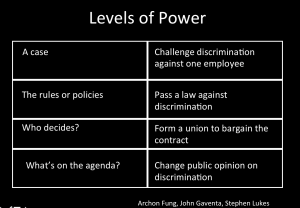
I venture the generalization that right-wing leaders are much better than the left at the third level of power. For example, Wisconsin Governor Scott Walker has relentlessly attacked public sector unions (except police) so that union leaders can’t help determine policies; and he has passed restrictive voters to change who participates in elections. The left is better at the first and second levels of power, but those levels have limits.

Finally, I reposted my “How to Respond?” chart, which I first released on this blog a couple of days after the November election. (Click to expand it.) It offers a set of strategies for activists in the current moment.
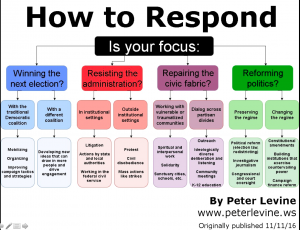
You can do more than one of these things. Probably some people should be doing each of them. But the eight options in the bottom row are too many for any one person or group to undertake, and they are in some tension. It’s hard for a group devoted to winning the 2018 election also to convene ideologically diverse conversations to bridge the gap between right and left. So most of us need to choose.

Note that I didn’t write, “How to respond to Trump’s victory.” This diagram doesn’t pretend to be nonpartisan or politically neutral. It offers options like winning the next election with a Democratic coalition and resisting the administration. But it is meant to be somewhat open-ended and subject to various interpretations. Genuine conservatives might take it to mean, “How to take our party back from a big-government chauvinist.” And leftists might interpret is as “How to respond to three centuries of injustice, in which Democrats are complicit.” As always, a plurality of views is an asset.

One way to use these tools might be to brainstorm concrete actions and then ask which cells in the last table you are filling, which levels of power you are addressing, how you are doing in SPUD, and whether you have deliberated and collaborated well. This process will not generate The Right Answer but it may help inform your strategies.

Building Civic Capacity in an Era of Democratic Crisis by Hollie Russon-Gilman and K. Sabeel Rahman

About $3 billion was contributed to influence 2016 federal campaigns. In a new paper entitled “Building Civic Capacity in an Era of Democratic Crisis,” Hollie Russon-Gilman and K. Sabeel Rahman suggest a much better way to spend some of that money.

I realize, by the way, that political donors want candidates to notice their support. It would nevertheless make all the difference if they gave one percent of their $3 billion to activities that strengthen democracy–compensating for irradiating the body politic with polarizing and demoralizing messages. Progressive donors would also build the base for more progressive policy by investing for the longer term.

Russon-Gilman and Rahman argue “that today’s populist moment emphasizes the need to create a genuinely responsive, participatory form of democratic politics in which communities are empowered, rather than alienated.” They advocate investments that “self-consciously strive to build constituencies and identities that are more inclusive and accommodating. Think of this as ‘us’ populism, as opposed to ‘them’ populism.”

That basic stance supports two strategies:

  1. More investment in community organizing, especially the types that build “new bridges across racial, gender, and geographic divides.” Russon-Gilman and Rahman advocate broad-based, long-term organizing instead of mobilizing people around specific issues.
  2. “Reforming our institutions of governance” so that agencies offer citizens more “hooks and levers” to influence power, and so that public sector workers have skills and incentives to engage the public better.

These strategies imply (as the authors note) a broad understanding of democracy. It is not all about elections, nor even about the official government. It’s about how people come together and exercise power.

The paper offers valuable case studies. For instance, under the heading of organizing:

  • “The Center for Rural Strategies (CRS) … based in Whitesburg, Ky. in the central Appalachian coalfields, provides rural communities and nonprofit organizations with resources on innovative media and communications strategies in order to strengthen their work.” CRS provides information, challenges stereotypes about its communities, and lobbies for better access to the physical infrastructure for communications, because both content and conduit matter. (See “Building Democracy in ‘Trump Country’” by Ben Fink for a similar case.)
  • “Coworker.org (Coworker) is a digital platform for workers’ voices founded in response to the decline of formal institutions organizing workers and geared towards building a twenty-first century model of worker power. The organization provides tools directly to workers to self-advocate within the workplace, usually where no labor structure or organizing already exists.” Like CRS, Coworker invests in people who develop as leaders.

Examples under the heading of institutions include:

  • “The Office of Community Wealth Building (OCWB) was established as a permanent city agency in Richmond, Va., in 2015 to provide anti-poverty strategy and policy advice to the mayor and to implement municipal poverty reduction initiatives and systemic changes around housing, education, and economic development.”
  • “The Public Engagement Unit (PEU) is a division in New York’s city government started in 2015 [is] devoted to knocking on doors and making calls to hard-to-reach constituents to enroll them in city services, as well as foster long-term individual relationships with city staff.”

Overall, “Building Civic Capacity in an Era of Democratic Crisis” helps make the case for investments that are less short-term, less oriented to immediate efficiency, less split between government and civil society, but more experimental, more open-ended, and more truly inclusive than we normally see (especially, I would say, on the left).

See also: why the white working class must organizeto beat Trump, invest in organizingfighting Trump’s populism with pluralist populism; and community organizing between Athens and Jerusalem.

the power of the NRA in an age of civic deserts

I can’t recommend too strongly Hahrie Han’s New York Times piece entitled “Want Gun Control? Learn From the N.R.A.” Her argument is important not only for gun-control advocates but for everyone who has a political cause in 21st century America.

Han notes that the NRA does not win because it deploys more money than its opponents do. Funding is substantial on both sides of the issue. I would add that most political scientists doubt that money has much influence on high-salience legislative battles.

Rather, the NRA has “built something that gun-control advocates lack: an organized base of grass-roots power.” Han identifies three characteristics of the NRA that I believe have always been the main ingredients of vibrant civil society in America:

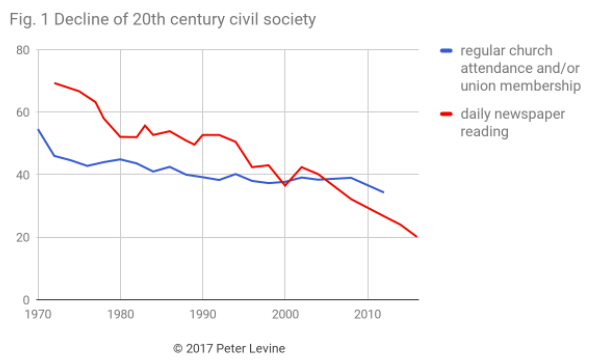
  1. Through gun clubs and gun shops, the NRA offers a wide range of activities and benefits, not merely opportunities to express one’s opinion on a policy issue. In that sense, the NRA is like the traditional bulwarks of 20th-century civil society: religious communities, unions, grassroots political party organizations, and metropolitan daily newspapers. All offered packages of non-political benefits (worship services, employment contracts, social opportunities, comics and box scores) while also steering their members into politics.
  2. The NRA recruits people who do not necessarily agree with its positions but brings them into a community that has strong norms and cultural resonances. Belonging then changes people’s opinions about issues. Again, this was true of religious denominations, unions, 20th-century parties, and newspapers.
  3. The NRA may be centrally run, but it offers lots of opportunities for leadership at the local level.

In contrast, most gun-control groups draw people who already agree about their issue. We join because we want to regulate guns, and only for that reason. Our relationship with the organization is transactional. They ask us to send them money or contact members of Congress, and we take these actions as individuals. Han recalls:

When I joined gun-control groups, I got messages about narrowly defined issues like background checks and safety locks. These messages were a pollster’s dream, tested down to the comma to maximize the likelihood that I would donate or take action. But they never challenged me to rethink who I was or what my relationship to my community was.

A community of people organized around a whole way of life and capable of developing relationships and leadership–that is a fearsome force in politics. A list of people who already vote in a given way and agree to send money or make phone calls–not so much.

One result is that the NRA beats the gun-control groups. The other is that many people lack opportunities to become effective and well-networked citizens because they don’t see organizations around them that offer any opportunities for belonging. They perceive their communities as what my colleagues Kei Kawashima-Ginsberg and Felicia Sullivan named “civic deserts.” (The analogy is to food deserts: places where nutritious food is not for sale.) In an era of civic deserts, a robust membership group like the NRA has awesome power. If you admire their structure but despise their lobbying agenda, then the solution must be to build alternative structures.

See also:  Civic Deserts and our present crisisthe Hollowing Out of US Democracy; we need SPUD (scale, pluralism, unity, depth). And see this new article by CIRCLE: Mitigating the Negative Consequences of Living in Civic Deserts – What Digital Media Can (and have yet to) Do