Category Archives: revitalizing the left

disadvantaged youth most likely to credit the rich for their own success

My friend Connie Flanagan reports on her study of 600 US adolescents:

It was adolescents in the least privileged circumstances (whose parents had lower levels of education, whose schools were located in low-income communities, and whose classmates reported few discussions of current events at home) who were more likely to admire the wealthy for making it and contend that people were poor because they lacked motivation or hadn’t applied themselves in school. In fact, the connection between working hard in school and succeeding in life was palpable [for poor kids, whereas privileged students were more likely to cite structural inequalities.]

This is a deeply important fact about the US, one that helps explain the weakness of economic populism. We just had an election in which the Democrats won the segment of voters with postgraduate degrees and the Republicans won the people whose educations stopped at high school–the working class. Connie proposes that more advantaged kids may have more “opportunities to learn about society,” for instance, in more demanding social studies classes or through media. She also thinks that

It may be easier to attend to the structural roots of inequality from a position of advantage since one’s own group is less likely to suffer the consequences of an unequal system. In other words, the freedom to criticize the system reflects, in part, the safety net of privilege.

In contrast, for those youth who remain in schools where half of their classmates will drop out, an ardent commitment to self-reliance and a belief in the efficacy of individual effort may keep them going. The imperative of self-reliance and the lack of safety nets also seem to be messages that they hear at home: it was youth in the least privileged families who were most likely to report that their parents admonished them that they should work twice as hard as others if they wanted to get a job; that people have to create their own opportunities since nobody hands them to you; that they couldn’t blame others for their problems; and that if they didn’t succeed in life, they would have only themselves to blame.

Jonathan Gruber and progressive arrogance

(Westfield, MA) Progressives must denounce this statement by Jonathan Gruber in no uncertain terms:

This bill was written in a tortured way to make sure the CBO [Congressional Budget Office] did not score the mandate as taxes. If CBO scored the mandate as taxes, the bill dies. So it’s written to do that.

In terms of risk-rated subsidies, in a law that said health people are gonna pay in — if it made explicit that healthy people are gonna pay in, sick people get money, it would not have passed. Okay — just like the … people — transperen— lack of transparency is a huge political advantage. And basically, call it the stupidity of the American voter or whatever, but basically that was really, really critical to get anything to pass.

I see partial defenses from the likes of Jonathan Chait, Kevin Drum, and Sarah Kliff, but they won’t do. Calling the American people “stupid” in this context is unjust and deeply damaging. It reflects a subsidiary stream of progressive politics but a real one. When your political movement harbors discreditable views, you must denounce them or you will be associated with them. Michael Kinsley once defined a gaffe as “when a politician tells the truth – some obvious truth he isn’t supposed to say.” We can’t let this be a gaffe for the whole progressive movement, whatever Dr. Gruber may privately believe.

The Affordable Health Care Act is fine public policy: see the New York Times’ roundup of its positive effects. It could not pass our deeply flawed political system in the face of determined opposition without the kinds of tortured moves Gruber is describing. It is a good thing that it did pass. And it should be more popular than it is.

On the other hand, it is pretty unpopular, and that is because Americans are deeply distrustful of the government as a solution to their problems. Three reasons for their distrust are reasonable: 1) The legislative process is indeed deeply messed up, as Gruber says—but that raises questions about whether government can work for the people. 2) The sheer competence and capacity of the executive branch is questionable, witness the rollout of the ACA. And 3) progressive reformers sometimes harbor arrogant and dismissive views about most Americans. Many do not, but I have personally heard comments about the stupidity of the American voter. I think those sentiments convey to the people they describe, who are then not so keen about handing over money and power.

More broadly, I have argued that the worthy core of conservatism is humility. Actual conservatives honor that principle inconsistently, at best. But it is a valid principle, and the corresponding evil of progressivism is arrogance. I am still a progressive because I believe we can combat arrogance and do some good. But when we see it plainly, we must denounce it.

what do the Democrats offer the working class?


According to the Exit Polls, 64% of white people without college educations, and also 64% of white men, voted Republican in this year’s House races. The Democrats performed better among white college graduates and much better among people of color. This is why so many progressives are fretting about the Republicans’ hold on the white working class.

Considering the 40-point difference in party choice between working-class white people and working-class people of color, race is obviously relevant. A partial explanation of the election results may be racial antipathy toward the president and toward government, seen as biased in favor of “minorities.”

Further, enormous amounts of money and effort have been spent to delegitimize government–to persuade citizens that it can do nothing good–whereas in fact programs like Medicare are strikingly efficient and beneficial.

But neither comes close to a complete explanation. The deeper problem (as authors like Harold Meyerson and Dean Baker argue), is that Democrats do not offer solutions to the actual problems of the working class. They have something to say to workers who face discrimination on the basis of race or gender: hence their stronger performance among women and people of color. They also favor somewhat stronger welfare policies and, indeed, won voters with family incomes below $30,000 by 20 points. But when it comes to the economic concerns of the working class, they’ve got nothing.

It used to be the case that a person without a college degree could find secure, remunerative, valued, and valuable work in a farm or a factory. But agricultural and manufacturing jobs have been disappearing–not cyclically in recessions but gradually and inexorably:

Those trends would be fine if former factory workers and farmers were now employed in secure, interesting, and well-paid service jobs, but we all know that is not the case, and the decline in real family incomes shows what has really happened:
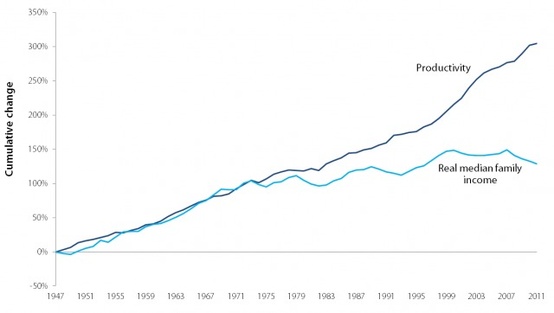
Baker says, “There is no shortage of policies that the Democrats could be pushing which would help ordinary workers.” Maybe, but I see difficulties–not only with the policies but also with their political impact.

Keynesian macroeconomic policy would help in recessions (and we didn’t get much of it in 2008-10 because states cut their budgets), but expansionary fiscal and monetary policy cannot stop or reverse long-term de-industrialization. Baker writes, “No one in either party has any proposal that will make more than a marginal difference in the productivity of the U.S. economy any time in the near future.”

Better education (if we knew how to deliver it) would prepare the next generation for a competitive, global, post-industrial labor market, but it would offer nothing to today’s 50-year-old.

Taxing and spending does no good unless the spending buys something that benefits that 50-year-old, and what he wants is a sense of economic contribution and importance. Being on the receiving end of a social problem cannot address that need. I would defend smart welfare programs against critics who think they inevitably create “dependency.” If you are in poverty, money can help you. But if you are stuck in an unsatisfactory job, welfare is not what you want. On the contrary, the government takes at least some of your income and spends it on other people. Government doesn’t look like a real or potential solution to your problems.

Reporting from Maryland, Alec MacGillis writes, “The voters I spoke with all said their own economic situations were basically stable and better than they were a few years ago, but they nonetheless felt as if the state of affairs was not where it should be. Eline, the university pest-control worker, has a secure job and is close to retiring, but as someone whose ancestors worked at the shuttered Sparrows Point steel plant, he worries about the decline of industry in Maryland, and sees [Republican candidate Larry] Hogan as more likely to do something to address that.” [As I note in We are the Ones, Sparrow Point used to employ 30,000 men.]

In years with higher turnout, the Democrats are bailed out by groups such as environmentalists, secular social libertarians, and people who may need protection against discrimination. In 2012, Obama won 76% of voters who described themselves as gay, 55% of people with postgraduate educations, and 96% of Black women (for example). But he lost 61% of whites between the ages of 45 and 64, and 53% of adults who had only high school diplomas. When turnout fell in 2o14, Democrats were left high and dry.

Bill Clinton did somewhat better among working-class whites, but we were then 20 years earlier in the process of deindustrialization to which Democrats (including Clinton) have had no serious response. In 1996, a Democratic administration could still get away with delivering fairly decent macroeconomic performance. It’s too late for that now.

I’m certainly not suggesting that we give up on using policy to assist working people of all races. Assisting them is a question of justice as well as political expediency. But it won’t be easy, and we’re not seeing anything plausible yet. As Meyerson writes,

But the Democrats’ failure isn’t just the result of Republican negativity. It’s also intellectual and ideological. What, besides raising the minimum wage, do the Democrats propose to do about the shift in income from wages to profits, from labor to capital, from the 99 percent to the 1 percent? How do they deliver for an embattled middle class in a globalized, de-unionized, far-from-full-employment economy, where workers have lost the power they once wielded to ensure a more equitable distribution of income and wealth? What Democrat, besides Elizabeth Warren, campaigned this year to diminish the sway of the banks? Who proposed policies that would give workers the power to win more stable employment and higher incomes, not just at the level of the minimum wage but across the economic spectrum?

the left has become Burkean

David Brooks makes a point today that is one of my hobby-horses:

[Edmund] Burke is known as the founder of conservatism, but his thought sits oddly these days with the Republican Party and those who call themselves conservative. The party has become much more populist, supporting term limits and political outsiders over those who have been educated by experience. Most call for pretty radical change to the welfare state. It’s the Democrats who fight to preserve the current structures of Social Security, Medicare and food stamps. It’s the Democrats who have been running ads through this election campaign accusing their opponents of being a bunch of wild-eyed radicals. Are Democrats now the conservators of tradition?

I would say: yes. And I would say the same of the European left and even of grassroots movements that view themselves as to the left of the Democratic Party in the US. I’ve argued that America’s most authentic conservative movement is composed of grassroots groups that emphasize community voice, localism, and sustainability. A characteristic leftist stance today is that a given institution (such as the public schools, higher ed, welfare programs, or public employees’ unions) fails to meet criteria of justice, yet we should defend the institution because it’s better than an untested alternative and because we should respect the experience and commitment of the participants (i.e., the teachers, professors, public employees, and their clients). The most ambitious leftist proposals are mostly patches to keep these existing institutions going, not whole new strategies. Therefore, I’ve posited that Edmund Burke would vote Democratic.

To the extent that other people make this argument, it’s often to score a debating point–either to denounce the left for abandoning its radicalism or to tweak conservatives for failing to recognize that their opponents are now more genuinely conservative than they are. For instance, Andrew Sullivan uses the premise that Democrats are conservative to endorse Obama and denounce both neoconservativism and what he calls “progressivism.”* But I intend this point as an analysis, not a polemic. If the left is the true home of conservatism today, that raises some important questions, but it is not necessarily good or bad.

*Sullivan: “As for our time, an attachment to a fixed ideology called conservatism (which is currently suffused with the zeal and passion Montaigne so deeply suspected) or to an ideology called progressivism (which increasingly regards most of its opponents as mere bigots) does not exhaust the possibilities. A disposition for moderation and pragmatism, for the long view over the short-term victory, for maintaining the balance in American life in a polarized time: this remains a live option. You can see how, influenced by this mindset, I have had little difficulty supporting a Democratic president as the most conservative figure, properly speaking, now on the national stage. You can see why I have become so hostile to neoconservatism whose unofficial motto is ‘Toujours l’audace!'”

the Left between Obama and Hillary Clinton

Let’s define “the Left” as thinkers and organizational leaders who are open to voting for Democratic candidates but generally critical of the party, holding more radical policy objectives than elected Democrats do.

The Left has had plenty of reason to criticize the Obama Administration: the president does not fully share its the goals and priorities. I have tended to defend the administration, both because my objectives are closer to the President’s and also because I think he has consistently accomplished more than they have given him credit for. I detect a tendency to overestimate the importance of presidential rhetoric (Obama’s being relatively moderate) while overlooking concrete and tangible victories for poor people. (See, e.g., “Obama Cares. Look at the Numbers” by But the president and his appointees have also at times given unnecessary offense to the Left; and the Left is entitled to be critical of an administration that is not actually Leftist.

Now the Obama Administration has just two years to run, and the overwhelming favorite to lead the Democratic Party is Hillary Clinton. She is her own person and should not be automatically equated with her husband. But I believe that both the Clinton presidency and Hillary Clinton’s own record in the Senate and the State Department suggest that she would stand at least somewhat to the right of Barack Obama. I have therefore always found Clinton nostalgia among members of the Left very strange and discomfiting. You can criticize the current president from the Left, but it seems completely mistaken to prefer his Democratic predecessors, Bill Clinton and Jimmy Carter.

Opinion is beginning to shift. For instance, from 2009 until a few months ago, Paul Krugman was generally a strong critic of the president. I yield to Krugman on all economic matters but argued (e.g., in the Huffington Post, 2010) that his political analysis was off. In any case, it interests me he seems to have revised his estimation. For instance,

One explanation may simply be that more data is in. It was unclear ca. 2010–and seemed unlikely–that the Obama Administration was advancing progressive policy goals, but now we can see that progress was made. In that case, Paul Krugman’s change of tone is the result of having more information.

Meanwhile, we are beginning to see signs that Hillary Clinton will tangle with the Left. According to the Amy Chozick in the New York Times, “Without discussing her 2016 plans, she has talked to friends and donors in business about how to tackle income inequality without alienating businesses or castigating the wealthy. That message would likely be less populist and more pro-growth, less about inversions and more about corporate tax reform, less about raising the minimum wage and more long-term job creation, said two people with firsthand knowledge of the discussions.”

Months ago, Ben White wrote in Politico:

“The darkest secret in the big money world of the Republican coastal elite is that the most palatable alternative to a nominee such as Sen. Ted Cruz of Texas or Sen. Rand Paul of Kentucky would be Clinton, a familiar face on Wall Street following her tenure as a New York senator with relatively moderate views on taxation and financial regulation.  … ‘If it turns out to be Jeb versus Hillary we would love that and either outcome would be fine,’ one top Republican-leaning Wall Street lawyer said over lunch in midtown Manhattan last week. ‘We could live with either one. Jeb versus Joe Biden would also be fine. It’s Rand Paul or Ted Cruz versus someone like Elizabeth Warren that would be everybody’s worst nightmare.’ … Most top GOP fundraisers and donors on Wall Street won’t say this kind of thing on the record for fear of heavy blowback from party officials, as well as supporters of Cruz and Rand Paul. Few want to acknowledge publicly that the Democratic front-runner fills them with less dread than some Republican 2016 hopefuls.  …

And the Left is beginning to get openly restive. According to Alexandra Jaffe in The Hill,  “'[A] Clinton presidency undos [sic] all our progress and returns the financial interests to even more prominence than they currently have,’ Melissa Byrne, an activist with the Occupy Wall Street movement, said in a November 2013 email.” The same article quotes the political consultant Mike Lux, who says, “I also came to know how close she was to the pro-Wall Street forces inside the administration and out, and the downsides on foreign policy are all very real. So I will hesitate for a long time before jumping into her campaign.”

How will the Left respond to the Clinton campaign, especially considering that she is very popular among voters who consider themselves progressive and is the first woman to have a serious shot at the presidency? How will the Left manage if four years of a conservative Democrat follow eight years of a moderate Democrat? And how will the Left describe and use the legacy of Barack Obama in years to come?

I am not interested in these questions because of the potential impact on two individuals, Hillary Clinton and Barack Obama. I am concerned about the condition of the Left as a countervailing force in American politics. The near future will be a difficult time.