Category Archives: education policy

the growing distance between people and schools

(Washington, DC) Liberals are often dismissive of local control in education. For example, in the current New York Review of Books, Christopher Benfey remarks on Mitt “Romney’s obligatory kowtowing to local and parental control of school systems (meaning, presumably, more school prayer and less evolution) …”*

Local control may mean more prayer and less evolution–in some districts–but it may also increase people’s stake in public education.
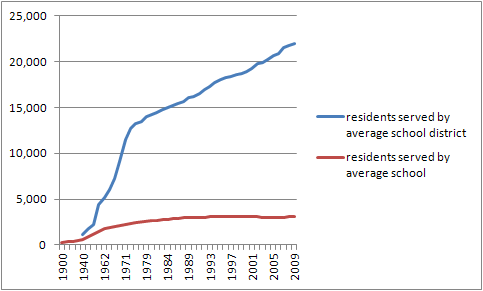
In 1940, each school district in the United States served only 1,117 people, and usually the district had an elected board. Today the average school board serves almost 20 times as many residents, and often it has an appointed leader. Meanwhile, the number of residents served by each school has grown tenfold since 1900. While these trends have unfolded–as the deliberate result of consolidation, undertaken in the name of efficiency–standardized testing has become more important, and state and federal mandates have proliferated. As a result, fewer people are involved in local school governance, which has become less consequential.

To be sure, districts can be too small for efficiency. And many of the important state–and especially federal–mandates have been enacted to protect vulnerable minorities and have had positive effects.

However, if it is true that people want accountability that is relational rather than informational, then Americans are going to perceive schools as less accountable the bigger the districts get. And they are not likely to fund or otherwise trust schools that they consider unaccountable.

This would be not be an essential problem if people generally trusted government and were involved in public life in other ways, such as on juries. But the trends of distrust and disengagement are evident across the government.

*In the same issue of the NYRB, Michael Greenberg interviews an Occupy Wall Street participant who extolls “direct democracy,” saying, “as you can see for yourself [it] works beautifully here on the whole.” Greenberg “mention[s] Proposition 8 in California, an instance of direct democracy that overturned a state supreme court ruling that had legalized same sex marriage.” Apparently, local control implies creationism, and direct democracy means overturning gay marriage. So much for democratic vistas.
species of educational reformer

(Washington, DC). Whom have I forgotten or mischaracterized?

The Testing Liberal: Argues that we have failed to educate our least advantaged children because we haven’t believed they can succeed, haven’t cared about them, and haven’t dedicated valuable resources–such as the best teachers–to them. Wants to monitor every child’s progress with standardized tests and respond rapidly to signs of failure.

The Crunchy Liberal: Believes that the most important and effective aspects of education include play, the arts, service, and open discussion. These cannot be measured and are being lost because of testing pressures. May or may not see small schools and charter schools as helpful.

The Social Context Liberal: Presumes that schools have only a small impact on educational outcomes. More important are external factors, ranging from nutrition and racism to crime and parenting styles. May want to devote much more money to schools serving poor children to compensate for their social contexts. May also want to defend the performance of schools as they are.

The Resource Equalizer: Like the Social Context Liberal, primarily concerned that we don’t spend enough money on the children who need it most. May be primarily concerned with funding formulas and mechanisms.

The Modernizer: Cannot believe that we still educate kids in classrooms with fraying textbooks and black- (or white-) boards. Wants everyone playing digital games and creating digital media, possibly from home instead of school. Some in this group are less interested in technology than in teaching 21st century skills or applying recent research on brain science to improve pedagogy.

The Efficiency-through-Consistency Maven: Cannot believe that 98,706 schools, 14,841 school districts, and 50 states are all separately developing curricula, lesson plans, professional development programs, manuals, and reading lists. Sees the potential for huge economies of scale and improvements in quality if teaching is standardized.

The School Choice Libertarian: Favors either charter schools or vouchers to break monopolies seen as inefficient, corrupt, static, and unresponsive to families–especially poor families. Some in this group are more concerned about the education schools’ monopoly on teacher certification than the schools’ monopoly on kids.

The Traditionalist: Admires and would like to return to the neighborhood school of 50 years ago, with prayer, corporal punishment, and high respect for teachers. Is more concerned about perceived declines in mores than about preparation for the 21st century labor market.

The Teacher Organizer: Believes that teachers have been downtrodden by most of the other reformers and wants to empower them collectively to reform schools or systems from the bottom up. May or may not see the teachers’ unions as helpful agents.

The Community Organizer: Emphasizes the importance of social capital, parental engagement, and cooperation between schools and neighborhood associations–including religious congregations. Wants to get the community involved in educating kids, and may distrust external forces (such as markets, state and federal mandates, and textbook companies). Should be concerned that we have only 14,000 school districts, sharply down from 119,001 districts in 1937, when the country was much smaller–because that is a sign of consolidation.

the public wants us to teach facts, not skills of citizenship

A perfect citizen would know an enormous range of facts, concepts, and skills, from macroeconomics to how to chair a meeting, from the contents of the Federalist Papers to the principles of statistics. (See my list in this HuffingtonPost article.) In practice, schools must decide what is most important to teach in the limited hours available to them. I value facts about politics and government and related academic concepts, but my highest priority would be the arts and habits of association that De Tocqueville thought were the basis of successful democracy in America. Unless citizens can successfully manage projects and groups, we are left to the mercies of the state and market. Further, by co-managing our own associations, we develop reasonable ideas about how to address larger public issues.

I find good news and bad news in a new American Enterprise Institute report entitled Contested Curriculum: How Teachers and Citizens View Civics Education. Good news: teachers, especially in public schools, generally share my goals and priorities. Bad news: American citizens do not.

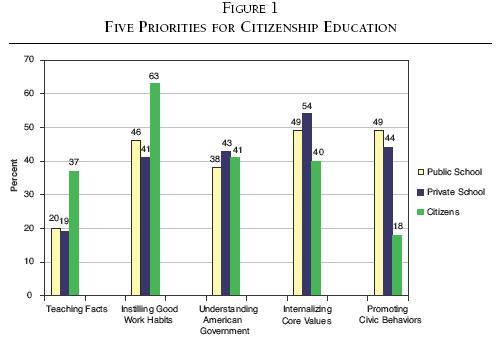
In the following graph, snipped from that report, “Public School” means the opinions of social studies teachers in public schools. “Private School” refers to social studies teachers in private schools. “Citizens” means a representative sample of 1,000 adult Americans. The bars bear simplified labels. For example, “Teaching facts” is short for: “It is absolutely essential [for students] to know facts (e.g., the location of the 50 states) and dates (e.g., Pearl Harbor).”

Look at the last cluster of columns, showing that while teachers think it is important to promote civic behaviors, citizens do not.

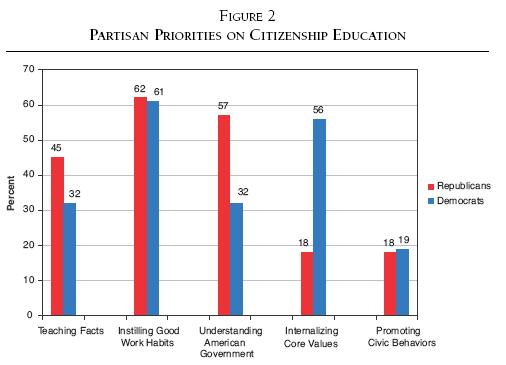
That first graph reveals one political obstacle for people who share my priorities: we are in the minority. Another–equally familiar–problem is the partisan split. Basically, Republicans are considerably more supportive of facts and academic concepts than Democrats are. But Democrats are more sympathetic to values. For instance, teaching students “To be tolerant of people and groups who are different from themselves” (one component of the bar shown below as “Internalizing core values”) seems “absolutely essential” to 31% of Republicans and 69% of Democrats.

Standards (official guidelines for what should be taught) tend to include all of the above priorities. That is the path of least resistance for policymakers: just add everything to the list. But the emphasis in classrooms is not determined by standards; it is much more shaped by tests. To the extent that states require tests of civics, almost all the content involves facts and academic principles.

In short, citizens, and especially Republican citizens, are getting an educational policy closer to what they want than to what teachers (and I) would prefer.

the movement to badges in education, and what it means for democracy

The idea of giving badges to people who can demonstrate specific skills is taking off rapidly.  A “badge” is shorthand for a portable credential, rather like the merit badges traditionally used in Scouting. (See the Boy Scouts’ badge for backpacking as an example.) In the modern, adult world we could have badges for being able to schedule meetings of more than four people, being able to write an effective op-ed piece, or being able to set up a social network.

Mozilla (which builds Firefox and other prominent software tools), the MacArthur Foundation, and Peer 2 Peer University have launched an explicit “badges” project. Meanwhile, the US. Commerce Department is leading a federal effort to promote digital literacy that may, I am told, soon generate recognized credentials that are similar to badges.

As the old song says, “This could be the start of something big.” We are used to credentials that come only with the completion of whole courses of study. For instance, a high school diploma signifies that you have successfully completed four years of high-school-level courses (or the equivalent). That system creates dilemmas:

  • You can obtain the credential without necessarily knowing anything relevant or useful: it can just measure years spent in the institution. Or …
  • Its value can be more “objectively” measured by means of some kind of high-stakes test, such as an exam that is required for graduation. But heavy use of tests encourages test-prep instead of real education. Also …
  • If we want to know whether a prospective employee or student can do something specific (such as participate effectively in a meeting), the available standardized test scores may be of no use.
  • Many people fail to obtain general credentials. About a third of our young people reach age 19 without a high school diploma. A substantial majority reach age 25 without a bachelors degree. Yet many possess particular skills that would have market value if they were recognizable.
  • You can develop valuable concrete skills in school or on the job and (if the institution works well) can be recognized for your skills while there. But no one in a different school or job will know what skills you have: they aren’t portable. Recommendation letters are devices for transmitting information about skills, but they are highly imperfect.

Hence the idea of defining specific skills and providing portable credentials to people who can demonstrate them. The main advantages are solutions to the dilemmas noted above, i.e., better measurement, better incentives for learning, more portability, and less waste of skills that people already have.

But there’s also a practical opening here for anyone who thinks we haven’t been teaching the right things. I, for example, believe that we haven’t been teaching the skills and arts of association–of group-membership and collective action–that de Tocqueville saw as the foundation of democracy in America. We can advocate for those skills to be included in our curriculum requirements or standardized tests, but all the above-mentioned dilemmas stand in the way. Instead, I am tempted to jump on the “badges” bandwagon and advocate for civic badges (at all levels).

This is a supply-side strategy: trying to increase the number of people who have civic skills by providing relevant credentials. We could also pursue a demand-side strategy: persuading admissions offices and employers to seek individuals who possess specific badges. For example, the federal government will need to find 91,000 new employees each year for jobs defined as “mission-critical.” Imagine if they sought employees who had civic badges, like interviewing fellow citizen to determine their values and needs; or moderating public meetings. Advertising a need for those badges would have a powerful effect on curriculum.

By the way, I am very far from believing that the only objective of education is a set of concrete skills to which we can award badges. A liberal education is supposed to result in a coherent mentality that encompasses a sensitive appreciation of a wide variety of perspectives, moral grounding, aesthetic appreciation, and analytical rigor. But that is the outcome that a diploma ought to signify. By reserving badges for more concrete attainments, perhaps we can restore the appropriate meaning to degrees.

working-class people versus elites on education

(Dayton, OH) I have been listening to preliminary qualitative research: focus groups of working class adults from several communities (almost all people of color). Asked to discuss “youth,” they identify behavioral problems: violence, crime, lack of respect for adults and for themselves. Asked to propose solutions, they cite family and community, not schools or government. When one of the researchers explicitly asked them about the government, the respondents (in this case, African Americans between 18 and 25) uniformly said that the government was irrelevant. Finally, despite some economic anxiety, many said they were optimistic that young people would have good economic futures because they are savvy about technology.

Meanwhile, there is a whole official debate about youth that focuses on schools (which are government-run or government-funded institutions) and their graduates’ inadequate preparation for economic competition. This is the expert or elite discourse of tests, standards, teacher quality, “the achievement gap,” charters, vouchers, and unions.

A hypothesis: It is bad for progressive politics that core Democratic constituencies do not see the government as the solution to the problems that matter most to them. And the reason they don’t see the government as a solution is that the government has defined a different set of problems from the ones that concern them. That doesn’t mean that working people are right and elites are wrong; but the gap creates a serious problem for both.