Category Archives: deliberation

civility, humility, tolerance, empathy, or what?

It sounds like a parody of a professor’s life, but I have actually attended conferences since 2016 on the themes of: 1) empathy and compassion, 2) civility, 3) responsiveness, and 4) tolerance. I missed an excellent-looking meeting on 5) humility and conviction, but I teach those concepts in classes on Gandhi’s political thought. Nobody has invited me to a meeting about 6) openness or 7) fallibalism, but I would consider attending.

In case you’re wondering, the participants in these meetings have been delightfully humble, empathetic, civil, and so on. It doesn’t mean we were right.

The question is: which intellectual virtues should we develop in ourselves and in others in various settings? This is not a matter of rules or controls. In many settings, people have–and should have–rights to talk and respond to others as they wish. It’s more a matter of what we should strive for, ourselves, and sometimes how we should assess others. For example, if I’m a high school teacher who assigns students to discuss a contentious issue, on what basis should I assess their interactions?

The full list of criteria would also include 8) truth and 9) justice. For instance, you can make a claim that is admirably civil, empathetic, and responsive, yet demonstrably false. That is not generally desirable. Or perhaps you could engage in an admirable way with other people while making claims that are simply unjust. You could be an avuncular and gracious Nazi. Unless we adopt a completely procedural understanding of justice (it just is what people decide that it is, by discussing), there can be a gap between a good discussion and a just outcome.

But the first seven criteria seem important even if we leave truth and justice aside for the moment. First, it matters how our discussions go because it’s one way that we explore truth and justice. Second, we should simply relate to each other well. By conversing, we form or sustain a community and share a social space. So the quality of discourse affects the quality of the commons.

So which of the first seven are virtues, for whom, and in which combinations?

  1. Empathy is an affective reaction that can distort our judgment (for instance, by focusing us too much on a concrete case) and that can be unwelcome or unhelpful. If you’re a victim of racial injustice, you don’t want me, a white guy, to say that I feel your pain–or even to try to feel it. You want me to keep a clear head and do something about it.
  2. Civility is sometimes defined in terms of rules and norms of politeness. For instance, to use an offensive word or to yell at another person is uncivil. Politeness actually has value in many circumstances, but civility-as-politeness doesn’t seem to be the core issue. You can say horrible things with polite words, or valuable things laced with profanity. As Tony Laden notes in his contribution to A Crisis of Civility?: Political Discourse and Its Discontent, there is a different scholarly literature in which civility means not politeness but “a form of engagement in a shared political activity characterized by a certain kind of openness and a disposition to cooperate.” That seems the right direction but not easy to assess in practice. It takes us to …
  3. Responsiveness. We all have a valid interest in others’ being responsive to us. It seems to be a virtue. But … should you respond positively to a heinous new idea? Does being genuinely responsive entail shifting your views closer to the speaker’s? Or can you be responsive without changing your mind? If so, what does that entail?
  4. Tolerance is much better than intolerance, as a general rule. But it doesn’t seem sufficient. We don’t merely want to be tolerated, but also welcomed and listened to. At the same time, some ideas are intolerable. Tolerance doesn’t seem necessary or sufficient for good interactions.
  5. “Humility and conviction” is the name of a great program at UConn. This combination of words has the advantage of balance. We should be humble, because we can easily be wrong; but we should also take a stand. Humility alone is compatible with being wishy-washy. But conviction without humility is zealotry. This is (in the broadest sense) an Aristotelian way to think about virtues–as the mean between extremes. It raises the standard problem for Aristotelian accounts: What is the mean in each circumstance? Who should be more humble, and should should be less so?
  6. Openness is one of the Big Five personality traits. It seems desirable but needs some balance and moral direction. Otherwise, it shades into prurient curiosity or thrill-seeking. For example, openness correlates with use of illegal drugs. Although I am not an alarmist about drugs, a psychological trait that could either cause you to listen well to new ideas or experiment with ecstasy doesn’t seem to be reliably a virtue.
  7. Fallabilism means knowing that you could be wrong. “The spirit of liberty is the spirit which is not too sure that it is right; the spirit of liberty is the spirit which seeks to understand the minds of other men and women” (Learned Hand). We should all be fallibalists, but again the question is what this means in practice. For example, I know colleagues involved in Science and Technology Studies who are primarily concerned about the excessive authority of science and want to preserve skepticism about climate change. My own view is that we should declare anthropogenic global warming a settled issue and decide what to do about it. But that would be less fallibalist.

See also: Empathy and Justice; civility: not too much, not too little; what sustains free speech?; responsiveness as a virtue.
a civic approach to free speech

I argued in a recent post that libertarians, social democrats, American liberals, and most US Constitutional scholars share a sharp distinction between the state and the private sector–but this distinction does not reflect our actual experience of the social world.

One result is a certain way of thinking about freedoms of speech, the press, assembly, religion, and petition (the Five Freedoms of the First Amendment, which are also important rights in other democracies).

A typical first step is to identify which institutions are public or state bodies. They should be prevented from interfering with other people’s speech and assembly, and they should be constrained from expressing themselves in certain ways. For instance, the US government may not express support for any specific religion, although anyone else in the society may.

The next step is to safeguard the freedoms of non-public groups, including their freedom to discriminate and exclude. For instance, the Catholic Church is not required to ordain non-Catholics (or women) as priests. Such requirements would violate its freedom of assembly and religion.

Then we face two recurrent debates. One is whether various private associations (universities, web platforms) should act like states, even though perhaps they don’t have to under the Constitution. For instance, should a private university accord its students untrammeled freedom of speech? The other debate is whether hybrid institutions (state universities, political parties, public broadcasting services) are more state or private. Do they have First Amendment rights or must they safeguard others’ rights, or both?

The debate about the role of speech in our democracy thus centers on questions like comment-moderation, inviting or disinviting speakers, speech codes, hate speech–all of which have a legalistic flavor. The question is who has a right to say what, where.

If I actually had any influence, I would not seek to upset the apple cart of American constitutional thought. The categories that we have drawn (public/private, freedom/restriction) reflect some accumulated wisdom and offer some practical advantages. I would give a Burkean justification for how we employ the First Amendment: it is how we have learned to operate.

But the distinction between state and private sphere is at odds with the reality of how institutions work. They are almost all hybrids, partly public and partly private, exercising power but also allowing voice, including some and excluding others.

So what if we started instead with a population of people–individual human beings–who come together in a wide range of organizational forms to define, discuss, and address problems? I think these are the important points for them to consider in relation to freedom of speech:

  1. They need structured, reflective discussions that encompass a diversity of views and respond to good reasons or insights, not to power. They don’t need consensus, but they must continuously learn from others.
  2. Good discussions take institutional forms, from op-ed pages to seminars to town meetings. All institutions have rules, norms, resources, and incentives. Incentives are necessary because participation in a discussion has costs. It takes time and energy to discuss, and the conversation may cause discomfort. Individuals don’t have to participate. Successful institutions for communication or discussion find ways to lure people in. A classic example was the package of the local daily newspaper: comics and sports to encourage subscriptions, and a sober front page to direct your attention to serious matters. The demise of this business model is an important example of what we should worry about.
  3. Any good discussion is a common-pool resource. It requires voluntary contributions, it serves all who participate, but it is easy for individuals to ruin. There are principles for the management of fragile common-pool resources.
  4. On the list of principles you will not find a requirement to discuss all the rules and incentives all the time. On the contrary, groups must economize on disagreement. They can’t handle too much of it. And any discussion assumes a prior solution to a problem of collective action. People didn’t automatically want to show up and talk; they were drawn in. This means that discussions generally rely on founders, small groups of leaders, or past generations of participants. We don’t make our own discussions; we join them. The structure of the institution constrains the discussions that take place within it, but there is no such thing as an unstructured discussion.
  5. Given the fragility of institutions for discussion and the importance of building institutions that match various needs and interests, they must be plural. We need lots of overlapping but heterogeneous forums–face-to-face, online, big, intimate, ideologically coherent and ideologically diverse. Each one will set rules for what speech it allows, but the rules will also determine who participates, the costs and benefits of participation, the scale, and a range of other issues. No set of rules is ideal; it’s the whole ecosystem that matters.

None of this is original. It reflects well-developed lines of argument from the sociology of communication and other fields. But it is an alternative to the US discourse of free speech, which is all about rights and restrictions. It focuses instead on the design of multiple institutions for communication–their resources, boundaries, rules, and norms.

on playing hardball with the shutdown

On the one hand … The recent shutdown and the threat of a second one result from the Democrats’ choices as well as Donald Trump’s. Nancy Pelosi could reflect that she previously supported legislation that expanded walls on the Southern border, that $6 billion is a mere 0.16 percent of the federal budget, and that closing the government to thwart the president’s desire for a wall causes real people real pain–above all the low-income contract workers who will never be repaid for missed work. These might be reasons for her to compromise. I might add that the shutdown gives me the satisfaction of a successful political brawl without costing me anything. (I wasn’t even inconvenienced at the various TSA inspections I crossed while the TSA workers weren’t being paid.) And there is a long, very ugly tradition of sacrificing other people’s immediate interests for political purposes, sometimes justified on the ground that you can’t make omelets without breaking eggs or that the revolution is more likely to begin if the government gets worse. This is a path to evil paved with dubious intentions.

On the other hand … The president was elected with (although not necessarily because of) racist and factually false claims: migration from the south is hurting “us,” a wall would stop it, and the republic to our south can be forced to pay for it. In a world of partisan polarization and weaponized disinformation, there are scant consequences for making such claims. A shutdown forces Trump to pay a price. For the American people and the political elites who watch the public’s reactions, it sharply clarifies what is at stake. It has reminded many voters of the value of civil servants’ work. It deters similar behavior by Trump and by his allies. Along with a few more such conflicts, it may prevent him from being reelected.

In the end, I favor playing hardball. I think the last shutdown was a good moment, and it is worth risking a second one by negotiating hard with the president.

We must be constantly attentive to the dangers of forcing conflicts when other people bear the costs, and we must resist the narcotic attractions of partisan victory. I’ve been reading a lot of Gandhi lately and can imagine him fasting or doing something self-sacrificial after having heightened tensions in this way–for the good of his soul and as a method of preventing hubris.

But he and other nonviolent political leaders do intentionally heighten tensions. When the openly racist Public Safety Commissioner of Birmingham, “Bull” Connor, was defeated by a White moderate candidate, the Civil Rights Movement rushed to take advantage of his lame duck months in office. They knew that he would turn firehoses and dogs on the children and teenagers in their movement. His reaction was an opportunity for victory that they didn’t want to squander.

Just because the end does not justify the means, it doesn’t follow that you can’t strategize with goals in mind. We must not forget the contract workers who go without pay in a shutdown. Neither can we overlook the long, slow, and vast injustices of our immigration and criminal justice policies. A shutdown forces those issues onto the agenda and may increase the odds of a new coalition governing the country.

If public deliberation is a value (as I think it is), then there would be better ways to reason together about public policy. We wouldn’t have to force vulnerable people to sacrifice in the interest of clarity. But the reality is a system of unaccountable government plus partisan polarization and hypercharged misinformatibon. Under those circumstances, nothing cuts through the fog and illuminates citizens’ choices as well as a crisis. Wise leaders must be ready to force crises if they think they can win.

See also: should Democrats play constitutional hardball in 2019-20?; game theory and the shutdown; moderation, civility, and bipartisanship are not the same; Brag, Cave and Crow: a contribution to game theory; and Gandhi on the primacy of means over ends.

Habermas with a Whiff of Tear Gas: Nonviolent Campaigns and Deliberation in an Era of Authoritarianism

Just published: Levine, Peter (2018) “Habermas with a Whiff of Tear Gas: Nonviolent Campaigns and Deliberation in an Era of Authoritarianism,” Journal of Public Deliberation: Vol. 14 : Iss. 2 , Article 4. 

Abstract:

Authoritarianism is gaining around the world. Statistics show that deliberation shrinks when authoritarianism grows. In the face of authoritarian repression, directly promoting and organizing deliberation is likely to fail. However, Erica Chenoweth and Maria J. Stephan (2011) find that nonviolent campaigns have a strong record of success against authoritarian states. Although nonviolent campaigns are not themselves deliberative or aimed at building deliberative democracy, I argue that some of the reasons that make them successful also stand to benefit public deliberation. Thus the most promising strategy for expanding deliberation in an increasingly authoritarian world is to support nonviolent campaigns and to reinforce strategies of nonviolent confrontation that also yield deliberation. Jürgen Habermas anticipated this argument in his defense of social movements. Revisiting that aspect of Habermas’ thought challenges interpretations that treat him as a theorist of calm, rational discourse.

I’m grateful to the Journal of Public Deliberation for commissioning this piece. At first, I wasn’t sure I had an article to contribute, but now I see its thesis as fairly central to my political philosophy. I’ve long been drawn to deliberative modes of politics, in which people listen and learn before they act. But I have also always believed in contentious politics: nonviolent but confrontational modes like strikes and occupations. Here I put them together.

This is also the first appearance in peer-reviewed form of my “SPUD” framework, which has proven useful in more practical contexts. For instance, I presented it at an #Indivisible gathering that ended up in this Washington Post article.

Finally, I’m grateful to appear in the special issue on “Deliberative Democracy in an Era of Authoritarianism.” The other articles are good and make a coherent whole. A running question is whether carefully designed deliberative fora (“minipublics”) are part of the solution to authoritarianism, irrelevant to authoritarianism, or a potential tool of repression. If they are part of the solution, what else is needed to accompany them? I’m close to the part of the spectrum that says “they’re irrelevant,” but the range is helpful.

the value of diversity and discussion within social movements

If you want a more deliberative society–one in which diverse people discuss and learn before (and while) they act politically–you’re not going to accomplish it simply by promoting deliberation. Too many people are understandably motivated by specific agendas, and too many resources are spent to promote specific goals, for a deliberative strategy to work on its own.

But we do have social movements, and they could fuel deliberation. At first glance, they don’t seem promising, because they tend to recruit people who share specific goals and then make demands on target authorities. They do not seem likely to encourage discussion among people who disagree. Charles Tilly, a major theorist of social movements, argued that movements need WUNC–worthiness, unity, numbers, and commitment–to succeed (Tilly 2004). A large group of people who demonstrate unity do not seem to be deliberating.

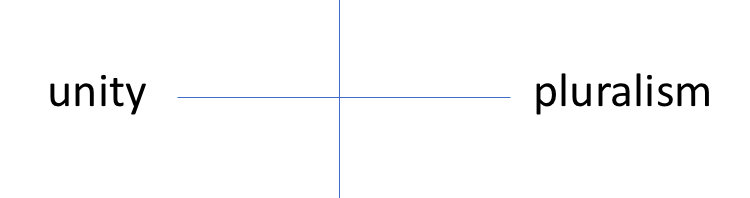
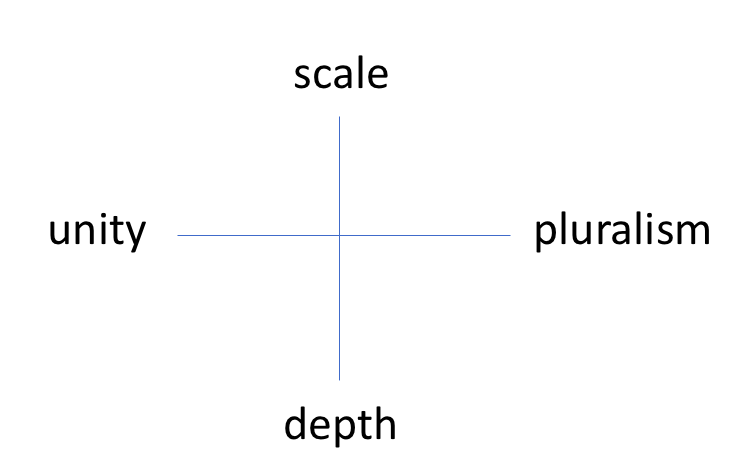
However, the research increasingly suggests that social movements are more likely to succeed if they are internally diverse and good at promoting a free and rich internal conversation. I have cited Erica Chenoweth & Maria Stephan (2011) and Marshall Ganz (2010) to this effect. My own model is SPUD: movements need scale (lots of people), pluralism (diversity of identities and views), unity (shared objectives and tactics), and depth (growth and learning for the participants). Deliberation is relevant because it takes talk to combine scale with depth and pluralism with unity.

New support comes from Wouters (2018). He has shown Belgian and American samples media clips of protests that demonstrate WUNC and that are experimentally altered to show either more or less diversity.

Diversity deals with the heterogeneity of a demonstration’s composition and thus with variation in descriptive characteristics of participants (participation of the young and the elderly; employers and employees; the rich and the poor). Whereas unity deals with the extent to which a group is on the same page and a solid bloc, diversity focuses on a march’s composition. Whereas numbers appeal through an increase in quantity, diversity boosts attractiveness through an increase in quality (various types of participants). Diversity breeds public support, I argue, because observers are presented with more opportunities to identify and because it signals observers that the movement and its grievance engage all citizens. Non-diverse crowds create the impression that the protest serves narrow self-interests, limiting potential identification. In sum, I expect more diverse protesters to facilitate identification and to trigger more supportive reactions.

His finding is that diversity improves audiences’ responses to the protests. He has coined the term dWUNC, “diverse WUNC,” and sees it as an ingredient of success.

Wouters argues that protests are more appealing when members of the audience can see individuals like them among the protesters. They are more likely to see people like themselves if the movement is diverse. He notes that Black Lives Matter protests became more appealing to white viewers if they included some white participants, but black viewers’ opinions did not change.

Wouters’ findings are troubling because demographically homogeneous groups also have value. Oppressed people have a right (and sometimes have good reasons) to act separately, without demonstrating that they have “diverse” support. However, if Wouters is correct, then it’s worth at least considering the cost of fielding a homogeneous group.

I would add that a movement that consistently puts diverse people onto the streets will have to promote internal deliberation to keep those people unified. If this is correct, then a strategy for making society more deliberative is to encourage social movements to maximize their internal diversity. They should do so to make themselves appealing, but as a major side effect, they will promote deliberation.

I make this argument in Levine 2018, but without citing Wouters 2018, which appeared too recently. Here is my PowerPoint on the topic:

Citations

  • Erica Chenoweth & Maria Stephan, Why Civil Resistance Works: The Strategic Logic of Nonviolent Conflict (Columbia Studies in Terrorism and Irregular Warfare, 2011)
  • Marshall Ganz, Why David Sometimes Wins: Leadership, Organization, and Strategy in the California Farm Worker Movement (New York: Oxford University Press, 2010), pp. 17-18.
  • Peter Levine, “Habermas with a Whiff of Tear Gas: Nonviolent Campaigns and Deliberation in an Era of Authoritarianism,” Journal of Public Deliberation, in press
  • Ruud Wouters; “The Persuasive Power of Protest. How Protest wins Public Support,” Social Forces, soy110, https://doi.org/10.1093/sf/soy110 (03 November 2018)
  • Charles Tilly, Social Movements: 1768-2004 (Boulder/London: Paradigm, 2004)
  • Support, Social Forces, 2018, https://doi.org/10.1093/sf/soy110

See also: we need SPUD (scale, pluralism, unity, depth)closing remarks at the Bridge Alliance summitWhy Civil Resistance Workstools for the #resistance; and so, you want to strengthen democracy?