Category Archives: deliberation

the World Bank and active citizenship

The World Bank has published a book entitled Accountability Through Public Opinion: From Inertia to Public Action. Its premise: governments perform better when citizens hold them accountable by seeking information, deliberating, and acting politically. Anyone who holds strongly negative stereotypes about the Bank–as a bastion of neoliberalism and the Washington Consensus–may be surprised to see, for instance, Marshall Ganz’ chapter on “Public Narrative, Collective Action, and Power.” (Ganz is a leading figure in the American left.)

My chapter is entitled “‘Social Accountability’ as Public Work.” I address the increasingly common practice of governments asking citizens to evaluate, influence, or inform policy. I see merit in this strategy, but also limitations …

  • Motivational: Most people lack sufficient reason to devote substantial time and energy to improving the performance of government. If governments provide incentives to participate, then citizens’ engagement is dependent on government.
  • Epistemic: If you are merely asked to assess the government, without having deep experience in addressing public problems, you may not know enough to evaluate well. You may have information but not deeply held, considered, experience-based values.
  • Political: Public forums and meetings are what John Gaventa calls “invited spaces.” The officials who issue invitations can revoke them. Power remains with the government.

I suggest an alternative, drawing on Harry Boyte’s concept of “public work.” Many millions of people are already at work addressing public problems, either as part of their jobs or as unpaid efforts. Work is motivating, educational, and empowering. If we see public consultations, deliberations, and input as aspects of public work, we can reframe these processes somewhat. In particular, we can embed them more thoroughly in jobs, professional roles, and volunteer activities.
John Gaventa on invited and claimed participation

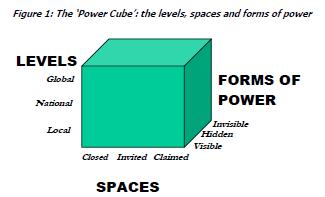
Today, I will be interviewing John Gaventa at a Tisch College forum to which all are welcome. Gaventa has been a major figure in democracy and popular education since his student days in the early 1970s. One of his recent contributions is the PowerCube, a simple device that activists can use for analysis and planning:

I am especially interested in the dimension that runs from “closed” to “invited” to “claimed.” Much of my work has involved trying to get powerful institutions to “invite” public participation by, for example, reforming elections to make them more fair, enhancing civic education, advocating changes in journalism, or recruiting citizens to deliberate about public policy. Increasingly, I believe that democratic processes must be claimed, not invited, if they are to be valid and sustainable.

For instance, in 2009, angry opponents of health care reform deliberately disrupted open “town meetings” convened by Democratic Members of Congress. The Stanford political scientist James Fishkin published an argument for randomly selecting citizens to discuss health care instead of holding such open forums. That was a classic proposal for “invited” democracy. The New York Times chose to give his essay the headline, “Town Halls by Invitation.” I would now say that democratic participation cannot be by invitation–it must be a right claimed or created by ordinary people, whether elites like it or not.

On the other hand, when officials do invite participation, that is often in response to public pressure or demand. In such cases, formally “invited” spaces are actually claimed ones. One of the most important innovations is Participatory Budgeting (PB). As I understand it, the Labor government of Porto Allegre, Brazil, invented PB to reduce political pressure on itself as it faced hard budget choices. But PB became so popular that it survived changes of party control in Porto Allegre and spread to many other municipalities around the world. In such cases, reform begins with an invitation but becomes an expectation.

educating for civility

I am concerned about civil society and active citizenship, not about civility per se. I think an obligation to be polite can suppress engagement or can favor one side over the other (normally the side that is invested in the status quo). Sometimes, an angry critique is just what we need.

But there is a sense of “civility” that means a willingness to listen to others and learn from them. Civility in that sense is vital unless one is certain one is right. Only a few people should enjoy that certainty. (For example, Frederick Douglass appropriately refused to hear or answer arguments in favor of slavery.)

Anyway, I have generally avoided debates about civility, but I was persuaded to write a chapter on the topic for a volume entitled Educating for Deliberative Democracy, edited by my friend Nancy Thomas. The book is now out. It is not available online, but Wiley has chosen my chapter as their free online excerpt (PDF).

deliberation on campuses

“Public deliberation” is a positive synonym for “talk”; and definitions of “public deliberation” tend to list positive characteristics like fairness, non-coercion, freedom of speech, seriousness, relevance, use of valid information, and civility. Since these are supposed to be characteristics of academic discourse, as well, it is natural to try to bring public deliberation to college campuses as a form of civic education and as a service to broader communities.

The Journal of Public Deliberation devotes a whole new special issue to the topic, with articles on everything from an overview of the prevailing practices to academic libraries as hubs of deliberation. For full disclosure, eight of the authors are friends and collaborators of mine, but I think the quality is objectively high.

what is the best participatory process in the world?

The Bertelsmann Foundation–the largest foundation in Europe, I believe–will give its Reinhard Mohn Prize in 2011 to the best project anywhere in the world that “vitalizes democracy through participation.” I am serving on an advisory board for the prize, but a major aspect of the competition this year is open and public. You can go to this website and nominate a project or read and vote on the nominees (or both).

I personally nominated the Unified New Orleans Plan, which was written after Hurricane Katrina by thousands of citizens whom AmericaSpeaks convened for town meetings; Community Conversations in Bridgeport, CT; and deliberative governance in Hampton, Va. These are strongly institutionalized, politically significant examples of public deliberation in the US. They have recruited diverse and representative citizens in large numbers, addressed real problems, and strengthened their communities’ civic cultures.

There are 78 other nominees right now. They include clever ideas, like an online space for citizens of different EU countries to agree to vote together. Promising work comes from unexpected places, like a deliberative polling exercise at the municipal level in China. There are many e-democracy platforms, most of which seem to be suites of online tools for following the government and discussing issues. The Danish Board of Technology, which has an impressive track record of public engagement over many years, convened people in 38 nations to discuss global warming together–an impressive experiment that yielded news reports in many of the countries.

Participatory Budgeting (which gives citizens the right to allocate public funds in deliberative meetings) has spread from its homeland of Brazil to places like Tower Hamlets, London and the Indian state of Kerala. Some important legislative reforms have been nominated and should be celebrated, although I am not sure they meet the criteria of the prize. The Central Information Commission in India is an example.

I am not sure that my own nominees are the best, but I am most enthusiastic about all the examples that are multidimensional, lasting efforts, driven by several institutions instead of only the government, and involving work, cultural production, and education as well as dialogue and advice. Some examples other than my own nominees would include Co-Governance in Belo Horizonte, Brazil, perhaps the Abuja Town Hall Meetings in Nigeria (if they are genuine democratic spaces), and Toronto Community Housing’s Tenant Participation System.

Vote for your favorites!