Category Archives: deliberation

professors and practitioners pontificate on political parody and persuasion

I am at a University of Pennsylvania conference entitled “P6: Professors And Practitioners Pontificate on Political Parody And Persuasion.” The focus is really on parody. An example is Steven Colbert’s real creation of a PAC and a Super PAC during the 2012 election. (We heard that story very engagingly recounted by Trevor Potter, who was Colbert’s real–and also on-air–election lawyer). Survey data suggest that people who watched The Colbert Report really did learn about campaign finance issues.

Colbert behaved badly. For instance, he created a nonprofit 501(c)4 corporation that could accept donations without disclosing the donors’ names, and then he donated all that corporation’s money to his Super PAC to pay for ludicrous attack ads that really aired. The Super PAC was legally allowed to say that it had only one donor, the 501(c)4. Trevor Potter advised him to do this on air, and his legal advice was real. The advice may even have been creative, developing a new loophole that other PACs could exploit. Colbert was trying to satirize Karl Rove, who had both a Super PAC and a 501(c)4. But it seems that Rove did not actually transfer money in the way that Colbert did, perhaps because Potter had invented this loophole for Colbert. Rove’s lawyer contacted the show to complain that Colbert had implied Rove was using this loophole. In another context, such a complaint would have had the feel of a “cease and desist” letter. In the context of a comedy show, the complaint became fodder for further humor at Rove’s expense. So Colbert’s sins include: raising and laundering private money to pay for attack ads that he didn’t sincerely agree with, commissioning aggressive legal advice to create new loopholes, and turning a fact-check of his own show into an opportunity for satire.

To be clear: I think everything he did was great. It was educational and effective. Even if Potter invented a loophole or two for Colbert, they would have developed anyway, and it was excellent to demonstrate how fragile the system is. But Colbert’s work is interesting from a theoretical perspective because it promotes good deliberation by blatantly violating most of the traditional principles of deliberation. For instance, in Amy Gutmann and Dennis Thompson’s Democracy and Deliberation (p. 81), we’re told that good deliberators demonstrate “civic integrity,” which means “consistency in speech” (saying the same thing regardless of audience and context) and “political sincerity.” Good deliberators also display “consistency between speech and action” and “integrity of principle,” which means “the acceptance of the broader implications of the principles presupposed in one’s moral positions.” Colbert, in contrast, speaks and acts precisely contrary to his actual principles.

Perhaps deliberation should be viewed broadly. It has always included forms of discourse like satire and guerilla theater that violate the narrow norms of David Lewis’ “serious speech situations.” Or perhaps it is problematic that only Brechtian satire and gonzo journalism now cut through the clutter of mass communications–telling the truth no longer works.

the Deliberative Democracy Handbook in Chinese

This is the cover of the Deliberative Democracy Handbook, edited by John Gastil and me, in Chinese. It was published in Taiwan, and the back cover says (according to Google’s translation, as edited by me):

“Twenty years after the lifting of martial law, we are still on the bumpy road to democracy. We  need to reconstruct the relationship between citizens and the state and think about more possibilities for citizens to participate. This book will open our imagination to democratic deepening. “- Tie-chi (political commentator) …

Let people who hold different beliefs and values be in dialogue– from listening to the formation of consensus–and produce better, more specific and viable policy options. The new global wave of democratic reform, “deliberative democracy,” is breaking through the dilemmas of democracy in advanced countries such as Denmark, Germany, the United States, Australia, and Brazil.

It’s interesting that the cover shows a fist, whereas the English-language version shows hands clasping in agreement. I like the confrontational imagery of the Taiwanese edition–for even deliberative forms of democracy involve power. (A Japanese edition is in progress as well.)

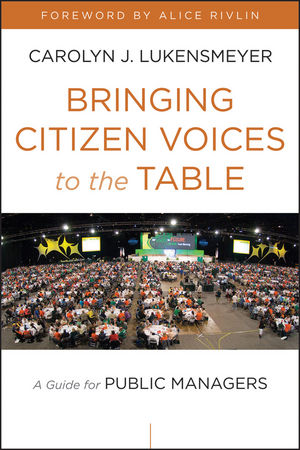
Carolyn J. Lukensmeyer, Bringing Citizens Voices to the Table

Carolyn Lukensmeyer has published Bringing Citizen Voices to the Table. Carolyn is Executive Director of the National Institute for Civil Discourse and founder and former President of AmericaSpeaks. She also has extensive experience in state and federal government. Her book distills the lessons of her career into seven strategies that can be adopted by public managers at all levels of government. If they implement these strategies, it will strengthen our democracy.

I know of no other book that provides the same recipe, and it is grounded in general principles and evidence plus compelling case studies and examples. Carolyn also argues for large-scale policy changes that would enable public managers and the public to use the strategies that she recommends. Most of the book is analytical and dispassionate, but she incorporates autobiographical material that will make it more approachable for practical readers. In places, it is quite moving.

The most immediate audience is public managers, from city managers and planners and school district superintendents to state and federal agency officials. Another large audience consists of people who may be considering becoming public administrators, especially graduate students of public administration. Organizers of deliberative democracy should also read it, and it deserves  an international audience, because the same strategies have also been tested in other countries–and in some cases, are better supported overseas.

See a nice summary in the form of a recent Nonprofit Quarterly article entitled “The Case for Citizen Engagement.

Call 800-356-5016 and use Promo Code CL252 to save 36% on the cover price of the book.

are we entering a post-truth era?

When the returns are in, just about half the people, those who voted for the loser, will have to ask themselves how seriously they believe the campaign orators who told them that democracy was lost if their opponents won the election. If they believe seriously that Mr. Wilkie is the head and front of an unholy alliance of revolutionaries and revolutionists or that Mr. Roosevelt is the center of an effort to set up a dictatorship and establish national socialism, then the loser cannot accept the result … But as a matter of fact the nation will accept the result …. because the people know in their hearts that the rhetorical threats and the rhetorical promises which they have just been hearing belong to the routine of campaigning in the month of October before election, and that for every grain of truth these political words contain, there are ten grains of buncombe.

–Walter Lippmann, “On the Strength of Democracy,” Nov. 5, 1940

To understand [diplomatic] briefings one must break out of the semantic fogs of our Orwellian times. The government information officer, to speak plainly, is a misinformation officer; his job is not to inform the press, but to put across the particular version or distortion, previously decided upon by the government for which he works. The briefing is a mild but effective form of brain-washing. … Arguments which the government disapproves are made to seem silly; key technical points are given rapid treatment so hurried and obscure as to hide their significance; one’s own position is high-lighted, the adversary’s is twisted and the neutral’s is given only a quick once-over.

— I.F. Stone, “How the Press is Brain-Washed and the Neutrals Gulled,” I.F. Stone’s Weekly, April 16, 1962

Last week, I heard my old friend Jason Stanley defend a thesis that he has also advanced very ably in series of pieces in The New York Times. He warns that we are entering a post-truth era.

The philosopher David Lewis proposed that in “a serious communication situation,” people generally say what they believe and expect listeners to accept statements that are true. Lying occurs, but it is like breaking the rules of a game that is still functioning as a game; lying is exceptional and risks a penalty. But people can also talk in situations that do not involve serious communication. Making up stories, exaggerating, or scoring points can be the normal and expected behavior.

In a reasonably deliberative democracy, politics is a serious communication situation, and lying or BS-ing are exceptional and risky behaviors. But once lying becomes widespread and incurs no political penalty, truth-telling becomes virtually pointless. Listeners don’t even expect it. They interpret speech as exaggeration, entertainment, counter-balancing of rivals’ exaggerations, motivational rhetoric, or other things that are not assertions of truth. Then, if you happen to say something true, listeners just discount it, divide your claims by the expected degree of exaggeration, and you lose the game that is being played in a post-truth era. Even fact-checkers, reporters, and other ostensible third-parties are quickly dismissed as partisan players.

I fully share Jason’s values and concerns, but I am open to two theses. Which one is right is an empirical question, and I am not quite sure how to investigate it.

1. Politics as serious communication was a fragile convention that we recently lost. We once had it because mainstream political leaders did not routinely and blatantly lie, and when they did, they paid some kind of price. Perhaps they paid a penalty for lying or being badly misinformed because the media system was controlled by a limited number of professional organizations, such as the TV news networks and the metropolitan daily newspapers. For all its ideological biases and blinkers, the media fact-checked. So if you said that Barack Obama was a Muslim born in Kenya who wants to establish death panels, you either could not get into the news at all or you would be debunked therein. Once prominent candidates and broadcasters started saying such things routinely and paid no price, the convention of politics as serious communication quickly died. Jay Rosen has been arguing this thesis effectively. He has blamed “movement” conservatives and the right-wing media even though his original framework is quite nonpartisan.

… or …

2. Politics has never been very much about truth. Politicians have always gotten away with massive lies or with mistruths they did not know to be false, such as blatant racism or exaggerations of the Communist threat during the second half of the last century. It is a standard trope of intellectual criticism to say that nobody even cares about truth any more. That is because neither politicians nor voters have ever cared about it all that much. They have always used and interpreted political speech as a mix of things, such as truth-claims, ideological commitments, signalling to the troops, and slams at the opponent. The relative importance of truth shifts from decade to decade as different institutional structures wax and wane. For instance, the demise of the monopoly press and the rise of the Internet has changed the rules of the game, both for better and for worse. The relative role of truth also changes from month to month according to the political cycle. Just as truth is the first casualty of war, so it is the first virtue thrown overboard in a competitive presidential campaign.

I began with two quotes to show that intellectuals have been worried about the demise of truth for at least a century. Many more examples could be cited, but I like these two because of some interesting contrasts.

First, Lippman and and Stone were opposites in many respects, ideological, professional, stylistic. “Everything about them was a study in contrast,” writes Myra McPherson. Yet they both wrote extensively about the dangers of propaganda, the public’s low esteem for truth, and the consequent dangers to America. That suggests that this is not a wholly new problem.

These short quotes only hint at their complex views, but they illustrate two different levels of concern. Lippmann describes the 194o campaign in words that eerily presage 2012. But he is not deeply worried, assuming that when Americans hear all the “buncombe” about socialist Democrats and plutocratic Republicans, they will discount it at an appropriate rate and expect sanity to return after the inauguration. In other words, they know what game is being played at any given moment and expect truth to reemerge during the legislative session (just not in October of an even-numbered year).

Stone’s words also seem prophetic.  As if describing a 2012 campaign commercial or debate, he writes (in 1962), “key technical points are given rapid treatment so hurried and obscure as to hide their significance; one’s own position is high-lighted, the adversary’s is twisted and the neutral’s is given only a quick once-over.”  But Stone is very concerned, arguing that the mass media and mass publics of the West have been lied into a state of terror to support the Cold War at the risk of nuclear Armageddon.

Neither man would be surprised by the spectacle of 2012, but their reaction would differ. Stone might say, “You are once again risking the loss of your democratic birthright by allowing powerful leaders to lie deliberately and destroy your very regard for the truth.” Lippmann might reply, “It was always thus. Politics (in the sense of national competitions over governmental power) has never relied much on truth. Just let the people make a general judgment about who’s on their side, and things will work out OK.”

Of course, there is another option, which is to build institutions and practices that favor truth. Walter Lippmann was deeply impressed by the power of propaganda in World War I and wrote in the Phantom Public (1925) that citizens could not know what is going on, lacked coherent values and interests, were easily manipulated, and never seriously affected the government. He concluded that their only role was to use the blunt force of majority rule to unseat extremely incompetent or tyrannical leaders. John Dewey responded in The Public and its Problems (1927) that citizens had indeed lost their ability to deliberate, pursue truths, and govern themselves, but this was the result of fixable flaws in the press, the university, the legislature, and other modern institutions.

Dewey saw that citizens need not only more and better information, but also relationships characterized by mutual trust and accountability. Information is easily dismissed, manipulated, and misused, but when people have good reasons to trust their metropolitan daily newspaper, it can tell them truths that they may not want to hear. When they trust religious congregations and unions, those organizations can call them to hard truths. And when they have genuine relationships with public institutions, public leaders can risk speaking the truth. Dewey’s theoretical writing was often frustratingly vague, but he played a role in building settlement houses, news magazines, social studies classes in high schools, the NAACP, and a host of other organizations that strengthened deliberative democracy for the 20th century. Our question is how to revive that in the 21st.

would we be better off without any horse-race polls?

A “horse-race” poll is one that asks people whether they plan to vote and, if so, for whom. These surveys are appearing at the rate of half a dozen per day right now. I don’t think the tide can be stemmed, because we have a constitutional right to ask other people about the election and print the results. And I acknowledge that I follow polls obsessively, checking them several times a day and reading all about the minutiae of party weighting, robocalls versus live calls, and “house effects.” CIRCLE will even ask horse-race questions on our own youth poll, soon in the field.

But what if they all just went away?

Although there would be pros and cons, I think we’d be much better off. The theoretical framework that helps explain why is Jürgen Habermas‘ distinction between instrumental and communicative reason.

With instrumental reason, you know what you want and you deploy resources, including speech, to get what you want. For that purpose, horse-race polls are very useful. For instance:

  • If you are Karl Rove, you are now moving money to House races instead of supporting Mitt Romney, because the presidential race looks lost to the GOP, while the House is more “in play.”
  • If you are a leftish critic of Barack Obama and you live in a blue state, you are probably contemplating not voting (in response to the Pakistan drone bombings and many other issues). You might feel differently if you thought that Romney was about to take your state and the national election was close.
  • If you work for the president’s re-election campaign, you’re not paying any attention to uncompetitive states, like California, Texas, and New York (combined population = 83 million), but you’re suddenly very interested in Nevada (pop. 2.7 million).
  • If you are Barack Obama, you think you’re ahead, and so you’re inclined to run out the clock, rather than, for example, explain what you propose to do about difficult public problems.
  • It’s possible that if you are a Republican, you are losing interest in voting for president, which would make the polls a self-fulfilling prophesy.

One way to assess instrumental action is in terms of the outcomes. From my perspective, Karl Rove’s targeting his millions is bad because he is supporting the wrong people. But lefties’ boycotting an uncompetitive election is fine, even though I am not personally moved to protest this president. (For the record: I voted for Nader in 1996, when I was certain that Clinton would win. This election is closer, and I much prefer Obama to Clinton.)

But we shouldn’t simply assess instrumental action by its outcomes, because that damages other values. In politics, one of the fundamental values is equality: everyone should count for the same. Another value is some version of integrity: you should say what you believe. And deliberation is a value: we should exchange reasons with our fellow citizens and give everyone a hearing. We should deliberate out of respect for other people and also because we might be wrong: deliberation is an opportunity to learn.

If you are sure what you want to happen and you have a pretty accurate sense of how your fellow citizens are going to vote, reasons become relatively unimportant, and some citizens count more than others. Forget about reasoning with all those New Yorkers and Texans: the electoral college outcomes in their states are utterly predictable. Forget about what should count as the best argument for your core positions, because those may not be  tactically valuable things to say. Pick the issues and arguments (no matter how trivial) that seem most likely to win you electoral college votes.

That’s advice for candidates and PACs, but individual citizens may regard the election as a spectator sport and believe that it’s interesting and worth their attention just insofar as the outcome looks close. That is wrong because our job is to decide how to vote and then move on to making other decisions that improve the world. Horse-race polls just distract us.