In the era of digital networks, you can enable waves of innovation and creativity by inviting people to form their own groups and contribute their own tools and culture. In the era of digital networks, you can also manipulate masses of people into doing what you want them to do by maintaining and exploiting a vast merged database of human activities, interconnections, and expressions.
These are warring impulses and rival temptations. Each is enabled by recent technology, but each also reflects a whole philosophy or worldview that makes it seem exciting and desirable. Since 2007, the Obama team has been pulled in both directions. The President’s new grassroots lobbying operation, Organizing for Action (OFA), could still go either way. I don’t think the administration and its friends recognize that they face a fateful choice, nor do they understand the dangers inherent in the new manipulative politics.
Barack Obama has a special affinity for decentralized politics, rooted in his years as a community organizer, and he was perfectly positioned to take advantage of the populist power of the new digital and social media. Back in May 2008, Steve Teles and I wrote:
While [Hilary] Clinton has depended for support on large-dollar donors and existing Democratic Party organization, Obama has shown an ability to mobilize thousands of citizens for his campaign. He has raised money from over a million people, and his Facebook page has 800,000 supporters.
It is precisely this network, which connects the Internet to the grassroots, that will need to be activated to counter the furious opposition to health care reform by supporters of the status quo. Obama should say in no uncertain terms that as soon as he is elected in November, he will immediately make good on his promise that his campaign is about what “we” can do. He should commit to turning his remarkable electoral machine into the most powerful mass movement for policy change since the civil rights movement.
After the election, the administration did not engage Obama’s grassroots base to counter the fierce opposition we had predicted. I lamented that lapse in a 2010 Huffington Post piece and many others also observed it. Lately, the President has explicitly called his failure to engage supporters his worst mistake, recalling that the “energy just kind of dissipated, and we were only playing an inside game.”
The energy of 2008 had many sources–including the simple desire to vote the Republicans out–but it was sustained by citizens who invented their own messages and built their own networks. Again, this strategy was enabled by new technologies (the Internet, smart phones, and social networking sites), but it also reflected a philosophy that gave its proponents morale and inspiration. They saw themselves as pushing power to the edges of the network.
The 2012 reelection campaign, however, was won by “backroom number crunchers,” analysts with access to a vast national database. According to Time’s Michael Scherer, they could “run tests predicting which types of people would be persuaded by certain kinds of appeals. Call lists in field offices, for instance, didn’t just list names and numbers; they also ranked names in order of their persuadability, with the campaign’s most important priorities first.” (For more reporting on what Reid Cherlin called the “whiz-bang technologies and startup geniuses” of the Obama campaign, see this summary.)
All this was possible because we now conduct so many of our routine activities online, where they can be saved and tracked. What we buy, whom we know, and how we vote can all be entered into databases that are sold and merged. Meanwhile, behavioral economics, prospect theory, the latest marketing science, and popular works by the likes of Malcolm Gladwell and Cass Sunstein tell us that: (1) people’s behavior is predictable, but it does not depend on rational calculations of benefits versus costs; (2) we can get people to do what we want by subtly shifting messages or the way we frame choices; and (3) this is all good because we can attain desirable social outcomes without paying people or threatening people to do the right thing. Governments needn’t ban or tax harmful products; they can “nudge” citizens into avoiding them. Campaigns don’t have to raise billions of dollars for broadcast ads, but can instead hire a few computer geniuses to target messages to people who think they want them.
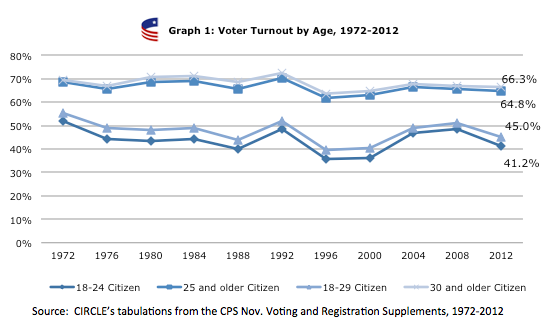
Indeed, the Obama reelection campaign got its voters out, including (as we find) young voters–notwithstanding evidence that they were relatively unenthusiastic during the campaign. We found in October that about 15% of young people had been contacted by a presidential campaign, about 60% of those by the Democrats. The targeting was efficient: young African American women in Southeastern states got relentless attention, for example, and everyone received messages tailored to their interests. West Coast females in their forties heard from George Clooney because, as Scherer reports, the actor “had an almost gravitational pull” on women “likely to hand over cash.”
These skills have evident value to private corporations who (Suzy Khimm reports today) are courting the Obama campaign’s “young geniuses.” But deep in her story is an indication that the campaign’s success was at least partly a result of sharing power rather than micro-targeting voters:
Sam Graham-Felsen, the “chief blogger” of Obama’s 2008 campaign, found that private audiences were so willing to pay for his insights that he was able to leave his post-election job at Blue State Digital for the speaking circuit. But he wasn’t always sure that corporations were thrilled about following his advice. “I talked about the freedom I was given as a blogger to really speak with an authentic voice,” he says. “But the main hurdle is a lot of corporate audiences are terrified of giving up message control.”
Now the same techniques and skills are being handed over to a formally independent grassroots lobby, the OFA.
One problem with that effort is the source of cash. In the LA Times, Matea Gold reports, “Obama stayed for two hours at the Organizing for Action dinner, whose attendees included wealthy donors who had been asked to give $50,000 each. During meetings last month between the group’s leaders and top campaign fundraisers, the idea was floated to name those who raise $500,000 a year to an advisory board that would meet quarterly with the president.” My former boss Fred Wertheimer argues–and I agree–that “President Obama has set out on a dangerous and unprecedented path as he begins his second term in office. … As far as I know, this is the first time a president has outsourced an important responsibility of his presidency to a private sector organization that is financed by unlimited private funds and that is, in effect, operating as an arm of the presidency.”
But it’s not only the source of money that is troubling. OFA may bring to governance and advocacy the methods of data-mining, micro-targeting, and experimentally tested messages that helped the President win reelection. I understand that the center-left doesn’t want to disarm unilaterally, and if these techniques work, they probably must be used in some form. But they pose serious dangers:
- You can use people for what you need and then ignore them. The campaign was eager to mobilize young African American women in Southeastern states last fall. But what incentive has OFA to solicit their opinions now? They don’t have a lot of money to contribute, and most live in safe districts that are sure votes for or against the administration in Congress. OFA will turn its attention to donors and persuadable people in swing districts. But what kind of a social contract is that? You vote for someone so that he can ask someone else’s opinion after the election.
- A candidate can say different things to different people without being accountable for his overall positions. To be sure, that has always been possible behind closed doors, and the Internet has in some ways made it more difficult. Mitt Romney’s “47%” remarks went to audiences he didn’t expect. But that was a blatant error. Now candidates can subtly shade their messages to increase their impact on the specific target audiences without anyone noticing.
- A combination of money and high-tech expertise now confers power. It’s only a matter of luck if the good side happens to have more of those commodities. And even the good guys may be over-influenced by the people who provide their money and tools.
- Campaigns and governments can get people to do what they want without the accountability that comes from spending money or making and enforcing rules. For example, if the government compels everyone to buy a certain kind of insurance, its power is overt and can be challenged. But if it enrolls everyone in the insurance scheme and allows them to opt out, it appears to have created a choice. Yet behavioral economics predicts that lots of people will end up with the insurance. In that case, the government shapes behavior without appearing to have coerced anyone. Likewise, if you get a personalized message from George Clooney asking you to contribute to Obama, it all seems very optional and inoffensive until you realize that data-mining and cluster analysis predicted you would open your wallet at the mere sound of his name (while someone else heard from Jay-Z).
Microtargeting is like using drones: it’s great if you’re the only one who has them. Of course, it’s a lot better to be microtargeted than to be hit with a drone strike, but in both cases, the only decision-maker is the one with the machinery. Even if OFA makes effective use of the new data analytics to advance good causes between now and 2016, they must also consider whether these tools are a net benefit for democracy, and if not, what to do about that.