Category Archives: elections

is Trumpism akin to the European right?

On the whole, I’m inclined to think that Donald Trump’s large lead in the Republican race is a passing phenomenon, similar to several candidates’ surges during 2011-12, and driven mostly by media attention and name-recognition at a time when most people are not yet following the campaign closely. In Die Hard III, which is 20 years old, Trump and Hillary Clinton are already two prominent references. The Donald has a level of celebrity that may give him disproportionate attention early in a multi-candidate campaign but that won’t win him the nomination.

However, there is an interesting substantive discussion of his candidacy. It’s not about whether he will win but rather whether he and his followers are like the right-wing parties in Europe. That constituency might outlast his presidential run.

Trump’s positions are not consistent with American conservative doctrine. He is fanatically anti-immigrant and lobs verbal grenades at various countries every day, but he also says, “I’m not going to cut Social Security like every other Republican and I’m not going to cut Medicare or Medicaid. … Every other Republican is going to cut, and even if they wouldn’t, they don’t know what to do because they don’t know where the money is.” Apparently, Trump would also raise taxes on unearned income.

The combination of grievances against foreign countries and immigrants plus enthusiasm for state intervention in the domestic economy is a position that tends to be called “populism” in Europe. I resist that terminology for the US because we have a very worthy political tradition officially known as Populism (on which Laura Grattan‘s forthcoming book is excellent). Another term could be “far-right.” As Mathew Yglesias writes, “several of [the European parties] have institutional roots in old fascist political movements.” That would indeed make them far-right. But, as Yglesias adds, “their current ideological positioning is generally much more complicated than that, and some of them have no such institutional roots.” They typically combine extreme positions against immigration with economic policies that would be left-of-center in the US. So perhaps the most accurate term is “economic nationalist.” It can then come in varieties that range from truly chauvinistic to plausibly mainstream.

Similar views make a popular combination in the US as well. As Lee Drutman shows, if you screen for people who favor expanding Social Security and decreasing immigration, you get 24% of the electorate. They may or may not be chauvinists, since their views on immigration could be moderate. But they are out of step with the Republican Party on Social Security and could accurately be called “economic nationalists.” Meanwhile, those who would expand Social Security and keep immigration at least at current levels constitute 26.5%. This second group is in sync with the Democratic Party’s leadership. The strong conservative position (trim or privatize Social Security and restrict immigration) draws just 2.4% of voters, one tenth as many.

Trump is aligned with the 24% who are economic nationalists. If we use Social Security and immigration as the two proxies for that view, then Trump’s constituency is comparable in size to liberals and much larger than conservatives. A third measure would be attitudes toward policing, on which Trump takes an aggressive position that may also be fairly popular (with similar people).

It’s common for a combination of views not to be represented in a two-party system. Antiabortion progressives, for instance, have nowhere to turn in presidential politics in the US. But economic nationalists represent a big enough bloc to possibly destabilize the political system. Antiabortion progressives are typically Democrats who are badly outvoted within their own party on that issue. Economic nationalists, in contrast, seem to be Republicans who represent a large force in their party but are at odds with its elites.

While Trump’s support (about 30% of Republican voters right now) may be boosted by his attention-grabbing style during the silly season of the campaign, it is conceivable that someone with similar views and a less rebarbative and risible style might actually perform better in the long term. Republican elites disagree with half of economic nationalism and will have to figure out how to keep it at bay even after Donald Trump no longer threatens the nomination.

on Hillary Clinton and Julius Jones of #blacklivesmatter

The taped discussion between Hillary Clinton and Julius Jones of Black Lives Matter is a rich and fascinating document (full transcript here). Jones begins by telling HRC, “You and your  family have been personally and politically responsible for policies that have caused … disasters in impoverished communities of color. … And so I just want to know how you feel about your role in that violence and how you plan to reverse it?”

HRC acknowledges the very bad consequences of the War on Drugs and mass incarceration. But the two disagree about whether those policies were “extensions of white supremacist violence” (Jones) or else well-intentioned responses to the “very serious crime wave that was impacting primarily communities of color and poor people” and to the “very real concerns of people in the communities themselves” (HRC).

(NB It is possible that both interpretations are true, or at least partly so. For an interesting contemporaneous document on Black politicians and the 1994 Crime Bill, see this clipping, courtesy of the Brennan Center.)

Clinton repeatedly asks Jones for policy proposals, and Jones repeatedly presses Clinton for more explicit expressions of regret or changes of heart. The dialog ends with this exchange:

JONES: The piece that’s most important, and I stand here in your space, and I say this as respectfully as I can, but you don’t tell Black people what we need to do. And we won’t tell you all what you need to do.

HILLARY CLINTON: I’m not telling you—I’m just telling you to tell me.


[snip]

HILLARY CLINTON: Well, respectfully, if that is your position then I will talk only to White people about how we are going to deal with the very real problems—

QUESTION: That’s not what I mean. That’s not what I mean. But like what I’m saying is what you just said was a form of victim-blaming. Right you were saying that what the Black Lives Matter movement needs to do to change white hearts—

HILLARY CLINTON: Look I don’t believe you change hearts. I believe you change laws, you change allocation of resources, you change the way systems operate. …

One difference here is about mechanisms of change. Clinton acknowledges that there is value to the “the consciousness-raising, the advocacy, the passion, … of your movement,” but she believes that change always requires the passage of laws that reallocate rights and powers. Jones thinks that what Clinton believes and says to other White people about their own responsibility is a crucial element of change.

Another (related) difference is about the diagnosis of social problems. Clinton sees a set of interlocking causes for mass incarceration, including well-intentioned laws, economic factors, racism, etc. “You know, it’s not just an economic issue—although I grant that some of you will see it like that. But it’s more than that and I think there is a sense that, low level offenders, disparity treatment, we’ve got to do something about that. I think that a lot of the issues about housing and about job opportunities—’Ban The Box’—a lot of these things, let’s get an agenda that addresses as much of the problem as we can.”

In partial contrast, Jones sees one root cause to the problem, and it involves the hearts of white people (which Clinton has said you can’t change). Jones says, “Until someone takes that message and speaks that truth to White people in this country so that we can actually take on anti-Blackness as a founding problem in this country, I don’t believe that there is going to be a solution.”

My thoughts, for what they’re worth:

First, if it is ever helpful to ask any candidate about her values and priorities, then it is appropriate to probe Hillary Clinton’s “heart” on questions about race. I tend to think that we rely too much on psychological evaluations of candidates. Our impressions are almost always inaccurate, because our relationships with politicians are mediated; and they have less scope for choice than we assume. But this is a huge issue on which President Hillary Clinton might have quite a bit of scope for choice. She also has a problematic record. It is helpful to know what she deeply thinks now. That is information a citizen can use in deciding how and whether to vote.

But I have doubts about a general strategy of trying to get people to acknowledge their privileges. (This is more about the White voters to whom HRC would talk about white supremacy than about her own opinions.) “Privilege” means an unjustifiable advantage. Telling people they have a privilege may easily remind them of an advantage that they will want to protect. Cases are rare indeed when large numbers of people have acknowledged privileges and then dropped them. One example was August 4, 1789, when representatives of the French aristocracy stayed up all night voting to repeal the various privileges of the nobility. It was a glorious night but it did not end well.

The last paragraph may seem cynical, but I am optimistic about other paths to change that do not involve getting privileged people to acknowledge their privileges. The oppressed can gain leverage (economic or political) and negotiate change. Or a majority can be persuaded that change is in their interests as well. For instance, middle class white people may be persuaded that mass incarceration is unnecessarily expensive. In the transcript, HRC says, “That’s what I’m trying to put together in a way that I can explain and I can sell it.  Because in politics, if you can’t explain it and you can’t sell it, it stays on its shelf.” I don’t know if she has in mind arguments about cost, but they would exemplify arguments that she could “sell.”

I am generally committed to a critique of root-cause analysis. (See Roberto Unger against root causes and this post on the idea of root causes in education.) I believe that problems typically involve multiple causes and complex feedback loops; and sometimes you can make the most substantial and lasting difference by attacking an apparently superficial element of a system. That said, the Black Lives Matter campaign is making a strong argument that racism, if not the one root cause of a wide range of problems, is at least necessarily involved in any solution.

Finally, I do not agree with Clinton that you can’t–or shouldn’t–“change hearts.” In the 2008 primaries, she and Senator Obama had an important debate about the role of bottom-up social movements in reforming society by changing values and perceptions. Clinton tended to disparage their impact, arguing, for instance, that the main impact of the Civil Rights Movement came from politicians’ passing the Civil Rights Acts. I think Obama was right to emphasize the deep changes in values and everyday behavior that arose from the social movement. (See Wilentz v. Ganz on the Obama social movement and the Clinton/Obama spat.)

However, a national political leader is well placed to pass laws but poorly placed to lead a social movement, as I think we have observed during President Obama’s period in the White House. So it could be that HRC is correct about the role she should be playing, even if she is wrong to downplay social movements that change hearts.

(Cf. #Blacklivesmatter and Sen. Sanders: social democracy and identity politics.)
the year the people took back politics: a vision for 2016

Below are my keynote remarks yesterday at …

Breaking Through: Increasing Civic Engagement, Before, During and After Elections

The video is here:


I departed from the prepared text a fair amount in order to address the audience of civic innovators who had gathered in Austin. By the time I spoke, I knew more about their projects. These are the prepared remarks:

A presidential election cycle is a great civic ritual. Even though only about 60% of adults vote—when we’re lucky—a national campaign still touches most Americans in one way or another. It challenges us to consider fundamental issues. And it connects us to our political heritage, for many of the greatest moments in our political history have been presidential elections.

As the 2016 cycle heats up, what should we expect from this great national civic experience? What do we have a right to expect from the election?

I would say …

The campaign must engage all Americans, without respect to wealth, social status, age, race, gender, disability, and political and religious opinions.

It must give all Americans equal weight and importance, honoring the fundamental principle of one person/one vote. It must make our leaders accountable to the people as equals.

The campaign must provoke a serious conversation about the most fundamental issues facing us as a country.

It must enlist our higher instincts. It is absolutely fine for citizens to retain their diverse political ideologies and their various and conflicting interests. But we must all be reminded of the more generous and idealistic aspects of our own views and interests—or what Lincoln called, after the fateful campaign of 1860, “the better angels of our nature.”

During a national political campaign, Americans must have respectful interactions with fellow citizens who hold different views from their own. The goal is not consensus but mutual understanding and an awareness that we are all legitimate participants in one great political debate.

Some of our interactions must be personal, in the sense that we get to know one another and can actually reply to each others’ ideas—whether online or face-to-face. In other words, it’s not enough to relate to politicians and other celebrities by following what they say. We must also relate to one another.

Citizens must see ways of acting on their political values that go beyond casting a ballot in November, important as that is. If, for instance, you are moved by the problem of climate change or concerned about moral decline, the campaign should inspire you to reduce carbon or to restore traditional values by working with neighbors and peers. The act of voting should be just one of the political efforts that you undertake as a result of the election.

Finally, a diverse set of new actors must see openings to enter political life, whether as campaign volunteers and staffers, independent activists, or reporters, artists, and bloggers. Presidential elections are entry points for new generations of activists and leaders.

I have described a national election in rather glowing terms, but we all know that the reality falls far short. Continue reading

2014 set records for lowest youth registration and turnout

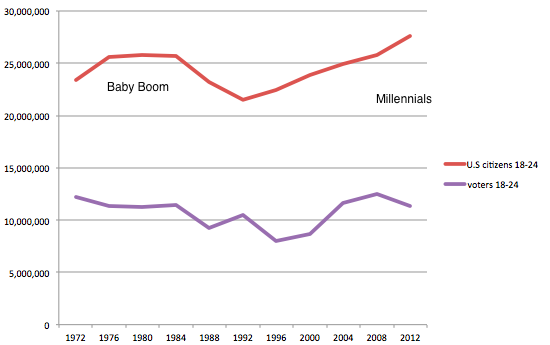
(Austin, TX) CIRCLE is reporting today that 19.9 percent of 18-to 29-years old cast ballots in the 2014 elections. That was the lowest rate of youth turnout recorded by Census data since the voting age was lowered to 18. The proportion of young people who said that they were registered to vote (46.7%) was also the lowest over the past forty years.

There was, however, a great deal of variation in youth turnout by state (e.g., 31% in Colorado and 15% in Texas). Since the degree to which a state had a competitive senatorial or gubernatorial race was strongly related to its youth turnout, one reason for the record-low may have been the shrinking number of competitive statewide races. Another reason could have been the slew of restrictive voting laws passed by many states between 2010 and 2013.

For more analysis, see the CIRCLE site.

#Blacklivesmatter and Sen. Sanders: social democracy and identity politics

(Winston-Salem) Last weekend, #BlackLivesMatter activists disrupted a forum with Democratic presidential candidates Martin O’Malley and Bernie Sanders at Netroots Nation. An objection to Gov. O’Malley was that he oversaw the State of Maryland while it incarcerated many thousands of young Black people. That was a pretty standard case of holding a leader accountable for his performance, and the governor’s response was terrible.

The critique of Sen. Sanders was more interesting, and I would love to see a real dialogue between the activists and Sanders–rather than what sounds like a dismissive response on his part. Without wanting to stereotype any individual, I would propose that Sanders and #Blacklivesmatter represent two wings of the American left that are genuinely different and that need more conversation. (See also “Why doesn’t Bernie Sanders talk about race” and “#BernieSoBlack: Why progressives are fighting about Bernie Sanders and race,” both in Vox.)

Consider two simplified ideological positions. One can be called classical social democracy. It holds that the root cause of social injustice is the economic and political power of capital, referring to the companies and individuals who control large economic investments. They represent a small slice of the population. The Occupy Movement asserted that the economic oppressors were 1% of Americans; and while that claim rested on some recent data about wealth distributions in the US, it has always been the case that capitalists are outnumbered by something like 99-to-1.

The classical democratic socialist view is that other problems follow from the power of concentrated capital. For instance, as I have argued, a situation like police violence in Ferguson, MO can be interpreted as a result of massive deindustrialization (the loss of hundreds of thousands of unionized blue-collar jobs in that region), which rendered young men without college degrees very economically weak, which has enabled violent abuse. So—argues the classical democratic socialist—it should be everyone’s priority to reduce the economic and political power of big capital. That means financial reform, antitrust, tax reform, and campaign finance reform to get capital out of politics.

Dara Lind writes:

When my colleague Andrew Prokop profiled Sanders last year, he pointed out astutely that Sanders’s career has been ‘laser-focused on checking the power of the wealthy above all else.’ Sanders believes in racial equality, sure, but he believes it will only come as the result of economic equality. To him, focusing on racial issues first is merely treating the symptom, not the disease.

Meanwhile, the political strategy of classic democratic socialists is to build very broad solidarity. Ninety-nine percent of us are not big capitalists, so we are in basically the same boat and should not allow ourselves to be divided. For instance, police officers are blue-collar or lower-income white-collar unionized state employees who need to be brought into the same coalition with unemployed youth.

The second view—I struggle to name it fairly—takes seriously many other sources of power, privilege, and domination. According to this view, we are not divided between the 99% and the 1%, but into a rainbow of racial/ethnic groups, genders, sexual identities, etc. Oppression is manifold and complex, and often “intersectional” in the sense that race, gender, sexual orientation, and class can overlap. Although it may be valuable to reform capital markets, that is neither sufficient nor the central concern. Power must be confronted directly in all of its forms and settings.

I suspect that neither Senator Sanders nor the #Blacklivesmatter activists at Netroots Nation would want to be placed simply in one of those two boxes. Every serious person develops more complex views in the course of struggling with difficult realities. But these are two general tendencies and they do explain, for instance, why the demographics of an #Occupy gathering or a Bernie Sanders rally are so different from the demographics of a #Blacklivesmatter protest.

For my part: I am not a democratic socialist, for two reasons. First, I am somewhat more enthusiastic about markets, individual economic liberties, and pluralism than a classical (statist) socialist would be. Secondly, I am somewhat persuaded by the second position summarized above and do not believe that concentrated capital is our only problem.

But I do worry a lot about concentrated, unregulated capital and doubt that much can be accomplished on other fronts if we don’t address that. I observe that concerns about race, gender, and sexual orientation have produced scattered victories over the past 30 years, not only in national politics (e.g., marriage equality) but also within institutions like corporations and universities. Meanwhile, the traditional democratic socialist agenda has been in steady retreat for the same 30 years, sometimes verging on a disorganized rout. National and global policies are more neoliberal and less economically egalitarian than at any time since the 1920s.

Younger people on the left typically have a lot to say about issues of race, gender, and sexual orientation. They have diagnoses, solutions, heroes, and movements they can join. But most struggle for comparable ideas about reforming the global political economy, if they think about that at all. Despite the terrible injustices that motivate movements like #Blacklivesmatter, there is some sense of momentum toward policy changes, such as sentencing reform. We see nothing comparable when it comes to global capital markets. Thus I am glad to see the voices of Bernie Sanders and Elizabeth Warren resonating with at least some Americans.

I wish Sanders had taken the #Blacklivesmatter protesters seriously, because they deserve that, and the progressive movement needs their support to win. Yet I’d prefer that Sanders stuck to his position in a respectful debate, so that his side of the argument would convey. He is not going to be president; his contribution may be to put a different diagnosis and solutions on the table. The last thing I’d do is to silence #Blacklivesmatter protesters, but I wish that they and the Senator could have a substantive debate, in which both sides laid out some of these genuine points of disagreement.