Category Archives: elections

what the Sanders youth phenomenon means for the future

(En route from NYC to DC) Early reports from the New Hampshire exit polls suggest that Sen. Sanders won about 8 in 10 voters under 30. Follow CIRCLE tomorrow for exclusive estimates of the size of the youth turnout. That will be important for helping to sort out whether Sen. Sanders’ dominance so far is a sign of his appeal–or of Hillary Clinton’s weakness.

I drew the latter conclusion while talking about Iowa last week on WGBH’s Greater Boston show with Jim Braude. Here’s the video clip. He and the other guests were very excited about Sen. Sanders’ large lead among young voters, both in the Iowa results and the Nrw Hampshire polls. Although I should try to avoid the role of the graying curmudgeon, I drew attention to Hillary Clinton’s poor showing in Iowa. Less than 5,000 young people caucused for her in the whole state, which seems to me an alarming sign both for Democrats in November and for anyone who cares about youth participation.

Just to put my comments in a broader context, I do think that Sanders’ youthful following is important. True, only about 35,000 youth voted for Sanders in Iowa. That is about one percent of the state’s population, and it was favorable terrain for him. Still, thousands of young people are having formative experiences as activists on the American left through his campaign (even as others come up through Black Lives Matter or the Dreamers’ or Marriage Equality campaigns). We know from extensive research that such experiences leave lasting imprints. A classic work is Doug McAdam’s Freedom Summer. It’s amazing how many leading figures of the left went to Mississippi in 1964, and McAdam shows how that summer shaped them for decades to come. I suspect when we read the biographies of leading progressive activists in 2030, many will say they worked for the Vermont senator in the winter and spring of 2016.

In the short term, the American left will struggle if Hillary Clinton is elected president (as I expect her to, unless a Republican beats her in November). While a centrist Democrat holds the ramparts against a Republican House, Republican statehouses, and a conservative judiciary, people to the president’s left will face constant pressure to pipe down. Concretely, the organized left may face a shortage of money, paid positions, media attention, technological innovation, and other forms of capacity–much as I recall from the Bill Clinton years, when I myself was young.

This is not ground for despair. Young activists can find solutions. For some of them, experiences with the Sanders Campaign will prepare them for the next four or eight years. Their activism will help President Hillary Clinton to do a good job, because (as FDR said) leadership is deciding who to cave to. She’ll need some pressure from that side.

All of which is to say that the youth support for Sanders is a real phenomenon that is worth following and caring about. But if one is interested in who will win the 2016 presidential election, I am afraid the Sanders phenomenon is likely to be something of a footnote as the primary campaign moves to larger and more diverse states. In that context, the important question is whether Senator Clinton can improve her showing with youth, whom she will absolutely need to win in November.

Sanders got about as many youth votes in Iowa as everyone else combined

My colleagues at CIRCLE are producing a stream of detailed and almost instantaneous analysis of the caucuses and primaries. Keep checking the CIRCLE homepage for the latest.

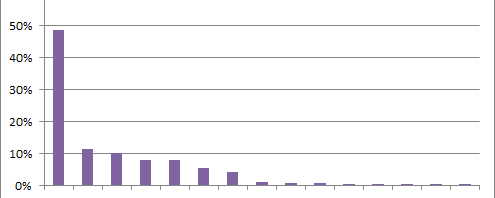
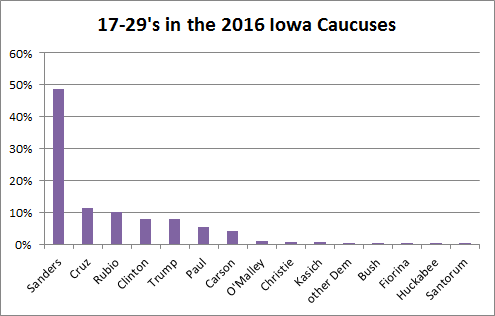
Here I use CIRCLE’s evidence to illustrate how Sen. Sanders’ dominated the youth vote in the Iowa caucuses. Consider the Democratic and Republican caucuses as one event: the voter first chooses which party to caucus with, and then selects a candidate. By that reasoning, about 50,000 young Iowans (ages 17-29) caucused, and about 58% of them chose the Democratic side. Sanders drew 84% of the Democratic youth, while the Republican youth split their support. As a result, Sanders drew about 49% of all the young caucus-goers put together. Cruz came in second with about 11% of all the youth, followed very closely by Rubio, then Clinton, and then Trump.

Iowa 2016

Sanders got about eight times as many votes as his main opponent on the Democratic side, and about eight times as many as Trump, with whom he is sometimes paired as a supposed enemy of “the establishment.”

That raises such questions as: Can Sen. Sanders do better among older people in other states? Can he perform as well among youth in states where young Democratic voters are far more diverse than they are in Iowa? Can Sec. Clinton narrow the generation gap, and can she get out the youth vote if she wins the nomination? (She only drew about 4,000-5,000 young Iowans on Monday and came in fourth in that age bracket, which ought to ring some alarms.) Finally, where will young Republicans land as their field narrows?

Sanders dominates the Iowa youth vote

Below is CIRCLE’s press release from this morning. Additional data can be found on the website.

Young Democrats Propel Sanders to Virtual Tie in Iowa; Record-breaking Participation Among Young Republicans, who Choose Cruz, Rubio Over Trump

Medford/Somerville, MA – Youth turnout in last night’s Iowa caucuses is estimated to be 11 percent, according to youth vote experts from the Center for Information and Research on Civic Learning & Engagement (CIRCLE) – the preeminent, non-partisan research center on youth engagement at Tufts University’s Jonathan M. Tisch College of Citizenship and Public Service.

Highlights of the youth vote in Iowa include:

  • An estimated 11.2% of eligible Iowan youth aged 17 to 29 participated in last night’s Republican and Democratic caucuses.
  • On the Democratic side, the youth choice was decisive. Of the estimated 31,000 young people who participated in the Democratic caucus, 84% supported Senator Bernie Sanders, contributing to a virtual tie between Secretary Hillary Clinton and Senator Sanders.
  • Young Republicans selected Senator Ted Cruz as their top candidate (with 26%), closely followed by Senator Marco Rubio (23%). Youth support for Donald Trump, which came in at approximately 20%, trailed the support he received among older Republicans.
  • Since 1996, youth turnout in Iowa has exceeded 4% only twice: in 2008 (14%) and yesterday (11.2%).
  • A record-breaking 22,000 young people voted in the Republican caucus.
  • About 31,000 young people participated in the Democratic caucus, the second highest level since 1996 (behind 2008).

“Last night’s Iowa caucuses demonstrated the potential power of young people to shape elections,” said Kei Kawashima-Ginsberg, Director of CIRCLE. “In the Democratic caucus, young voters helped to propel Senator Sanders to a virtual tie, and Republican youth broke their own record of caucus participation. One message is clear: when candidates and campaigns ask young people to participate and inspire them to get involved, they respond.”

For CIRCLE’s full Iowa caucus analysis, please see here. Throughout this election season, CIRCLE’s 2016 Election Center will offer new data products and analyses – such as a preview of youth participation in the NH primary – providing a comprehensive picture of the youth vote, both nationally and in targeted states and congressional districts across the country. You can view trend data on youth turnout via CIRCLE’s interactive maps.

on voting by mail

Washington Monthly has a cover story by Phil Kiesling arguing that voting by mail would raise turnout substantially and also produce a more representative electorate, especially in primaries, thus reducing partisan polarization. Kiesling makes many good points, and his argument is definitely worth reading. Among other things, he is right to be frustrated by the research on voting-by-mail, although I wouldn’t characterize the problem as he does–as “the tyranny of dated, superficial, and/or irrelevant, academic research.” In fact, my colleagues and I are responsible for some of that research, and there are reasons that we analyze the data as we do. It is genuinely hard to measure the effects of a policy that has been adopted in only one or a few states. But that methodological challenge can limit our imaginations as reformers. Even though I don’t think he characterizes the research fairly, Kiesling helpfully challenges our imaginations.

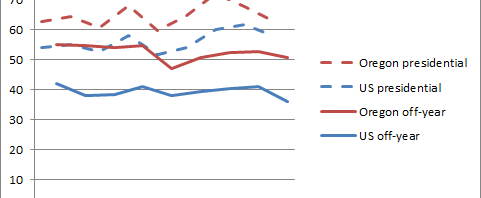
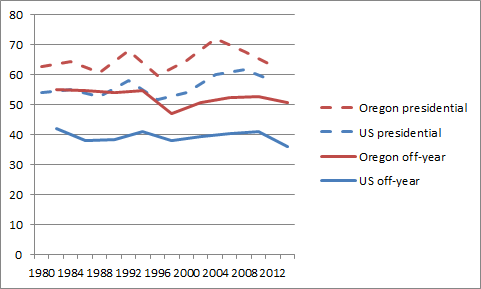
Before getting into the methodological weeds, let me explain why I am not yet convinced that vote-by-mail would increase turnout. Below is Oregon’s turnout trend compared to the national trend. I show the presidential years and off-years as separate lines, because otherwise you get a confusing zigzag pattern. Oregon abolished polling places in 2000 and has run its elections entirely by mail since then. Turnout in the 2004 presidential election was strong, but not so great in 2008 and 2012. Turnout in the off-year elections since 2000 has been lower than it was in the 1980s and 1990s. I don’t see evidence of positive impact here.
Oregon

Kiesling calls it a “problematic assumption” to measure turnout as I do above: as the percentage of all eligible citizens who voted. (My data come from Michael McDonald.) Kiesling would rather define turnout as the percentage of registered citizens who vote. But if votes-per-registered rises, and yet votes-per-eligible-citizens does not, then there is only one mathematical possibility: the percentage of the population that registered must have fallen. That’s not a good thing. So the only way to assess the net impact of a reform on our democracy is by measuring turnout as votes per eligible population. We always do this, not in a “selective manner … to overlook (or even disparage)” vote-by-mail.

My graph simply allows you to see whether turnout has risen or fallen in Oregon before and after the vote-by-mail reform. That is not really a satisfactory method because many other factors are obviously at work. Nor can we conduct randomized experiments with new voting laws. Thus the way almost all academics study state policy reforms is by building large datasets that include statistics from all 50 states over many years. Then we try to isolate the apparent impact of a given change, controlling for everything else that we have measured, including the baseline turnout rates for states prior to the reform.* That method has yielded a rough consensus in favor of Election Day Registration–mentioned by Kiesling and exemplified in our own research.

This method cannot, however, assess the impact of a reform that has only been implemented in one or a handful of states. The math just doesn’t allow estimates of impact when there are very few cases in the category of interest. Thus, frustratingly, we omit Oregon’s vote-by-mail system from most of our models. Kiesling is right to complain about that gap, but I know of no satisfactory solution. One potential option would be to lump universal vote-by-mail together with other reforms, to increase the number of cases, but that would hide any special advantages of universal vote-by-mail.

Kiesling says that the research “lazily tries to extrapolate absentee ballot-based data, inappropriately uses VEP-based yardsticks, and/or focuses on presidential contests only—ignoring midterm and primary elections, where the approach is best suited to show dramatic results.” Those are not fair complaints about our models.

I’d still vote for and recommend universal vote-by-mail, as an experiment. The graph shown above makes me a little pessimistic about its impact (particularly in midterm elections). And I do lament the loss of a secret ballot when elections move to mail. The secret ballot was a hard-won reform designed to prevent voters from being coerced by employers and relatives or from selling their votes. (If you promise to pay me for voting for A, but my ballot is secret, I can take your money and vote for B, which ruins the market. In an election-by-mail, however, your boss, your spouse, or a bribe-giver can check your ballot.) Kiesling says the Oregon Secretary of State is aware of “just a dozen documented cases,” and I guess we could live with that–although each case of coercion is a human rights violation.

More broadly, I resonate with Kiesling’s frustration. If a state does something bold and different, the standard methods of social science really struggle to assess its impact. When a bunch of states implement the same rather modest change, we can measure impact, but often it’s disappointing. For instance, we have found that the variation in states’ education laws does not seem to matter for students’ media literacy or electoral participation. I don’t conclude that reforming education is a waste of time, but rather that the prevailing reform strategies are too weak. A few states have done more interesting things with civic education policy, but we can’t assess their impact using multivariate models.

As citizens, we must keep our imaginations vivid and hopeful. Statistics are always about the past, and the future can be different. I welcome the Washington Monthly’s cover article as a spur to creativity. A 21st-century election system should look very different from the clunky mechanisms we have in place today. Universal vote-by-mail could be the answer. I just don’t read the existing research evidence as Kiesling does.

*Kiesling writes: “But point out that in 2014, the nation’s three UVBM [universal vote-by-mail] states’ voter turnout—based on the identical VEP denominator—was 16 percent higher than non-UVBM states, and the response is often something along the lines of, ‘Yes, but that’s irrelevant because Oregon (and presumably now Washington and Colorado) have always been high-turnout states.’ As if Minnesota, Maine, and Wisconsin are any different?” This is overlooking the power of a multivariate model, which takes into account the historical turnout rate as well as many other variables. We favor Same Day Registration not because turnout is simply higher in states that have it, but because it is higher controlling for other factors.
the pantomime of the Democratic primary, or the choices that actually confront the next president

The first question in Sunday’s Democratic primary debate was: “President Obama came to office determined to swing for the fences on health care reform. Voters want to know how you would define your presidency? How would you think big? So complete this sentence: in my first 100 days in office, my top three priorities will be — fill in the blank.”

All three candidates answered as they had been encouraged to, by describing grand changes in society that would require legislation to accomplish. None mentioned that conservatives have almost a 100% chance of controlling the House, the judiciary, and most states.

I wouldn’t criticize their approach to answering the question. If they had stuck to politically realistic answers, they would have allowed the other party to narrow the scope of discussion and debate. Also, it was illuminating to understand the differences that emerged when the candidates discussed legislation. For instance, are the Affordable Care Act and Dodd-Frank hard-won and fragile victories to be protected with strongly affirmative rhetoric (Clinton), or mere promissory notes demanding to be redeemed with better laws (Sanders)? Are almost all political dysfunctions traceable to campaign money (Sanders), or could skillful leadership within the current system improve things (Clinton)? Finally, it would have been defeatist for these candidates to offer realistic plans for their first 100 days. That would have undercut progressives’ efforts to win down-ballot races and would have converted a prediction into a self-fulfilling prophesy. In other words, it would have been bad leadership.

And yet, as someone deciding which candidate to choose, I am interested in what each candidate would actually do in office (as well as the more pressing question: Who has a better chance of beating the Republican nominee?). At least in the first two years, they would be able to do virtually none of the things they proposed in the debate. Any of them would veto assaults on the Affordable Care Act and negotiate a budget deal that retains most of the status quo. But some choices would confront them:

What unilateral foreign policy decisions to make. This is the area where Congress has–perhaps unfortunately–the least scope, although the national security apparatus has a great deal of say, and it’s not clear that the president really does decide. Dovish progressives have a hard choice in ’16, because Clinton has a hawkish record and Sanders has no experience managing the military and security agencies.

What legislation to propose to Congress first. Three options to send to the Hill are: 1) Widely popular but small-bore bills that can pass and establish a record of accomplishment. 2) Wedge issues: bills designed to catch the House Republicans between their constituents’ opinions and their party orthodoxy. Or 3) grand visions of alternative health or justice systems. These would fail but could possibly alter the terms of public debate. It’s a hard choice.

What executive orders to issue. Note that President Obama seems intent on using that authority to its full in his final year, and he may not leave a lot of attractive options for his successor.

Whom to nominate for a wide range of offices. Within many domains of policy, a Democrat has genuine choices. For instance, she or he could nominate an education reformer enamored of metrics, accountability, and competition (continuing the status quo) or switch to someone who prefers to give teachers autonomy and resources. There is plenty of room within the legislative framework of the Elementary and Secondary Education Act to push in either direction. In the economic agencies, there is a choice between mollifying Wall Street and the markets or regulating them aggressively.

In making appointments, the president also gets to choose leaders with a range of personal profiles. Any Democratic president will look for racial and gender diversity, but how to weigh ideological, religious, generational, and regional diversity? Should most cabinet secretaries have extensive experience as CEOs of large bureaucracies so that they can run things smoothly, or should they be thinkers and advocates?

I enjoy the debate about long-term directions for progressive politics and the nation, but we should probably ask the candidates how they will resolve the decisions that they will actually face.