Category Archives: elections

the last qualified president was Zachary Taylor

There has been lots of debate this week about whether various people are qualified to be president. Peter Shane once observed that the US Constitution, Art. II, § 1, ¶ 5, renders all the current candidates ineligible:

No person except a natural born citizen, or a citizen of the United States, at the time of the adoption of this Constitution, shall be eligible to the office of President; neither shall any person be eligible to that office who shall not have attained to the age of thirty five years, and been fourteen Years a resident within the United States.

It seems that to be president, you have to have been either a natural-born citizen or a citizen of the US on June 21, 1788, the date when the Constitution was ratified. Zachary Taylor was three-and-a-half years old at the time, so eligible. Millard Fillmore was born in 1800, so unqualified–along with all of his successors. It’s that second comma that makes it so. And we know that every jot and tittle of the Constitution is perfect.

(Those wacky Framers.)

Clinton must not patronize Sanders voters

Hillary Clinton told Glenn Thrush last Friday: “There is a persistent, organized effort to misrepresent my record, and I don’t appreciate that, and I feel sorry for a lot of the young people who are fed this list of misrepresentations. … I know that Senator Sanders spends a lot of time attacking my husband, attacking President Obama. I rarely hear him say anything negative about George W. Bush, who I think wrecked our economy.’”

It is very strongly in Clinton’s interest to stop talking this way. Indeed, she should adopt almost exactly the opposite position. There is room to her left on the ideological spectrum. Sanders voters are in that space. Many of them happen to be young, but it’s their beliefs that line them up with the Sanders campaign. Clinton will need their votes in November. They will be weighing whether to vote for her–or stay home. She must communicate very clearly that she respects their positions, that they are the future of her party, that she has a different “theory of change” from theirs but is open to learning from them, and that the Democratic primary debate has been dignified, substantive, and valuable.

Instead, she is implies that they are naive and callow youth who would vote for her if they hadn’t been misled about her personal contributions by a cynical pol. It would be difficult to devise a message with more power to alienate a pivotal group of potential supporters.

two theories of American political parties

Bernie Sanders and Donald Trump have almost nothing in common, except that each campaign is now struggling with its respective party over the rules for selecting and binding delegates. Google News finds these recent headlines: “Trump backers: ‘There will be war’ over disputed delegates,” “Superdelegate system favors Hillary Clinton, say Bernie Sanders voters”–and more than 100,000 more.

Many people will take a side in this argument depending on who they want to win the nomination. They don’t necessarily have an opinion about parties in general. But some Sanders and Trump voters may believe–as a general principle–that the major parties should play very limited roles. That stance is consistent with other aspects of their candidates’ general worldviews. In that case, they will have principled (not merely tactical) reasons to want to strip the parties of discretion.

There are at least two general and current theories of political parties in the US.

On the older view, a party is an association in civil society. It is entitled to organize itself according to its own rules, and people will join if they agree or can stay away if they don’t. Like all associations, a party should consider rules that empower its leaders and core members over casual participants. For one thing, associations want to reward dedicated service. One reason that Democrats have Superdelegates is to make sure that their most devoted members–the ones who have given lots of time to the party itself–can attend and vote at the Convention. Second, like other associations, a party can select individuals to be trustees of its long-term interests. In acting as trustees, the leaders are empowered to check majorities to protect what they consider the best interests of the association. So Republican Rules Committee members who block Trump can argue that they are protecting the GOP.

On the newer view, the parties simply manage the first stage of a two-stage electoral process. In the US, we could use nonpartisan general elections in which all qualified candidates appeared together on the ballot. But then, in most elections, no one would get a majority, and we’d either have to organize a run-off election for the two top vote-getters or allow a person with well under 50% of the vote to take office. Instead, we structure elections so that people first have to compete within one party, and then the parties’ nominees square off in November, producing (usually) a clear winner. Insofar as this is simply a mechanism for organizing a two-stage election, the parties are responsible to the whole public for managing an open, equitable process. The candidate with the most primary votes should always win each party’s primary, and probably the primary should be open to anyone regardless of party registration. That allows any citizen to exercise an equal right to vote in a two-stage election.

Note that the second theory would be appealing to anyone who holds the view of the American Framers or French republican revolutionaries–that parties are odious factions that shouldn’t really exist at all. If parties evolve into highly regulated means for managing two-stage elections, they will cease to be factions, in the bad sense. But then it would be odd that in addition to managing one stage of our election system, they are also expected to campaign for candidates and issues.

The theory of parties as voluntary associations sustained a heavy–and well-deserved–blow when the Supreme Court made a series of rulings against discriminatory practices within the Democratic Party. The Texas party, for instance, had restricted primary voting to whites on the basis that it was a private association devoted to white supremacy. Thurgood Marshall argued successfully against that rule in Smith v Allwright (1944), in which the Court found:

The United States is a constitutional democracy. Its organic law grants to all citizens a right to participate in the choice of elected officials without restriction by any state because of race.  This grant to the people of the opportunity for choice is not to be nullified by a state through casting its electoral process in a form which permits a private organization to practice racial discrimination in the election.

That was only one of a long series of cases, and I am not well informed about all the constitutional issues. However, I think that Smith v Allright is consistent with both theories of parties that I outlined above. One reading of the case is that parties are private associations that can make their own rules; they just cannot discriminate on the basis of race (or other constitutionally relevant characteristics that may arise in other cases). An alternative reading is that the parties now fulfill a state function in our “constitutional democracy,” and they must fully honor the equal rights of all voters. Then any rule or practice that stands in the way of open primaries and majority rule would be unconstitutional.

The courts have not gone so far as reach that second conclusion. What we have in practice is a hybrid. Parties are voluntary associations in civil society that are allowed to protect their own interests and favor their core members. Yet they are seen as performing an essential function for the democracy as a whole and must honor democratic principles. That means there is room for constant debate about party rules, and the disagreement is not just about who should be nominated but also about what kind of thing a party should be.

See also my article from last week, “The waning influence of American political parties,” in The Conversation and in US News.

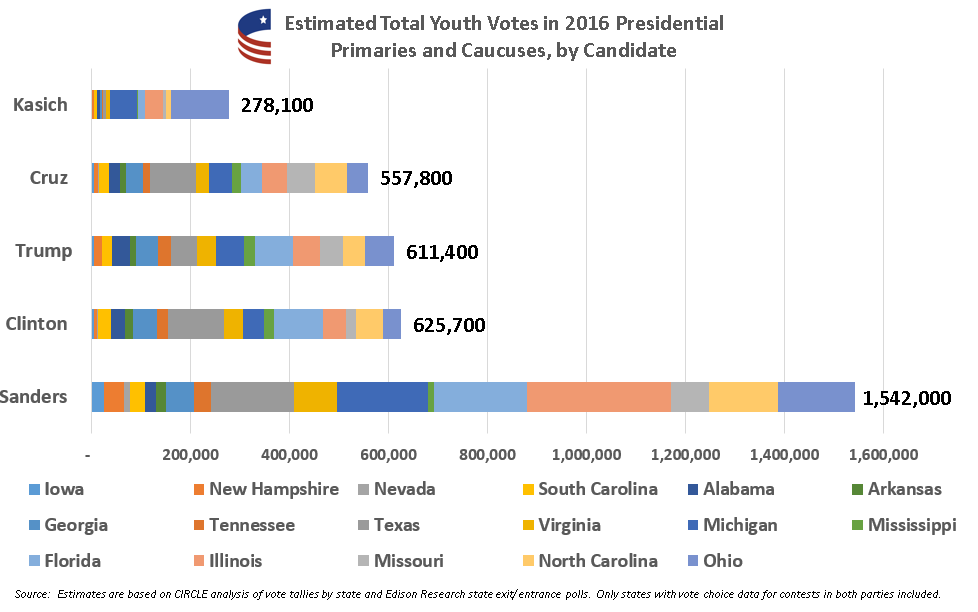
Sanders’ youth votes > Clinton + Trump

This graphic is the focus of Aaron Blake’s Washington Post article entitled “74-year-old Bernie Sanders’s remarkable dominance among young voters, in 1 chart.” As Blake writes, “Hillary Clinton and Donald Trump are well on their way to becoming their parties’ 2016 nominees for president. Among young voters, though, Bernie Sanders has more votes than both of them — combined.” The source is CIRCLE’s analysis released today.

Cumulative-Graph-March15

is the Sanders campaign a movement?

My friend Micah Sifry has a must-read article in The Nation entitled “How the Sanders Campaign Is Reinventing the Use of Tech in Politics.” He interviews two key staffers, Zack Exley and Becky Bond, who reveal a lot about the way their campaign has engaged its supporters.

I’ve written before about an oscillation: campaigns go back and forth between using technology to empower volunteers and accumulating Big Data to make their centralized outreach efforts more precise. Bond is explicit about which direction the Sanders campaign wants to move:

We’re shifting the focus away from a small number of sophisticated data and technologists engaged in a kind of Election Day arbitrage that ekes out incremental advantages by using micro-targeting algorithms to identify and turn out voters based on a model. Instead, we’re putting hundreds of thousands of volunteers to work, and in some states have literally called every single voter who will pick up the phone to identify everyone who supports Bernie or is undecided. Then we have other volunteers persuade the undecideds and turn out those who indicated support.

The article repeatedly describes the campaign as a “movement.” For instance, Exley says, “When Claire and I first arrived at the campaign, we knew that a movement was already way out ahead of the campaign. We believed it was our job to set up structures and tools to … help grow the movement.” A campaign fueled by volunteer hours and small donations that encourages its activists to recruit and lead certainly has a movement “feel.” But what would qualify the Sanders campaign as an actual movement–or as part of one?

Some would say that it’s already a movement because it has engaged a lot of fired-up people in unpaid political activity. Exley describes “a massive volunteer organization that’s making more than 1 million calls every day right now, knocking on countless doors and doing so much more.” Those accomplishments are typical of big, grassroots-based campaigns–not only partisan electoral campaigns but also bursts of grassroots energy in civil society. According to the late Charles Tilly and his colleagues, such campaigns are components or activities of social movements. But one campaign–even a large one–does not itself constitute a social movement.

Others would say that Sanders is part of a movement because he belongs to a loose, evolving, open network of academics, cultural figures, union leaders, organizers, and a few politicians that originated in the New Left and that supports democratic socialism in the United States. Not only is that network called a movement, but it is sometimes called The Movement–as in, “I grew up in the movement, you know,” or “I got to know Bernie through the movement back in the ’70s.”

I personally do not identify with this network, in part because I haven’t done anything worthy of admission to it and in part because my actual political beliefs are too eclectic. (I am not sure you can love Hayek and be in The Movement.) But I’ve known and admired bono fide participants all my adult life. The questions are … Does this strain of political thought and activism really qualify as a movement, even as it has spanned multiple decades? Has it shown enough signs of motion to be a movement? And how much of a movement activist is Senator Sanders? My sense is that he has been a solo voice on important issues, but not much of a movement-builder. He is not known for training organizers or leading organizations. As a voice and a vote in the Senate, he may be an asset to the movement–much like a noted author or musician who supports the cause–but I’m not sure he’s a movement person.

His campaign could nevertheless be an important episode in a movement that spans a longer time horizon and that has many more leaders than Bernie Sanders. It’s too early to say whether that’s the case, because everything depends on what happens after the 2016 election.

Another question is what movement his campaign is part of, if it turns out to be part of a movement at all. Sanders’ own roots are in ’60s-style US-based democratic socialism (see the Port Huron Statement), but other currents are feeding his campaign. Bond says, “First of all, I want to take this opportunity to say that the movement to defend black lives is fundamentally changing the terrain of social-change organizing. After recognizing that, yes, the young people and working-class folks, many of whom are from communities of color, who are leading the movement behind Bernie Sanders as volunteers on the ground are changing American politics.” That comment sounds somewhat aspirational to me–Sanders would be closer to the nomination if he had engaged the Black Lives Matter movement more effectively. But a large coalition could still form after his campaign concludes. Influenced in part by Tilly, I’d look for these features as evidence that a movement is afoot:

  • A set of campaigns–such as the Sanders presidential run and the civil disobedience in cities like Ferguson–that gain rather than lose momentum over a span of years and that look increasingly interrelated.
  • A characteristic repertoire of political acts, which might encompass everything from viral “memes” on social media to people shutting down highways.
  • A diverse, not completely consonant, yet overlapping and interacting set of prominent leaders, some involved in politics and some outside of it.
  • Cultural manifestations, such as very popular music in support of the cause.
  • A set of increasingly specific demands that begin to be implemented by major institutions.

See also: questions for the social movement post Ferguson.