Category Archives: elections

should Democrats play constitutional hardball in 2019-20?

In How Democracies Die, Steven Levitsky and Daniel Ziblatt use comparative evidence to argue that democracies rely on two “soft guardrails”: constitutional forbearance and mutual toleration.* Forbearance means that political actors refrain from using all the powers that the written text of the constitution affords them. Regimes rarely survive once politicians routinely honor the letter but not the spirit of the rules. Toleration means explicitly acknowledging that the other side has a legitimate place in politics, a right to its views, and a right to govern if it wins elections.

We are perilously close to losing both constraints. This won’t be the first time in our history, but then again, our history has involved major breakdowns, like a Civil War that killed 620,000 Americans.

If Republicans beat expectations in 2018 and 2020, both parties’ behavior is predictable. Republicans will remain behind Trump because their base likes him and because the whole party will be winning under his banner. Democrats will resist as aggressively as possible, but with built-in limitations.

The choices for both sides will become much harder if the Democrats do well in 2018 and then 2020, capturing at least one house of Congress and then maybe the whole federal government. The Republicans’ choices will then be:

  1. The GOP stays Trumpian. This is what their base wants. Their losses will have been concentrated in swing districts and among independent-minded incumbents who tangled with the Trump base. The remaining party will be all-in for Trump. Since this scenario assumes that they lost ground in elections, they will be even more hostile to the political system, the media, and the Democrats, now seen as clearly rigging the system against real Republicans.
  2. Or the GOP turns into a principled conservative party that is skeptical of ambitious government, resistant to both taxation and public debt, and committed to constitutional restraint, including a restrained presidency. It presents that package as attractive to younger and more diverse voters and grows less demographically distinct from the Democrats.

Meanwhile …

  1. The Democrats play what Mark Tushnet calls Constitutional Hardball. Because they lost a Supreme Court seat when the Republicans wouldn’t even consider Merrick Garland, they return the favor and refuse Trump any new appointments. They launch aggressive investigations against Trump, his family, and his cabinet, focusing on potential financial crimes. They lay the predicate for impeachments and then prosecutions. They shut down the government over budget disputes, reckoning that Trump will send undisciplined tweets that will make him look at fault. If a Democratic presidential candidate wins in 2020, they drive through political reforms that advantage them in subsequent elections. In short, they decide not to be rolled, and also that their substantive policy goals require strong action.
  2. Or the Democrats try to restore mid-20th century norms of constitutional forbearance and partisan toleration. That doesn’t mean that they seat Trump’s Supreme Court nominees or refrain from investigations, but they try to follow the traditional procedures. For example, they bring Trump’s nominees up for votes but vote nay, and they make their investigations as focused and as bipartisan as possible. Democrats look to peel off independent-minded Republicans who are uncomfortable with Trump’s style and go out of their way to honor these colleagues.

Game theory is tailor-made for situations in which two players can make independent choices and the result is a single outcome. Here is a guess about how these choices would play out.

Democrats play “Constitutional Hardball” Democrats try to restore cooperative norms
Republicans stay Trumpian Democrats probably win on policy–increasingly so as the demographic trends favor them. Republicans retain 35% of the population that is overwhelmingly white and Christian and increasingly angry. The GOP still dominates some states and regions. Right-wingers give Democrats rationales for using increasingly hardball tactics. Political violence grows. Democrats are corrupted by the lack of legitimate checks. Democrats get rolled on policy. Possibly they expand their electoral power as a result of demographic trends plus a reputation for being responsible (if their forbearance is widely understood as such). Possibly they just look weak, and lose.
Republicans shift to principled conservatism Perhaps the Democrats prevail on policy and grow stronger due to demographics. Or perhaps they further erode confidence in government and thus strengthen principled conservatism, which wins elections and policy battles. The republic is safe. Democrats make incremental progress on policy, but Republicans offer a conservative alternative that sometimes prevails.

This is pretty close to a Prisoner’s Dilemma (PD), with the best option for all being the bottom-right, yet both sides have strong reasons to choose the other course. It’s a little more complicated than a pure PD because it plays out over time. The options and payoffs depend on the precise circumstances of the moment–say, in 2019 with a Democratic House and a narrowly Republican Senate, or in 2021 with (hypothetically) a newly inaugurated Democratic president. But versions of the choices arise at each stage, from congressional primaries today to legislative strategies in 2021.

*See pp. 7-8. However, my comments are based on hearing the authors speak, not having read their whole book yet.
powering youth civic engagement with data

(Providence, RI) Two of our marquee data projects have made the news this week. In The New York Times (March 3), Farah Stockman writes:

Efforts to bolster student turnout have been aided by a new national study that analyzes voting behavior on campuses across the country.

For the first time, schools can get detailed data on how many of their students cast a ballot, either locally or absentee, thanks to the National Study of Learning, Voting, and Engagement, put out by researchers at Tufts University.

The study aims to assess how well schools are doing at preparing students to be active citizens in a democracy, said Nancy Thomas, director of the Institute for Democracy & Higher Education at Tufts University, who oversees the study.

The study, which matches enrollment records with voting records, began in 2013 with a modest expectation of getting a few hundred colleges to participate. Today, it includes voting data from more than nine million students on 1,100 campuses in all 50 states. Identifying information has been removed from the data to protect students’ privacy.

The data has unearthed a series of fascinating insights about the 2016 elections: Social science majors had higher turnout than math and science majors (53 percent versus 44 percent). Female students had higher turnout than males (52 percent versus 44 percent). Asian students turned out at a far lower rate than their peers (31 percent versus 53 percent for white students, 50 percent for black students and 46 percent for Hispanic students).

“This initiative will hopefully motivate educators to teach students across disciplines why they should not take democracy for granted,” Dr. Thomas said.

And Josh Kurtz writes in Scientific American (March 5):

Millennial voters are poised to drive the U.S. debate on climate change—and they could have an oversized impact on 10 competitive congressional elections this year, two new studies suggest. …

The second study, also released late last week by the Center for Information & Research on Civic Learning and Engagement at Tufts University, showed the 10 congressional districts where millennial voters could potentially make the greatest difference in November. Eight of the 10 districts are in the Midwest or Plains states. …

“Millennial voters have generally favored Democrats in midterms, and that trend continues,” the Pew report says. “But, comparing early preferences this year with surveys conducted in previous midterm years, Millennial registered voters support the Democrat by a wider margin than in the past.”

That’s where the Tufts study comes in.

The Center for Information & Research on Civic Learning and Engagement created a Youth Electoral Significance Index, using demographics, historical voting patterns and projected competitiveness to produce a ranking of the congressional districts where young people (ages 18-29) have the highest potential for impact on the 2018 elections.

The study identified 10 swing districts with large populations of young people, including college campuses.


new CIRCLE report on Millennials’ ideology

CIRCLE has released a new report entitled “Millennials’ Diverse Political Views: A Typology of the Rising Generation.” From the summary:

Millennials are already the largest group of potential voters and are destined to dominate American politics in decades to come. As a demographically and economically diverse generation, they naturally hold a wide range of opinions. In the 2016 election, for example, voters under the age of 30 split their support: 55% percent for Hillary Clinton, 37% for Donald Trump, and 8% for other candidates.

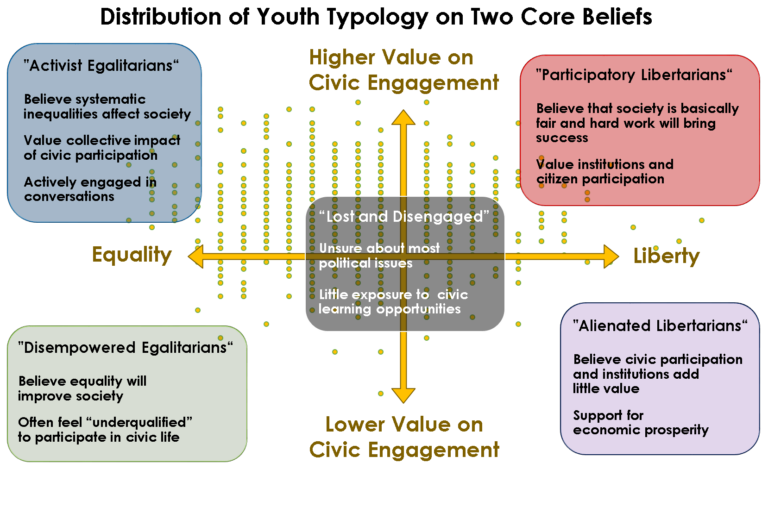
We use recent data to identify clusters of Americans between the ages of 18 and 34 into five groups:

  • Activist Egalitarians (39% of Millennials)
  • Participatory Libertarians (29%)
  • Disempowered Egalitarians (8%)
  • Alienated Libertarians (5%)
  • The Lost and Disengaged (18%)

The two egalitarian groups are concerned about social, political, and economic inequality, and they tend to support government action to combat it. The two libertarian groups are concerned about individual freedom and are more skeptical of government. These orientations characterize some, but not all, core characteristics of young people’s beliefs about the size and responsibilities of government, and whether inequality is seen as a major barrier to progress.

Within both the libertarian and the egalitarian sides, there are disagreements about civic engagement. Millennials of all political stripes differ on whether it is useful for people like them to engage with fellow members of their community or with institutions—or both—to change society. Meanwhile, the Lost and Disengaged do not seem sure where they fall, are disconnected from news media, and largely disengaged from civic life.

The largest group, Activist Egalitarians fit an influential stereotype of Millennials. However, they number less than two-fifths (39%) of all Millennials, and are themselves not monolithic. Less than a third (28%) see themselves as liberal or extremely liberal, and 14% see themselves as conservative or extremely conservative. More than half (54%) of Hillary Clinton’s Millennial voters came from this group, but they have mixed feelings about the Democratic Party.

Demographic and Social Differences

There are important demographic and social differences between the groups, particularly related to education and income.

Participatory Libertarians are almost three times as likely to have a college degree as the Lost and Disengaged.

Among the two Egalitarian groups, the Activists are almost twice as likely to have completed college as the Disempowered, more than half of whom have no college experience at all. That a lack of civic efficacy and confidence correlates with these disparities only exacerbates political and social inequalities.

Those who do not believe in the power of people’s collective work in communities and society vary not only on their Egalitarian-Libertarian polarity, but also on why they may not believe that people can make a difference:

Disempowered Egalitarians acutely feel social inequities but may be hopeless that anything could change.

Alienated Libertarians appear to worry about individual prosperity first and foremost and believe that everyone should look out of themselves rather than work with institutions or with each other.

It is encouraging that a majority of young people of diverse ideologies believe that they should work with others to benefit society and communities, and that civic institutions can play a positive role if they are kept accountable. Still, a troublingly sizable minority are unconvinced that they and their fellow citizens can effect change, and/or feel unqualified to contribute to civic life. Engaging these young people will be challenging, but it is not impossible. We must implement multi-pronged, short- and long-term strategies for engagement that support all young people as they develop their civic and political identity. And we must ensure that Millennials have the resources and opportunities to express their identities with a loud and clear voice, and to turn that voice into effective action.

22 million new voters by 2020

With The LAMP, a New York City nonprofit that works on media and digital literacy skills, my colleagues at CIRCLE are launching the 22×20 Campaign, which has the tagline “22 million new voters by the year 2020.”

For the night of the State of the Union, 22×20 helped organize Action Parties in “New York City, Washington D.C., Austin, Chicago, Boston and San Francisco with partners such as Austin Public Library, Mikva Challenge, DoSomething.org, KQED, OZY, Sony, and YVote.” Students were encouraged to discuss, analyze, and share their reactions. More information about how to organize such events is here.

The campaign also provides educational resources. For example, you can find lesson plans on media literacy and tutorials on how to create videos using news clips. I thought the guide entitled “Ten Easy Steps to Fact-Checking” was a perfect resource for viewers of the State of the Union.

More events are coming up. Follow the campaign on Twitter (@22millionVotes) or by using the hastag #22×20. CIRCLE also has an explanatory blog post on “Teens and Elections” with valuable background data. 

youth in the Alabama Senate race

CIRCLE estimates that 23% of young Alabamians voted in yesterday’s special election. Just for a rough turnout comparison, 21.5% of youth in the United States as a whole voted in the 2014 election. We would normally expect turnout to be lower in a special election with only one person on the ballot than in a national Congressional election, and also lower among Alabama youth than youth across the country because just 40% of young Alabamians have any college experience (and college is correlated with voting). Thus I would call the turnout pretty good compared to expectations.

According to the Exit Polls, youth supported Doug Jones over Roy Moore by 60% to 38%. The older vote was dramatically different, with Moore winning people over 45 pretty easily. CIRCLE suggests two interesting contributing factors. First, young Alabamians are more diverse. “More than a third of the state’s young people are Black, and … Black voters of all ages went overwhelmingly for Jones (96%) in yesterday’s race.” Second, Moore may not have “garner[ed] overwhelming support even among youth who identify as conservative or Republican.” CIRCLE has previously found that “some Republican-leaning youth break with older voters on same-sex marriage and other social issues that were central to Moore’s campaign in Alabama. In addition, CIRCLE analysis of the Pew Research Center’s Political Typology dataset finds that only 5% of young people who lean toward or belong to the Republican party are “Steadfast Conservatives” (compared to 25% of Republicans or Republican-leaners aged 30+) while 31% are “Young Outsiders” who may feel less committed to the party and its candidates.”

More detail is on the CIRCLE website.