Category Archives: philosophy

why we miseducate children to think of values as opinions

In “Why Our Children Don’t Think There Are Moral Facts,” Justin P. McBrayer observes that his second-grade son has been taught to distinguish between facts (which can be “tested or proven”) and opinions (which are just what “someone thinks, feels, or believes”).

In the category of “opinions” are placed all moral claims, including “Copying homework assignments is wrong,” and “All men are created equal.” Presumably, if a child says it is wrong to kill someone for the fun of it, that is labeled an opinion.

McBrayer notes that the same school that teaches his son to view moral claims as opinions also insists that it is really is wrong to cheat and really important to protect other students’ rights. I assume that the school not only proclaims these ideas explicitly but also builds them into its “hidden curriculum” of norms, expectations, punishments, and rewards. By teaching moral values while defining them as opinions, the school contradicts itself.

McBrayer has not just discovered an educational fad or a politically controversial agenda being pushed lately by a small group of adults under our noses. The fact/opinion distinction, as it is taught to his son, is a troubling hallmark of our age.

For instance, education is deeply influenced by standardized testing. What is tested will determine what McBrayer’s son learns in school for the next decade. I have been involved in writing exams, such as the federal government’s National Assessment of Educational Progress (NAEP) in Civics. This is an excellent instrument, supported by impressive science. Much skillful effort is devoted to identifying questions that yield good statistical results. Proposed questions that produce anomalous scores get cut. Based on their scores, the higher-performing students are labeled as “proficient” or “advanced.”

But each item on the NAEP is fundamentally a value-judgment. Should a citizen know the text of the Second Amendment, how many votes it takes to pass a law, or the history of racist violence in the US? Is a young person who understands half of these topics a “proficient” citizen, or “below basic”?

There are no scientific answers to those questions. They are matters of value, on which the entire edifice of testing rests. Yet all the official discourse about standardized tests skirts value questions and dwells on the statistics.

A Nazi civics test could be scientifically valid and reliable. It could work beautifully to identify young Nazis. It would be evil, whereas our standardized tests are at least reasonably decent—but the difference is not scientific. It is a moral matter.

Going beyond tests, the whole educational system that serves Prof. McBrayer’s son is built on techniques and practices scrutinized by science. The No Child Left Behind Act (still the governing federal law on k-12 education), favors forms of instruction supported by “scientifically-based research.” Randomized experiments count as the most scientific.

Thus, for example, experiments endorsed by the federal government show that paying teenagers to stay in school can cut their dropout rates. Another approach that also seems to lower dropout consists of “weekly after-school discussion groups … on personal, family, and social issues,” such as those arranged by a program called Twelve Together.

These very different programs are both presented as proven by science. But it is not self-evident that completing high school is a valid target, especially given the kinds of schools we actually provide. To identify graduation as the goal is a judgment. If such judgments are mere opinions, then there is nothing more to be said about them. But surely we can reason about the ends of education.

We should also reason about means. Could paying teenagers to stay in school “work” (boosting their graduation rates) yet still be wrong? Could it be an example of treating human beings as objects rather than autonomous subjects?

Finally, nothing just “works.” Ideas that are ready to be scientifically evaluated have always been designed, advocated, funded, implemented, tweaked, and refined. That implies effort by teachers or other front-line practitioners, administrators, and social scientists. A wide range of ideas can be made to work if the investment is sufficient and skillful.

But what we should invest in is a value question. We could start by paying teenagers to stay in school and work to make that a highly effective program. Or we could start by teaching them philosophy and refine our methods until that keeps them in school. Which approach we should try to make work is again not a scientific question but a moral one. All the scientific data on “effective practices” follow from our fundamental moral choices.

I have used educational examples here to connect to McBrayer’s article, but the same modes of thinking will be found in health, environmental protection, labor—indeed, all domains of policy and practice. A simplistic fact/opinion distinction influences sophisticated scholars and policymakers as much as 2nd graders and their teachers.

To be sure, budding social scientists are taught that values matter; they influence people’s behaviors and actions, and they influence social science itself. But this influence is treated as a problem. In the “limitations” section at the end of a scholarly article, the authors may confess that they have a “bias” in favor of certain values.

But moral commitments are not limitations; they are preconditions of decent scholarship. The difference between valuable and harmful social science is that the former manifests good values.

Science has achieved prodigious successes in understanding and controlling nature. It can also debunk certain assertions that are morally problematic, for example, that white people are biologically superior. But science cannot demonstrate most moral claims.

For instance: every child in second grade has the same moral value and importance. Looked at from a scientific perspective, that statement makes no sense because value is not a scientific idea. Or perhaps the statement is scientifically false, because science translates “value” into something like capacity or functioning, and not every second-grader does function at an equivalent level. We can try to equalize their capacity by devoting care and resources to the children who need it most—but science provides no reason to do that.

The influence of a simplistic fact/opinion distinction is not the fault of philosophers, who have always viewed the topic as complex. But it is philosophy’s responsibility to challenge the distinction that is so prevalent today. Otherwise, not only will we teach second-graders to view morality as mere opinion, but we will build massive social institutions on the same untenable premise.

Hannah Arendt and philosophy as a way of life

In “Martin Heidegger at Eighty” (1971), Arendt recalled:

The rumor about Heidegger put it quite simply: Thinking has come to life again. … People followed the rumor about Heidegger in order to learn thinking. What was experienced was that thinking as pure activity–and this means impelled neither by the thirst for knowledge, nor the drive for cognition–can become a passion which not so much rules and oppresses all other capacities and gifts, as it orders them and prevails through them. We are so accustomed to the old opposition of reason versus passion, spirit versus life, that the idea of passionate thinking, in which thinking and aliveness become one, takes us somewhat aback.

I first read this passage many years ago. Lacking any enthusiasm for Heidegger, I thought that Arendt was just celebrating her former teacher’s excellence and originality. “Thinking has come to life again” meant that someone as important as Kant or Hegel was again developing a philosophy, and one could study with him.

Now, having read works like Pierre Hadot’s Philosophy as a Way of Life, I think I understand Arendt better. People called “philosophers” have made at least three kinds of contribution over the millennia; Arendt was seeking a union of the three and believed that Heidegger offered it. That’s what she meant by “Thinking has come to life again.”

First, philosophers have interpreted other people’s thought in valuable ways. In this mode, philosophy is form of cultural critique or intellectual history. Describing the rumors about Heidegger’s seminar, Arendt recalled: “the cultural treasures of the past are being made to speak, in the course of which it turns out that they propose things altogether different from the familiar, worn-out trivialities they had been presumed to say. There exists a teacher; one can perhaps learn to think. …”

Second, philosophers have offered arguments: chains of reason that carry from a premise to a conclusion. If you hold the premise and the reasons are valid, you should endorse the conclusion. Following the argument to its end should change your store of beliefs, because now the conclusion should join the list of things you consider true.

Third, philosophers have taught reflective practices, methods of introspection or even meditation. These are different from interpretations of texts, because the process is more personal and creative. If a text is used it all, it is a prompt for introspection. These reflective techniques are also different from arguments, because they can begin with a range of premises and go in unexpected directions. They tend to require practice and repetition to yield their outcomes, which are changes in mental habits, not just lists of beliefs. You can read an argument once and evaluate it. You must introspect many times to have any impact on your psychology.

It makes sense to put these three contributions together because we are reasonable creatures (capable of offering and sharing reasons for what we do), but we are also habitual creatures (requiring mental discipline and practice to change our thinking) and historical creatures (shaped by the heritage of past thought). Reason without acquired habits of self-discipline is empty. But self-discipline without good reasons is blind and can even lead in evil directions. Both are rootless without a critical understanding of the ideas that have come before us.

Hadot argued that the schools of Greek philosophy between Aristotle and Christianity offered reflective practices more than arguments or readings. We misread a work like Marcus Aurelius’ Meditations if we assume that it is a set of conclusions backed by reasons. Instead, we will find there a record of a Stoic’s mental exercises, beginning with his daily thanks to each of his moral teachers. He lists his teachers and other exemplary men by name because he would actually visualize each of these people in turn. The Meditations shows us how.

Martha Nussbaum (in The Therapy of Desire, p. 353) and others have argued that Hadot exaggerated. The ancient Greek philosophical schools all took argumentation very seriously. (I would add that they were serious about interpreting older works, such as those of Plato and Aristotle.) But Hadot’s thesis strikes me as interesting even if he overstated it. The Greek schools combined argumentation with repeatable mental exercises and saw the two as closely linked. In this respect, they resembled the early Buddhist teachers who flourished at the same time. Today, the latter are often stereotyped as merely offering mental exercises (such as yoga), but they excelled at exacting formal argumentation. Indeed, the Buddhists and Hellenistic philosophers were in close contact in Northern India and learned from each other. (I see a distinction between Eastern and Western philosophy as useless, because each tradition encompasses enormous diversity, and the two have been closely linked.)

Hadot claimed, however, that Christianity ruptured the combination of argument and mental exercise that had been common in the Mediterranean and in Northern India before the Christian Era. Christians adopted all the major ideas of the classical Stoics but parceled them out. Abstract reasoning went to the medieval university, where Arendt’s “thirst for knowledge” and “drive for cognition” were prized. Hadot wrote, “In modern university philosophy, philosophy is obviously no longer a way of life or form of life unless it be the form of life of a professor of philosophy.” Meanwhile, the reflective practices went to monasteries.

Arendt perceived Heidegger as putting these parts back together. Reading classical works in his seminar (or in a reading group, called a Graecae) was a creative and spiritual exercise as well as an academic pursuit. Karl Jaspers held different substantive positions, but he had a similar view of philosophy, the discipline to which he had moved after a brilliant career in psychiatry. Elisabeth Young-Bruehl writes that Jaspers’

new orientation was summarized in many different ways, but this sentence is exemplary: ‘Philosophizing is real as it pervades an individual life at a given moment.’ For Hannah Arendt, this concrete approach was a revelation; and Jaspers living his philosophy was an example to her: ‘I perceived his Reason in praxis, so to speak,’ she remembered (Hannah Arendt: For Love of the World, pp. 63-4).

Arendt fairly quickly decided that “introspection” was a self-indulgent dead-end and that Heidegger’s philosophy was selfishly egoistic. Then the Nazi takeover of 1933 pressed her into something new, as she assisted enemies of the regime to escape and then escaped herself. She found deep satisfaction in what she called “action.” From then on, she sought to combine “thinking” (disciplined inquiry) with political action in ways that were meant to pervade her whole life.

That combination is hard to find today, if it can be found at all. Moral philosophy is dominated by an argumentative mode that doesn’t take seriously mental exercises and practices. Meditation is increasingly common but usually separate from formal argumentation and moral justification. Meanwhile, “therapy”–the ancient Greeks’ word for what philosophers offered–has been taken over by clinical psychology. That discipline does good in the world but misses the ancient objectives of philosophy. Modern therapy defines the goals in terms of health, normality, or happiness (as reported by the patient). Therapy is successful if the patient lacks any identifiable pathologies, such as depression or anxiety; behaves and thinks in ways that are statistically typical for people of her age and situation; and feels OK. Gone is a restless quest for truth and rightness that can upset one’s equilibrium, make one behave unusually, and even bring about mental anguish. To recover that tradition, we would need thinking to come alive again.

how judgment is structured

Everything is judged

As you walk through the supermarket, your senses absorb data from tens of thousands of objects. Each presents a binary choice: buy or don’t buy. That is a value judgment, even if the only value consideration is whether you happen to like the item’s taste. But most likely, other considerations are relevant as well. Is it healthy? Would your toddler eat it? Is it worth the price, the weight in your basket, and the space on your shelf? And perhaps: were animals harmed in making it? Were people exploited? How much carbon was used to make it? Does the picture on the box objectify the human subject?

You can widen the lens, too, and ask not about individual items on the supermarket shelves but about the supermarket as a whole: Should you be spending your time there? Should your money flow to its owners? Should our systems of production and exchange be organized this way? Who cannot shop here?

And the choices are not really binary: buy or don’t buy. For each object, you could also appreciate it, recommend it, make a note to buy it another time, disparage it, steal it, throw it out the window. You could even act like Allen Ginsberg in “A Supermarket in California” (1955):

I saw you, Walt Whitman, childless, lonely old grubber, poking among the meat in the refrigerator and eyeing the grocery boys.

I hear you asking questions of each: Who killed the pork chops? What price bananas? Are you my angel?

I wondered in and out of the brilliant stacks of cans following you, and followed in my imagination by the store detective.

We strode down the open corridors together in our solitary fancy tasting artichokes, possessing every frozen delicacy, and never passing the cashier.

These lines remind us that we experience more than goods in a store. There are also the other shoppers and workers, real and imagined, alive and dead, with their words and desires. We can walk past anyone or anything without making a judgment; but that, too, is a choice and it implies a judgment.

Everything is structured

It is a familiar observation that experience presents us with too much data, and it all flows together without clear separations in space or time. William James, The Principles of Psychology, 13:

The law is that all things fuse that can fuse, and nothing separates except what must. … The baby, assailed by eyes, ears, nose, skin, and entrails at once, feels it all as one great blooming, buzzing confusion; and to the very end of life, our location of all things in one space is due to the fact that the original extents or bignesses of all the sensations which came to our notice at once, coalesced together into one and the same space.

Therefore, we organize, categorize, simplify, select. We don’t consider each box of Kellogg’s Cornflakes but the whole product line, or perhaps breakfast cereals taken as a class.

Aristotle began the discussion of categories with his book of that name, in which he argued that any thing could be classified in ten ways: where it is, when it is, its relation to other objects, its action, its being acted on, etc. In Kant’s version, the categories were not features of nature but tools of reason—by which he meant not merely human reason, for any animal, angel, or alien would have to use the same tools if it reasoned. Parting with Aristotle and with Kant, we could instead attribute these categories to human psychology (treating them as phenomena of our evolved, physical brains) or of language, which has a deep structure shared by all human beings.

But what matters most to moral judgment in a supermarket are not these fundamentals of location, duration, action, etc., but a more evident type of classification. Objects in a store are for sale or not, expensive or not, healthy or not. Such categories are not features of nature, reason, psychology, or the deep structure of language. They are constructed. Objects in a store have been designed and labeled so that they fit in various categories, for reasons determined by their owners and influenced by governments. Even the people wear various kinds of labels that intentionally classify them. The building as a whole also has marked boundaries and a location on an organized street plan. Although these categories have been constructed, no one controls them completely, for nature intrudes (an object isn’t healthy just because someone says it is) and because each observer has some individuality. I may think a given product is desirable even if you do not.

Some of these categorizations are morally neutral or unexceptional. Some are helpful. But some may be unethical or even evil: for instance, if they encourage us to buy products that gradually kill us or that have required murder and expropriation to create. The typical object is not actually lethal but it does have bad as well as good features. The same is true of each socially constructed category of objects, such as all the breakfast cereals or all the vegan items. And it is true of each institution that has constructed and maintained these categories.

But how can we tell how to judge right? From early school days, we are taught to distinguish between facts, which can be demonstrated or disproved, and opinions, which belong to the person who holds them. Moral judgments seem more like opinions than facts, hence not demonstrable or disprovable. Some people also argue that science is the only path to truth, and science has nothing to say about which objects are good or bad. There is not one “scientific method,” but many methods that scientists use: observation, measurement, classification, model-building, experimentation. But all scientific methods involve rigorous efforts to insulate the facts—to the greatest degree possible—from the observer’s value-judgments.

Such efforts are necessary because we have affective reactions to objects—positive or negative emotional surges that come faster than articulate thought. Francis Bacon already observed that “human understanding when it has once adopted an opinion (either as being the received opinion or as being agreeable to itself) draws all things else to support and agree with it.” Recent psychology insists that our emotional surges–what we find agreeable or disagreeable–explain the thoughts that follow them. We have a feeling and then we rationalize it with conscious ideas.

Thus we need not worry that we are morally apathetic, but we should worry that we are morally wrong. Consider, for example, the experimental evidence that most White Americans (and not a few African Americans) have immediate negative responses to Black faces. That is an example of a strong affective response that is relevant to such everyday experiences as shopping in a supermarket, where both the real people and some of the images on the goods appear to modern Americans to have racial identities. If, after science sifts out the facts, we are left only with instinctive reactions–including some invidious ones–which we then justify with moralizing rationalizations, we are in deep trouble.

Judgment, too, is structured

Individual moral claims are indeed untrustworthy, whether they are instinctive and inarticulate affective reactions or carefully constructed moral propositions. Taken one at a time, they do appear to be nothing more than opinions. We know that people’s opinions differ, and so we have grounds to be skeptical that any are better than others.

But moral claims do not come alone. We connect each one to others. I favor marriage equality–why? Because gay marriage is like heterosexual marriage. Because people want to love and be loved exclusively and durably. Because marriage tends to benefit the children. These are connections among pairs of ideas. They start to form a network. The network is much more persuasive than any particular idea.

First, the network bridges facts and values. Many of the claims in the previous paragraph are empirical, or partly so. Yet the same sentences that make empirical claims also embed deeply moral concepts.

Second, the network has formal features that cannot be attributed to individual ideas. For example, it is more or less consistent and coherent. Those are the most frequently cited criteria of good moral thought, and I believe they are overrated. (Evil fanatics are often highly consistent.) But we can add other formal criteria: networks of ideas ought to be rich, complex, and dense.

Third, a network permits interaction with other people. If I believe X and you do not, there is not much to discuss. But if I believe X because of Y, and Y because of Z, and Z because it resembles A, there is probably some node or connection in what I’ve said that you can lock onto.

My own structured network of ideas reflects the influences on me so far. If I had been born a gentile German ca. 1900, I probably would have favored Hitler in 1939 (if I had lived that long). Because I was born to an American Jewish father in 1967, it was easy for me to see that Nazism was evil. Still, I was correct in that judgment. The quality of the moral network with which we begin to reason is a matter of luck (“moral luck“). It is up to us, however, whether we test our structured ideas with people differently situated and motivated and revise it accordingly.

the two basic categories of problems

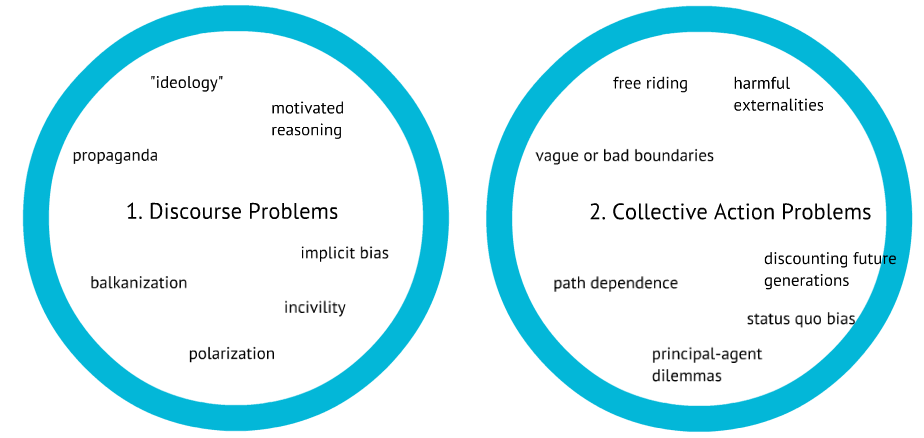
Human beings face two fundamental categories of problems: problems of discourse and problems of collective action.

Problems of discourse make our conversations go badly, so that we believe or desire the wrong things. They include, for example, our unconscious biases in favor of members of our members of our own groups and our strong tendency to “motivated reasoning,” or picking facts and theories because they yield the results we want. A different example is ideology, defined (in this context) as holding a distorted view of reality that preserves the advantages of the privileged.

Meanwhile, problems of collective action cause us to get results that we do not desire, even when we agree about goals and values. An example is the temptation to “free ride” on other people’s contributions, or the extreme cost of changing a system once it has been chosen and developed (“path dependence”).
Screen Shot 2015-02-10 at 10.20.04 AM

How can I justify the claim that these are the two fundamental categories of problems? My claim is subjective, but it does arise from 20 years of thinking about social problems, during which I have constantly found myself drawn to two quite different conversations. One is about deliberation, communication, and the flaws thereof. The most relevant disciplines are political philosophy, cultural studies, and communications. Famous authorities include Marx and the Frankfurt School, Habermas, Derrick Bell, John Rawls, Judith Butler, and many more. The other conversation is about rational choice, public choice, and game theory. The most relevant disciplines are economics and social psychology. Authorities include Elinor Ostrom, James M. Buchanan, Mancur Olson, and Kahneman & Tversky.

The two sets of problems are connected. For instance, one explanation of motivated reasoning is that to choose the most convenient facts is easier than giving all the evidence a full and rigorous consideration; and we can get away with the easier path because we can free-ride on other people’s intellectual labor. Thus the discourse problem of motivated reasoning is linked to a basic collective action problem.

Yet neither set of problems is, in my view, reducible to the other. For instance, a very ambitious game theorist might assume that game-like models can explain all breakdowns of human interaction. But game theory takes as given the values and identities of the players. In fact, those are not fixed but are generated and changed by discourse.

By the same token, some cultural critics might argue that all of our problems arise from distorted discourse, bias, and ideology. But I think that even if we all sincerely agreed about something as important as climate change, problems of collective action would still be formidable. We would not only face the mother of all tragedies-of-the-commons but also challenges of path dependence (e.g., our dependence on internal combustion engines) and boundary issues (the countries that use the most carbon are separated from the big producers).

I am well aware that we also face a whole range of urgent concrete problems not shown above, such as global warming or racism today–or (at other times in our history) plagues and famines and invading hordes. But while those threats are matters of life and death for specific communities, the two categories shown above apply at all times. They establish the form of human interaction, into which are poured such specific content as poverty, racism, authoritarianism, disease, etc.

I was trying to think of a place where demographic diversity would be absent and where there would be such a high degree of consensus about one transcendent goal that the participants would not care about matters like poverty or climate change. In such a place, we might see neither discourse problems nor collective action problems. I came up with the all-male Orthodox Holy Community of Mount Athos, which is now a quasi-autonomous monastic republic within the EU. Although I certainly do not know the details, I quickly found an example of the two generic problems afflicting this community:

In June 1913, a small Russian fleet, consisting of the gunboat Donets and the transport ships Tsar and Kherson, delivered the archbishop of Vologda, and a number of troops to Mount Athos to intervene in the theological controversy over imiaslavie [the belief that the Name of God is God].

The archbishop held talks with the imiaslavtsy and tried to make them change their beliefs voluntarily, but was unsuccessful. On 31 July 1913, the troops stormed the St. Panteleimon Monastery. Although the monks were not armed and did not actively resist, the troops showed very heavy-handed tactics. After the storming of St. Panteleimon Monastery, the monks from the Andreevsky Skete (Skiti Agiou Andrea) surrendered voluntarily. The military transport Kherson was converted into a prison ship and more than a thousand imiaslavtsy monks were sent to Odessa where they were excommunicated and dispersed throughout Russia.

If a bunch of white men who have voluntarily renounced property, sex, and freedom and who are totally devoted to the Orthodox faith can face deadly problems of discourse and collective action, then these challenges seem universal. That doesn’t mean they always defeat us; it just means we always have to work on them.

social criticism as reading social forms

Patterns and forms are very common in the social world. In Forms: Whole, Rhythm, Hierarchy, Network, my sister Caroline Levine focuses on the four forms named in her title. She acknowledges that her list may not be exhaustive, and one form that I might add is clustering, which arises when cases congregate near a mode that is seen as normal. But certainly, her four forms are ubiquitous.

To take a very simple example: Employees A and B work at Organization C. (They are within the same bounded whole). A was hired first, has more seniority, and will retire first. (Rhythm.) A supervises B. (Hierarchy). A and B exchange information. (Network.)

Some social theorists would argue that one of these forms is logically or temporally primary or is simply more important than the others across a wide range of cases. For instance, Marx recognized trade networks and the bounded wholes of states and classes, but for him, the key question was hierarchy: which class was dominant? Some current network theorists are eager to understand everything (including organizations’ hierarchies) as special forms of networks. But there is no a priori reason to presume that any of these forms is primary. They overlap and interact. If, within some broad domain (such as religion, or America, or postindustrial capitalism) one form is most important, that is an empirical generalization, not an analytical truth.

Why do we use certain forms to construct society?

I can imagine three mutually compatible reasons for the frequent appearance of these forms in the social world. First, they work. They have various practical advantages, or, as Caroline says, “affordances.” If you want to protect a group, then building a wall or perimeter around them can be a good idea. If you want information to flow, then a network of dirt paths or fiber-optic cables can be useful. Sometimes what people intend is irrelevant. A form just turns out to have practical value, and therefore it survives and spreads regardless of the intentions of its designers, revisers, and adopters.

Second, the same forms and patterns are very common in nature, and particularly in biology, where the study of them is known as morphology. Sometimes we imitate natural forms as we construct social phenomena.

Third, our brains may be designed to detect the forms found in nature, so that we are good at making (and also noticing) similar forms in society and culture. My dog is good at noticing bounded wholes (the perimeter of our house or any place we stay), rhythms (he expects to be fed at exactly 6:00 pm) and hierarchies (he understands himself as the lowest creature on the family’s organizational chart). But I am not sure he recognizes networks. If humans shared that limitation, then our society might not have any networks—because we couldn’t create them—or it might have networks that we couldn’t detect. And just as Barkley probably cannot see networks, we may miss forms that arise in nature or society.

By the way, we are not considering categories such as before and after or near and far that might be viewed as features of being (Aristotle) or thought (Kant). We are rather considering concrete and constructed distinctions such as inside/outside the prison or on the sabbath/on a workday. The question is not whether these distinctions are metaphysical or epistemological (or linguistic). They are social facts that we make. The question is whether they resemble similar forms in nature because lawlike tendencies govern both domains, because we choose to copy nature, or because we think that we see forms in nature that look like the forms of our social life.

Emile Durkheim navigated these waters and found himself, I would say, in roughly the right place. He held that the categories of thought had social origins. For instance, the rhythms of time with which a scientist measures biological or geological change have origins in the social rhythms of work and festivals.

But if the categories originally only translate social states, does it now follow that they can be applied to the rest of nature only as metaphors? If they were made merely to express social conditions, it seems as though they could not be extended to other realms except in this sense. Thus in so far as they aid us in thinking of the physical or biological world, they have only the value of artificial symbols, useful practically perhaps, but having no connection to reality….

But when we interpret a sociological theory of knowledge in this way, we forget that even if society is a specific reality it is not an empire within an empire; it is a part of nature, and indeed its highest representation. The social realm is a natural realm which differs from the others only by a greater complexity. …. The fundamental relations that exist between things … cannot be fundamentally dissimilar in the different realms. [The Elementary Forms of the Religious Life, trans. J.W. Swain, 1915]

Thus, by building and interpreting social structures that involve boundaries, rhythms, hierarchies, and networks, we gain the vocabulary and conceptual apparatus to attain real understanding of similar forms in nature.

Value judgments of social forms

One thing that we do—and nature does not—is to make value judgments about the instantiations of the various forms. For instance, if A supervises B, we may judge that wise and fair, unfortunate but necessary, or oppressive. If A and B belong to the same organization, but C does not, we may likewise judge that arrangement to be desirable, acceptable, or unjust. And of course, we can broaden the lens, making judgments not about A and B but more generally about employment, organizations, states, and markets. Asked why we make any of these judgments, we may cite a whole range of relevant value considerations: equity, liberty, desert, obligation, virtue, precedent, and more.

We could think of each judgment as a tag or descriptor applied to the case under consideration, but here is where I see my own recent work on moral networks as relevant. After all, our various judgments are connected. They form structures of their own.

In fact, it has often been noted that moral judgments can take the form of bounded wholes. All lies are unethical, Kant argued—putting a boundary around a large set of cases.

It has also often been noted that moral judgments can be placed in hierarchies. J.S. Mill began On Utilitarianism: “From the dawn of philosophy, the question concerning the summum bonum, or, what is the same thing, concerning the foundation of morality, has been accounted the main problem in speculative thought, has occupied the most gifted intellects, and divided them into sects and schools, carrying on a vigorous warfare against one another.” Highest goods and foundations are metaphors of hierarchy. For Mill, the principle of utility was supposed to govern our other moral ideas, much as the leader of an organization directs her employees.

And it has often been noted that moral thought, which has extension in time, involves rhythms. You sow what you reap; punishment follows the crime. Far more complex moral rhythms can be found in novels and works of narrative history.

I am interested in adding moral networks to the other three types of moral forms (boundaries, hierarchies, and narratives), because I believe that we connect our specific moral ideas to others in numerous meaningful ways. We see causation, implication, similarity, and other relations between pairs of moral ideas; and the result is a complex network that has interesting network features (centrality, modularity, gaps). But this way of thinking about morality does not exclude the categories of wholes, rhythms, and hierarchies. In fact, often the ideas that we connect together into networks are claims about boundaries; portions of our networks take the form of hierarchies; and our networks evolve over time.

So now we see at least four formal types (the keywords in Caroline’s title) playing out in at least three domains: nature, society, and ethics. Moreover, those three domains are intimately linked. Durkheim already explored how biological and social forms connect. I would add that moral judgments are closely and reciprocally connected to social forms. B accepts A’s supervision because both believe that A has an obligation to guide B. (Then the social form gains its power from its perceived moral significance.) A stranger who independently criticizes their arrangement must have learned to make her judgments as a social being enmeshed in her own wholes, rhythms, hierarchies, and networks. (Her moral structure has a social origin). She thinks that B should be liberated from A’s oversight because she has observed a different society in which people are not so supervised. (Her moral norm derives from analysis of an actual social structure). And so on.

Moral judgment deals with emergent and evolved natural and social realities rather than simple categories and scenarios. Social realities are complex because millions of diverse people have constructed them over long periods and under conditions of imperfect communication, collective-action problems, path-dependence, incomplete information, mixed motives, etc. Hardly any societies look neatly designed.

If we make value judgments based on rough heuristics and instincts that our ancestors acquired millennia ago in simpler social situations, we are poorly prepared to deal with this complexity. To the extent that our instincts guide us, we are prone to serious error. But instincts may not guide us to the degree that it appears if one studies moral psychology by asking subjects their gut reactions to stylized cases, such as out-of-control trolley cars. What we actually do all day is to navigate complex, overlapping social forms. We may be a bit better at that task than current psychological data suggests.

Implications for structure and agency

Learning to make better moral judgments is then a matter of interpreting complex, overlapping forms—not only social structures but also moral ones. I am interested in solitary methods for improving that analysis, such as literally mapping our own networks of moral ideas and looking for formal strengths and weaknesses.

But we have grave cognitive limitations, so moral learning is intrinsically social and cumulative. Durkheim again:

Collective representations are the result of an immense co-operation, which stretches out not only into space but into time as well; to make them, a multitude of minds have associated, united and combined their ideas and sentiments; for them, long generations have accumulated their experience and their knowledge. A special intellectual activity is therefore concentrated in them which is infinitely richer and complexer than that of the individual.

This seems correct as far as it goes, but it can imply that individuals really don’t have much agency or choice and we cannot achieve intentional social improvements. Consider this passage from Talcott Parsons’ An Outline of the Social System (1961):

… As the source of his principal facilities of action and of his principal rewards and deprivations, the concrete social system exercises a powerful control over the action of any concrete, adult individual. … The patterning of the motivational system in terms of which he faces this situation also depends upon the social system, because his own personality structure has been shaped through the internalization of systems of social objects and of the patterns of institutionalized culture. This point, it should be made clear, is independent of the sense in which individuals are concretely autonomous or creative rather than “passive” or “conforming,” for individuality and creativity are, to a considerable extent, phenomena of the institutionalization of expectations.

Although Parsons denied he was dismissing agency, this passage certainly seems to. But we can look at the same phenomena another way. Some social systems reflect accumulated, collaborative learning. They do not just exist and control us; we have made them, working together and expressing our diverse values and interests. They are also responsive to our further learning.

To the extent that we persuade ourselves that existing patterns are all-powerful, we renounce our capacity and obligation to change them. The opposite view has been staked out by Roberto Mangabeira Unger, who argues in False Necessity that the analysis of society in terms of inflexible structures arbitrarily blocks our freedom. Unger takes “to its ultimate conclusion” the thesis “that society is an artifact” (p. 2). All our institutions, mores, habits, and incentives are things that we imagine and make. Unger “carries to extremes the idea that everything in society is politics, mere politics”–in the sense of collective action and creation (p. 1). According to Unger, even radical modernists have assumed that some things are natural, although we can actually change them. Importantly, radicals have assumed that the relations between one domain (or type of form) and another are given. For instance, for Marxists, the economy is fundamental and it always determines politics. Unger thinks we can change any part of the picture. He wants to get rid of all “superstitious inhibitions.”

I am drawn to Unger but worry that his mechanical model overlooks the degree to which a society is like an organism: sensitively interconnected and not so easy to retool without doing unanticipated damage. In any case (and here Unger would agree), social systems differ in the extent to which they embody and enable collaborative learning.

Caroline uses the depiction of Baltimore in HBO’s series The Wire as an exemplary analysis of overlapping social forms, which it is. And Baltimore (as depicted in The Wire) does reflect some democratic agency and learning—more so than North Korea would, even though North Korea could also be interpreted as a pattern of human-made boundaries, hierarchies, networks, and rhythms. But even if Baltimore is better than North Korea, it is far from optimal as a venue for democratic learning because of poverty, violence, racism, and bad institutional design.

In The Public and its Problems, John Dewey wrote (p.158), “philosophy [once] held that ideas and knowledge were functions of a mind or consciousness that originated in individuals by means of isolated contact with objects. But in fact, knowledge is a function of association and communication; it depends upon tradition, upon tools and methods socially transmitted, developed, and sanctioned.” Nevertheless, said Dewey, we need not continue doing what we have done so far. We can ask whether we should change our political system. As Hilary Putnam Putnam writes in “The Three Enlightenments” (from “Ethics without Ontology”):

For Dewey, the problem is not to justify the existence of communities, or to show that people ought to make the interests of others their own [that much is natural and unavoidable]; the problem is to justify the claim that morally decent communities should be democratically organized. This Dewey does by appealing to the need to deal intelligently rather than unintelligently with the ethical and practical problems that we confront.

To conclude: we must analyze any social situation for its formal patterns. We must make value judgments about those patterns. Our value judgments are also patterned, so we should reflect on their structure, not only on each opinion by itself. Finally, we must ask whether these patterns (in the social world and in our own thought) permit human agency and desirable change. Effective and responsible agency is not solitary but requires deliberation with people different enough from ourselves that their perspectives challenge and expand ours, but close enough to us that we can build new structures with them using the shared material at hand. In turn, that requires certain political and social conditions, which we must work to attain.