Category Archives: philosophy

the sublime and other people

Early last month, I posted a little poem in celebration of a deep snowfall. I was hardly the first. People appreciate natural phenomena, find ways to represent aspects of what they see, and share the results. We have done this, I suppose, for at least 64,000 years, since the oldest cave paintings we know.

In some cases, an explicit goal is to thank a benevolent power for the gift. For instance, I love how Gerard Manley Hopkins detects a Divine Father behind all “dappled things“–like “skies of couple-colour” or “a brinded cow.” “Praise Him,” says Hopkins. Unfortunately, I cannot share that type of explanation.

For others, the theme is the objective beauty of nature, understood as impersonal but perfect. “The hills / Rock-ribbed and ancient as the sun,—the vales / Stretching in pensive quietness between …” I must admit that I am struck by the subjectivity of such judgments. Our dog appreciates, but I don’t think he is much taken by distant vistas of snow on sagging branches. Smelly fire hydrants are closer to his sublime. A nest of cockroaches has as much objective complexity and order as a snow-covered forest, but most of us human beings (although not all of us) would recoil from it. Nature gives us pure drifts of fresh snow, but also muddy slush and freezing rain. These examples cause me to doubt that beauty lies in nature.

Another response is that we are constituted to enjoy things like snowy views, and this is a wonderfully good fact about us. Just as we may lament our human proclivities to violence, despair, and cruelty, so we can celebrate our ability to savor what we find sublime. And not only celebrate it, but actively cultivate this appreciation and share it with other people through the representations that we create. In that case, the beauty is essentially in us, but it is really there, and that is a reason for gratitude.

I don’t know whether human beings are automatically constituted to enjoy a snowscape. Perhaps we are, but our responses could vary by personality and culture. I am sure that my own appreciation is something learned. I do not simply see the snow; I see it with things already in my mind, like Christmas decorations, paper snowflakes on second-grade bulletin boards, Ezra Jack Keats’ A Snowy Day, Pieter Bruegel the Elder’s “Hunters in the Snow,” Han-shan’s Cold Mountain lyrics, Robert Frost’s ”lovely, dark and deep” woods, Hiroshige’s woodblock prints of wintry Japan, Rosemary Clooney with Bing Crosby. In short, I have been taught to appreciate a winter wonderland, a marshmallow world, and a whipped cream day. Some of these influences probably detract, but they were meant well, which is how I would defend “Hush.”

It’s sometimes said that when Petrarch climbed Mont Ventoux (in Provence) in 1336–simply to enjoy and describe the view–he was the first European ever to do such a thing. Clearly, some people outside of Europe had loved mountain views long before Petrarch. I find it plausible that certain communities of people appreciate vistas, while others do not. And some of us may have learned the sublimity of landscapes from a chain of people originally inspired by Petrarch, although he was surely influenced by the classical sources that he knew so well. We all see what we have learned to see.

To me, this debt to other human beings only deepens the sublime. Nature was not created for us; it just is. And we were not created to enjoy it, although–very fortunately–we do. But our fellow human beings have deliberately shared their appreciation and heightened our own, which means that we are the beneficiaries of benevolent intelligence after all. Praise them.

modeling a political discussion

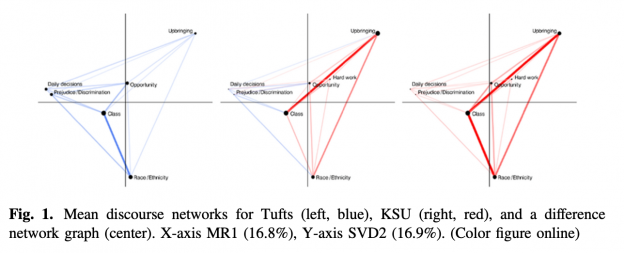
In 2015, students at my university, Tufts, and at Kansas State University discussed the same topic–the social determinants of health–in online forums. Colleagues and I analyzed the text in a novel way. The underlying theory is that conversations can be modeled as networks, where the nodes are specific ideas and the links are reasons and other connections that people assert. Specifically, we sought to use Epistemic Network Analysis (ENA) to model and compare the conversations. ENA is now very easy to use online and I have been playing with it for other purposes. One of its distinctive features is its ability to locate specific ideas at meaningful locations on a two-dimensional graph so that you can see dimensions of agreement and disagreement.

Our results are now published as Peter Levine, Brendan Eagan & David Williamson Shaffer, “Deliberation as an Epistemic Network: A Method for Analyzing Discussion,” in Barbara Wasson and Szilvia Zörgo (eds.), Advances in Quantitative Ethnography, proceedings of the Third International Conference, ICQE 2021 Virtual Event, November 6–11, 2021 (Springer Switzerland, 2022), pp. 17-33.

The image I reproduce with this post shows one particular ENA visualization of the discussions. The one at Tufts is in blue; the one at KSU is in red; and the one in the middle shows the difference between them (literally, the Tufts network subtracted from the KSU network).

You would have to read our paper to get a full explanation, but here is a glimpse. Basically, the Tufts students tended to connect inequities in health with race and class. Some of the KSU students also made those connections, but some of them drew connections between bad health outcomes and personal behavior, for which they blamed individuals’ upbringings. Thus the KSU discussion roughly looks like a triangle with three corners (race and class, personal choices, and health outcomes), while the Tufts discussion omits one of those corners.

The same result might have been clear enough from a conventional approach–reading, interpreting, and (possibly) coding the transcripts. However, we argue that the plausibility of the ENA findings validates the method, which can then be used to model other discussions.

individuals in cultures: the concept of an idiodictuon

In linguistics, a language is a whole system of communication used by a group, encompassing its semantics, grammar, and pragmatics. A dialect is a particular form of a language typical of a specific region. A sociolect is like a dialect, except that it is used by a dispersed social group, such as a profession or a class. A register is a form of a language used in a particular situation or context, such as by lawyers in court. And an idiolect is the distinctive way that an individual speaks: that person’s active vocabulary, grammar, accent, and preferred forms and style of speech.

Previous authors have used these distinctions from linguistics to inform models of culture. Language offers a useful model or example for understanding culture because we are familiar with explicit efforts to learn second languages, to list components of a given language in a dictionary, and to invent a writing system to represent a language (Goodenough 1981, p. 3; Goodenough 2003). I am especially interested in the aspects of culture that involve value-judgments: ethics, politics, aesthetics and religion.

I believe the following ten points from linguistics are relevant to thinking about culture (in general) and specifically about values:

  1. Registers, dialects, sociolects, and languages all encompass variation. Each person talks and understands differently from others and evolves as a speaker over time. Therefore, the same body of communication by real human beings can be carved up in many ways. For instance, we can draw a dialect map of the USA that shows more or fewer regions, and we can declare the same material to be a language or a dialect depending on whether we prefer to accentuate differences or similarities.
  2. Idiolects do not nest neatly inside dialects and sociolects, which do not not nest neatly inside languages. They are more like complex Venn diagrams. An individual may draw on several dialects or languages. In cases of code-switching, the individual sometimes uses one register or sociolect and sometimes switches to a different one. Or people may consistently use a mix of influences from multiple sources. For instance, Spanglish is characterized by Spanish influences on English–and there are several different regional Spanglish dialects within the United States today. On the other hand, imagine an elderly American whose speech reflects some influence of Yiddish from the old country. Her idiolect is then not part of any dialect but is a unique mix of two languages with which she may successfully communicate even though no one else nearby sounds like her.
  3. Nobody knows all of any given language, dialect, or sociolect. An effort to catalogue an entire language describes a body of material that none of the users know in full. For instance, nobody knows all the meanings of all the words in an impressive dictionary (which is, itself, an incomplete catalogue of the entire language). Instead, people share sufficient, overlapping portions of the whole that they can communicate, to varying degrees.
  4. Each of us knows our own entire idiolect. (That is what the word means.) However, we could not fully describe it. For instance, I would not be able to sit down and list all the words I know and all the definitions I employ of those words, let alone the grammatical rules I employ. If I were presented with a dictionary and asked which words I already know, I would check too many of them. The dictionary would prompt me to recall words and meanings that are normally buried too deep in my memory for me to use them. That brings up the next point:
  5. Language is dynamic, constantly changing as a result of interaction. A language constantly borrows from other languages. A person’s idiolect is subject to change depending on whom the person talks to. The best way to characterize an idiolect or a language (or anything in between) is to collect a corpus of material and investigate its vocabulary and grammar. That is a worthwhile empirical exercise, but it requires a caveat. The corpus is a sample taken within a specific timeframe. The idiolect or the language will change.
  6. It is possible to make a language (or a smaller unit, like a sociolect) relatively consistent among individuals and sharply distinguish it from other languages. For instance, a government can set rules for one national language and encourage or even compel compliance through schooling, media, religious observance, and even criminal penalties. Law schools teach students to talk like lawyers in court. However, there are also language continua, in which local people speak alike, people a little further away speak a little differently, and so on until they become mutually unintelligible. Before the rise of the nation-state and modern mass media, language continua were much more common than sharply distinguishable languages. Linguistic boundaries require exercises of power that are costly and never fully successful. Meanwhile, at the level of an idiolect, individuals may strive to make their own speech consistent and distinctive or else let it change dynamically in relation with others. People vary in this respect.
  7. Language is–in some way or degree–holistic. That is to say, the components of a language depend on other components. For instance, a definition of a word uses other words that need definitions. I leave aside interesting and complicated debates about holism in the philosophy of language and presume that some degree of holism is inescapable.
  8. Therefore, it can be helpful to diagram an idiolect, a dialect, or a language as a network of connected components rather than a mere list. I am not saying that language is a network; language is language. However, semantic network diagrams are useful models of idiolects, dialects, and languages because they identify important components (e.g., words) and connections among them. A semantic network diagram for a group of people will capture only a small proportion of each individual’s language but may illuminate what they share, showing how they communicate effectively.
  9. While words and other components of language are linked in ways that can be modeled as networks, people also belong to social networks, linked together by relationships of influence. A celebrity influences many others because many people receive her communications. The celebrity is the hub of a large social network. At the opposite extreme, a hermit would not influence, or be influenced by, anyone (except perhaps by way of memories).
  10. Whole populations change their languages surprisingly quickly, and sometimes without mass physical migration. The same population that spoke a Celtic language (Common Brittonic), transitioned partly to Latin, then fully to Germanic Anglo-Saxon, and then to a mixture of Anglo-Saxon and French without very many people ever moving across the sea to England. Today about 33 million people in South Asia also speak dialects of it. A few people can strongly influence a whole population due to their network position–which, in turn, often reflects power.

The point of this list is to suggest some similarities with other aspects of culture. Like a language, another part of a culture can be modeled as a shared network of components (e.g., beliefs, values, or practices) as they are used by people who are organized in social networks, which reflect power.

Such a model is a radical simplification, because each individual holds a distinctive and evolving set of components and connections (e.g., linked moral values); but simplifications are useful. And we can model culture usefully at multiple levels, from the individual to a vast nation.

There are precedents for this kind of analysis. The anthropologist Ward Hunt Goodenough encountered the concept of idiolects in the 1940s, while studying for a doctorate in anthropology (Goodenough 2003). By 1962, he had postulated the idea of “each individual’s private culture, if we may call it that, [which] includes his conception of several wholly or partially distinct cultures (some well elaborated and others only crudely developed in his mind) which he attributes to others individually and collectively, both within and without his community. A person’s private culture is likely to include knowledge of more than one language, more than one system of etiquette, more than one set of beliefs, more than one hierarchy of choices, and more than one set of principles for getting things done” (Goodenough, 1963, 261)

Later, Goodenough named a private culture a “propriospect” from the Latin words for “private” and “view” (Goodenough 1981, p. 98). Harry Wolcott summarizes: “Propriospects … are networks of sense-making connections created and constantly being reformulated by each of us out of direct experience. As we develop and refine our competencies, simultaneously we ‘construct” (and continually ‘re-model’) our individual propriospects” (Wolcott 1991, p. 267).

Individuals may actually share fundamental characteristics of a group, they may perceive themselves to share those characteristics, and they may be viewed by others as sharing them–but these perceptions do not necessarily align, because every group encompasses diverse propriospects. For instance, you might think that believing in God is essential to a culture; and since you believe in God, you are part of that culture; but someone else may define the culture differently and view you as an outsider.

In a review of Goodenough, Mac Marshall (1982) wrote, “While some may disagree with the finer points of his argument, his position on these matters represents the dominant orientation in American anthropology today.”

A different precedent derives from the Polish tradition of humanistic sociology, founded by Florian Znaniecki in the early 1900s. In the 1980s, a Polish sociologist named Marek Ziolkowski (later a distinguished diplomat) wrote interestingly about “idio-epistemes” (presumably from the Greek words for “private” and “knowledge”) meaning “not only … the cognitive content of an individual’s consciousness at a given moment, but … the whole potential content that can be activated by the individual at any moment, used for definite action, and reproduced introspectively.”

Ziolkowski called on sociologists to “enquire into the social regularities in the formation of idio-epistemes, seek relationships among them, establish basic intragroup similarities an intergroup differences.” He acknowledge that any individual will have a unique mentality, “yet every individual shares an overwhelming majority of opinions and items of information with other definite individuals and/or groups.” Those similarities arise because of shared environments and deliberate mutual influence. Ziolkowski coined the word “socio-episteme” for those aspects of an idio-episteme that are shared with other individuals. As he noted, these distinctions were inspired by concepts from linguistics.

Even earlier, in 1951, the psychologist Saul Rosenzweig had coined the word “idioverse” for an individual’s universe of events” (Rosenzweig 1951, p. 301).

An analogous move is Wilfred Cantwell Smith’s influential redefinition of “religion” from a bounded system of beliefs (each of which contradicts all other religions in some key respects) to a “cumulative tradition” of thought and behavior that varies internally and overlaps with other traditions (Smith 1962). According to this model, everyone has a unique religion, although shared traditions are important.

These coinages–idioverse, propriospect, idio-episteme, and cumulative tradition–capture ideas that I would endorse, and they reflect research, respectively, in psychology, anthropology, sociology, and religious studies. However, none of the vocabulary has really caught on. There may still be room for a new entrant, and I would like to emphasize the network structure of culture more than the previous words have done. Thus I tentatively suggest idiodictuon, from the classical Greek words for “private” and “net” (as in a fishing net–but modern Greek uses a derivation to mean a network). An individual has an idiodictuon, a group has a phylodictuon, and a whole people shares a demodictuon.

These words are unlikely to stick any better than their predecessors, but if they did, it would reflect their diffusion through a social network plus their utility when added to people’s existing networks of ideas. That is how all ideas propagate, or so I would argue.

A final point: “culture” encompasses an enormous range of components, including words, values, beliefs, habits, desires, and many more. Given this range, it is useful to carve out narrower domains for study. Language is one. I am especially interested in the domain of values, so I would focus on the interconnections among the values that people hold.

Note, however, that there is no neat way to distinguish values from other aspects of culture, such as desires and urges or beliefs about nature. In his influential empirical theory of moral psychology, Jonathan Haidt identifies at least five “Moral Foundations,” one of which is “sanctity/degradation.” I would have treated this category as a powerful human motivation, akin to sexual desire or violence, but not as a moral category, parallel to “care/harm.” Maybe Haidt is right, or maybe I am, but the evidence isn’t empirical. People actually see all kinds of things as the basis for action and make all kinds of connections among the things they believe. They may link a moral judgment to a metaphysical belief, or a personal aversion, or an aspect of their identity, or a belief about prevailing norms. When we carve out an area for study and call it something like “morality” or “ethics” (or “religion,” or “politics”) we are making our own claims about how that domain should be defined. Such claims require philosophical arguments, not data.

So the steps are: (1) define a domain, a priori, (2) collect a corpus of material relevant to that domain, (3) map it as a network of ideas, and (4) map the human relationships among people who hold different idiodictuons.

For me, the ultimate point is to try to have better values, and the study of what people actually value is preparatory for that inquiry. Clifford Geertz concludes his famous “Thick Description” essay: “To look at the symbolic dimensions of social action–art, religion, ideology, science, law, morality, common sense–is not to turn away from the existential dilemmas of life for some empyrean realm of de-emotionalized forms; it is to plunge into the midst of them. The essential vocation of interpretive anthropology is not to answer our deepest questions, but to make available to us answers that others, guarding other sheep in other valleys, have given, and thus to include them in the consultable record of what man has said.” 

References:

  • Geertz, Clifford, “Thick description: Toward an interpretive theory of culture.” In Geertz, The interpretation of cultures. Basic books, 1973. (pp. 41-51).
  • Goodenough, Ward, Cooperation in change : an anthropological approach to community development. New York, Russel Sage 1963
  • Goodenough, Ward H. In Pursuit of Culture, Annual Review of Anthropology 2003 32:1, 1-12
  • Goodenough, Ward H. Culture, Language and Society (Menlo Park: Benjamin Cummings, 1981)
  • Mashall, Mac, “Culture, Language, and Society by Ward H. Goodenough” (review), American Anthropologist, 84: 936-937.
  • Rosenzweig, Saul. “Idiodynamics in Personality Theory with Special Reference to Projective Methods 1.” Dialectica 5, no. 3-4 (1951): 293-311.
  • Smith, William Cantwell, The Meaning and End of Religion (1962), Fortress Press Edition, Minneapolis, 1991
  • Wolcott, Harry F. “Propriospect and the acquisition of culture.” Anthropology & Education Quarterly 22, no. 3 (1991): 251-273.
  • Ziolkowski, Marek, “How to Make the Sociology of Knowledge Sociological?.” The Polish Sociological Bulletin 57/60 (1982): 85-105.

See also individuals’ ideologies as networks; ideologies and complex systems; judgment in a world of power and institutions: outline of a view; from I to we: an outline of a theory, etc.
compassion, not sympathy

This is a passage from Seneca’s On Clemency (written in 55–56 CE):

Pity [1] is a sickness of the soul due to the sight of others’ suffering, or a sadness caused by someone else’s misfortunes which one believes to be undeserved; but no sickness can affect a wise man [2], for his mind is serene and nothing can get through to it that he guards against. Besides, nothing is as becoming to a man as a great soul, but it is impossible to be both great and sad. Sadness breaks the mind into pieces, throws it down, and collects the parts, but this cannot happen to a wise one [3] even in a disaster. Instead, he will repulse any outrage of fortune and shatter it to pieces before him, always maintaining the same appearance–quiet, firm–which he couldn’t do if he were overcome with sadness.

Also to be considered: a wise person discerns the future and makes decisions without interference, yet nothing clear and lucid [4] can flow from turbulence. Sadness is unfitted for discerning circumstances, planning useful tasks, evading dangers, weighing equities. Therefore, the [wise person] will not feel pity, because there cannot be pity without suffering of the soul. [5]

Whatever others who feel pity want to do, he will do freely and with a lofty spirit. He will help those who weep, but not weep with them [6]. He will reach a hand to the drowning, welcome the exile, donate to the poor, not in the abusive way of most people who want to be seen as pitying–they toss something and flinch in disgust at those whom they aid, as if they feared to touch them–but as a man gives to a man from the common pool. He will return the child to the weeping mother, unfasten chains, save people from [gladiatorial] games, and even bury the stinking body, but he will do these things with a tranquil mind, of his own will. Thus the wise person will not pity but will assist and be of use, having been born to help all and for the public good, from which he will distribute shares to all. He will even give from his store to those sufferers who deserve a portion of blame and correction, but he will be even more pleased to assist those who are genuinely unfortunate. Whenever he can, he will counter fortune, for what better use of his powers than to restore what fortune has overturned? He will certainly not cast down his eyes or his soul toward someone who is shriveled or ragged and meagre and leaning on a staff; instead he will do good to all and kindly regard all who suffer, like a god.

Pity is close to suffering [7]; it even has something in common with it and derives from it. You know eyes to be weak if they water at the sight of someone else’s bleariness, just as, by Hercules, it is a disorder and not a case of merriment when people laugh just because others laugh or yawn whenever someone’s mouth opens. Pity is a flaw in the soul of one who feels suffering too much, and he who expects it from a wise person is not so different from someone who expects lamentations at a stranger’s funeral.

Seneca’s De Clementia (2.5.4-2.6.4), trans. Peter Levine

The topic of this book is clemency (clementia) which in modern English means a virtue or prerogative of governors and other rulers. Seneca addresses the young Emperor Nero and urges him to exhibit clemency (I:v). Emperors were sometimes addressed with the honorific “clemens” (similar to “your grace”), presumably to play to their good side.

However, a different meaning of clementia was calmness or mildness. The weather could be clement, and so could a human mind. Anyone could direct this kind of clementia toward anyone else. A better translation than “clemency” might be “compassion.” Seneca contrasts it with misericordia, which I have translated as “pity” to capture its negative connotations. (After all, nobody wants to be pitied.) But misericordia is close to the modern word “sympathy.” So let us consider the differences between clementia as compassion and misericordia as sympathy.

“Sympathy” means feeling some version of the same emotion that another person feels. Your friend is sad, so you feel sad for her and with her. Although I am sympathetic to the emotion of sympathy, Seneca suggests several reasons to avoid it. Feeling the same way as a suffering person does not necessarily help that person. Sympathy often comes with at least a tinge of condescension, since the person who is sympathetic does not actually experience the same circumstances as the one who suffers. By trying to replicate the sufferer’s emotions, you may undermine your ability to help. And by tying your emotions to another person’s state of mind, you expose yourself to fortune. This is not a reliable way to achieve your own happiness.

Instead, those who suffer deserve to be assisted effectively by people who genuinely respect them. The helper should not try to mirror their emotions but should display a different emotion: clear-headed and equitable good-will. To name that emotion “compassion” is a bit confusing, since it has precisely the same root meaning as “sympathy,” which is a suggested translation of misericordia. (Com = sym = with. Passio = pathos = feeling). Nevertheless, compassion seems to be the word we would use for Seneca’s idea of disinterested benign sentiments (2.6.3) that we exercise freely and with a tranquil mind (2.6.2). It can translate the Sanskrit word karuna, which is fundamental in Buddhism.

Seneca also relates this virtue–let’s call it compassion–to a political idea: equal standing and a common claim on the public good. Even though Seneca addresses De clementia to Nero, I think that in this passage, he describes a republican virtue, appropriate for relations among equals who co-own the commonwealth. (It is interesting that he doesn’t actually use “clementia” in these chapters of the book.)

A compassionate person is not exposed to chance. If we feel worse as another person worsens, and better as he improves, then we demonstrate sympathy, which subjects us to fate. But compassion remains unchanged regardless of the state of the sufferer. Compassion can even fill the mind’s attention, thus displacing emotions that are the cause of discomfort.

One question for me: is sympathy a path to compassion or is it a diversion or a dead end? There is a long tradition in Buddhism of cultivating an imaginative identification with another sentient being, feeling its pain, and “exchanging self and other” (e.g., Shantideva, Bodhicaryavatara, 7:16) The goal is to shake one’s attachment to oneself and begin a journey from selfishness to concrete sympathy for specific others, and from there to generalized good-will for all, or karuna. I can’t criticize this path without having been taught it properly or seriously tried to practice it, but Seneca makes me wonder whether intense involvement in another’s suffering might detract from the cultivation of compassion rather than setting us on the right track.

Notes: [1] misericordia; [2] gendered in the original (vir); [3] not necessarily gendered; [4] socerumque, which doesn’t make sense to me unless it should read serenumque; [5] ergo non miseretur, quia id sine miseria animi non fit; [6] non accedet = not come near them; [7] Misericordia vicina est miseriae. See also: Horace against the Stoicshow to think about other people’s interests: Rawls, Buddhism, and empathyempathy, sympathy, compassion, justice; empathy boosts polarization; empathy and justice, “you should be the pupil of everyone all the time” ; Foucault’s spiritual exercises; John Stuart Mill, Stoic; etc.

what would happen to race in a just world?

What is Race? Four Philosophical Views (2019)* presents a debate among four sophisticated, current philosophers of race. All the authors are committed anti-racists who are eloquent about the evil histories of the use of race. They would take similar views on most political controversies involving race. All would reject what Kwame Anthony Appiah (quoted in Quayshawn Spencer’s chapter) called “racialism”: “the view that humans naturally divide into a small number of groups called ‘races’ in such a way that the members of each race share certain fundamental, inheritable, physical, moral, intellectual, and cultural characteristics with one another that they do not share with members of any other race.” They would all say that “racialism” is false and evil. Yet they disagree about metaphysical and methodological issues that arise when we ask what kind of a thing a race is, if it’s anything at all.

Their arguments are subtle and hard to summarize, but an example offers a way into the debate. Imagine a future state in which racial injustice is over. All implicit and explicit biases are gone. All structural inequities linked to race have been solved. All appropriate reparations have been fully paid. You can imagine this happening after many decades or centuries of political action in our real world, or as a result of a thought-experiment: aliens from another planet or divine forces have repaired things on earth. What then should happen to the word and the idea of race?

I think Sally Haslanger would say that race would then cease to exist, because it means subordination. To be a little more precise: the meaning of a social construct is the historical tradition of how it has been used in a society. Race has been used in several ways; it has multiple meanings. But one major way is as the basis for privilege and subordination in the USA. Emphasizing that aspect of the word is the right thing to do now because it “highlight[s]—in the relevant cases—how our racializing practices and identities contribute to injustice.” Once racial subordination is solved, there is no good reason to try to change the meaning of the word “race” and continue to use it. People will have races until justice prevails; after that, they will no longer have races. It can be valuable to preserve cultures, religions, and other groupings, but they should be voluntary and specific. Races don’t work like that and would no longer have any justification after the world is just. “I find problematic the idea that a just world is one in which cultural groups can restrict their membership on racial grounds. I embrace, instead, a model of multiple coexisting cultures that are mutable, flexible, and creatively tolerant around issues of ancestry and appearance.”

Chike Jeffers argues that although racial categories originated as a result of white supremacy, racial identities have developed valuable cultural significance for people of color—notably, people who identify as Black (as he does).  “Everyday talk about black people, for example, is best understood as referring to a real group to which one can belong, even if such talk often involves false assumptions.” He envisions a world in which Blackness is preserved and developed even though white supremacy has been defeated. He argues that this is logically possible and also desirable. “Race as a social construction could live on past the death of racism, in my view, given that racial groups could continue to exist as cultural groups. … The continued existence of racial diversity as cultural diversity after the end of racism is therefore, in my view, something good. … [A]s someone of sub-Saharan African descent, I personally desire the indefinite persistence of black people as a cultural group.” (He argues, too, that pan-African solidarity reflects real cultural similarities across the continent before European imperialism and racism; it is not completely reactive.)

Quayshawn Spencer argues that the races currently counted by the US government refer to “human continental populations”:  Africans, Eurasians, East Asians, Oceanians, and Native Americans. Races define distinctions that are useful empirically (mainly for medicine) although they could not possibly justify inequality. A “biologically real entity is an epistemically useful and justified entity in a well-ordered research program in biology.” Race meets this criterion. Thus “a Black person is a person with genomic ancestry from the African population. That’s it. … Furthermore, the degree to which a person is Black is equal to the proportion of her alleles that originated from the African population.” This would continue to be true under just conditions, although then all the associations between racial categories and health issues that result today from injustice would be gone.

Joshua Glasgow says that this situation would prove that race had always been false, and people had simply been racialized in a way that would no longer happen if the world became just. “Even if tomorrow all groups currently recognized as racial had equal power and participated equally in eating the world’s foods, dancing its forms of dance, playing its kinds of music, and so on—even in such a world, I do not think we’d say that on the ordinary concept of race Hillary Clinton somehow loses her whiteness or that Jeremy Lin stops being Asian because of those points of equality.” Therefore, the ordinary concept of race points to something independent of oppression and of culture, and as such, it is a wrong and false idea that should be rejected now. We should recognize and even emphasize racialized oppression but not concede the reality of race.

*Glasgow, Joshua; Haslanger, Sally; Jeffers, Chike; and Spencer, Quayshawn, What Is Race? Four Philosophical Views (Oxford University Press, 2019). See also: why social scientists should pay attention to metaphysics; how philosophy is supposed to work; is social science too anthropocentric?; social criticism as reading social forms;