Category Archives: advocating civic education

CIRCLE Commission on Youth Voting & Civic Knowledge

CIRCLE today announced the formation of a new Commission on Youth Voting & Civic Knowledge. We have organized it in response to controversies about recent voting legislation (for instance, the new state photo ID laws) as well as debates about civic education in schools and colleges. The commission will, however, take a broader view, considering a wide range of potential influences on political knowledge and engagement. It begins with no position on the existing or proposed policies; its deliberations will be heavily influenced by new data that we will collect and analyze.

The commission is funded by the Spencer Foundation, the S.D. Bechtel, Jr. Foundation, the Youth Engagement Fund, the W.T. Grant Foundation, and the Chicago Community Trust. CIRCLE will staff it.

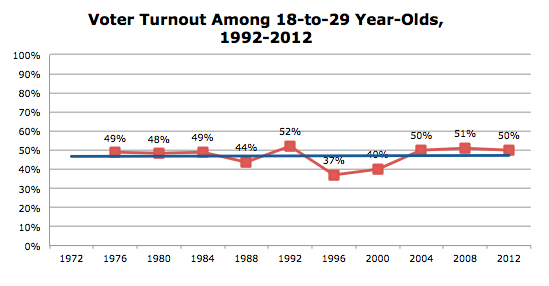
Youth turnout was comparatively strong in 2012, and enough young people voted that they effectively chose the president. Also, our preliminary analysis shows that the new voting laws had modest impact, or else efforts to combat them paid off–either way, their net effect was very small.

But these findings do not diminish the significance of the youth voting problem. In seven of the 10 elections since 1976, youth turnout has settled in a very narrow range of 48%-52% of eligible people under 30. (The only exceptional years have been worse.) Most of the young adults who vote have college experience; working-class and poor young people tend not to vote. This year’s turnout rate–50%–is really no cause for celebration, and we need to find ways to break through that ceiling and include everyone.

as Florida threatens to charge more for the humanities, those disciplines require a defense

A gubernatorial task force in Florida proposes making state university tuition cheaper for students in “high-skill, high-wage, high-demand (market determined strategic demand) degree programs.” The task force suggests that those programs may include 111 different majors in science, technology, engineering and math (STEM)–but no humanities programs. A petition organized by history professors “take[s] issue with the task force’s recommendations.” The petition turns quickly from an invocation of the “liberal arts” (undefined and undefended) to an economic argument:

The punitive differential tuition model will lead not only to a decimation of the liberal arts in Florida. It will also have a destructive impact on the essential and transferrable skills that these disciplines teach. Indeed, the Florida Council of 100 (a non-partisan organization of business leaders) submitted a lengthy memo to the task force in which the Council noted the pressing need for “liberal arts grads with superior analytical, critical thinking, and communication skills who can quickly learn and apply industry/company specific skills.”

The humanities and other liberal arts require a defense. We who teach or study them do not have an automatic right to the voters’ money. (I wrote the “voters’ money,” not the “taxpayers’ money,” because the public purse belongs to everyone on an equal basis, not just to the people who pay income or other direct taxes.) As representatives of the public, the Florida legislature is entitled to ask what it achieves by modestly subsidizing tuition in state universities and, specifically, in liberal arts departments. I don’t think that calling the task force’s proposal for differential rates uncultured would be helpful or adequate. For one thing, many cultures have produced and prized both arts and scholarship without having institutions like state universities.

Also, I am not completely against subsidizing education that has “market-determined strategic demand.” If there is demand for a skill, someone will teach it, but the reason to offer it in a public university is to give disadvantaged students a chance to learn it affordably. That is an equity-oriented argument for investing in subjects like STEM.

The argument for the humanities and other liberal arts could also be “consequentialist,” pointing to concrete benefits from studying these subjects. I am hoping to do some ambitious empirical research on the community-level benefits of participating in the humanities. I’d hypothesize that the benefits will be seen in areas like mental health.

But consequentialist arguments are a double-edged sword. Maybe the humanities do not pay off as expected–or maybe they have benefits, but something else is more cost-effective. That alternative could even be something that we also admire, such as making music. Once one begins looking for ratios of cost to benefits, it’s not a safe bet that history, literature, or philosophy will come out ahead.

In any case, one hopes for a good cost/benefit ratio because there is something about history, literature, and philosophy that seems intrinsically valuable. Imagine a society in which everyone had a secure and well-paying job (zero unemployment), but no one knew anything about the past. Presumably, that would be worse than our current society. Now, it doesn’t necessarily take subsidized tuition at state universities to produce and disseminate knowledge of the past–the History Channel also does that. But if we add considerations of excellence and equity to the mix, we start to make a case for the liberal arts in public universities.

We might also think in terms of moral and civic outcomes. Presumably, studying history, literature, and philosophy is important for a voter, a juror, and a community-member. But that also requires some investigation. Is there an empirical link between the humanities and good citizenship? Or is the link intrinsic?

The philosopher Anthony Laden argues that civic engagement is essentially about “engagement,” i.e., genuine dialogue among peers that involves listening and responding as well as mere communication or action. Thus voting does not count as civic engagement unless the voter acts on the results of authentic engagement with other people. The humanities could be defined, in turn, as genuine engagement with other people’s ideas as mediated by words and images. Then the connection between civic engagement and the humanities is definitional, not empirical. The interesting empirical questions might be qualitative, e.g., how many citizens who have studied the humanities actually listen to other people before they vote?

Protagoras argued that the humanities were particularistic and evaluative. They dealt with particular cases, richly described and morally judged, whereas Socrates’ form of philosophy offered broad generalizations. So then the question becomes: should a good citizen generalize, or be primarily attentive to particulars? The social sciences offer methods of generalizing, and they tend to avoid value-judgments. Recently, the Danish theorist Bent Flyvbjerg has taken a very hard line against the social sciences: “No predictive theories have been arrived at in social science, despite centuries of trying. This approach is a wasteful dead-end.” He advocates phronesis, practical wisdom, which is about particulars and is judgmental. Phronesis looks like the political application of the humanities disciplines. On this theory, employing the humanities as phronesis is civic engagement, but the value of civic engagement depends on whether it improves policies and institutions. (Note that this is also an argument for some humanities disciplines and not for others–for history and literary criticism but not for philosophy or literary theory.)

Some see the humanities as sources of moral uplift and challenge. Then they should influence communities by calling citizens to act according to higher values rather than interests and prejudices.

Of course, it is controversial whether communities should aim for higher values. But everything about social outcomes is–and ought to be–controversial. Who says that we should expand the economy? Such topics need deliberation, and the humanities may have a crucial role in teaching people to deliberate.

Note, finally, that merely teaching and studying the humanities shouldn’t count; the point is for students and the public to learn. Unless actual learning goes on, the case is weak.
centers for politics in higher ed

I am spending today at the New Hampshire Institute of Politics at St. Anselm’s College in Manchester, NH. I will give a public talk here and also meet to discuss the Institute’s programs. I’ve done much the same thing (i.e., speak and consult) at several similar centers, including the Graham Center for Public Service at the University of Florida, PACE (the Political and Civic Engagement Program) at Indiana University, and the Institute for Policy and Civic Engagement at University of Illinois-Chicago. I also serve on the advisory boards of the Center for Civic Literacy at IUPUI in Indianapolis, Cambridge University’s Forum for Youth Participation & Democracy; the Center for Engaged Democracy at Merrimack College; and the California Civic Engagement Project at UC-Davis. I am recently back from the Netter Center for Community Partnerships at Penn, and I work full-time for the Jonathan M. Tisch College of Citizenship and Public Service at Tufts.

In reflecting on these centers (and many others that I know more vicariously), I see some common themes and strategic choices:

They are all nonpartisan efforts, but they are concerned, in part, with explicitly political participation. They challenge two prevailing trends. In political science, politics is treated remotely and dispassionately, as something to be analyzed but not practiced by the political scientist or student. Meanwhile, in community service and service-learning, explicitly political action is often marginal or even discouraged. In contrast, most of these centers cite political action in their mission statements.

They almost all seek to combine practical experiences for students (such as internships or service projects) with academic study, plus intellectually challenging events and discussions, faculty-led research, and collaborations between the college or university and its neighbors.

They are almost all physical places on campuses that attract people with political and civic interests, but without a bias toward a particular ideology or party.

The differences among the centers are also significant. They indicate the choices one would have to make in starting or reorienting a center like this:

  • Geographical scope. Local, regional, national, or international?
  • Type of engagement or participation. Should the center emphasize deliberation (as at Colorado State’s Center for Public Deliberation)? Or preparation for public service careers? Or activism for social justice? Or policy analysis?
  • Place in the curriculum. Should the center offer a a certificate, as at PACE, or a minor, as at the Graham Center? One specialized course or short list of courses, like “Education for Active Citizenship” at Tufts? A co-curricular leadership program, like the Graham Center’s Civic Scholars, or the Bonner Network‘s more than 75 programs nationwide?
  • Role of faculty. Does the center promote research on politics and policy, broadly defined? Or research on citizen engagement in politics, as at Illinois-Chicago? Or research on civic education, as at IUPUI? Or research that requires civic engagement, such as participatory-action research?
  • Public programs and products. The Graham Center, for example, serves the whole state by offering high-profile conferences on state and national issues. Harvard’s Institute of Politics does the same with a national and global focus. The California Civic Engagement Center produces reports on topics like voting rates in California counties. The Illinois-Chicago center maintains a web portal for Chicago citizens.

Clearly, no single recipe is best, but these are some of the tradeoffs and choices that any institution must address.


service-learning tips for elementary school teachers

I’m going to meet today with the faculty of an urban k-8 school that has adopted service-learning as a pervasive strategy. I’ve personally conducted service-learning with high school and college students and have helped study the effects of service-learning on adolescents. My experience with the early grades is much more limited. However, CIRCLE recently evaluated a Massachusetts 8th-grade program called “Green in the Middle,” which encourages environmental service projects; we found good effects on the students’ academic performance and motivations. Examples of their projects:

  • Kids studied the science of composting and began composting cafeteria waste in their school (see the curriculum with links to appropriate science standards);
  • Kids studied the effects of Styrofoam on their environment and made a PowerPoint for the school administration to advocate for using alternative materials in the cafeteria
  • Kids grew vegetables on the school grounds, made them into healthy cooked food, and gave the food to families.

I am also involved in a voluntary multi-state effort to revise social studies standards for grades k-12. Our job is not to write service-learning standards, but we are thinking about what kids should learn in the early grades about society, citizenship, and communities. Service-learning may be one way to attain some of those goals.

Here are some points that I am thinking of making:

Service-learning means collaborative work of public value combined with academic learning.

Service-learning should benefit a community, but the community need not be outside the school. It can be the classroom or the school itself.

Service-learning must involve actual work and must produce public goods–but “work” and “goods” can be defined broadly. Digging in a garden is one kind of work; critically analyzing a state law is another. If an individual student writes an analysis for the teacher’s eyes alone, that is not service-learning, but if students pool their knowledge and publish their analysis on a public website, that is service.

The concept of “service” is attractive and even compelling to many people, who think that we should serve others more than we do. It is intrinsic to the Buddhist, Jewish, Christian, and Muslim traditions, among others. But it can also be problematic in several respects. It can imply that some people are privileged and have an obligation to serve other people. In almost any circumstance, that implies an inappropriate and inaccurate distinction between the people with assets and responsibilities and the others, who mainly have needs. That distinction would be particularly problematic in a school like the one I will visit this afternoon, which is genuinely diverse socioeconomically and where people are fairly conscious of disparities within the student body. We do not want students to conclude that some families need service and others ought to serve.

Another problem is that “service” can seem un-serious: not real academic work, and not like what adults are paid to do. For these reasons, I actually prefer the concept of public work to service-learning, but the phrase “service-learning” is well established and can support excellent teaching if properly understood.

There is evidence that service-learning is good pedagogy. It is motivating, because students tackle real problems. It is intellectually challenging. Students investigate ideas and information not to fulfill apparently arbitrary requirements from the teacher or the state, but in order to solve problems that seem important to them–which is how adults use their brains. It requires collaboration and discussion, which are essential skills for the 21st-century workplace. And it integrates ethical reflection with intellectual work.

But service-learning is not automatically or consistently effective. The quality and impact vary greatly. Sometimes the academic element is weak. Sometimes the students do not really serve their community. Very often, even in excellent programs, the students fail to solve social problems and may lose a sense of confidence and motivation. This is such a frequent problem that I think it is the great dilemma for our field. The more we encourage kids to tackle problems that feel important and authentic to them, the more we set them up to fail.

Sometimes, teachers try to maximize student voice. They gather the class and say (in effect), “Kids, we are going to do service-learning. It’s up to you to decide what issues to address, develop a plan, and execute it during this year (or during this month).” No wonder the students fail. That is not how adults do civic work. Adults citizens rarely start from scratch, and we don’t impose arbitrary deadlines on ourselves. Instead, we almost always enter ongoing projects and organizations. We may adjust the current course; we do not invent it.

By the way, the burden on teachers is also unreasonable if they must develop a new curriculum every year to match the students’ chosen service project.

I think students–most especially at the early grades–are best served by ongoing service-learning projects. They should be told (in effect), “We have a community garden at this school. It has been designed and built by students to serve environmental and social needs. It already works, but it needs your help and your ideas. You won’t solve social problems like hunger and global warming, but you will contribute.” Over time, if a school builds up a series of such projects, it can begin to offer students attractive choices while also making a real difference in the community.

CIRCLE in the news

(Woods Hole, MA) With our new report on civic education published recently–and the election coming up–we have been in the news a lot lately. Here’s a sampling of recent coverage:

Nora Fleming, Out of School Engagement in Civic Education and the 2012 Election, Education Week, 10/10/2012 (interview format)

Education Week: And in the future? Is there more interest now in early engagement around elections, politics, and civic life than in the past?

Peter Levine: It’s a mixed picture. I think more organizations and individuals are concerned about these issues and doing their best to help. I think some of the new strategies are very innovative and promising, such as the use of computer simulations to teach politics. On the other hand, as our new study shows, states have cut back a lot on civics requirements, and social studies tests have shifted to exclusively multiple-choice. Neither No Child Left Behind nor Race to the Top did anything positive for civics. So policies have been unhelpful.

Nora Fleming,  Civic Education Found Lacking in Most States, Education Week, 10/10/2012

“The standards in most states include some high aspirations, but typically have nothing to do with assessments. The standards are miscellaneous, the assessments are lacking, and when they are high stakes, they are trivial,” Levine said. “I think in a big, deep way, civics and preparation for citizenship has been left out by policymakers, who think in terms of preparation for college and for a difficult labor market but don’t think of civics as part of this.”

Amelia Woodside, Parenting young voters: There’s still time in this election season, Christian Science Monitor, 10/12/2012

“Young people age 18-29 are a large bloc of 46 million eligible voters, larger than the senior population, and they tilted sharply in favor of Obama in 2008,” writes Peter Levine, director of The Center for Information and Research on Civic Learning and Engagement (CIRCLE) & Lincoln Filene Professor of Citizenship & Public Affairs at Tufts University in an e-mail interview. “If their turnout is much lower, or if Mitt Romney controls more of their votes than John McCain did in 2008, that could have a substantial effect on the outcome. In 2008, if young voters had not supported Obama, he would have lost Indiana, North Carolina, and Virginia.”

Steven Yacino, Colleges Take a Leap Into Voter Registration, The New York Times 10/13/2012

Roughly 11 million eligible voters ages 18 to 24 are in college, about a quarter of all eligible young voters, according to the Center for Information and Research on Civic Learning and Engagement at Tufts University.

Zoë Carpenter, The Missing Millenials, The Nation, 10/17/2012

The public discussion about millennial turnout has focused on educated voters like Amber rather than her sisters. “The media talks about college students as if they’re all young people, and all young people are college students,” CIRCLE’s Peter Levine says. “And that contributes to the fact that noncollege youth are overlooked.” Voter registration and turnout are strongly correlated with education, and about 42 percent of the current youth population has never been to college. However, studies show that when undereducated youth are registered to vote, they do so at rates similar to nearly every other group. It’s the classic chicken-or-the-egg problem: campaigns don’t target poor and uneducated voters because they’re considered “low potency,” while those populations are less likely to vote because they aren’t engaged by the campaigns. The destruction of institutional networks in poor neighborhoods has further increased their distance from the electoral process. Older generations left high school, joined unions and worked in organized workplaces such as factories. They read newspapers and went to church. That is no longer the case, according to Levine: “They’re on their own in a way that is unprecedented.”

Fawn Johnson, Growing Young Voters (Without Boring Them), National Journal (online)  10/22/2012

If the casual mention of a high school social studies class makes your eyes glaze over, you aren’t alone. The stereotype of the throw-away, easy A class taught by the football coach is there for a reason.

But you also aren’t thinking about civics the way that education scholar Peter Levine thinks you should. “In 1948, 41 percent of American kids took a class called Problems of Democracy. It was reading the newspaper and discussing the issues and writing papers about it, which is pretty much what I would want to happen. …It’s basically gone now,” said Levine, who runs the civic engagement organization CIRCLE.

Levine worries a lot about how kids learn to become citizens. He says schools aren’t teaching them about civics in any consistent or meaningful way. CIRCLE’s research on government curriculum finds that all states require some form of social studies, but most states don’t test on it and those that do use the cheapest multiple-choice tests.

Also: