Category Archives: advocating civic education

differences in voting by major

My colleague Inger Bergom has a piece in The Conversation with  entitled “Why don’t STEM majors vote as much as others?” They are analyzing data from the two million college students who are included in our National Study of Learning, Voting and Engagement at Tisch College.

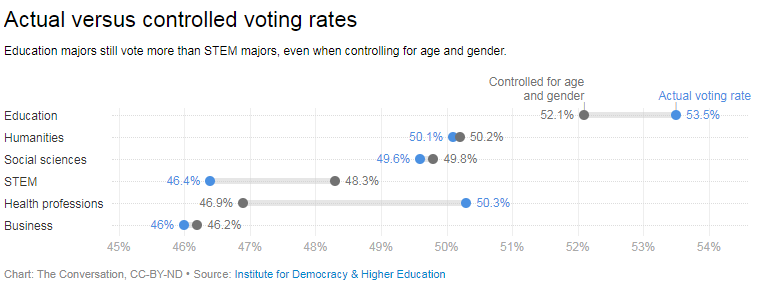
The raw correlations between college majors and voting rates are pretty substantial. In 2016, more than half of all education majors voted (53.5%), which was more than 7 points ahead of the rate for business students.

But majors attract different demographic groups. For example, women vote at somewhat higher rates than men. If more education majors were men, the turnout rates in education programs would fall. By the same token, STEM turnout would rise if STEM majors recruited more women. However, education majors would still be ahead.

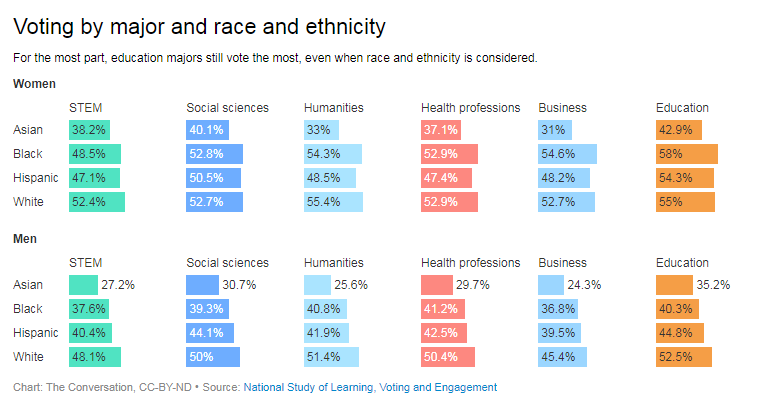
Once you zero in on major, race and gender together, you see some interesting patterns. African American women who major in education voted at a 58% rate in 2016, well over double the rate of Asian-American men who majored in business.

Self-selection must be part of the story: people who are more interested in the kinds of issues that arise in politics may also enroll in majors like education. Still, there is room to improve the civic education that STEM and business majors experience.

where to invest to RAYSE youth civic engagement

CIRCLE has developed RAYSE (Reaching All Youth Strengthens Engagement) to help nonprofits, philanthropists, agencies, political campaigns, activists, and others decide where to invest in youth engagement or understand the strengths and weaknesses of the places where they are committed to work. It organizes data on all the counties in the US.  This new video explains how to use it and also presents a broad strategy for renewing democracy by investing in youth. Get started by looking up your own county!

100Kin10 as a model of education reform

The Clinton Foundation recently hosted a small roundtable discussion led by Chelsea Clinton and made up of funders and civic education organizations. The purpose was to learn about the 100Kin10 model. Although 100Kin10 is concerned with STEM education, it is also a model for reform in other areas, such as the one that concerns me professionally: civic education.

In his 2011 State of the Union Address, President Obama said, “Over the next 10 years, with so many baby boomers retiring from our classrooms, we want to prepare 100,000 new teachers in the fields of science and technology and engineering and math.”

I’d be open to arguments against the target he set, but I’ll assume for the sake of this post that it was a good one. It wasn’t the President’s own idea but resulted from previous research and discussion. Thus the story really begins before the 2011 State of the Union, with the research and advocacy that influenced President Obama.

With the President ‘s term running out, a group of 28 organizations came together to form 100Kin10. They included unions and districts that bargain with unions, education schools and alternatives to ed. schools (like Teach for America), companies, and foundations. New groups could be added to the network by nomination after a vetting process. Membership does not require ascribing to any particular model of science education, any specific strategy for getting to 100k, or any philosophy of education–groups must simply share the goal of 100,000 new STEM educators and be committed to seriously assessing quality.

The network has a very lean central node. Lots of money circulates in the form of grants or contracts from one network member to another, but the 100Kin10 team doesn’t collect and redistribute that money. Members of the network make commitments to advance the cause, and they do their actual work in a decentralized way.

100Kin10 has promoted consistent measurement by helping to develop assessment tools. There’s an agreement not to share the data with funders. That encourages members to use the tools and reflect candidly on what their data tell them.

The network has made strong progress toward the numerical goal set by President Obama. However, members have become increasingly aware that meeting the 100,000 target will not solve the problem. More teachers will still be needed as the years go by. Besides, there is more to improving STEM than hiring more and better STEM teachers.

I am a critic of “root cause analysis” because I believe that complex problems never have one or a few determinative causes. Problems are almost always systems of interlocking causes and consequences. With a similar view in mind, 100Kin10 asked a large number of experts and stakeholders to identify reasons for the chronic shortage of strong STEM teachers. Respondents came up with around 100 causes, each of which could plausibly be seen as the “root.”

If the respondents had been asked to identify the single most important factor, they would have been biased by their own vantage points and organizational missions. Instead, they were asked whether changing one factor would affect another specific one–in other words, whether each given pair of factors was causally related. These data were collected to produce a network map of causation.

As with most networks that develop in nature, this one was skewed. The rule of thumb is that 20% of nodes will have 80% of the links. I don’t know whether the 100Kin10 map follows that 80/20 distribution precisely, but it looks roughly like that to the eye. This means that by changing 20% of the variables measured in this complex system, we can directly move 80% of the whole system. Therefore, 100Kin10 has recently focused on encouraging members to shift their attention and discretionary efforts to the most central nodes. That is a powerful form of social analysis and leadership.

We could do something similar for civics. The goal would not be 100,000 qualified civics teachers, but some other broad and compelling outcome. Many of the steps would be similar. However, we would have take some differences into account:

Incentives: STEM education pays off for the individual who gains skills and credentials, and for firms and communities that gain more qualified workers. Thus the case for STEM is economic. The case for civics has to be different–probably patriotic and democratic (with a little “d”).

Politics: STEM is not without political controversy. (Should evolution be taught? Should resources be distributed to the poorest students, or to schools that demonstrate success?) However, civics is more pervasively political. Political opponents disagree in principle about what should be taught. Civics can also have immediate partisan implications by affecting who votes. To be clear, turnout is not the central goal of civics, but it could be an ancillary effect, and that makes it “political” (in a bad sense). On the other hand, there is more consensus about the core purposes of school-based civics than we sometimes assume.

Outcomes: The debate about what counts as a good outcome for students is more controversial in civics than in STEM. Disagreements go beyond simple left/right debates. People who share other views about politics may still disagree about the importance of civic knowledge versus civic action, or appreciating the constitutional system versus critically assessing it, or local citizenship versus global citizenship. (For my own part, I believe that an absolutely central goal is to increase students’ sheer interest in politics, because without a sense of intrinsic motivation to stay involved and informed, they will forget what they learn in civics class or fail to update it as the world changes.)

The role of the classroom: In education generally, there’s a live debate about how much the school, the classroom, and the teacher matter compared to the economy and social context beyond the school walls. People who believe that we can educate our way to social mobility are rightly challenged by critics who argue that the economy must be reformed to generate real opportunity. That debate is even more fundamental in civics, because it’s fairly clear that the political context beyond the classroom is unsatisfactory. In civics, the context starts with the school as a community (is it a just and loving place or a pipeline to prison?) and extends to the democracy as a whole, because our formal institutions are clearly flawed. I’m one who believes that good civics teaching is beneficial even under conditions of injustice, but we need to consider the critique that civics just accommodates students to an imperfect system and that reform should focus elsewhere.

These are differences between civics and STEM. They are mostly differences of degree, not profound gaps, and they do not suggest that reforming civics is impossible. In fact, civics has a great deal of momentum right now because of a broadly shared sense of civic crisis. (See our recent White Paper, “The Republic is (Still) at Risk and Civics is Part of the Solution.) It’s exciting to contemplate something like 100Kin10 for civic education.

effects of school climate on civic engagement

Sarah K. Bruch (Iowa) and Joe Soss (Minnesota) are conducting important research on the relationships between school climate and young people’s civic engagement. They have more research in the pipeline, but their working paper entitled “Learning where we stand: How school experiences matter for civic marginalization and political inequality” is already available.

Bruch and Soss challenge the idea that schools prepare students for democracy by transmitting a set of skills and knowledge that make people better citizens. If that were the whole picture, then more–and more equal–civic education would yield a better and more equal democracy. But Bruch and Soss note that schools are also institutions and communities that can encourage–or discourage–participation by demonstrating how the larger society works. Bruch and Soss did not invent this framework–it has a scholarly heritage, which they summarize, and it is being forcefully advocated by young people today–but they contribute important empirical findings.

Bruch and Soss use nationally representative surveys of students and administrators to measure the strictness of the school’s disciplinary policies, the perceived negativity of the school’s culture, individual students’ reported personal experiences with punishments, perceptions of unfair treatment by the school, rates of membership in school groups, and reports of feeling included or marginal in the school community. Some of these factors are about perceptions of the whole school, and others about perceived personal experiences. Some are about treatment by adults, while others involve treatment by fellow students. Some come from student data; others, from administrators.

To a large extent, these factors are related to race, class, and gender. To illustrate with a strong example, African American boys whose parents have little education are more than ten times more likely to be punished by a school than White girls with well-educated parents.

In a multivariate model that includes many other factors, most of these school climate variables are related to civic engagement, with harsher and less inclusive climates depressing graduates’ community engagement, voter turnout, and trust in government. But there are important differences among these relationships.

Perceptions of unfair treatment are related directly to lower civic and political engagement and trust in government. Not being involved in school activities is a strong predictor of being disengaged from community after graduation, but half of that relationship is indirect: students who miss out on school activities go on to have adult experiences with criminal justice, welfare, etc., that are related to disengagement from civic life.

Authoritative disciplinary climates are related directly to more civic engagement, more voting, and higher trust in government, but such climates also predict adult roles that tend to depress these outcomes. The net impact is insignificant for voting and civic engagement and comes out as positive for trust in government. This finding begins to suggest that the problem is not school discipline per se: in fact, a well-ordered school may be a good place to learn to be a citizen. The main problem is unfairness. In political philosophers’ terms, a school can restrict freedom (defined as individual choice) by establishing and enforcing rules, but it should avoid “domination” in the sense of arbitrary power.

See also: school discipline in a democracyavoiding arbitrary command.

working on civic education in Ukraine

(Kyiv, Ukraine) I am here for just a few days, working with Ukrainian civic educators and my American colleagues at Street Law, Inc. I’ve served on Street Law’s board for more than a decade, but this is my first time directly helping with a project. Ukraine’s plans to revamp democratic education in their primary and secondary schools seem highly promising, and I’m pleased to be able to participate. This effort also connects to another project I’ve done with Ukrainian colleagues since 2014: the European Institute of Civic Studies (which is aimed at adults). Finally, it’s nice to be back in this handsome city as the leaves turn yellow and the air is cool and damp.