Category Archives: advocating civic education

three new cases for learning how to organize and make collective change

The SNF Agora Institute at Johns Hopkins University has published three cases about the choices and dilemmas that confront groups of people who strive to make social change. These are like business-school cases: they are factual narratives that conclude with moments of choice that are meant to be discussed in groups, whether in high school, college, or in movements and organizations.

I am proud to have played a role in the project from the start. We felt that cases are really useful for teaching and professional development, but most actual cases provided by business schools, schools of public policy, and wonderful initiatives like The Pluralism Project and Justice in Schools focus on individual protagonists. We were interested in voluntary groups that must deliberate before they can choose. David Moss’s excellent Case Method Project does some of what we intended, but its focus is on high schools and American history, whereas we wanted to serve social movements with some current examples.

These are free, and we would love to know how they work in various settings.

The Montgomery Bus Boycott

What objectives, targets, strategies, demands, and rhetoric should a nascent social movement choose as it confronts an entrenched system of white supremacy? How should it make decisions?

The Montgomery, Alabama, Bus Boycott of 1955–1956 is a classic example of a social movement episode that accomplished its immediate goals despite severe obstacles. It catapulted the 26-year-old Rev. Martin Luther King Jr. into international prominence and launched similar episodes in many American cities across the South and then also the North. By investigating their situation and choices, you can develop skills and insights to use as activists today.

The ISAIAH Trash Referendum

Should a faith-based organization take on an issue not of its choosing? Can relational organizing help its leadership support a new mayor while also engaging their base and holding their coalition together?

This is a case study about an organization in Minnesota called ISAIAH, a faith-based organization that works to expand the power and influence of people who have often been overlooked, especially poor people and people of color.

This case examines what happened when, to support a new mayor with whom the organization wanted to work,  ISAIAH became involved in a divisive issue—not of its own choosing—that revolved around garbage. ISAIAH faced at least three choices: 1) stay out of the fight over garbage; 2) use mobilizing techniques to help the mayor win the garbage issue; or 3) use relational organizing to enter into a power relationship with the mayor in the garbage fight—even though most of the people in ISAIAH’s networks didn’t care much about the issue.

The AMOS Project and the Campaign for Universal Preschool

Can faith-based organizers garner enough support to win universal preschool in a racially divided city? How should a grassroots group manage a disagreement with its own powerful coalition partners?

This case study is about the AMOS Project, an organization in Cincinnati, Ohio, and its grassroots efforts to pass legislation that would provide preschool education for most of the city’s children. AMOS’s grassroots efforts increased the political pressure to pay for the program, but at one point, the whole effort seemed likely to fall apart. How could a grassroots network of congregations manage a disagreement with allies in the business community and achieve its goals?

The Educating for Democracy Act of 2020

Senator Chris Coons (D-DE) and Senator John Cornyn (R-TX) have introduced the Educating for Democracy Act of 2020. It would significantly increase federal investment in civic and history education. It is the Senate companion to the U.S. House version of the Educating for Democracy Act that was introduced on September 17th by Congresswoman Rosa DeLauro (D-CT) and Congressman Tom Cole (R-OK). 
Note those D’s and R’s–this is bipartisan legislation with support from influential Members on both sides of the aisle.

The Act would authorize $1 billion in federal investment in civic and history education, including research, innovation and teacher professional development. Funds would go to state and local education agencies to strengthen and improve civic and history education; to non-profit entities to develop or expand access to curricula, instructional models, and other programs; and to colleges and universities to educate future elementary and secondary school teachers. The bill would also require the National Assessments of Educational Progress (NAEPs) in civic and history education to be conducted every two years at grades 4, 8 and 12, with state level results made publicly available so that states can be tracked and assessed.

The full bill summary is available here

Senators Coons and Cornyn and Representatives DeLauro and Cole will reintroduce this legislation in the new congress in January, but it is important to persuade U.S. Senators to co-sponsor the bill now. Please be in touch with your own Senators.

who needs civic education?

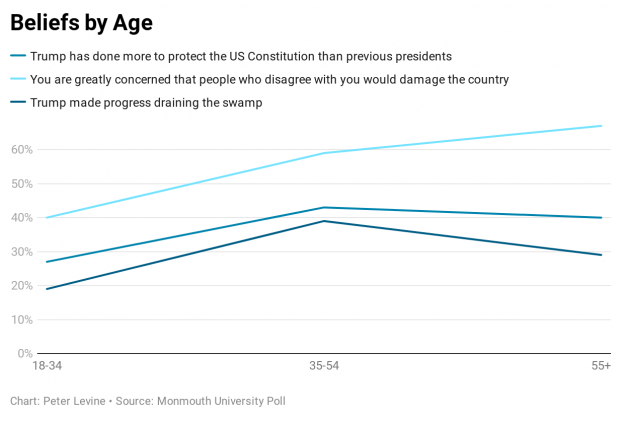
The Monmouth University Poll released on Nov. 19 asked people (among other questions), whether Trump has done more than other presidents to undermine or to uphold the Constitution, whether respondents fear what their political opponents would do to the country, and whether Donald Trump has “drained the swamp” or made corruption worse. Here are the responses by age group.

Young people are the least likely to think that Trump upheld the Constitution, least afraid of their opponents governing, and most likely to believe that Trump worsened corruption.

I suppose reasonable people might debate these questions. A very conservative person might believe that Trump’s judicial appointments are saving the Constitution. A thoughtful progressive might fear what Trumpian Republicans would do to the country.

But generally, we would want people to answer these questions in the negative. Citizens should know that Trump disparages the Constitution, that it’s important to cede power when opponents win elections, and that the forms of corruption reported during the Trump administration are deeply problematic.

Of course, everyone needs civic education. The young need it most because they are the future and because they must be equipped to become more effective as citizens. But if you want to know who demonstrates the greatest deficits in basic civic dispositions, it is not the young.

the debate shows why we need civic education

Imagine young Americans watching last night’s debate. Try telling yourself that we have a special problem with youth. Try telling yourself that young people’s understanding of the system, commitment to democracy, or civic and personal virtues represent particular deficits.

Young Americans do urgently need and deserve more and better civic education–meaning not only courses and curricula by that name, but a whole k-12 education that prepares them to be active and responsible citizens. This need is critical.

But the reason is not a decline in civic education since Donald Trump’s youth (or mine), nor a decline in young people’s knowledge, skills, and virtues. The evidence about how courses and requirements have changed over time is mixed and ambiguous, but we never offered much civic education. Outcome measures such as the NAEP Civics Assessment are remarkably flat. Certainly, American history is presented much better now than in my day, in part due to mountains of valuable scholarship.

Improving civics is an urgent need not because it used to be better but because older people have handed today’s youth a republic in disastrous condition. The fiasco of the debate serves as an apt metaphor for the whole system. One can assign most, or even almost all, of the blame for last night to Donald J. Trump; nevertheless, the debate encapsulates our whole era.

Civic education is not well positioned to address some aspects of the problem. For instance, presidential overreach is on Suzanne Mettler’s and Robert C. Lieberman’s list of Four Threats, but it is not something that civics can directly fix; nor is gerrymandering; nor is income inequality. Trump himself is a threat (according to me), and he must be dealt with at the polls and then perhaps in the courtroom, not in the classroom.

However, on their list are two problems that civic education can address: hyper-polarization and conflicts over who belongs in the citizenry. Students can learn to deliberate with people who disagree and can learn to understand, appreciate and include all their fellow Americans. Some would add misinformation as yet another threat, and it is also something that civics addresses.

Saving the republic is not the only reason to teach American history, government, and civics. These are intrinsically interesting and worthy topics. Learning about them enriches the mind and soul. And teaching social studies demonstrably improves reading scores. But saving the republic is a pretty good reason to focus on civics, now.

what if the traditional and student-centered pedagogies go together?

I’m helping with the evaluation of a civic education curriculum. I don’t want to go into details because this is an unpublished evaluation for a specific organization in a particular context. However, I have observed an interesting pattern and wonder what explains it and whether it generalizes.

We asked both the students and the teachers about various pedagogies. For instance, the students were asked to evaluate statements like these (among others):

  • Memorizing facts was the best way to get a good grade from teachers my classes.
  • Teachers lectured, and the students took notes.
  • Students were encouraged to make up their own minds about issues.
  • Teachers encouraged students to express their opinions during class.

Their teachers were asked about the same list of pedagogies, but the questions for them were phrased in terms of how much they used each approach.

The goal was to distinguish various approaches and then correlate them with things like the number of correct answers to factual questions, students’ skills, and their beliefs about democracy. Then we could see whether, for example, students who discussed issues more in class were more confident about their skills for discussion. The findings wouldn’t be causal, but they would be suggestive.

In the actual data, the most teacher-centric and the most student-centric approaches (if you can accept those descriptions) correlated. For instance, there was a positive correlation (0.29) between “Teachers encouraged students to discuss political or social issues about which people have different opinions” and “Memorizing facts was the best way to get a good grade from teachers in my classes.” Likewise, there was positive correlation (0.28) between “Most students felt free to express opinions in class even when their opinions were different from most of the other students” and “Teachers required students to memorize facts or definitions.” The correlations were even larger in the teacher data.

Most of the student outcomes–especially their ability to answer factual questions–correlated positively with all of the pedagogies. Students were more likely to know the facts if their teachers lectured and if they discussed issues–not surprisingly, since these two pedagogies correlated with each other.

One interpretation is that some students just got more of everything than the others–their “dosage” was higher. But I don’t think so, based on what I know about the intervention. Besides, the questions weren’t phrased in a way that should measure dosage.

Another interpretation is that these approaches should and do complement each other. I can certainly see why good teachers might say both “I encouraged students to express their opinions during class” and “I placed great importance on students learning facts.” (These responses were correlated at 0.8).

A third interpretation is that these questions don’t yield valid data, because teachers and students are not very aware of the pedagogies they experience, and are especially unaware of how their experiences compare to others’.

I’m wondering whether the positive correlation between apparently contrasting teaching styles is commonly observed.