
Category Archives: Ukraine

Ukraine means borderland

This isn’t a travel blog, and my photos aren’t very good, but here are some images that hint at Ukraine’s history as a borderland (which is its very meaning).

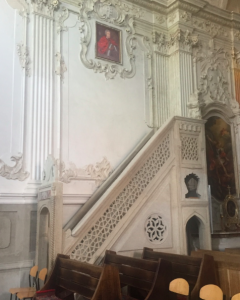
For instance, a minbar (the staircase a preacher ascends in a mosque) is preserved inside the rococo church of St Nicholas in Kamyanets-Podilsky.
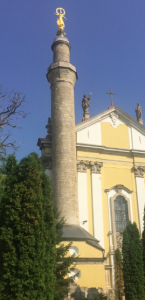
The same city’s cathedral preserves a minaret. The Ottomans had built towers all around this building, as at Aya Sofya in Istanbul. When the Poles regained the city, they removed the other minarets but had to retain this one for structural reasons. They surmounted it with a gold Madonna.

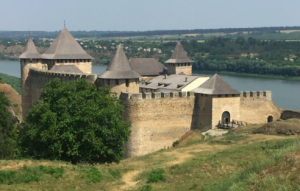
At Khoytn, the border is symbolized by a massive fortress, built and partially leveled in sequence by Christian, Muslim, Christian, and modern totalitarian armies.

In Chernivtsi, while it was still Austro-Hungarian Czernowitz, each “nation” had a handsome cultural house of its own: the Romanians, the Ukrainians, the Germans, the Poles, the Jews. The Ukrainian house made space for the first international Yiddish conference in 1908, because the city’s Jewish leadership favored German and Hebrew.

Today, the former Jewish People’s House still sports Atlas-type sculptural figures, two of whom are unusual in that they look upward.

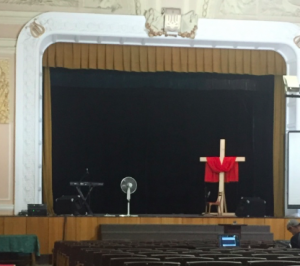
In the old auditorium on the third floor, where the stair-rail still shows a Star of David, the stage was set with a cross when I wandered in. The building is understandably used for various community functions today, in a city that is overwhelmingly Christian. This sight was nevertheless a bit disconcerting. (I suspect the Nazis smashed the other Jewish symbols in this room.)
But downstairs is a fine museum celebrating and mourning the annihilated Bukovinian Jewish community, including this mass-produced Hebrew typewriter from the interwar period.

Here is a raffish Art Nouveau/Orientalist building called the “Sorbonne,” in the University area of Chernivisti. I saw it at dusk, when the sunflower’s face had sagged.
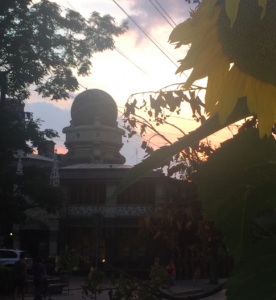
That could be an elegy for the faded elegance of Austria-Hungary. But the sunflower must have turned upward again the next morning, because there’s always a dawn. Half a century after the “Sorbonne” opened, Chernivtsi’s now-Soviet citizens could take off from their space-age airport under a frieze of Sputniks and ICBMs.

History didn’t stop then, either. Since I was last in Chernivtsi in 2015, a cheerful new 24/7 pharmacy has opened across the street from the “Sorbonne.”

civics road trip: from Philadelphia to Ukraine

I’m in Philadelphia for the Action Civics Initiative Summer Convening, a gathering of students, educators, and NGO leaders who are working to make civic education more action-oriented. From the closing plenary tomorrow, I’m heading to Ukraine to participate in the third annual European Institute of Civic Studies, this year at the Chernivtsi National University. The Institute draws practitioners, scholars, and activists involved with strengthening democracy in Ukraine and its neighbors. On my way home, I’ll stop in Kiev to talk with civic educators who work at the high-school level.

I predict some consistent themes (polarized societies, fragile democratic norms, inequalities of power and agency) as well as some important differences. I plan to blog periodically as I travel, or at least on my return.

See also: action civics goes mainstream and gets controversiallessons from a large youth service program, creating good citizens, and the European Summer Institute of Civic Studies.

European Summer Institute of Civic Studies, this August in Chernivtsi, Ukraine

The Summer Institute of Civic Studies will take place in Chernivtsi, Ukraine, from July, 31st to August, 12th 2017 (at the Chernivtsi Yuri-Fedkovych-University). The Summer Institute of Civic Studies is organized by a team from Tufts University (Prof. Peter Levine), the University of Maryland (Prof. Karol Soltan) and the University of Augsburg (Prof. Tetyana Kloubert).

The total number of participants will be limited to 20. Ukrainian scholars and practitioners are strongly encouraged to apply. We will also consider the applications from Germany, Belarus, Poland and Moldova. We are especially interested in applicants who have a long term interest in developing the civic potential of Ukraine and the region.
The working language of the Summer Institute will be English. Your mastery of the English language must be sufficient to read and understand complex texts from multiple disciplines, and to take part in a lively discussion.

Objectives and topics

The Summer Institute of Civic Studies is an intensive, two-week, interdisciplinary seminar bringing together advanced graduate students, faculty, and practitioners from diverse fields of study.

The Summer Institute of Civic Studies deals with issues of development of civil society, the role of an individual/citizen in society, the role of education in promoting democracy, the role of institutions in the development of a civil society and questions related to the ethical foundation of civic issues in a (democratic) society. These topics will be examined in international and comparative perspectives, considering European (especially German) and US-American civic traditions. International examples will be discussed in the context of consolidation of democracy in Eastern Europe, particularly in Ukraine, Poland, Moldova und Belarus.

The Summer Institute of Civic Studies engages participants in challenging discussions such as:

  • What kinds of citizens (if any) do good regimes need?
  • What should such citizens know, believe, and do?
  • What practices and institutional structures promote the right kinds of citizen-ship
  • What ought to be the relationships among empirical evidence, ethics, and
    strategy?

Summer Institutes of Civic Studies were annually organized by Peter Levine and Karol So?tan at Tufts University since 2009. Read about the summer institutes.

How to apply

All application materials must be submitted in English. The application must include the following:

  • A cover letter telling us why you want to participate in the summer institute and what you would contribute (maximum 2 pages)
  • A curriculum vitae

All application material can be sent as an email attachment in DOC or PDF format to
tetyana.kloubert@phil.uni-augsburg.de.

Decisions will be announced before the end of May 2017. For best consideration apply by May 20, 2017.

Expenditures: Selected participants will be provided with accommodation, meals and full event access (in some urgent cases also with travel costs).

Contact: For more information about the Summer Institute of Civic Studies please contact tetyana.kloubert@phil.uni-augsburg.de

We encourage you to share this message with your networks of people who might be interested by the Summer Institute of Civic Studies.

to the European Institute of Civic Studies

I am fleeing the country heading to Augsburg, Germany for the 2016 Summer Institute of Civic Studies. It is aimed at participants from Ukraine, Belarus, and Poland, but they are convening this summer in Germany (thanks to the generosity of the DAAD). The other organizers are my friends Dr. Tetyana Kloubert (Augsburg) and Prof. Karol Soltan (Maryland). I’ll paste the syllabus below; it may be interesting because of its European focus. It ends with a practical training on nonviolent resistance that should be particularly illuminating when experienced right after relatively abstract discussions of democracy and civic society. I will unfortunately miss that part because I’m coming back to the US on August 29, and I will resume blogging then.

Continue reading

European Institute of Civic Studies, 2016

Summer Institutes of Civic Studies have been held annually at Tufts University since 2009. They are open to applicants from all countries, and the 2016 version will take place from June 13-23. In 2015, Tanja Kloubert, Karol Soltan, and I also organized a version of the Institute in Chernivtsi, Ukraine. Thanks to support from the German Academic Exchange Service (DAAD), we will be able to repeat that European Institute in 2016. It is open to individuals from Ukraine, Belarus, Poland and Germany and will take place in Augsburg, Germany, from July, 25th to August 5th 2016 (at the Augsburg University).

What is the DAAD-supported Summer Institute of Civic Studies?
It is is an intensive, two-week, interdisciplinary seminar bringing together advanced graduate students, faculty, and practitioners from diverse fields of study

Who can apply?
Ukrainian scholars and practitioners are strongly encouraged to apply. We will also consider the applications from Germany, Belarus and Poland. We are especially interested in applicants who have a long term interest in developing the civic potential of Ukraine, and the region.

How to apply?
All application materials must be submitted in English. The application must include the following:

  • A cover letter telling us why you want to participate in the summer institute and what you would contribute (maximum 2 pages)
  • A curriculum vitae

All application materials can be sent as an email attachment in DOC or PDF format to tetyana.kloubert@phil.uni-augsburg.de.

Deadline: For best consideration apply by March 31, 2016.

Expenditures: The Summer Institute of Civic Studies is being funded by the DAAD (German Academic Exchange Service). Selected participants will be provided with travel costs, visa expenses, accommodation, meals and full event access.

Contact: For more information about the Summer Institute of Civic Studies please contact tetyana.kloubert@phil.uni-augsburg.de