The situation is fluid and unpredictable, but it’s worth tracking these developments.
Lots of philanthropy for COVID-responses. The Foundation Center and GuideStar are tracking $7.9 billion in philanthropic commitments (so far) that specifically address COVID-19. You can find extensive detail here.
Lots of creative new forms of collective action and dissent under pandemic conditions, including protests in which participants stand far apart or ride in cars, refusals to go to work, etc. This crowdsourced list* is admirably broad, encompassing everything from pure service efforts (e.g. sewing masks) to adversarial politics, and ranging from evangelical pastors holding services in defiance of meeting bans to pro-ban parishioners protesting such pastors.
I continue to think that the problem for civil society will not be the pandemic; it will be the depression. If you can resume pre-COVID values, priorities, methods, and habits once the pandemic eases, you will. But many people will not be able to do so because they will have lost their jobs in civil society or their ability to afford civic activity. Still, some of the creative ideas that we’re seeing under the current extreme conditions may prove durable.
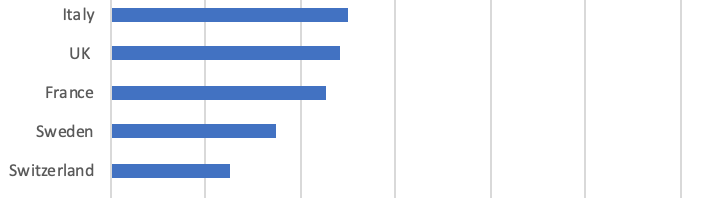
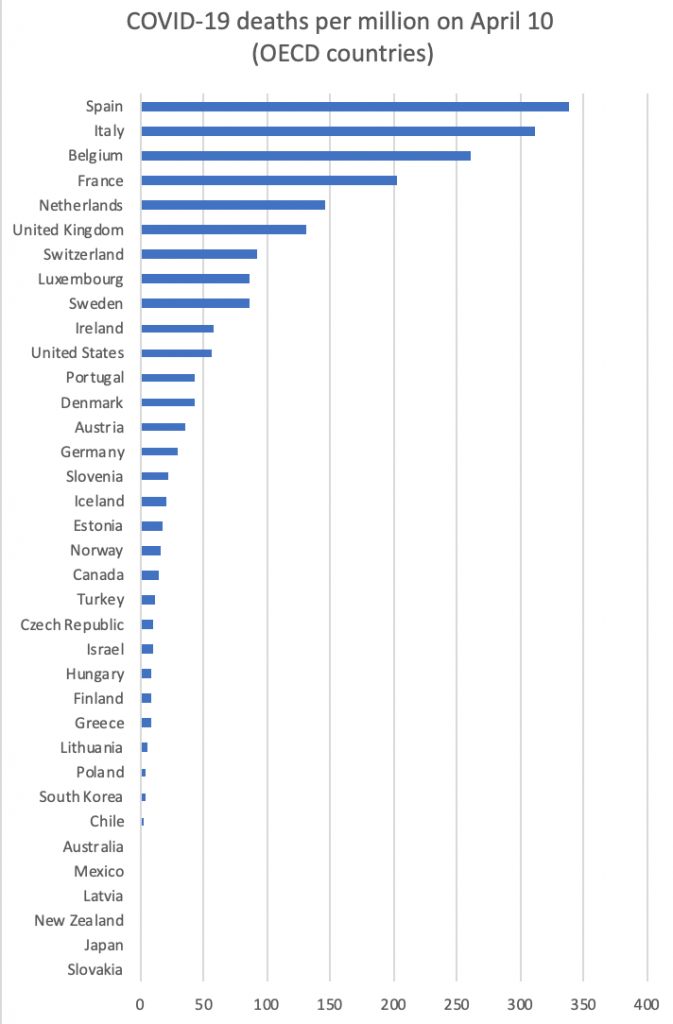
Major news sources are reporting that the USA has had the most cumulative COVID-19 deaths. That is a meaningless statistic, since our population is, for example, seven times larger than Spain’s. On a per capita basis, the US is reporting far fewer cumulative deaths than ten major OECD countries.
One objection is that we are experiencing the pandemic later than Spain and Italy, and our per-capita cumulative rate will grow to meet theirs. However, assuming we peak (as expected) early this week, then we should not converge with Italy and Spain.
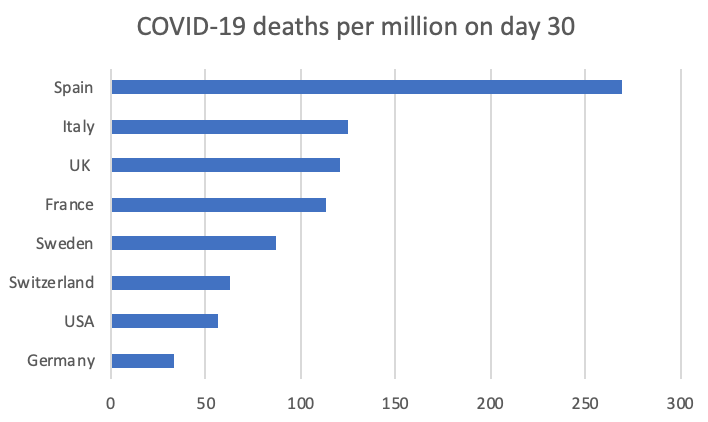
For a more precise comparison, here are per-capita cumulative deaths on the 30th day after each country saw its deaths reach one in ten million.
(I have consulted Kevin Drum’s daily updates to find Day 30 for each country. Several nations have not yet reached Day 30 and are not shown.)
The ratios are, indeed, smaller in this second graph than in the first. For example, on April 10, Spain had almost six times more cumulative deaths per capita than the USA that same day. If you compare the two countries on their respective Day-30’s, which happened weeks apart, the ratio is just 4.8-to-one. Still, the gap is unlikely to close much further, which means that Spain’s outcome will be four or five times worse than ours.
Another objection is that national aggregates are misleading because health outcomes in the USA are badly unequal by race. If per capita mortality for African Americans and Native Americans were shown separately, those numbers might look much worse. Then again, white Americans would then look even more fortunate in international comparison.
The same goes for regional breakdowns. On its own, New York City would look bad, but removing New York would make the national statistics look even better.
A third objection is that these statistics are inaccurate. No doubt, some COVID-19 deaths are not being appropriately counted. However, I am using deaths instead of diagnoses, because mortality statistics are generally considered pretty reliable and comparable across countries. Also, the epi-curves in these countries are rising smoothly in the expected ways.
A fourth objection is that we have only considered the first wave. If the pandemic revives in a second wave, all bets are off. I would say that it is wise to prepare for a second wave, but the only data we can discuss come from the current phase. It’s worth trying to analyze what it means.
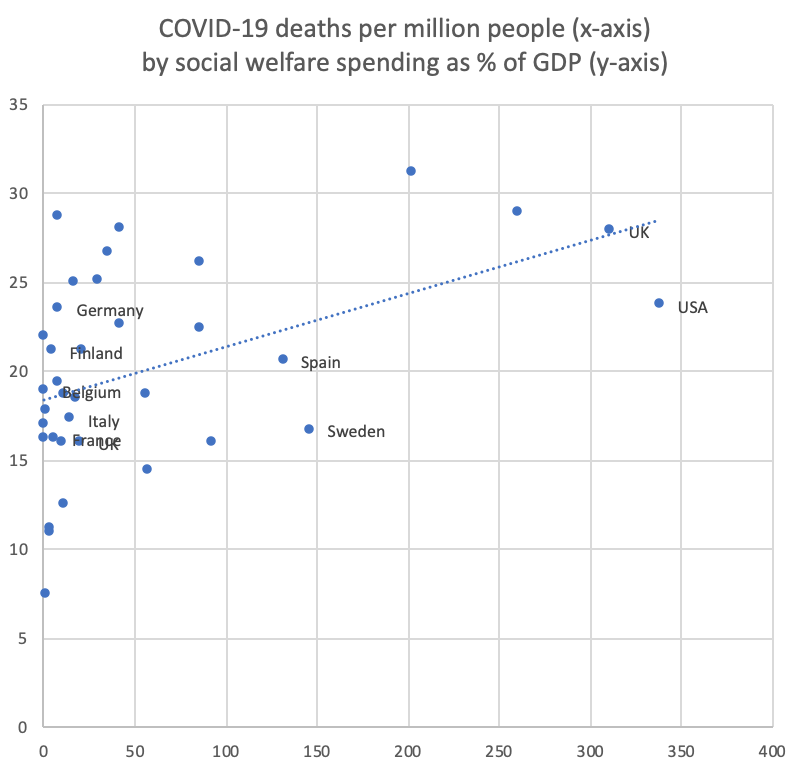
Assuming that these statistics are fairly accurate, there doesn’t seem to be a meaningful relationship between COVID-19 mortality and the size of a welfare state (% of GDP spent on social welfare). The correlation would be positive (more spending goes with higher mortality), but the scatterplot is diffuse.
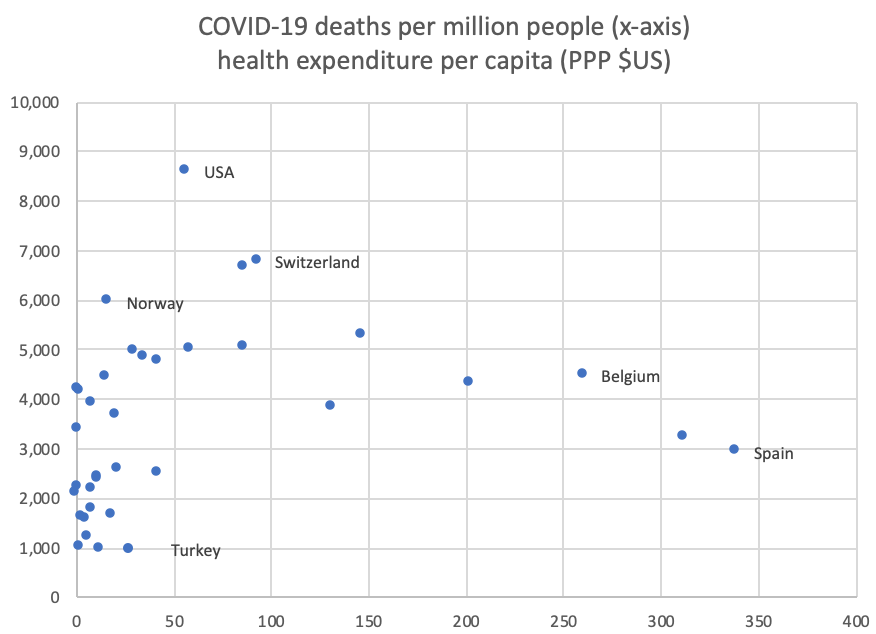
Nor is there a correlation between COVID mortality and health expenditures per capita, adjusted for purchasing power.
The preliminary evidence suggests that public policy, political leadership, and the social contract matter much less in this pandemic than I would have thought. I think we must look elsewhere for explanations of the variance in COVID-19 deaths.
Some differences in national outcomes may be due to social and geographical factors, such as the median age of populations, population density, or the frequency of living together in intergenerational households. I suspect a major variable is the timing of the onset of the disease. By the time the pandemic was starting its rise in the USA, many Americans had already become alarmed by the news from Italy and Spain; we self-isolated pretty rigorously. Like Iran, Italy and Spain didn’t have the benefit of as much warning. Meanwhile Taiwan and South Korea did better because they had previously experienced SARS.
This analysis is preliminary and amateurish and could easily change. That said, it challenges my own ideological priors. I would have assumed that Donald Trump would make things worse here than in other countries, and that our lack of health coverage would set us up for failure. It is always worth challenging your own ideological premises when conflicting evidence arises.
It’s also important to prepare for a summer and fall in which anti-Trump forces will try to blame the US situation on him, and the most cogent defense will be that the US is actually faring better than most social democracies. I don’t expect Trump to present his defense with any discipline, but his critics should be ready for it.
How will the current pandemic affect civic engagement? We certainly cannot know, but I would offer the following hypotheses:
People’s voluntary behaviors, values, and preferences will not change very much. If you can, you will snap back to pre-COVID habits and beliefs as soon as possible. However, the economic turmoil caused by the shutdown will destroy many nonprofit associations, newspapers, and businesses that are integrated into community life (such as cafes and barber shops). In the short term, not only will that destruction harm many people, but it will suppress civic life, since most people engage in and because of organizations. In the longer term, there will be space for civic innovation and growth, and maybe younger and more diverse leadership will emerge. However, civic organizations–particularly, local newspapers–that already have fragile business models may never be replaced.
Although it’s a century old, our best model for predicting the pandemic’s effects is the great influenza pandemic of 1918. In many parts of the world, its effects are impossible to disentangle from the impact of World War I, the Russian Revolution, and the collapse of empires. However, the US was peripheral to those matters and lost less than 1/20th of one percent of our population in the Great War. Changes that occurred between 1918 and 1920 can be plausibly attributed to the pandemic, which killed 650,000 out of 103 million Americans (equivalent to about 2 million deaths today).
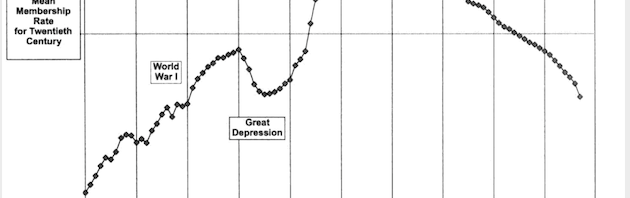
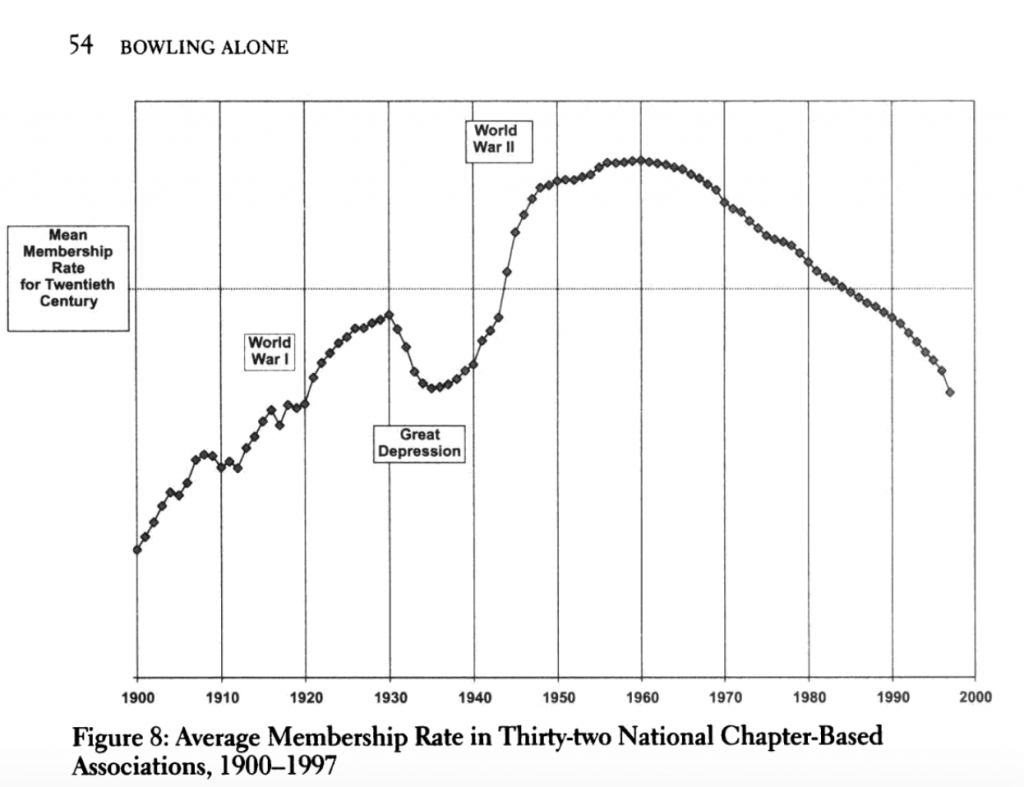
Graphs from Robert Putnam’s Bowling Alone show no significant or lasting impact on civil society. Deep trends–industrialization, urbanization, the Great Migration–were ongoing, and so were trends in civic life. For instance, the early 1900s was the era when Americans constructed national organizations with local chapters, and their growth proceeded unabated through 1918.
Putnam also presents trends for membership in professional associations and unions, the rate of playing card games, the number of police officers per capita, and telephone ownership. These rates do not all smoothly rise in the early 1900s, but none seems to bend around 1918.
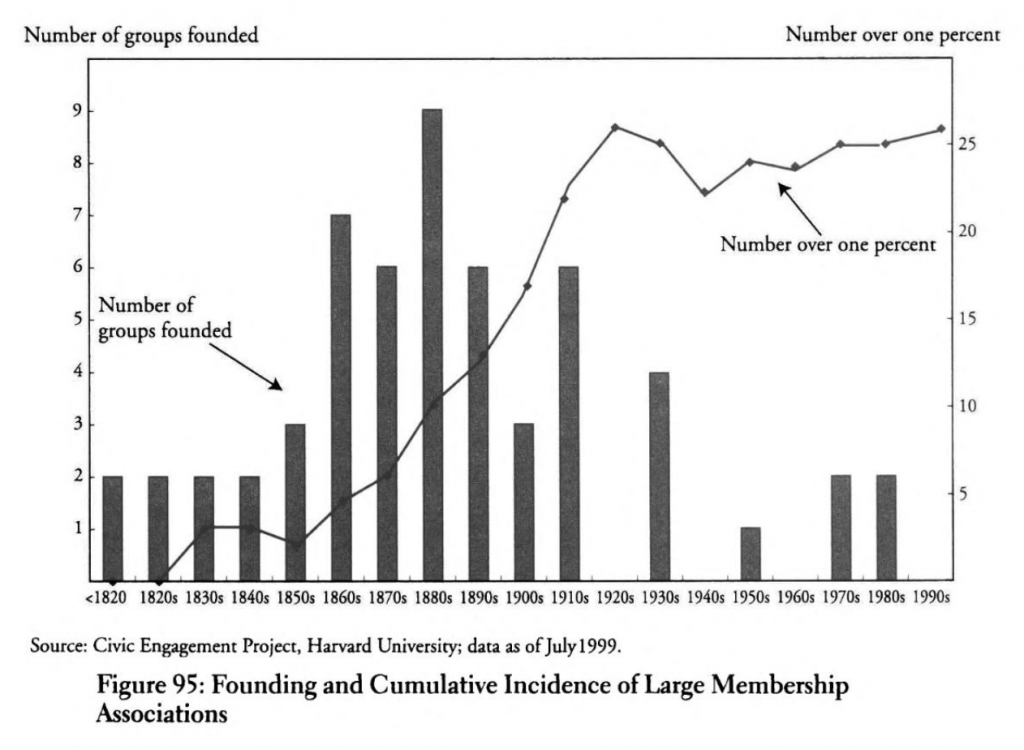
One possible exception is the rate of founding of major membership organizations, which was lower in the 1920s than in the 1910s:
Putnam lists the actual associations by their date of founding. None were launched in 1918, but three came into being in 1919. I see little evidence that the pandemic affected associations, unless it caused a delay in foundings during the actual year of the flu. In 1920, Warren Harding won election on the promise of a “return to normalcy”–poor grammar but a pretty accurate prediction.
However, the civic life that Americans built in the early 1900s depended on small contributions, dues, or subscriptions (in the case of newspapers) from many ordinary people. As long as they had jobs, they could support the associations. Organizations seemed to have weathered any short-term loss of income.
In contrast, today’s civil society is heavily dependent on philanthropy from foundations and wealthy individuals and contracts with governments. Many 21st century nonprofits basically run as businesses with a small number of investors and lots of constituents who do not pay for their services. A market meltdown could easily kill them off. In an international survey conducted from March 24-26, 68% of nonprofits already report a decline in contributions.
I worry especially about the metropolitan daily newspaper, because I believe it was an interesting hybrid invented between 1890 and 1920. Newspapers were often very profitable thanks to advertising and wide reach. At their peak, they attracted more than 80% of households by providing a basket of goods–sports, classified ads, comics. Meanwhile, they served a civic function by presenting important news on the front page. They did not invest in reporting because it maximized their profits but because professional reporters and editors–“the press”–exercised some influence over the owners of newspapers. The resulting combination was valuable but vulnerable and already in steep decline by 2010. If the recession now kills the last surviving metropolitan daily newspapers, there is no reason to think that any functional equivalent will replace them.
A quick search reveals scores of articles by people who, like me, have recently read or re-read Susan Sontag’s Illness as Metaphor (New York: Farrar, Straus and Giroux, 1977).
Sontag’s thesis is simple: “illness is not a metaphor, and … the most truthful way of regarding illness—and the healthiest way of being ill—is one most purified of, most resistant to, metaphoric thinking” (3). She adds, “The people who have the real disease are also hardly helped by hearing their disease’s name constantly being dropped as the epitome of evil” (85).
I would say: It is wrong to use sick people as assets in arguments, as new reasons for conclusions you already held. If you want to use a disease as a metaphor, ask yourself whether you would make that argument in a sick person’s hearing. If that would be cruel, don’t say it anywhere.
There is no such thing as a fact that is innocent of comparison and evaluation, no “writing degree zero” that lacks metaphor. But we can adopt an ethic of very close attention to known details about our actual fellow human beings, or we can venture into broader speculation
Sontag explores how “Illnesses have always been used as metaphors to enliven charges that a society [is] corrupt or unjust.” She shows that “to liken a political event or situation to an illness is to impute guilt, to prescribe punishment.” (72) But little actual insight comes from likening a moral or social problem to a disease, or vice versa. “Traditional disease metaphors are principally a way of being vehement” (83).
This is a warning against using the pandemic for rhetorical purposes. I am collecting examples for a short commissioned article of political theory that is mostly an argument against theorizing casually while people are suffering.
Sontag’s main examples are cancer and tuberculosis. She argues that they provided rich (but problematic) material for metaphor because their causes were unknown. Their mysterious etiology gave them rhetorical power. In contrast, everyone always understood that syphilis was an infection transmitted through sex, so it never worked as anything but a crude and direct trope. Since we basically understand COVID-19 already, maybe its rhetorical uses will be limited.
“We have a responsibility to recover better” than after the financial crisis in 2008, UN secretary general António Guterres warned. “We have a framework for action – the 2030 Agenda for Sustainable Development and the Paris Agreement on Climate Change. We must keep our promises for people and planet,” he added.
On this topic, I would yield to people who understand economics and the environment better than I do. I also recognize obstacles to making sure the recovery benefits the environment. (Will we have a recovery at all within a reasonable amount of time? Will the political elites in any important country allocate resources well?) But it seems worth discussing principles, because a decent outcome will depend on public pressure. We should decide what to demand.
I would propose four principles:
The fiscal stimulus should be large and carbon-negative. Governments can and should spend heavily, because borrowing costs are extraordinarily low and social needs are critical. Once the pandemic ends, to the maximum extent possible, unemployed people should be paid to build and install renewable energy sources, to improve the power grid, to enhance public transportation (which will face a crisis of confidence in response to the pandemic), to restore natural resources, and to change agriculture.
Bailouts should be carbon-neutral. I am not callous about people whose livelihoods depend on mining or drilling for carbon. But nowhere is it written that oil, gas, and coal companies deserve public subsidies, especially given the massive negative externalities of their industries. There is an immense amount of carbon underground and enormous incentives to extract and burn it. Our best hope is to cut the supply in the short term so that alternatives can become more affordable. Turmoil in carbon markets will have human costs, but also benefits. Thus: no bailouts for carbon.
Financing should be equitable and carbon-neutral. I think the wisest macroeconomic policy is to borrow in the short term and pay it back with new taxes only later on–that’s the most stimulative approach. But we could negotiate an agreement now to pay it back later in a good way. That could mean phasing in carbon taxes along with highly progressive wealth taxes while permanently holding down income and payroll taxes for households with lower incomes.
Spending should be planned and allocated in a participatory and deliberative way. This is not just a matter of justice or a way of generating civic benefits from the pandemic crisis. It is also an urgent practical need. Let’s say you want to build a new transit line to reduce carbon use. If a community organizes against it, it won’t go through. Also, people won’t ride the line unless it meets their needs, and transit without many passengers does no good for the environment. Therefore, effective spending depends on genuine support, which can be earned by creating opportunities for people to discuss and decide. Ideally, such discussions will also influence individuals’ decisions as workers, consumers, and investors, giving many people a justified sense that we are rebuilding the economy, and saving nature, together.