Category Archives: pandemic

Navigating the Pandemic webinar series

Tisch College of Civic Life is launching an eight-part weekly webinar series this summer aimed at supporting students, including the Class of 2020—and the Tufts community generally—during the COVID-19 pandemic.

Navigating the Pandemic: Knowledge, Resilience, Civic Purpose and Engagement will be offered on Wednesdays, 11 a.m. to 12:30 p.m. ET, starting June 10. It draws on the expertise of Tisch College faculty and staff, Tufts faculty in a variety of academic disciplines, and experts from Boston-area universities, hospitals, and community nonprofit organizations.

“We have developed this webinar series to help mitigate the sense of isolation and unsettledness many students are experiencing,” said Deborah Donahue-Keegan, Tisch College senior fellow and Department of Education faculty member. She is leading the effort with Tisch associate dean Peter Levine.

“We are offering a way for students to stay connected to the university community and to each other over the summer,” she said. “We also want to help students acquire more knowledge and skills in order to navigate conflicting information and misinformation regarding COVID-19.”

“The pandemic is confusing and unpredictable,” said Levine. “For some, it can be isolating, damaging, and even tragic. As a major research university, Tufts offers a wealth of resources to learn about the disease and its social impact and how to take care of ourselves, help others, and be civically engaged during the pandemic.”

Webinar topics will include:

  • emotional resilience in the face of trauma and uncertainty
  • civic engagement and voting
  • dispelling COVID-19 misinformation with science
  • the public policy and economic implications of the pandemic
  • physical health and nutrition
  • building and maintaining connections

The weekly seminars for undergraduate and graduate students are free. Those who attend at least six of the sessions and submit responses to questions at the end of each session attended will qualify for a certificate of completion. The panel discussions will be broadcast via Tisch College’s YouTube channel and will be recorded to ensure access for the entire Tufts community.

“This effort reflects Tufts’ commitment to promote social emotional resilience and well-being skills across the university,” said Donahue-Keegan. “This webinar series is one of many ways we strive to foster the development of such skills in service of fostering civic purpose, agency, and ethical civic engagement.”

For more information and to sign up, go to https://tischcollege.tufts.edu/navigating-pandemic-knowledge-resilience-civic-purpose-and-engagement.
the Biden-Trump polling gap

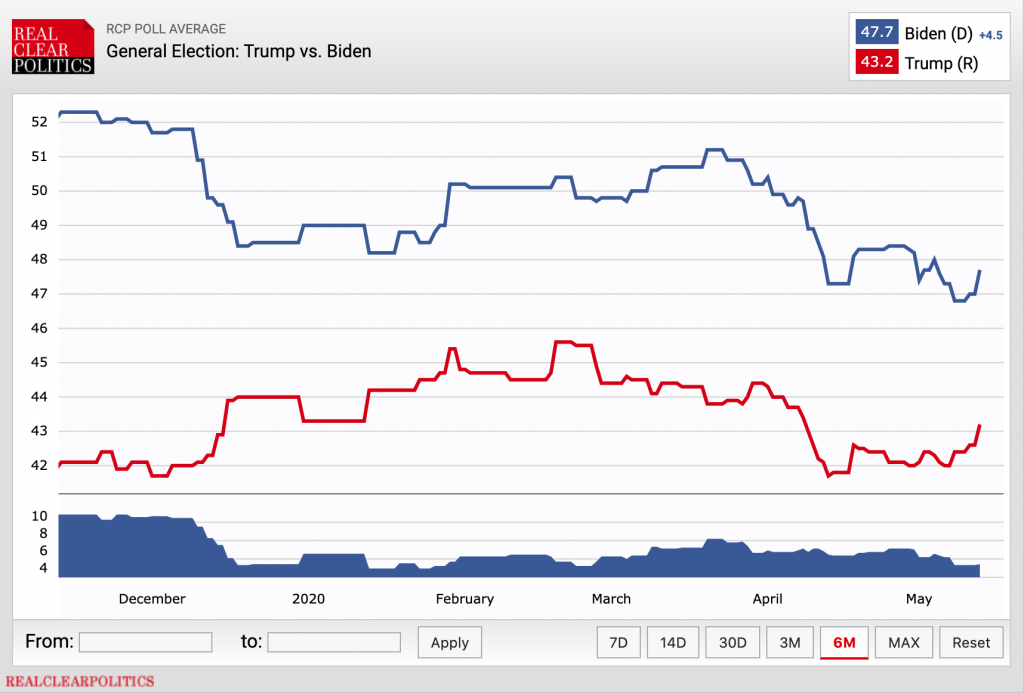
I have been watching these lines for months:

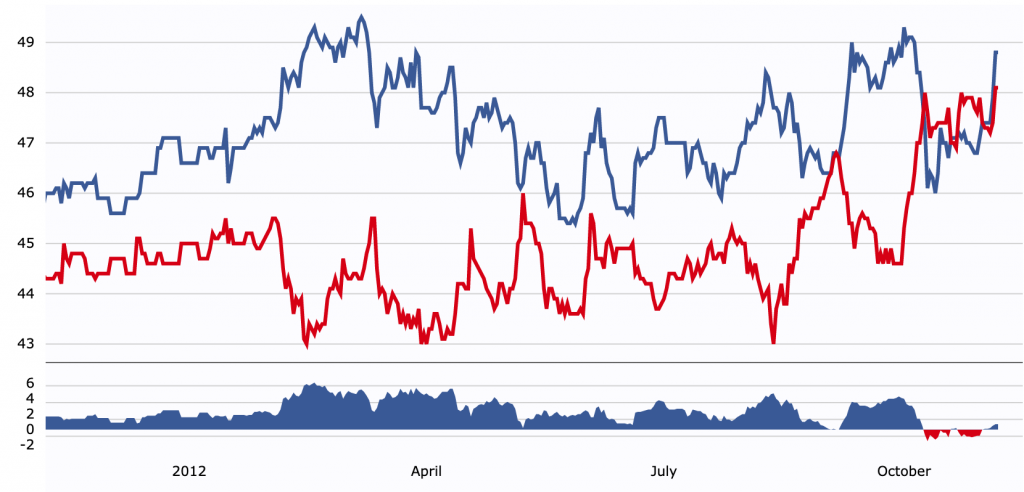
The gap is very steady, which means that every time Trump moves up, so does Biden–at the expense of undecideds–and vice-versa. By way of contrast, this is how the 2012 election looked:

Granted, the scale is even tighter in the 2012 graph than in 2020, and the length of the trend is longer. Still, we saw points when the lines converged, crossed, or moved apart.

Likewise in 2016:

Or 2008, according to Gallup’s polling:

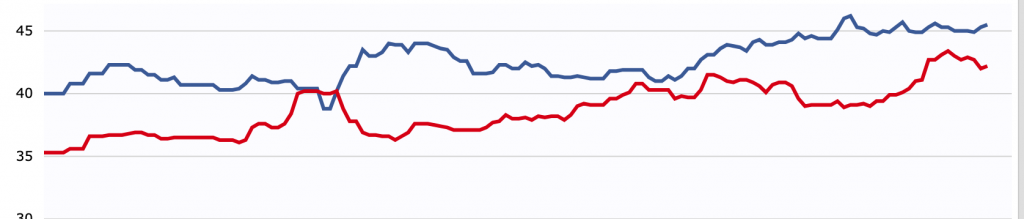
Henry Enten does better and compares Biden/Trump 2020 polling to historical trends going back to the beginning of polling. He says, “The steadiness in the polls is record breaking. Biden’s advantage is the steadiest in a race with an incumbent running since at least 1944.” Enten adds: “all the [national] polls taken since the beginning of 2019 have [Biden] up 6 points.” He means an average of six points, but that has a small standard deviation. The Real Clear Politics chart, reproduced above, suggests that the full range has been 4-10 points.

The consistency of this gap is noteworthy in an extraordinarily tumultuous period, marked by impeachment, a competitive Democratic primary campaign, a global pandemic, and the worst economic decline since 1929. Donald Trump’s own support has risen and fallen–although only within a five-point range. Biden has had his own ups and downs: near defeat in the primary, a serious accusation of sexual impropriety. Yet the gap between the candidates has been virtually unchanged since December.

Polls this far out are not necessarily very predictive. National polls don’t map exactly onto Electoral College outcomes. Polls conducted now include all adults or self-described “registered voters”; actual voters will be a subset of those. Turnout in 2020 is particularly hard to predict given the practicalities of voting in what may still be a pandemic.

But all these caveats are about whether the graph foretells the result in November 2020. Even if it doesn’t, it tells a very interesting story about now. As Matthew Continetti writes

It is not foolish to suppose that these world-shaking events would affect the presidential election. On the contrary: One would expect a dramatic swing toward either the incumbent or the challenger. But look at the polls. Not only has there been no big shift. There has been no shift. … Neither good nor bad news has an effect.

I think that almost all Americans have formed such firm and well-anchored beliefs about both Trump and Biden that even epoch-making events don’t shift us. We already have enough information to judge these men, whatever the news throws at us. By six percentage points, we like Biden more than Trump.

(By the way, Biden also leads in battleground states’ averages: by 3 points in WI and NC, by 4 in NV and FL, by 7 in PA and NH, and by 8 in Michigan. That would bode well for an Electoral College win, if we want to get into forecasting November.)

Educational Equity During a Pandemic

In lieu of a post here today, I have an article up on the American Federation of Teachers’ Shanker Institute blog, entitled “Educational Equity During A Pandemic.” It begins:

My wife and I have each spent many hours teaching by video this spring. While sitting in the same house, I meet online with college students who attend a selective private university; she meets with 5-to-9-year olds in an urban public school system, helping them learn to read. 

Both of us think and worry about equity: how to treat all students fairly within our respective institutions and across the whole country (even the world). And both of us discuss these issues with our respective colleagues. I suspect that many other educators are similarly wrestling with the challenges of teaching equitably while schools are closed. 


I hope it may have some value for people currently teaching remotely (at any level) or for parents and other adults concerned about education while schools are shut.

New Report: Massachusetts elections in the shadow of COVID-19

MEDFORD/SOMERVILLEMass. (May 6, 2020)—To bolster participation and keep voters safe in 2020, Massachusetts needs to quickly redesign its voting system, according to a new policy report from the Center for State Policy Analysis (cSPA) at Tufts University’s Jonathan M. Tisch College of Civic Life. The report, titled “Preparing for elections in the shadow of COVID-19,” details the essential decisions and difficult choices facing the Commonwealth as it responds to the challenge of holding elections during a pandemic.

Key findings:

  • Demand for absentee voting and vote-by-mail will likely be enormous, requiring dramatic upgrades to state and municipal capacity. Centralizing parts of this process could help alleviate the burden on cities and towns and reduce the risk of local bottlenecks.
  • There is no definitive answer to the question of whether Massachusetts should automatically send absentee ballots to all registered voters, only a complex balance between expanded opportunity and election security.
  • Keeping the voter registration period open longer—or allowing election day registration—would help offset the disruptions COVID-19 will have on field operations and traditional registration drives.
  • Polling places need to remain open as an option for all voters, including those with unstable housing, individuals with serious disabilities, and black and Hispanic voters, who have historically shown a preference for in-person voting. Allowing early voting for the September primary could also improve access.
  • The cost of necessary changes could be substantial, particularly for cities and towns. However, Massachusetts has access to significant federal funding for voting access, including a large amount of unused money from the 2002 Help America Vote Act.
  • Keeping voters informed of these changes will require a concerted communications campaign.  Young voters, including college students, may benefit from robust partnerships connecting election officials with universities, educators and youth-serving organizations.
  • The COVID-19 crisis makes Massachusetts susceptible to other risks, and contingency planning needs to account for the threats of voter suppression, disinformation and more.

Read the full report here.

“We have four months until the September primary,” said Evan Horowitz, executive director of cSPA. “These kinds of system-wide changes take time—whether it’s recruiting poll workers from less vulnerable populations or reorganizing operations to accommodate the projected spike in absentee voting.”

”Now is the time to closely consider and enact changes to the Commonwealth’s election procedures to ensure that all voters, including young people voting for the first time, can safely and securely participate in the 2020 primary and general elections,” said Alan Solomont, dean of the Tisch College of Civic Life. “While there are many legislative, regulatory and financial considerations, we also must be ready to deploy innovative partnerships—between state and local officials, universities, schools, non-profit organizations, and the media—to ensure that Massachusetts’ voters have access to clear and reliable information about voting.”

In developing this report, cSPA was aided by a number of election experts, including Kei Kawashima-Ginsberg, Director of the Center for Information and Research on Civic Learning and Engagement at Tisch College, and Brian Schaffner, Newhouse Professor of Civic Studies at Tufts.

In the coming months, cSPA plans to release:

  • An analysis of the Transportation Climate Initiative, which would establish a regional cap-and-trade system covering emissions from cars and trucks; and,
  • Research on the projected impact of the fall 2020 ballot questions, potentially including right to repair, nursing home reimbursement rates, expanded sales of beer and wine in food stores and ranked-choice voting.

A COVID-19 survey for teenagers

I am sharing this survey invitation by request and would encourage you to send it to middle-school or high-school students you know, including those in schools or programs where you work (if their own policies allow).

I would like to invite you to participate in a survey on how adolescents are understanding and processing what COVID-19 means to humanity and their societies, as well as thinking about themselves, their societies, and their future trajectories and opportunities during the COVID-19 global crisis. I want to know more about your perspective on what is going on, and your participation is valuable to helping better understand what impacts the changes related to COVID-19 have on young people.

The study is being conducted by myself, Gabriel Velez, with the approval of the Marquette University Institutional Review Board. You are eligible to participate in this study because you are a middle or high school student.

If you decide to participate in this study, you will be asked to complete an online survey of approximately 20 to 30 minutes. Your answers will be recorded, but they will only be connected to your name if you provide us with your name to be contacted for a follow up survey. Your responses will not be shared with your school. At the end of the survey, we will ask for your email address if you are willing to participate in a follow up interview with a researcher.

In order to participate in this survey, you will have to give your informed consent. If you are under 18 years old, you will also need your parents to indicate that they give you permission to participate. When you click the link to the survey, the first page will be for you to read and agree to. The second page will then be for your caregiver, and they should read it over and click that they give permission for you to participate.

To access the online survey and participate, please click this link:
https://marquette.az1.qualtrics.com/jfe/form/SV_e52JGB5TPllRpSB

Remember, this is completely voluntary. Your decision to participate or not will not be known by anyone at your school or affect your relationship with your school or with any school personnel.

You can choose to be in the study or not. If you’d like to participate or have any questions about the study, please email Gabriel Velez (Gabriel.velez@marquette.edu).

Thank you very much. Sincerely,
Gabriel Velez
Marquette University College of Education