Category Archives: 2018 election

powering youth civic engagement with data

(Providence, RI) Two of our marquee data projects have made the news this week. In The New York Times (March 3), Farah Stockman writes:

Efforts to bolster student turnout have been aided by a new national study that analyzes voting behavior on campuses across the country.

For the first time, schools can get detailed data on how many of their students cast a ballot, either locally or absentee, thanks to the National Study of Learning, Voting, and Engagement, put out by researchers at Tufts University.

The study aims to assess how well schools are doing at preparing students to be active citizens in a democracy, said Nancy Thomas, director of the Institute for Democracy & Higher Education at Tufts University, who oversees the study.

The study, which matches enrollment records with voting records, began in 2013 with a modest expectation of getting a few hundred colleges to participate. Today, it includes voting data from more than nine million students on 1,100 campuses in all 50 states. Identifying information has been removed from the data to protect students’ privacy.

The data has unearthed a series of fascinating insights about the 2016 elections: Social science majors had higher turnout than math and science majors (53 percent versus 44 percent). Female students had higher turnout than males (52 percent versus 44 percent). Asian students turned out at a far lower rate than their peers (31 percent versus 53 percent for white students, 50 percent for black students and 46 percent for Hispanic students).

“This initiative will hopefully motivate educators to teach students across disciplines why they should not take democracy for granted,” Dr. Thomas said.

And Josh Kurtz writes in Scientific American (March 5):

Millennial voters are poised to drive the U.S. debate on climate change—and they could have an oversized impact on 10 competitive congressional elections this year, two new studies suggest. …

The second study, also released late last week by the Center for Information & Research on Civic Learning and Engagement at Tufts University, showed the 10 congressional districts where millennial voters could potentially make the greatest difference in November. Eight of the 10 districts are in the Midwest or Plains states. …

“Millennial voters have generally favored Democrats in midterms, and that trend continues,” the Pew report says. “But, comparing early preferences this year with surveys conducted in previous midterm years, Millennial registered voters support the Democrat by a wider margin than in the past.”

That’s where the Tufts study comes in.

The Center for Information & Research on Civic Learning and Engagement created a Youth Electoral Significance Index, using demographics, historical voting patterns and projected competitiveness to produce a ranking of the congressional districts where young people (ages 18-29) have the highest potential for impact on the 2018 elections.

The study identified 10 swing districts with large populations of young people, including college campuses.
 

new CIRCLE report on Millennials’ ideology

CIRCLE has released a new report entitled “Millennials’ Diverse Political Views: A Typology of the Rising Generation.” From the summary:

Millennials are already the largest group of potential voters and are destined to dominate American politics in decades to come. As a demographically and economically diverse generation, they naturally hold a wide range of opinions. In the 2016 election, for example, voters under the age of 30 split their support: 55% percent for Hillary Clinton, 37% for Donald Trump, and 8% for other candidates.

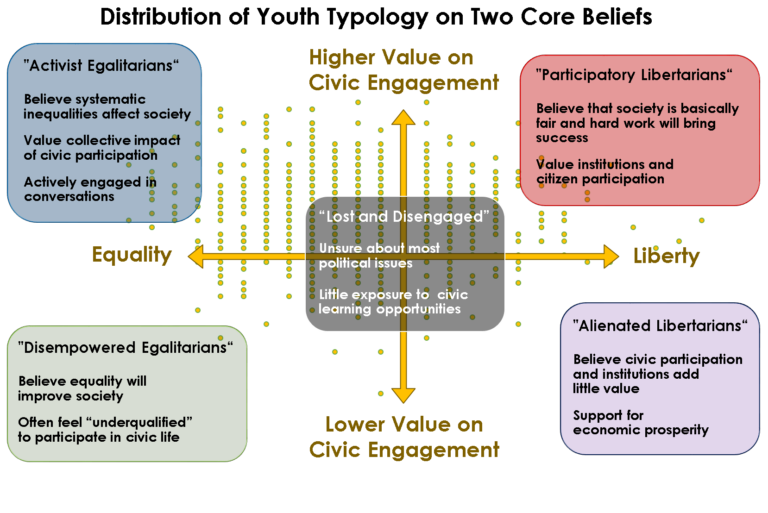
We use recent data to identify clusters of Americans between the ages of 18 and 34 into five groups:

  • Activist Egalitarians (39% of Millennials)
  • Participatory Libertarians (29%)
  • Disempowered Egalitarians (8%)
  • Alienated Libertarians (5%)
  • The Lost and Disengaged (18%)

The two egalitarian groups are concerned about social, political, and economic inequality, and they tend to support government action to combat it. The two libertarian groups are concerned about individual freedom and are more skeptical of government. These orientations characterize some, but not all, core characteristics of young people’s beliefs about the size and responsibilities of government, and whether inequality is seen as a major barrier to progress.

Within both the libertarian and the egalitarian sides, there are disagreements about civic engagement. Millennials of all political stripes differ on whether it is useful for people like them to engage with fellow members of their community or with institutions—or both—to change society. Meanwhile, the Lost and Disengaged do not seem sure where they fall, are disconnected from news media, and largely disengaged from civic life.

The largest group, Activist Egalitarians fit an influential stereotype of Millennials. However, they number less than two-fifths (39%) of all Millennials, and are themselves not monolithic. Less than a third (28%) see themselves as liberal or extremely liberal, and 14% see themselves as conservative or extremely conservative. More than half (54%) of Hillary Clinton’s Millennial voters came from this group, but they have mixed feelings about the Democratic Party.

Demographic and Social Differences

There are important demographic and social differences between the groups, particularly related to education and income.

Participatory Libertarians are almost three times as likely to have a college degree as the Lost and Disengaged.

Among the two Egalitarian groups, the Activists are almost twice as likely to have completed college as the Disempowered, more than half of whom have no college experience at all. That a lack of civic efficacy and confidence correlates with these disparities only exacerbates political and social inequalities.

Those who do not believe in the power of people’s collective work in communities and society vary not only on their Egalitarian-Libertarian polarity, but also on why they may not believe that people can make a difference:

Disempowered Egalitarians acutely feel social inequities but may be hopeless that anything could change.

Alienated Libertarians appear to worry about individual prosperity first and foremost and believe that everyone should look out of themselves rather than work with institutions or with each other.

It is encouraging that a majority of young people of diverse ideologies believe that they should work with others to benefit society and communities, and that civic institutions can play a positive role if they are kept accountable. Still, a troublingly sizable minority are unconvinced that they and their fellow citizens can effect change, and/or feel unqualified to contribute to civic life. Engaging these young people will be challenging, but it is not impossible. We must implement multi-pronged, short- and long-term strategies for engagement that support all young people as they develop their civic and political identity. And we must ensure that Millennials have the resources and opportunities to express their identities with a loud and clear voice, and to turn that voice into effective action.

22 million new voters by 2020

With The LAMP, a New York City nonprofit that works on media and digital literacy skills, my colleagues at CIRCLE are launching the 22×20 Campaign, which has the tagline “22 million new voters by the year 2020.”

For the night of the State of the Union, 22×20 helped organize Action Parties in “New York City, Washington D.C., Austin, Chicago, Boston and San Francisco with partners such as Austin Public Library, Mikva Challenge, DoSomething.org, KQED, OZY, Sony, and YVote.” Students were encouraged to discuss, analyze, and share their reactions. More information about how to organize such events is here.

The campaign also provides educational resources. For example, you can find lesson plans on media literacy and tutorials on how to create videos using news clips. I thought the guide entitled “Ten Easy Steps to Fact-Checking” was a perfect resource for viewers of the State of the Union.

More events are coming up. Follow the campaign on Twitter (@22millionVotes) or by using the hastag #22×20CIRCLE also has an explanatory blog post on “Teens and Elections” with valuable background data. 

youth in the Alabama Senate race

CIRCLE estimates that 23% of young Alabamians voted in yesterday’s special election. Just for a rough turnout comparison, 21.5% of youth in the United States as a whole voted in the 2014 election. We would normally expect turnout to be lower in a special election with only one person on the ballot than in a national Congressional election, and also lower among Alabama youth than youth across the country because just 40% of young Alabamians have any college experience (and college is correlated with voting). Thus I would call the turnout pretty good compared to expectations.

According to the Exit Polls, youth supported Doug Jones over Roy Moore by 60% to 38%. The older vote was dramatically different, with Moore winning people over 45 pretty easily. CIRCLE suggests two interesting contributing factors. First, young Alabamians are more diverse. “More than a third of the state’s young people are Black, and … Black voters of all ages went overwhelmingly for Jones (96%) in yesterday’s race.” Second, Moore may not have “garner[ed] overwhelming support even among youth who identify as conservative or Republican.” CIRCLE has previously found that “some Republican-leaning youth break with older voters on same-sex marriage and other social issues that were central to Moore’s campaign in Alabama. In addition, CIRCLE analysis of the Pew Research Center’s Political Typology dataset finds that only 5% of young people who lean toward or belong to the Republican party are “Steadfast Conservatives” (compared to 25% of Republicans or Republican-leaners aged 30+) while 31% are “Young Outsiders” who may feel less committed to the party and its candidates.”

More detail is on the CIRCLE website.

tools for the #resistance

I was in Eau Claire, WI, on Sunday and honored to present to a large group of active citizens convened by a local Indivisible chapter and other parts of the #resistance. I offered five tools for thinking about political movements. My presentation went into somewhat more detail, but this is the gist.

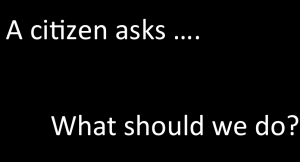
First, the question for citizens is “What we should do?” — where “we” means a concrete group of people like the folks convened in a room in Eau Claire on Sunday.

The hard part is to avoid a shift into “What should be done?” or “How should things be?” Those questions evade responsibility. They are also excessively easy. Carbon should be taxed; Trump should resign. Those points may be correct but they don’t tell us what we should do.

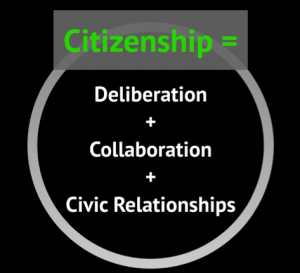
Second, any functioning political group, network, or movement should combine deliberation, collaboration, and civic relationships. Deliberation means discussing what to do in diverse groups. That makes us wiser. Collaboration means actually getting work done together, coordinating voluntary action. And civic relationships are the reasons that people participate.

That framework is central to my book We Are the Ones We Have Been Waiting For, which I wrote while Barack Obama was president. I have considered whether this framework is obsolete when a man who threatens the republic occupies the White House. I still believe it applies. For one thing, people learn to value deliberative and collaborative styles of leadership by participating personally in decent groups. When only 28 percent of Americans report belonging to any group that is inclusive and accountable, no wonder many tolerate Trump’s style of leadership. Besides, every large-scale social movement, no matter how adversarial, needs deliberation, collaboration, and civic relationships to move forward. These are scarce but renewable sources of power.

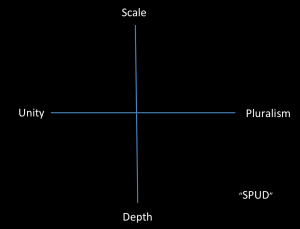
Third, try to maximize four goods that are often in tension. “Scale” means involving a lot of people. You can’t win without numbers. “Depth” means transforming people, building their skills, confidence, wisdom, and leadership. That’s necessary because we must all grow to be effective. “Pluralism” means encompassing a diversity of ideas and identities. Groups that fail to be pluralist get stupid and are unable to appeal to outsiders. “Unity” means coming together for one cause. Together they spell “SPUD,” which is a handy acronym. The challenge is that Depth trades off against Scale, and Pluralism against Unity. But the best movements achieve a bit of all four.

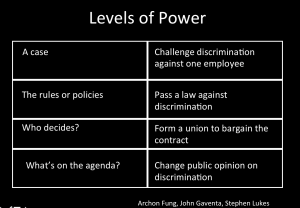
Fourth, work at several levels of power. The discussion of  “faces” or “levels” of power goes back at least to Stephen Lukes and John Gaventa in the 1970s; I borrow from the recent version by Archon Fung. The basic idea is that you can challenge a particular wrong, or a rule or policy, or who makes the rules and policies, or what’s on the public’s agenda. For instance, you could help an individual vote, change voting laws, change who makes the voting laws (e.g., who draws district boundaries), or change how the public thinks about voting.

I venture the generalization that right-wing leaders are much better than the left at the third level of power. For example, Wisconsin Governor Scott Walker has relentlessly attacked public sector unions (except police) so that union leaders can’t help determine policies; and he has passed restrictive voters to change who participates in elections. The left is better at the first and second levels of power, but those levels have limits.

Finally, I reposted my “How to Respond?” chart, which I first released on this blog a couple of days after the November election. (Click to expand it.) It offers a set of strategies for activists in the current moment.

You can do more than one of these things. Probably some people should be doing each of them. But the eight options in the bottom row are too many for any one person or group to undertake, and they are in some tension. It’s hard for a group devoted to winning the 2018 election also to convene ideologically diverse conversations to bridge the gap between right and left. So most of us need to choose.

Note that I didn’t write, “How to respond to Trump’s victory.” This diagram doesn’t pretend to be nonpartisan or politically neutral. It offers options like winning the next election with a Democratic coalition and resisting the administration. But it is meant to be somewhat open-ended and subject to various interpretations. Genuine conservatives might take it to mean, “How to take our party back from a big-government chauvinist.” And leftists might interpret is as “How to respond to three centuries of injustice, in which Democrats are complicit.” As always, a plurality of views is an asset.

One way to use these tools might be to brainstorm concrete actions and then ask which cells in the last table you are filling, which levels of power you are addressing, how you are doing in SPUD, and whether you have deliberated and collaborated well. This process will not generate The Right Answer but it may help inform your strategies.