Category Archives: 2018 election

youth in recent protests

A new Washington Post-Kaiser Family Foundation poll provides detailed information about participation in current protests and social movements. The Post leads with: “Tens of millions of Americans have joined protests and rallies in the past two years, their activism often driven by admiration or outrage toward President Trump.” Here, I’ve broken out the data for ages 18-29 and separated the questions into categories.

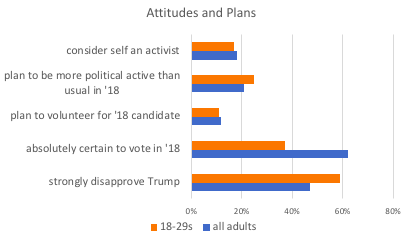
To begin, 17% of 18-29s would call themselves “activists,” just a point below the whole adult population. They are less sure than older people that they will vote in 2018 (only 37% are “absolutely sure”), but more likely to disapprove strongly of Donald Trump. Just under 20 percent actually voted in 2014, the last midterm election. It will make a great deal of difference whether that number rises in 2018.
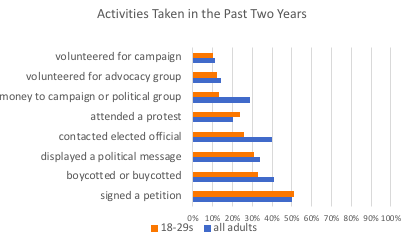
During the past two years, an outright majority of 18-29s have signed a petition, and many have taken other classic political acts. They are less likely than older Americans to give money, but they come close on most other measures of engagement.
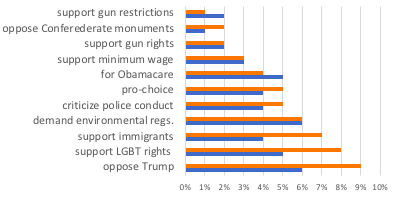
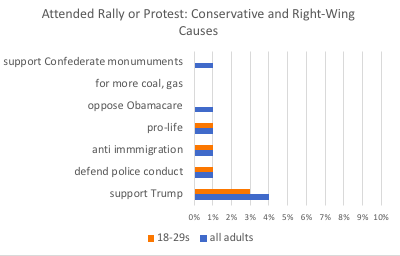
I’ve divided the long list of topics for rallies and protests into right- and left-wing causes. Respondents are asked whether they have personally attended a rally or protest of each type in the past two years.

Under-30s do not appear in detectable numbers in the rallies for Confederate monuments, for oil and gas, or against the Affordable Care Act. About one percent of 18-29s have rallied against abortion, against immigration, or in support of police conduct. Three percent have turned out at physical events for Trump. For right-wing causes, the rates of participation are low for all adults. Most of these are fringe movements.
Young adults have been more active on the other side of the political spectrum. Nine percent have marched or rallied against Trump, the most popular cause. (They have been over-represented in the anti-Trump events.) Marches for LGBT rights and immigration have also been popular for youth, and disproportionately so.
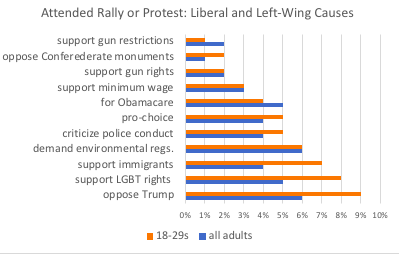
Only one percent have turned out (so far) in support of gun control. However, that could be misleading because students under the age of 19 have played notable leadership roles in the gun-violence movement. I commented on MSNBC about the youth protests against gun violence.
youth voting on All Things Considered

Excerpts from “All Things Considered” (March 29): Barbara Howard  interviewing my colleague and our CIRCLE director, Kei Kawashima-Ginsberg:

BH: It seems like with these rallies last weekend, there was a real crackling in the air. People registering kids right there at the rallies. And you can register now when you’re 17, coming up into the midterms. Is there a chance that the interest will wane? There’s some months between now and November.

KG: That’s correct. Registering young people is, of course, very important, but it’s often not enough. There are many ways we can keep young people engaged, though. One of them is to really make sure that they can feel like they can do something at their local community. Some of the ways in which to do that is [to] make sure young people are motivating their own friends and families, uncles and aunts, and even grandparents. Also, they can work at polling places in some states, including, I believe, Massachusetts, where young people can be [a] really active part of the process even before they’re actually eligible to vote.

BH: But young people do tend to turn out in much smaller numbers than older voters.

KG: That’s correct. Traditionally, they’ve turned out at the lower numbers; it is especially the case in midterm elections. Last midterm election we measured youth turnout was 2014, and nationwide only 20 percent of under 30s actually turned out.

BH: Do you think this time it’s different, having seen the rallies last weekend?

KG: There are certainly great indicators of hope. One is that there’s of course been a lot of enthusiasm and passion from young people, and it’s for the movement that’s started by and led by young people. So they’re certainly taking the lead and really putting a stake in the ground to say, we’re not going to wait for a political leader to come to us and talk about the issues that’s important to them, but we’re going to tell them what’s important to us, and they’re going to put that on their agenda. So it’s certainly promising. We’re also seeing other polling that there is a lot of young people saying we’re enthusiastic about coming out to vote in November, and also the suggestion that they actually may be signing up with political parties, especially the Democratic Party, more than they did before.

I’d also note the clear connection between this social movement’s agenda and voting. The youth who are working for gun control are on the same side as the majority of all voters; it’s just elected officials who block the legislation they want. The solution is to vote new politicians in. Voting is more fraught and complicated for radical social movements that challenge mainstream public opinion or that lack allies in electoral politics (or both). Thus I would predict a bigger electoral impact from the gun control movement than from other recent social movements.

the 2018 Youth Electoral Significance Index (YESI)

From CIRCLE today:

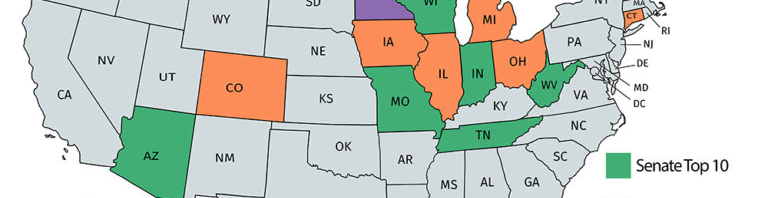
CIRCLE’s updated Youth Electoral Significance Index (YESI) is a valuable tool for any individual, campaign, organization, or institution that seeks to increase youth political engagement. Earlier this month, we highlighted the top 10 congressional districts where young people might have an especially high electoral influence. Today we are releasing the top 10 senate and gubernatorial races where young people have the potential to do the same. The YESI can help stakeholders identify places where additional efforts and resources to turn out the youth vote could be decisive. It can also be a tool for equity and broadening engagement, if efforts focus on reaching those not yet engaged in the top-ranked locations.

Please click to Explore the Interactive Index  or Read the Full Report and Methodology

talking about student activism on Under the Radar with Callie Crossley

I was on WGBH’s “Under the Radar” today with host Callie Crossley and an excellent student activist named Victoria Massey, who is a senior at Charlestown High School and a member of the Hyde Square Task Force community organizing group. The segment is entitled “Is Student-Led Activism A Driving Force For Change In America?” It airs on Sunday but is officially available for listening and sharing now. Here it is.

And here’s how the conversation was framed:

Alexander Hamilton wrote his first political pamphlet as a student at King’s College, now known as Columbia University. He was 17 years old. On February 1, 1960, The lunch-counter sit-ins in Greensboro, North Carolina, were started by four college freshmen started the lunch-counter sit-ins in Greensboro, N.C. Three years later, the “Children’s Crusade” in Birmingham, Alabama, involved kids as young as 7 in peaceful protests against segregation. And this weekend, a group of high school students who got the nation to say “Never Again” will lead  thousands at the March For Our Lives.

Student-led activism has always been a part of American culture. Could it be one of the country’s driving force for change?

should Democrats play constitutional hardball in 2019-20?

In How Democracies Die, Steven Levitsky and Daniel Ziblatt use comparative evidence to argue that democracies rely on two “soft guardrails”: constitutional forbearance and mutual toleration.* Forbearance means that political actors refrain from using all the powers that the written text of the constitution affords them. Regimes rarely survive once politicians routinely honor the letter but not the spirit of the rules. Toleration means explicitly acknowledging that the other side has a legitimate place in politics, a right to its views, and a right to govern if it wins elections.

We are perilously close to losing both constraints. This won’t be the first time in our history, but then again, our history has involved major breakdowns, like a Civil War that killed 620,000 Americans.

If Republicans beat expectations in 2018 and 2020, both parties’ behavior is predictable. Republicans will remain behind Trump because their base likes him and because the whole party will be winning under his banner. Democrats will resist as aggressively as possible, but with built-in limitations.

The choices for both sides will become much harder if the Democrats do well in 2018 and then 2020, capturing at least one house of Congress and then maybe the whole federal government. The Republicans’ choices will then be:

  1. The GOP stays Trumpian. This is what their base wants. Their losses will have been concentrated in swing districts and among independent-minded incumbents who tangled with the Trump base. The remaining party will be all-in for Trump. Since this scenario assumes that they lost ground in elections, they will be even more hostile to the political system, the media, and the Democrats, now seen as clearly rigging the system against real Republicans.
  2. Or the GOP turns into a principled conservative party that is skeptical of ambitious government, resistant to both taxation and public debt, and committed to constitutional restraint, including a restrained presidency. It presents that package as attractive to younger and more diverse voters and grows less demographically distinct from the Democrats.

Meanwhile …

  1. The Democrats play what Mark Tushnet calls Constitutional Hardball. Because they lost a Supreme Court seat when the Republicans wouldn’t even consider Merrick Garland, they return the favor and refuse Trump any new appointments. They launch aggressive investigations against Trump, his family, and his cabinet, focusing on potential financial crimes. They lay the predicate for impeachments and then prosecutions. They shut down the government over budget disputes, reckoning that Trump will send undisciplined tweets that will make him look at fault. If a Democratic presidential candidate wins in 2020, they drive through political reforms that advantage them in subsequent elections. In short, they decide not to be rolled, and also that their substantive policy goals require strong action.
  2. Or the Democrats try to restore mid-20th century norms of constitutional forbearance and partisan toleration. That doesn’t mean that they seat Trump’s Supreme Court nominees or refrain from investigations, but they try to follow the traditional procedures. For example, they bring Trump’s nominees up for votes but vote nay, and they make their investigations as focused and as bipartisan as possible. Democrats look to peel off independent-minded Republicans who are uncomfortable with Trump’s style and go out of their way to honor these colleagues.

Game theory is tailor-made for situations in which two players can make independent choices and the result is a single outcome. Here is a guess about how these choices would play out.

Democrats play “Constitutional Hardball” Democrats try to restore cooperative norms
Republicans stay Trumpian Democrats probably win on policy–increasingly so as the demographic trends favor them. Republicans retain 35% of the population that is overwhelmingly white and Christian and increasingly angry. The GOP still dominates some states and regions. Right-wingers give Democrats rationales for using increasingly hardball tactics. Political violence grows. Democrats are corrupted by the lack of legitimate checks. Democrats get rolled on policy. Possibly they expand their electoral power as a result of demographic trends plus a reputation for being responsible (if their forbearance is widely understood as such). Possibly they just look weak, and lose.
Republicans shift to principled conservatism Perhaps the Democrats prevail on policy and grow stronger due to demographics. Or perhaps they further erode confidence in government and thus strengthen principled conservatism, which wins elections and policy battles. The republic is safe. Democrats make incremental progress on policy, but Republicans offer a conservative alternative that sometimes prevails.

This is pretty close to a Prisoner’s Dilemma (PD), with the best option for all being the bottom-right, yet both sides have strong reasons to choose the other course. It’s a little more complicated than a pure PD because it plays out over time. The options and payoffs depend on the precise circumstances of the moment–say, in 2019 with a Democratic House and a narrowly Republican Senate, or in 2021 with (hypothetically) a newly inaugurated Democratic president. But versions of the choices arise at each stage, from congressional primaries today to legislative strategies in 2021.

*See pp. 7-8. However, my comments are based on hearing the authors speak, not having read their whole book yet.