Forty-three states require students to learn about political parties; however, the language in the standards nearly always promotes a simplistic understanding of the role that political parties play in a democracy.
Only eight states ask students to study the ideological underpinnings of the two major political parties.
Only 10 states ask students to study controversial political issues and their relationship to political parties.
There is very limited support for learning about political ideology. When states do include language about ideology, it is most commonly mentioned in history/social studies standards and very rarely linked to contemporary political parties.
“This generation has grown up in a vitriolic and polarized political climate. In order to sort through the noise, young people need to have a deep understanding of the ideological values that divide us and how those values do, and do not, map onto political parties,” reports Paula McAvoy, lead author of the study and program director for the Center for Ethics and Education at UW-Madison, who completed this study with Rebecca Fine and Ann Herrera Ward. “Our team’s findings show that state standards stop short of asking students to make meaningful connections between partisanship, ideology, and the issues of the day. If schools are to fulfill their mission of preparing young people for political participation, teachers need to be encouraged to bring these ideas into the classroom.”
“Understanding what major political parties are and what they stand for is essential in navigating politics and elections in the U.S., but very little support exists. These findings emphasize the need to strengthen standards and support teachers in U.S. civic education,” said Kei Kawashima-Ginsberg, Director of CIRCLE. “Encouraging this type of learning about politics, elections and voting is a major reason why we are collaborating with other organizations to support teachers during this election year via the Teaching for Democracy Alliance.” For more on this Alliance see here.
For CIRCLE’s full briefing, please see here or the interactive map here. More research and background on youth civic education can be found on CIRCLE’s Quick Facts on Civic Education page.
CIRCLE’s 2016 Election Center will continue to offer data products and analyses providing a comprehensive picture of the youth vote, including the Youth Electoral Significance Index, which offers insight into key states where young people have the potential to shape the 2016 general election.
Last May, at a campaign rally, Donald Trump said, “the only important thing is the unification of the people – because the other people don’t mean anything.” Jan-Werner Müller quotes that phrase both in his book What is Populism? and in a useful summary article that he wrote for The Guardian. Müller defines “populism” so that it describes Trump, Hungry’s Viktor Orbán, Venezuela’s Hugo Chávez, Britain’s Nigel Farage, and Turkey’s Recep Tayyip Erdogan, but not Bernie Sanders or Jeremy Corbyn. The difference isn’t their placement on a left-right spectrum but their attitude toward diversity. In his book (p. 101), Müller writes:
Not everyone who criticizes elites is a populist. In addition to being antielitist, populists are antipluralist. They claim that they and they alone represent the people. All other political competitors are essentially illegitimate, and anyone who does not support them is not properly part of the people. When in opposition, populists will necessarily insist that elites are immoral, whereas the people are a moral, homogeneous entity whose will cannot err.
Müller thinks that populists despise actual participation because the bestpolicy can already be deduced from a correct understanding of “the people.” If populists support referenda, it’s only because they expect their view to win. When they lose elections, they are prone to declare them illegitimate. Their fundamental stance is inconsistent with immigration and an independent civil society, both of which threaten an imagined uniformity of identity and beliefs.
The results are very dangerous (p. 102):
Populists can govern, and they are likely to do so in line with the idea that only they represent the idea of the people. Concretely, they will engage in occupying the state, mass clientelism and corruption, and the suppression of anything like a critical civil society. These practices find an explicit moral justification in the populist political imagination and hence can be avowed openly.
Note that Müller’s account avoids attributing views to populists that they would dispute. It doesn’t assume, for instance, that Trump is a representative of “deplorables,” defined by their racism and sexism. It takes his explicit views at face value and explains their dangerous implications.
Radical democratic actors, from grassroots revolutionaries, to insurgent farmers and laborers, to agitators for the New Deal, Civil Rights, and the New Left, have historically drawn on the language and practices of populism. In doing so, they have cultivated peoples’ rebellious aspirations not just to resist power, but to share in power, and to do so in pluralistic, egalitarian ways across social and geographic borders.
In the examples that Grattan explores, populists who celebrate “the people” (in contrast to corrupt elites) do not merely tolerate diversity or accommodate themselves to it. They are actively enthusiastic about pluralism, inventing “alternative” spaces and styles of engagement, inviting disparate actors to join in their festivals and parades, emphasizing freedom of speech and assembly as core values, and usually preferring to retain some distance from the state. In fact, one of their political liabilities is their tendency to splinter because they fear uniformity.
In the US context, being populist in that sense requires a concern for racial and ethnic inclusion. However, traditions of pluralist populism go back to Old World countries that were more ethnically homogeneous. Mikhail Bakhtin recovered the medieval spirit of carnivals, of special feast days, and of places set aside to be fairs. In the carnival, all social strata, deviant groups, odd individuals, and exaggerated behaviors were welcomed and expected to mix on terms of equality. The spirit of carnival was populist in the sense that it encompassed the whole people and undermined hierarchies and distinctions, but at the same time it celebrated differences, novelties, and creativity. It was part of what Grattan calls “the language and practices of populism.”
The carnival was a world apart. It didn’t reliably improve the everyday world of authority and control except by giving people circumscribed times and places in which to escape and create ephemera together. Democratic revolutions drew on the carnival tradition, but not in sustained or satisfactory ways. I think that countering Trumpian populism requires liberal norms: limited government and individual rights guaranteed by written laws and independent courts. These protections are necessary but not very vibrant and participatory. We also need a dose of pluralist, carnivalesque populism to answer the grim version on offer from men like Donald Trump.
Here is a graph of the presidential polls from this election so far. Most people choose narrow ranges for the y-axis in graphs like this, to draw attention to the shifts. I show the full 0%-100% range, to display how the whole American public has split. I also choose the stronger option for “smoothing,” so that each day’s measure is an average of several days on either side. The result is a highly stable advantage for Hillary Clinton all the way along.
It doesn’t really seem to have made that much difference what Trump has said, or what has been reported about Clinton’s emails and her Foundation, or how she has spent her $319 million in TV ads. It looks as if most people had their minds made up as soon as it was clear who the nominees would be.
The trend looked similar in 2012, except that it was always much closer that year.
I’d say that partisan identification outweighs almost everything, except that Trump is underperforming, for a GOP nominee, by a few points.
Young voters overwhelmingly favored Sanders in Democratic primary, but the general electorate offers more potential upside to Clinton than Trump; young women, black youth more likely to support Clinton
How did Hillary Clinton perform among young people who voted in the primaries? And how did her youth support compare to that of previous Democratic nominees?
Secretary Clinton won 20 of the 27 state primaries for which exit poll data are available, but won the youth vote (ages 17-29) in just two of those states—Alabama and Mississippi.
In these 27 states, she averaged only 28% of young voters, lagging far behind recent Democratic presidential nominees.
Secretary Clinton performed relatively better with young African Americans and she did better with slightly older youth (ages 25-29).
Data from Super Tuesday primaries indicate that young women were more likely to support Secretary Clinton than young men; but young women still supported her at lower levels than did older women.
How do young people overall view Hillary Clinton? And which groups of young people are most likely to vote for her?
At least half of young people have negative views of Secretary Clinton, and similar numbers do not find her honest and trustworthy.
However, more youth report that they intend to vote for Secretary Clinton than for Donald Trump, who has even lower favorability numbers.
Secretary Clinton may enjoy higher support from constituencies who have been especially supportive of other recent Democratic presidential nominees, such as young single women, young Black women, and young Latinas.
Is the general youth electorate more or less favorable to Hillary Clinton than the Democratic primary electorate?
The youth electorate in recent general elections has been more diverse than this year’s Democratic primary, which may benefit Secretary Clinton given her relative strength over Mr. Trump with young women and youth of color.
Together, young people of color and young women comprise roughly 70% of youth eligible to vote, and young women have historically turned out at higher rates than young men.
Voter outreach, always important, is especially critical with youth; our research has shown that young people who are contacted about voting are more likely to cast a ballot on Election Day.
In arecent long post, I argued that one reason white working class Americans are alienated from government is that they lack the productive political power that comes from organizations, such as political parties that rely on ordinary members, and unions. Moreover, because of the weakness of such organizations, white working class people are simply not visible in positions of power. A few leaders can rightly say that they started life in the working class, but almost by definition, they are now all well-paid and highly educated professionals.
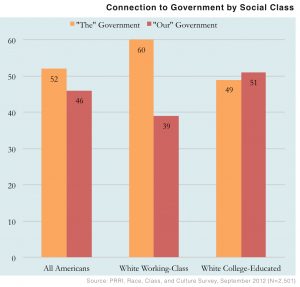
As a supportive data point, here is a graph from a 2012 PRRI survey. Respondents are asked: “When you think and talk about government, do you tend to think of it more as ‘the government’ or more as ‘our government?'” The adult population is fairly evenly split, with almost half of Americans opting for “our government.” More than half of white college-educated people see things that way. But six-in-ten working class whites perceive it as “the government.” Among seniors who are working-class whites, a majority still see it as “their” government. That could be because they are invested in certain government policies (such as Social Security and Medicare), but it’s also true that they came of age at a time when working-class people exercised political power. Among young working-class whites, 70% see it as “the government.”
I don’t think they’re wrong. It is “the” government rather than “their” government in a meaningful sense. But as long as they feel this way, and no one offers actual empowerment, they are going to be ripe targets for demagogues who want to blow the whole thing up.