Category Archives: 2016 election

Joseph Schumpeter and the 2016 election

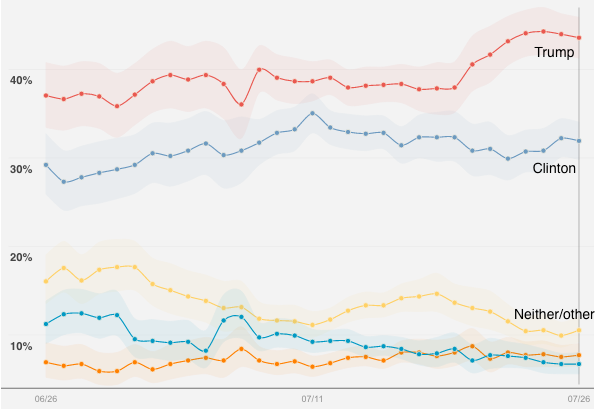
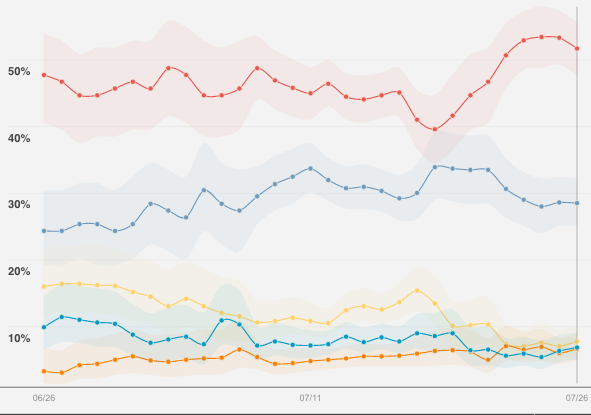
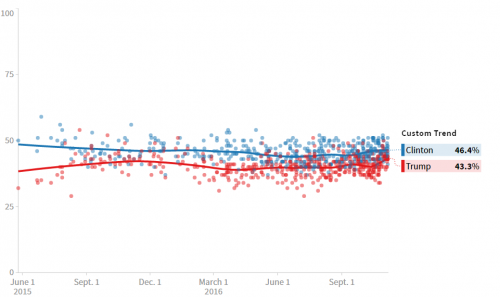
The graph below depicts the 2016 campaign as I see it. When all the polls are displayed on a graph with a y-axis from 0-100% and a fairly strong “smoothing” algorithm is applied, it becomes evident that hardly anything has changed for 18 months. Hillary Clinton has been ahead of Donald Trump by about 4-5 points nationally all along, and she leads by a mean of exactly four points in the major final polls released by this point on the last Monday. The ups and downs revealed by zooming in are best understood as temporary responses to news that may influence who participates in surveys–or who feels enthusiastic on a given day–but very few people have actually changed their minds; and most of those switches have been random and have canceled each other out.
2016-2

I think this means that Clinton is likely to win the national popular vote by about 4 points, although GOTV operations could change result that (in either direction).

It’s hard to know whether different nominees would have performed differently. A reasonable guess is that if both parties had nominated politicians with typical levels of popularity who used typical methods of campaigning, the Republican would have an edge. That implies that Trump v. Clinton costs the GOP maybe 4-6 points, net–but that is not much more than a guess.

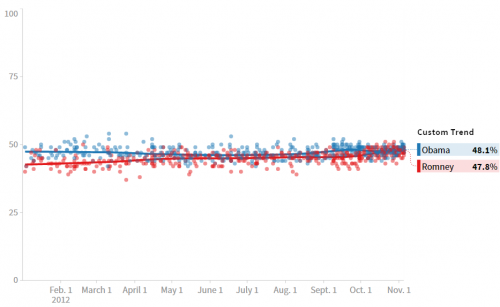
By the way, 2012 looks about the same, except Romney ran closer to Obama all the way along.
2012

But 2008 was different: McCain was ahead at first but slipped behind Obama to lose pretty badly.

For me, the interesting question is what this means about our civic culture and the purpose of campaigns and elections. The presidential candidates have raised about $1.3 billion so far and spent most of that on such activities as advertising, canvassing, and events. The press has spent untold billions on campaign coverage and commentary. All kinds of remarkable events have occurred. As all that has played out, citizens have been exhorted to pay attention and to change their opinions in response to arguments and information. But it looks as if almost everyone already had enough data 18 months ago to make up their minds. That includes me: nothing has transpired since June 2015 that has altered the probability of my voting for Clinton versus Trump by even one thousandth of a percentage point.

I used to subscribe to the view that the actions of candidates and campaigns matter, but they usually cancel each other out because all presidential nominees of major parties are effective campaigners. This year, we have one truly incompetent candidate, yet the trend remains flat. Unless you think that Clinton’s weaknesses cancel out Trump’s incompetence, it looks as if campaigns hardly matter at all. Once citizens know the candidates’ party labels, demographics, and basic facts about their biographies, they are ready to vote.

Perhaps Joseph Schumpeter was right, at least about presidential politics. It’s all about rendering a verdict on the status quo and choosing either the incumbent elites or an outsider. Schumpeter adds:

The reduced sense of responsibility and the absence of effective volition in turn explain the ordinary citizen’s ignorance and lack of judgment in matters of domestic and foreign policy which are if anything more shocking in the case of educated people and of people who are successfully active in non-political walks of life than it is with uneducated people in humble stations. Information is plentiful and readily available. But this does not seem to make any difference. Nor should we wonder at it. … Without the initiative that comes from immediate responsibility, ignorance will persist in the face of masses of information however complete and correct. It persists even in the face of the meritorious efforts that are being made to go beyond presenting information and to teach the use of it by means of lectures, classes, discussion groups. Results are not zero. But they are small. People cannot be carried up the ladder. …

Thus the typical citizen drops down to a lower level of mental performance as soon as he enters the political field. He argues and analyzes in a way which he would readily recognize as infantile within the sphere of his real interests. He becomes a primitive again. His thinking becomes associative and affective.

Since Schumpeter’s view of democracy is unattractive, we must either reform presidential politics or (if that seems impossible) write it off and focus on other aspects of our political system, where more people can show more “immediate responsibility” for collective decisions.
the ethics of vote swaps

David Iaconangelo writes, “this year is seeing a resurgence of vote-swap websites and apps that pair voters for a major-party candidate – in most cases, Democrats in blue states – with a third-party supporter living in a swing state. … Some find the tactic a little unsettling, even if it isn’t illegal or clearly unethical. ‘I’m a little conflicted,’ says Peter Levine, a political philosopher and associate dean at Tufts University’s College of Civic Life.”

As I say in the article, you’re not supposed to do anything as a quid pro quo for your vote. Swapping would seem to violate that principle. “On the other hand, the president is a national political figure, meaning the allocation of one’s vote across state lines might be considered a matter of personal choice. And if there’s no enforcement involved …, the deal might be little more than two people talking about how they’re going to vote, since the ballot is secret, anyway.”

I also note in the piece that we may have two different theories of what a vote is. On one view, it’s an instrument for getting the outcome you want. The point of our voting laws should be to ensure that everyone has the same influence. The Electoral College introduces inequality because only some states are competitive. If you can coordinate with someone in a different state to remove that obstacle, you are using your instrument more effectively.

On a different view, voting is partly an expressive civic act. Your vote won’t make a tangible difference in a presidential election anyway (with or without the Electoral College). But your vote is one way for you to belong to a community that governs itself–and not only by voting. You should vote in the community that you belong to.

I have a expressed a similarly nuanced opinion about where you should vote if you have a legal right to choose. For example, I support the right of college students to decide whether their residence is their college or their family’s home for the purpose of voting. However, it’s not obvious to me that they should (ethically) make that choice by deciding where their vote will count the most. Quite honestly, the differential impact of where you cast your single vote in a presidential race is microscopic. I think you should decide where you are a citizen in the full sense, and vote there.

CIRCLE breaks down the youth vote

When CIRCLE’s Millennial survey was conducted (9/21-10/3), Clinton was beating Trump by 21 points (49% vs. 28%). Clinton may do better when the actual votes are cast, because there seems to be a trend in her favor among youth. That said, the CIRCLE poll allows detailed comparisons between young Americans who were favoring the two candidates at a moment when Trump was drawing one in four.

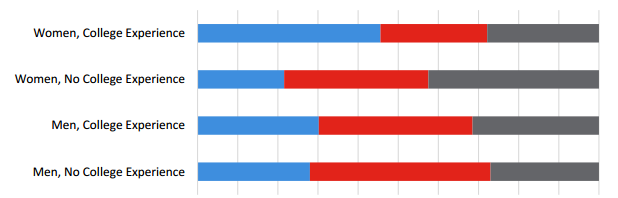
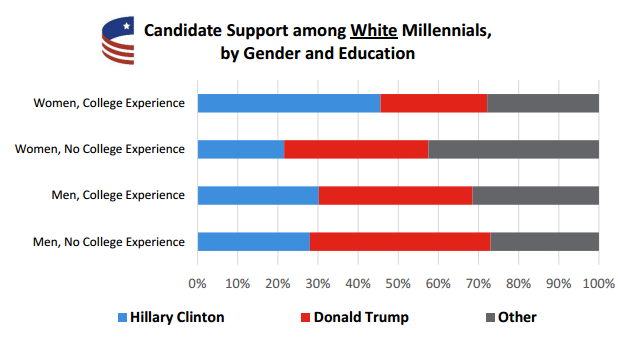
Young Trump and Clinton voters were starkly different people, and today CIRCLE has published an analysis that compares them by demographics and by opinions. For example, this graph shows Trump winning a plurality of non-college-educated men under 30 even as he was losing college-educated young women by almost 2-to-1.

circletrump

A couple of other illustrative findings from the report, which deserves to be read in full:

  • 85% of young Trump voters are dissatisfied with the way things are going for the country, and they are far more likely than Clinton supporters to believe that the country’s best days are behind us.
  • Trump supporters are less experienced with various types of political engagement, and more likely than Clinton supporters to say that they would “never, under any circumstances” do things like volunteer for a campaign or attend a political rally, suggesting that Trump supporters are overall less likely to be politically engaged.

social class does predict Trump support

Some say that Trump has captured the support of working-class Whites who are economically stressed or anxious. Others reply that Trump voters are relatively upscale but motivated by racial resentment alone. The former premise suggests that Democrats must do more to empower the working class, including Whites. The latter suggests that White nationalism is our fundamental problem today. Although I see truth in both positions, I’ve argued for addressing the economic and political vulnerability of the White working class. I present that as a strategy for countering Trumpism, but it’s a misguided strategy for that purpose if Trump voters are relatively affluent.

The raw story is that White people with lower incomes are Trump’s strongest backers.

Presidential Candidate Preference for Whites with Family Income <75K (Reuters)

Presidential Candidate Preference for Whites with Family Income <$75K (Reuters)

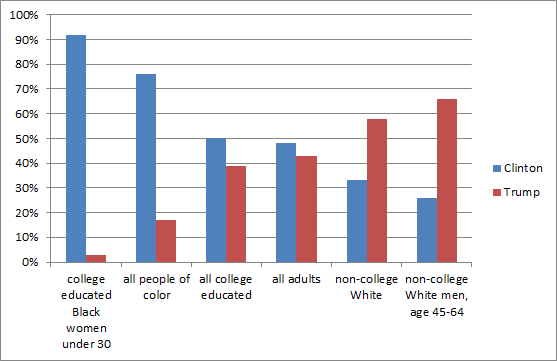
But it’s not just about income and race. Education levels, age, and gender are also strongly related to voters’ preferences in this election, as I illustrate with data from YouGov:

yougov

The question is what to make of those middle-aged White men without college degrees, who are preferring Trump over Clinton by more than two-to-one in the YouGov polls (and by 59%-25% in Reuters). Is it economic anxiety, racial identity, or what?

One of the most widely cited pieces of evidence against the economic-anxiety explanation is Jonathan Rothwell’s paper, “Explaining nationalist political views: The case of Donald Trump.” Rothwell, who works for Gallup, conducted a regression analysis of almost 100,000 Gallup survey responses collected over the year that ended in July (i.e., mostly during the primary season). I have no quarrel with the paper, but I would note that it does not debunk a class analysis of the Trump vote.

Rothwell finds that holding a favorable view of Trump correlates with higher, not lower, income. Nate Silver is also widely cited for his finding that Trump voters during the primary season had higher median incomes than Clinton and Sanders voters (but the same as Cruz voters and lower than Kasich voters).

However, Rothwell also looks at whether household income remains a significant predictor of Trump support once you consider the fact that Trump voters are disproportionately White, male, and older. Using one measure of income, it remains a significant predictor; with a different measure, it ceases to predict Trump support.

At the same time, Rothwell’s model shows that you are more likely, to a statistically significant degree, to favor Trump if you: (1) hold a blue-collar job; (2) did not attend college; and (3) live in a community with high White mortality rates. Those relationships appear in the whole sample but are especially strong when the model is restricted to non-Hispanic Whites. Further, “more subtle measures at the commuting zone level provide evidence that social well-being, measured by longevity and intergenerational mobility, is significantly lower among in the communities of Trump supporters.”

If social class means income, then class is not a strong predictor of Trump support in Rothwell’s model. At least during the primary season, Trump voters were actually wealthier than the mean American voter. But if class means social status, and status involves occupation and education, then Trump voters tend to be downscale Whites in downscale White areas.

Rothwell’s paper uses a binary outcome of Trump support versus non-Trump support. The non-supporters include Republicans who were still favoring Cruz, Rubio, and others, plus Democrats for Sanders. That makes the analysis a bit dated now that we’re down to Clinton v. Trump. Reuters data suggests that Trump widened his lead among working class White men once he won the nomination.

Presidential Candidate Preference, White Men Without College Degrees (Reuters)

Presidential Candidate Preference, White Men Without College Degrees (Reuters)

Meanwhile, Clinton is now doing very well among the top 1 percent of the income distribution.

In sum, the relationship between working class status (measured by education) and Trump support seems strikingly strong for the White population. This doesn’t mean that class is the only issue. Race/ethnicity and gender are obviously very significant. But it means that there is some truth to the class analysis.

See also why the white working class must organize and it’s hard to talk about tough issues if no organization represents you.

state of the youth vote in 2016

CIRCLE has begun to release results from its survey of 1,605 Americans between the ages of 18 and 34. CIRCLE’s headlines are:

  • Most Millennials paying attention to presidential election, but far fewer to congressional elections
  • 30% of Clinton supporters contacted by campaigns, 28% of young Trump supporters contacted, 70% not contacted at all

Contact is important because it gives the recipients information and motivation to vote. These contact rates are disturbing low–and also uneven by region, gender, and party. Young men who live in battleground states have been contacted at nearly twice the rate of young women in “safe” states (38% vs. 20%).

Among likely young voters, Clinton beat Trump by 21 points (49% vs. 28%) in this poll, which was conducted between September 21 and October 3, 2016. USA Today/Rock the Vote released a youth poll yesterday that put the margin at 68%/20%. I’m not sure whether that difference results from methodological choices, such as the way the surveys define likely voters and present third-party candidates; but it is interesting that USA Today/RtV were in the field on October 11-13. The difference could therefore suggest a substantial improvement in Clinton’s margin since September.

The CIRCLE release presents additional information about young people’s attitudes, including this chart that compares the words that Trump supporters and Clinton supporters used to describe their own favored candidate.