Category Archives: audio and video

a civic silver lining?

Thanks to the Former Members of Congress Association, I joined Former Member Dennis Ross (R-FL) and mayors Nan Whaley (D-Dayton), Francis Suarez (R-Miami) and Marty Walsh (D-Boston), for a discussion of civic engagement during the pandemic.

I particularly appreciated Mayor Walsh’s eloquence about respecting poorly-paid work. His point expanded into a broader discussion of how to get everyone involved in the “public work” of rebuilding our community and country. On that topic, see “War Is a Poor Metaphor for This Pandemic” by Harry Boyte and Trygve Throntveit in Yes!.

I learned a lot from the mayors. I ended up thinking that the attitudinal effects of the pandemic may well be positive. We may care more about each other and feel more motivated to work together on public goals. The fact that the crisis is widely (although inequitably) shared will provide an opportunity to bring Americans together. However, the economic impact on civic life is very worrying.

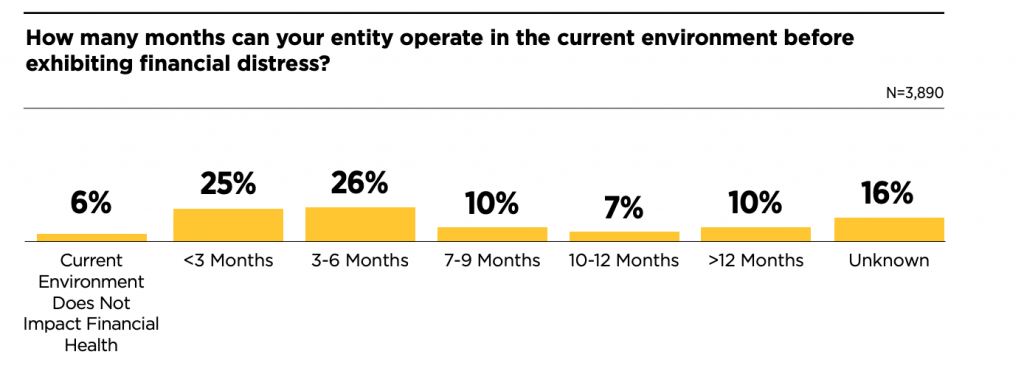
To that last point, the Federal Reserve system recently surveyed a mix of local organizational leaders (two thirds of them from nonprofits) about the impact of the pandemic. “Nearly 2 out of 3 respondents (66%) indicated demand for their services has increased or is anticipated to increase, and more than half of the respondents (55%) noted a corresponding decrease or anticipated decrease in their ability to provide services.”

This chart from the Fed. paper is particularly significant:
See also: the Coronavirus information commons; a Green recovery;Educational Equity During a Pandemic“; trends to watch in civil society; why the relatively good US numbers for COVID-19 mortality?; effects on civil society will be mediated by the economy; and COVID-19 is not a metaphor.
political reform in Massachusetts

This is the video of me presenting our study entitled MassForward: Advancing Democratic Innovation and Electoral Reform in Massachusetts at the Boston Foundation in November, with discussion by Jay Kaufman, a former state representative and Founder and President of the Beacon Leadership Collaborative; Beth Lindstrom, former Executive Director of the Massachusetts Republican Party; Laurie Nsiah-Jefferson, Interim Director of the Center for Women in Politics & Public Policy at UMass Boston; and Pavel Payano, an at-large city councilor in Lawrence.

The report was covered in MassLive WGBH , WBUR CommonWealth NEPR WPRI SouthCoast Today, and The Salem News (an editorial) 

talking about gerrymandering and political reform on WCAI (Cape Cod and Islands)

I was on Mindy Todd’s show The Point yesterday, for a program on “Strengthening our Representative Democracy.” The other two guests were David Daley, author of Ratf**ked: The True Story Behind the Secret Plan to Steal America’s Democracy,” and Judy Zaunbrecher, co-president of the Massachusetts League of Women Voters. The audio is here. If you start at 42:00, you can hear Mindy ask Judy whether Massachusetts has been gerrymandered; Judy accurately summarizes the research by my colleagues at Tisch College. (Spoiler alert: not really, although it would still be better to use a nonpartisan districting commission.) I join shortly after that to discuss why our state government is so dominated by white men.

podcast: “can young people revive civic engagement?”

(LaGuardia Airport) Michael Berkman, Chris Beem, and Jenna Spinelle from the McCourtney Institute for Democracy at Penn State recently interviewed me for their podcast series, “Democracy Works.” We talked about young people, the 2018 election, and social movements. Here’s the audio. (I enter at about the 5th minute.)


talking about student activism on Under the Radar with Callie Crossley

I was on WGBH’s “Under the Radar” today with host Callie Crossley and an excellent student activist named Victoria Massey, who is a senior at Charlestown High School and a member of the Hyde Square Task Force community organizing group. The segment is entitled “Is Student-Led Activism A Driving Force For Change In America?” It airs on Sunday but is officially available for listening and sharing now. Here it is.

And here’s how the conversation was framed:

Alexander Hamilton wrote his first political pamphlet as a student at King’s College, now known as Columbia University. He was 17 years old. On February 1, 1960, The lunch-counter sit-ins in Greensboro, North Carolina, were started by four college freshmen started the lunch-counter sit-ins in Greensboro, N.C. Three years later, the “Children’s Crusade” in Birmingham, Alabama, involved kids as young as 7 in peaceful protests against segregation. And this weekend, a group of high school students who got the nation to say “Never Again” will lead  thousands at the March For Our Lives.

Student-led activism has always been a part of American culture. Could it be one of the country’s driving force for change?