Category Archives: epistemic networks

outline of a philosophy

At any given moment, an individual holds a very large number of beliefs relevant to moral evaluation and judgment. Some of these beliefs are connected to other ones, producing a network. Not all the connections are strict logical entailments; some are resemblances, similarities, or causal generalizations.

Our moral networks may not determine—or even strongly influence—our choices and actions. We often act because of unconscious instincts, emotions, and interests. Yet it is important to have a good network of explicit ideas, for only a reflective life is fully worthy. Besides, our ideas can constrain and motivate our choices, sometimes indirectly, by way of the general rules that we devise and submit to.

Each person’s network is unique, but our ideas and connections overlap profoundly. A culture is a group of people who share many nodes and links, yet every member of a culture is at least partly different, and it is typical for several cultures to overlap and for individuals to belong to many cultures at once. There is no perspective external to all culture, no view from nowhere.

We normally do not adopt our moral networks wholesale, nor are they designed or planned. We start our lives with virtually no moral ideas and add or subtract a few nodes and connections at a time. Some philosophical and religious systems present themselves as whole designed systems or as rules for improving any given network. Such systems may provide insights by directing our attention to particular ideals and implications that are worthy of attention, but they do not and should not generate anyone’s whole network.

An ideal network would contain all the relevant and correct beliefs and connections applicable to an individual. That is what we ought to strive for. However, in the moral domain, truth is difficult to ascertain and demonstrate. What we actually do is to assess nodes and connections, one or a few at a time. When we make those judgments, grand abstract questions about the nature or basis of moral truth tend to recede, and we focus instead on whether a given choice is right or wrong given the other things we believe.

Since our personal perspectives and interests are too narrow, we reason better together. Since we think most carefully when we are deciding how to act (or when we reflect on what we have done), our best reasoning is often connected to work in the world. And in order to reason well with others, we must cultivate moral networks that have certain formal properties, e.g., they should not be too centralized nor too disconnected.

In reflecting on our own moral networks, we are obliged and entitled to consider at least three large classes of questions: Am I relating well to others? Am I promoting my own equanimity or a healthy inner life? And am I avoiding falsehood and error? These three goals map onto sangha, buddha, and dharma, or onto oikeiosis, eudaimonia, and logos as pursued by Hellenistic philosophers.

Alas, they are are not consistent with each other. For example, truth often disrupts relationships and reduces happiness. That is why reflecting on all three will generate a complex moral network, rife with tensions.

The social contexts that best allow us best to improve our networks are ones characterized by talking and listening, collaborative action and reflection, and ongoing relationships that involve the exploration of other people’s moral thought. These contexts are not necessarily small; whether by using digital tools or by reading printed texts, we can form relationships with thousands of people. But the most valuable contexts are personal and relational, characterized by responsiveness to other human beings and tangible human actions.

Relational politics cannot achieve sufficient stability and scale to distribute goods and rights fairly or to deliver security and predictability, without which liberty is impossible. Although huge agglomerations of people may form, they cannot honor the abstract virtues of large systems, such as equity, impersonality, and rule of law. Thus we also need impersonal systems: laws, states, and markets.

Of these systems, we should ask whether they are just, and if not, how they fall short. Justice has many aspects (including fair treatment of other species), but an important component is whether systems protect and help all people to live lives informed and enriched by their own complex moral network maps, which they develop in voluntary interaction with others.

But whether a system is just is not the only political question we must pose. After all, we lack the capacity to design or reconstruct whole systems. Even a king or dictator cannot usually do that. All we can literally do is take concrete steps, such as saying something to someone, seeking an office or other official role, designing and making an object, joining or forming a group, or buying or selling a good.

Using these actions to change (or maintain) an impersonal system requires some combination of replication, leverage, and leadership. Replication means encouraging a desirable practice or activity to arise over and over again, and tying the instances together as a network. Leverage means exercising power at a distance. (For example, to vote is to try to move the government from afar.) And leadership—in this context—means obtaining a position or reputation within a system that permits more than the average amount of impact.

The essential political question is not “How should a society be structured?” but rather “What forms of replication, leverage, and/or leadership should we use now to change the world?” Our strategies should still be guided and constrained by the moral networks that we develop with one another through dialog and relationships. But when we use power, we must combine sequences of concrete actions into strategies and choose ethical and effective means to relatively distant ends.
is a network a good representation of a person’s moral worldview?

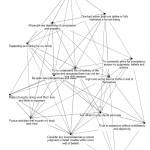
Here is a method that I and some colleagues have been using to model the moral worldview of individuals and of groups. First, pose questions about individuals’ principles, beliefs, and methods and ask them to respond with ideas that they endorse. Then show them their own ideas in a table and ask them to identify pairs that they consider closely related. That will allow you to generate a network diagram of their ideas. Give the diagram back to them and ask them to explain their ideas and connections to their peers. As they do so, ask them to modify their own networks.

This method will generate network graphs for each individual at each time-point during the discussion. All of their networks can be placed on the same plane to produce a map of the group; and to the extent that they have chosen the same ideas, the group will have a connected network. See, for example, these maps of the Summer Institute of Civic Studies and two of its members:

subject3subject2subject1

Of course, you will get networks because you have asked for networks. You could instead ask people to give you lists of moral ideas, in which case you would receive lists back. People’s lists could be shown as sets that would overlap when two or more individuals chose the same ideas. Respondents could also be asked for ranked or weighted lists or for lists of ideas that trump other ideas, just as all the diamonds may trump all the clubs in a card game. In the “5 Whys?” technique, individuals propose a basic idea, answer the question “Why?” about it, then ask “Why?” about the reason they have given, and so on. That method will produce a chain or ladder of ideas, instead of a network.

On what grounds is the network model preferable?

We could treat it as a method for modeling the moral psychology of research subjects. In that case, it would be an empirical psychological model and we would want to know whether it was reliable and valid. Reliability would be assessed as follows. Do individuals and groups give substantially similar responses when studied at different times and when the questions and instructions have been changed in superficial ways that should not alter the results? Validity would be assessed by asking whether the results for individuals and groups correlate with other reliable measures of moral thinking, such as how people respond to dilemmas or how they express moral views in narrative form. Both reliability and validity would have to be tested with samples of people who varied by culture, age, religion, language, etc. Regardless of the results that came back from initial studies, the method could be tightened. For instance, this summer I gave extremely vague instructions about what should count as a link between two ideas. Clarifying those instructions should improve reliability.

This suggests a whole empirical research agenda, which I consider valuable and have just begun to pursue. I’ve also argued that the model is consistent with and explains empirical results by Ann Swidler and Stephen Valsey, who do not use a network model. That is a modest claim of validity. Using the network concept to reinterpret previous empirical work in moral psychology would be another part of the research agenda.

However, there are two other ways to use the model that I find more significant. The first is normative. I want to argue that certain network forms are morally preferable–quite apart from how many people hold those forms. For example, networks should be relatively flat and dense. Making distinctions among network forms only becomes possible if we think of moral ideas as networks. If we model moral psychology using lists, then we will be restricted to asking how many items are on people’s lists, whether they are consistent, how they are ranked, and whether the right ideas are listed. Network models open up additional questions about how ideas are structured. To pursue this line of inquiry, we would not hypothesize that people think with networks of ideas. We would posit that their ideas can be so modeled and inquire into the differences among network forms.

The other (related) use is conceptual. A network is a picture, and I want us to shift our picture of morality. At the beginning of the Philosophical Investigations, Wittgenstein quotes St. Augustine and asserts that the quoted “words give a particular picture [Bild] of the essence of human language” (PI, 1). Wittgenstein suggests other pictures, starting with the metaphor of a game and going on to families and woven fibers. He wants to shake our confidence in the standard picture and argue that certain questions that it provokes are pointless. “What is your aim in philosophy? To show the fly the way out of the fly bottle” (PI, 308).

In a similar spirit, I would like to shake our confidence in a set of standard pictures of morality that generate false questions. For example, Rawls thought that we live in a world of many “reasonable but incompatible comprehensive doctrines.” That “fact” about the world posed difficult problems. How could we construct a political system that was fair to all the comprehensive doctrines? Would that system not also require its own comprehensive doctrine? His picture was not an idiosyncratic one. It arose from a widespread assumption that people hold rival but internally coherent moral worldviews. In my Nietszche and the Modern Crisis of the Humanities (1995) and Reforming the Humanities (2009), I assemble evidence that this assumption was fundamental for a whole range of modernist authors, from Hegel and Nietzsche to Leo Strauss and Jacques Derrida. For instance, Nietzsche’s Zarathustra says: “A table of values hangs over every people. Behold, it is the table of their overcomings; behold, it is the voice of their will to power.” Note: one table for each people, and every table different. “Never did one neighbor understand another: his soul always wandered at his neighbor’s madness and evil.” 

We do not need this picture. If you map many people’s worldviews as networks, you will not ask the question: “How many comprehensive doctrines do we see here, and on what grounds do they conflict?” You will see diversity and disagreement, but not plural systems of thought. And so some of the dilemmas of modernism and of liberalism will vanish.

The debate about foundationalism in ethics should also end. Traditionally, we call moral views “foundationalist” if all their ideas derive from a few that are large and indubitable. Basically, no one wants to be called a foundationalist these days, because a dependence on indubitable ideas is problematic. Geoffrey Sayre-McCord redefines the issue by calling any ideas, no matter how modest and fallible, “foundationalist” if they have some kind of epistemic advantage over one’s other ideas.* But then why talk about “foundations” at all? This is a metaphor, alluding to a building with a large, strong base on which the rest of the edifice is constructed. The metaphor produces an infinite regress: on what does the “foundation” of morality rest? If we switch to a network model, the paradox disappears. Moral ideas are linked, and some have stronger reasons than others. Some have non-moral reasons. A persuasive position includes lots of ideas that are reasonably well founded and well connected to each other. 

*Geoffrey Sayre-McCord, “Coherentist Epistemology and Moral Theory,” in Walter Sinnott-Armstrong and Mark Timmons, eds., Moral Knowledge? New Readings in Moral Epistemology (New York: Oxford, 1996), pp. 137-189.

watching a community form

The 2014 Summer Institute of Civic Studies consists of 24 people who differ by discipline and profession, age, gender, race/ethnicity, ideology/religion, and nationality. (India, Iran, Ukraine, German-speaking Northern Italy, France, Britain, the Netherlands, Francophone Canada, Mexico, and the US are represented.)

Before the Institute began, I asked each member to tell me as many as five general principles that she or he strives to live by; up to five truths about life that she sees as relevant to her moral decisions; and up to three methods that she uses to make moral decisions. I then gave them back their own lists of ideas and asked them to link any pairs that they saw as strongly connected. That allowed me to map each person’s moral worldview as a network of ideas.

The resulting maps differed not only in their content, but also in their form. Here is a network that is small (just six nodes) and largely centralized around a single idea: “Love the world.” This individual felt that Loving the World implied three other very general ideas. He added two more ideas that he chose not to connect to anything. That produced a disconnected network with a highly centralized core:

subject1

In contrast, this person produced a much larger and denser network in which many nodes are connected but there is no clear core:

subject2

I believe that moral reasoning is intrinsically social–we believe what we do because of our interactions with other people, and we have better beliefs if our interactions go well. I think we each start with the network of ideas that our context gives us, and our duty is to improve it through interaction. I posit that different network forms are better or worse for interaction.

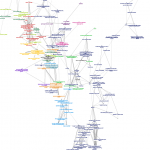
Because some members of the Institute provided identical (or substantially identical) responses to the questions I had asked before we met, I could graph all of their ideas and connections as one network. Once we convened at Tufts, I gave them opportunities to discuss their own network maps with their colleagues. I did not encourage them to link their ideas together, but some chose to do so, and others simply borrowed ideas from their fellow participants. I edited the database when people changed their responses. As a result, the class map became gradually denser. Here is an illegibly small image of all 272 ideas and how they relate in the minds of our participants on Day 6 of the Institute. (Responses are color-coded by individual.)

subject3

I would posit that we have formed an intellectual community to the degree that the individual networks have linked up. This community is not defined by shared premises. There is no one idea that everyone shares–in fact, not even close–and several ideas on the map are mutually contradictory. (To name an evident example, the map includes both “God is loving and kind” and “God is dead–everything is permitted.”) The community is rather defined by its density and connectedness. These are matters of degree. Ten nodes are completely disconnected, and the network as a whole is only 1.5% as connected as it would be if every node were directly linked to every other one. But we have more of a community than we had on Day 1, as any participant would attest.

By the way, this means that John Rawls was wrong. Rawls saw a “plurality of reasonable but incompatible comprehensive doctrines” as a “fact” about the world, or at least about the modern world. He explained: “a reasonable doctrine is an exercise of theoretical reason: it covers the major religious, philosophical, and moral aspects of human life in a more or less consistent and coherent manner. It organizes and characterizes recognized values to that they are compatible with each other and express an intelligible view of the world” (Political Liberalism, New York: Columbia University Press, 1993, pp. xvii, 59).

Do we see a comprehensive doctrine here? Or two doctrines, or three? I know that the group includes an observant Mexican Catholic, a couple of explicit atheists, a highly Kantian liberal, and some Deweyan communitarian pragmatists. I can identify their favored ideas on the map. But I do not see separate islands of thought. A few people have organized their networks, made their ideas mutually compatible, and could summarize them by identifying one or more core premises from which they think the rest follow. Most people could not do that. To “express [their] intelligible view[s] of the world,” they would have to show their whole maps, which now connect to other people’s maps.

Diversity is a fact. A diversity of “comprehensive doctrines” is not.

how do we perceive an identity?

(Providence, RI) What makes us think that certain features of objects are integral or essential while others are optional? For instance, a banana could be straight and still a banana, but a wheel must be round to be a wheel. You could change the material of a wheel without changing its status, but you cannot make a (real) banana out of something other than a certain kind of fruity flesh.

This is a psychological point and not a logical or metaphysical one. People will differ in what they consider definitive about a banana, and many (or even all) of us could be wrong. But we tend to think of some aspects of objects as central and essential, and others as optional. We can develop models that mimic–and help elucidate–how people make those distinctions.

These models interest me not so much when applied to everyday objects like bananas and wheels, but when turned toward matters relevant to human values. For instance, what makes us assign a person to a “culture”? (Cultures have many features, and they always encompass much internal diversity, yet we confidently declare that individuals represent particular cultures.) Likewise, when do we assign a person to a moral category, such as “liberal” or “religious”?

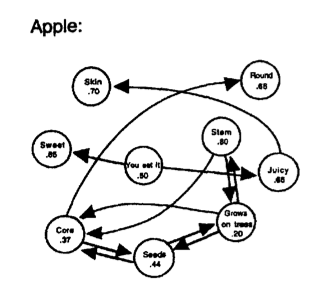
Sloman, Love, and Ahn* ask subjects various questions about what features of an ordinary object, such as an apple, are integral to it. For instance, surprise: How surprised would you be to find an apple that had no skin, that did not grow on a tree, or that was blue? Salience: How prominent in your conception of an apple is that it is edible, or red, or round? Inference: If you knew that something grew on trees, would you guess that it was edible, round, or red?

The authors develop a statistical model that can predict which features of an object are seen as most integral. The model turns out to depend on the survey questions about mutability. We define an object by the kinds of features we think can’t be changed. These features compose its identity, as we perceive it. (Again, this is a psychological finding and not a logical or metaphysical one.)

The authors then argue that what makes a feature seem immutable is the degree to which other features seem to depend on it. That leads to a second experiment in which the features of an object are scattered on a piece of paper and subjects are asked to draw lines between the features that they consider dependent on each otherScreen Shot 2014-06-04 at 6.45.20 PM. For example, this graph shows an arrow between two features of an apple: “sweet” and “you eat it.” Apparently, we eat apples because they are sweet. Overall, the graph reveals two connected subnetworks, one concerned with apples as food and the other with the apple’s reproductive history (p. 223).

Of course, the image above is not a representation of an apple. It does not depict or convey the juicy crunch of the real fruit. Nor would it define an apple as objectively as, say, a DNA sequence. It doesn’t provide necessary and sufficient conditions for being an apple. It is rather a representation of the everyday mental model that subjects use in classifying objects as apples.

Now consider what happens when we introspect and assign ourselves to normative categories. Even if I limit my introspection to ethical matters, I observe many features of my own thought: principles, methods, aversions, enthusiasms, commitments, loyalties, open questions. Some of these I consider quite optional and superficial. If I changed those opinions, I wouldn’t believe that I had changed. Others seem more fundamental, so that I doubt that I could change them at all, and if I did, I would be someone new.

The model from Sloman, Love, and Ahn suggests a way of distinguishing between superficial and fundamental commitments. The fundamental ideas have many dependent ideas, so that if they change, it starts a whole chain of other changes.

Of course, people can differ in the degree to which their worldviews depend on just a few ideas, and therefore how much change any shift will cause. Some people organize their moral thought systematically, so that it all depends on a few premises (or even one sumum bonum). Others are not able to systematize in that way, or object to doing so. John Keats, for example, defined “Negative Capability” as the capacity not to organize one’s thought so that it was dependent on any particular ideas. He attributed that capacity to Shakespeare and also to himself, writing, “it is a very fact that not one word I ever utter can be taken for granted as an opinion growing out of my identical nature [i.e., my identity].” He implied that he could change any given idea without much effect on the whole of his thought, whereas people like Coleridge built their whole mentalities on narrow foundations.

The model from Sloman et al. suggests this is difference is a matter of degree. Probably all of us fall on the spectrum somewhere between Keats and, say, Jeremy Bentham. The network model is flexible enough to depict anyone.

*Steven Sloman, Bradley C. Love, and Woo-Kyoung Ahn, “Feature Centrality and Conceptual Coherence,” Cognitive Science, vol. 22, no. 2 (1998), pp. 189-223.

See also: “the politics of negative capability“; “toward a theory of moral learning“; and “a different take on coherence in ethics.”

are religions comprehensive doctrines?

John Rawls saw a “plurality of reasonable but incompatible comprehensive doctrines” as a “fact” about the world, or at least about the modern world. He explained: “a reasonable doctrine is an exercise of theoretical reason: it covers the major religious, philosophical, and moral aspects of human life in a more or less consistent and coherent manner. It organizes and characterizes recognized values to that they are compatible with each other and express an intelligible view of the world” (Political Liberalism, New York: Columbia University Press, 1993, pp. xvii, 59).

Since my first book, I have been criticizing this assumption that the world is divided into separate, internally coherent worldviews. It’s certainly not Rawls’ assumption alone. I would define “modernism” as the premise that there is a plurality of incompatible comprehensive views. And I would assert that modernism is a mistake, driven by certain confusing metaphors: culture as a perspective, culture as a structure built on a foundation, culture as a table of values. I’d prefer a metaphor of overlapping horizons or a model of cultures as interconnected networks of ideas.

If anyone holds a “comprehensive doctrine” that is incompatible with other views, it would be a religious authority in one of the Abrahamic faiths. For instance, in 2011, during the turmoil of the Egyptian revolution, the most senior cleric who had been appointed under the old regime of Hosni Mubarak, the Grand Mufti of al-Azhar University, gave a sermon against political “extremists”:

They preferred to learn in their own beds at home from The Book with neither a methodology nor a master, so they stopped at the outer shell of Islam without realizing its goals and meanings. They stopped at the surface and they failed to realize the truth behind matters and the truth behind rules. They stopped at the partial and failed to see the whole. They favored the specific over the general. They favored their own interest over the interest of the ummah [nation or community].

Here a theologian and jurist asserts that his religion is fully coherent and centralized. This cleric, Ali Gomaa, goes on to address particular issues; for example, he opposes destroying the idols of other faiths, which he calls  an act of extremism. He argues that to make such judgments correctly, one must apprehend the core of the true faith—or else follow a master who possesses such knowledge.

This is a familiar rhetorical move within any faith tradition. For an outsider, it may seem obvious that the faith is a “comprehensive doctrine,” uniting all believers into the same structure of reasoning. But a learned member of the faith always knows that almost every element of it is contested within the tradition. Certainly, Gomaa would be aware that the Islamic Brotherhood and Salafi sheiks were preaching different messages in Egypt at the same time.

Gomaa did not actually specify how the core truths of Islam led to his particular judgments. He wanted his listeners to picture a chain of reasoning that flowed from the core of the faith to the particular cases, but he did not spell it out. That is because his purpose was to assert authority, not to offer reasons. One can offer reasons within a faith tradition, but that will be a matter of picking a path through a complex web. And many of the nodes and connections in that web will be shared with other faiths, so much so that the borders between faith traditions are often blurred.

The problem for liberalism is not that citizens hold strong and controversial metaphysical commitments. Citizens in a liberal regime may believe that Jesus is their personal savior or that science delivers the only valid truths. The problem is a moral network that is overly dependent on a few central ideas. And that is not intrinsic to a religion. To put it a different way: It is not a fact that the world is divided into comprehensive and incompatible doctrines. It is a choice to view it that way.