Category Archives: epistemic networks

it’s not just what you think, but how your thoughts are organized

We come into the world with no moral ideas at all and must learn them from others. We learn not just from arguments and explicit principles, but also by observing practices and experiencing emotional reactions.1 We must make judgments about complex, evolved, historically contingent phenomena (such as, among many others, marriage, democracy, and art) that we cannot apprehend as wholes but must learn to assess from accumulated and vicarious human experience.2 In Habermas’ terms, we begin with a “Lifeworld” formed of our shared experiences and improve it through explicit deliberation with diverse people in civil society.3

Some people are much better at this process than others are, and we can explain why by understanding their moral worldviews as networks of ideas and connections and considering how their whole networks are organized. Consider these hypothetical discussion partners:

  • Aaron constantly returns from any situation or moral consideration to the same value. He considers that value immediately relevant to all others and nonnegotiable. It defines his moral identity and appears to him manifestly true. Deliberating with Aaron is impossible, but not because his network contains a foundational belief in the sense of one that is “infallible, or indubitable, or incorrigible, or certain.”4 What makes him a poor deliberator is rather the over-centralization of his network of moral ideas. One cannot find a route around his core principle.
  • Bao endorses a lot of moral ideas, examples, and principles. But he cannot connect one to another. Asked why he believes P or Q, he has nothing to say about his reasons, let alone can he offer a chain of reasons that connects P to Q. It is hard to talk to Bao because his network is disconnected.
  • Carlos simply has nothing to say about many choices, dilemmas, and cases that arise in conversation and practice. He can discuss some topics cogently, but many others seem not to interest or concern them. The problem with Carlos’ network is that it is too small (having too few nodes) or has too restricted a scope.
  • Dominique cheerfully holds both P and not P, depending on her mood or perhaps her self-interest or convenience. Dominique frustrates deliberation because her network harbors blatant inconsistencies that she does not attempt to resolve.
  • Eduardo is committed to one idea, like personal liberty or economic equality, and he will not recognize the legitimate pull of other values that conflict with his summum bonum, e.g., order and security, solidarity and community, or democracy. Eduardo’s network is consistent but impossible to connect to if one holds other values.
  • Fiona holds many ideas and can thoughtfully connect them to each other. But asked whether she has tried to apply any of his ideas in practice or observed them in application, she demurs. Fiona’s network is well structured for talk but disconnected from experience.

This list can be extended. The point is that the structure of a moral network is important. That follows from the premise that we each begin with whatever ideas and connections we happen to hold, and our responsibility is to refine the whole set in discussion and collaboration with others. In that case, we should be concerned not only about the various values that we endorse, but also with how they are configured. The best networks for discussion are likely rich, complex, connected, not overly centralized, and not necessarily fully consistent.

Notes

  1.  Cf. Owen Flanagan, “Ethics Naturalized: Ethics as Human Ecology,” in Larry May, Andy Clark , and Marilyn Friedman (eds.) Mind and Morals: Essays on Ethics and Cognitive Science (Cambridge, MA: MIT, 1998) p. 30: “The community itself is a network providing constant feedback to the human agent.”
  2. See Richard N. Boyd, “How to be a Moral Realist,” in Geoffrey Saye-McCord, Essays on Moral Realism (Ithaca, NY: Cornell University Press, 1988), p. 205: ““Much [moral] knowledge is genuinely experimental knowledge and the relevant experiments are (“naturally” occurring) political and social experiments whose occurrence and whose interpretation depends both on “external” factors and upon the current state of our moral understanding.” Cf. Friedrich A. Hayek, The Constitution of Liberty (Chicago: University of Chicago Press, 1960), pp. 59-65
  3. Habermas’ preferred metaphor is a horizon, but he explicitly mentions networks in Jürgen Habermas, Between Facts and Norms: Contributions to a Discourse Theory of Law and Democracy, trans. by William Rehg (Cambridge: MIT Press, 1996), p. 18.
  4. Geoffrey Sayre-McCord, “Coherentist Epistemology and Moral Theory,” in Saye-McCord, p. 154.

how judgment is structured

Everything is judged

As you walk through the supermarket, your senses absorb data from tens of thousands of objects. Each presents a binary choice: buy or don’t buy. That is a value judgment, even if the only value consideration is whether you happen to like the item’s taste. But most likely, other considerations are relevant as well. Is it healthy? Would your toddler eat it? Is it worth the price, the weight in your basket, and the space on your shelf? And perhaps: were animals harmed in making it? Were people exploited? How much carbon was used to make it? Does the picture on the box objectify the human subject?

You can widen the lens, too, and ask not about individual items on the supermarket shelves but about the supermarket as a whole: Should you be spending your time there? Should your money flow to its owners? Should our systems of production and exchange be organized this way? Who cannot shop here?

And the choices are not really binary: buy or don’t buy. For each object, you could also appreciate it, recommend it, make a note to buy it another time, disparage it, steal it, throw it out the window. You could even act like Allen Ginsberg in “A Supermarket in California” (1955):

I saw you, Walt Whitman, childless, lonely old grubber, poking among the meat in the refrigerator and eyeing the grocery boys.

I hear you asking questions of each: Who killed the pork chops? What price bananas? Are you my angel?

I wondered in and out of the brilliant stacks of cans following you, and followed in my imagination by the store detective.

We strode down the open corridors together in our solitary fancy tasting artichokes, possessing every frozen delicacy, and never passing the cashier.

These lines remind us that we experience more than goods in a store. There are also the other shoppers and workers, real and imagined, alive and dead, with their words and desires. We can walk past anyone or anything without making a judgment; but that, too, is a choice and it implies a judgment.

Everything is structured

It is a familiar observation that experience presents us with too much data, and it all flows together without clear separations in space or time. William James, The Principles of Psychology, 13:

The law is that all things fuse that can fuse, and nothing separates except what must. … The baby, assailed by eyes, ears, nose, skin, and entrails at once, feels it all as one great blooming, buzzing confusion; and to the very end of life, our location of all things in one space is due to the fact that the original extents or bignesses of all the sensations which came to our notice at once, coalesced together into one and the same space.

Therefore, we organize, categorize, simplify, select. We don’t consider each box of Kellogg’s Cornflakes but the whole product line, or perhaps breakfast cereals taken as a class.

Aristotle began the discussion of categories with his book of that name, in which he argued that any thing could be classified in ten ways: where it is, when it is, its relation to other objects, its action, its being acted on, etc. In Kant’s version, the categories were not features of nature but tools of reason—by which he meant not merely human reason, for any animal, angel, or alien would have to use the same tools if it reasoned. Parting with Aristotle and with Kant, we could instead attribute these categories to human psychology (treating them as phenomena of our evolved, physical brains) or of language, which has a deep structure shared by all human beings.

But what matters most to moral judgment in a supermarket are not these fundamentals of location, duration, action, etc., but a more evident type of classification. Objects in a store are for sale or not, expensive or not, healthy or not. Such categories are not features of nature, reason, psychology, or the deep structure of language. They are constructed. Objects in a store have been designed and labeled so that they fit in various categories, for reasons determined by their owners and influenced by governments. Even the people wear various kinds of labels that intentionally classify them. The building as a whole also has marked boundaries and a location on an organized street plan. Although these categories have been constructed, no one controls them completely, for nature intrudes (an object isn’t healthy just because someone says it is) and because each observer has some individuality. I may think a given product is desirable even if you do not.

Some of these categorizations are morally neutral or unexceptional. Some are helpful. But some may be unethical or even evil: for instance, if they encourage us to buy products that gradually kill us or that have required murder and expropriation to create. The typical object is not actually lethal but it does have bad as well as good features. The same is true of each socially constructed category of objects, such as all the breakfast cereals or all the vegan items. And it is true of each institution that has constructed and maintained these categories.

But how can we tell how to judge right? From early school days, we are taught to distinguish between facts, which can be demonstrated or disproved, and opinions, which belong to the person who holds them. Moral judgments seem more like opinions than facts, hence not demonstrable or disprovable. Some people also argue that science is the only path to truth, and science has nothing to say about which objects are good or bad. There is not one “scientific method,” but many methods that scientists use: observation, measurement, classification, model-building, experimentation. But all scientific methods involve rigorous efforts to insulate the facts—to the greatest degree possible—from the observer’s value-judgments.

Such efforts are necessary because we have affective reactions to objects—positive or negative emotional surges that come faster than articulate thought. Francis Bacon already observed that “human understanding when it has once adopted an opinion (either as being the received opinion or as being agreeable to itself) draws all things else to support and agree with it.” Recent psychology insists that our emotional surges–what we find agreeable or disagreeable–explain the thoughts that follow them. We have a feeling and then we rationalize it with conscious ideas.

Thus we need not worry that we are morally apathetic, but we should worry that we are morally wrong. Consider, for example, the experimental evidence that most White Americans (and not a few African Americans) have immediate negative responses to Black faces. That is an example of a strong affective response that is relevant to such everyday experiences as shopping in a supermarket, where both the real people and some of the images on the goods appear to modern Americans to have racial identities. If, after science sifts out the facts, we are left only with instinctive reactions–including some invidious ones–which we then justify with moralizing rationalizations, we are in deep trouble.

Judgment, too, is structured

Individual moral claims are indeed untrustworthy, whether they are instinctive and inarticulate affective reactions or carefully constructed moral propositions. Taken one at a time, they do appear to be nothing more than opinions. We know that people’s opinions differ, and so we have grounds to be skeptical that any are better than others.

But moral claims do not come alone. We connect each one to others. I favor marriage equality–why? Because gay marriage is like heterosexual marriage. Because people want to love and be loved exclusively and durably. Because marriage tends to benefit the children. These are connections among pairs of ideas. They start to form a network. The network is much more persuasive than any particular idea.

First, the network bridges facts and values. Many of the claims in the previous paragraph are empirical, or partly so. Yet the same sentences that make empirical claims also embed deeply moral concepts.

Second, the network has formal features that cannot be attributed to individual ideas. For example, it is more or less consistent and coherent. Those are the most frequently cited criteria of good moral thought, and I believe they are overrated. (Evil fanatics are often highly consistent.) But we can add other formal criteria: networks of ideas ought to be rich, complex, and dense.

Third, a network permits interaction with other people. If I believe X and you do not, there is not much to discuss. But if I believe X because of Y, and Y because of Z, and Z because it resembles A, there is probably some node or connection in what I’ve said that you can lock onto.

My own structured network of ideas reflects the influences on me so far. If I had been born a gentile German ca. 1900, I probably would have favored Hitler in 1939 (if I had lived that long). Because I was born to an American Jewish father in 1967, it was easy for me to see that Nazism was evil. Still, I was correct in that judgment. The quality of the moral network with which we begin to reason is a matter of luck (“moral luck“). It is up to us, however, whether we test our structured ideas with people differently situated and motivated and revise it accordingly.

social criticism as reading social forms

Patterns and forms are very common in the social world. In Forms: Whole, Rhythm, Hierarchy, Network, my sister Caroline Levine focuses on the four forms named in her title. She acknowledges that her list may not be exhaustive, and one form that I might add is clustering, which arises when cases congregate near a mode that is seen as normal. But certainly, her four forms are ubiquitous.

To take a very simple example: Employees A and B work at Organization C. (They are within the same bounded whole). A was hired first, has more seniority, and will retire first. (Rhythm.) A supervises B. (Hierarchy). A and B exchange information. (Network.)

Some social theorists would argue that one of these forms is logically or temporally primary or is simply more important than the others across a wide range of cases. For instance, Marx recognized trade networks and the bounded wholes of states and classes, but for him, the key question was hierarchy: which class was dominant? Some current network theorists are eager to understand everything (including organizations’ hierarchies) as special forms of networks. But there is no a priori reason to presume that any of these forms is primary. They overlap and interact. If, within some broad domain (such as religion, or America, or postindustrial capitalism) one form is most important, that is an empirical generalization, not an analytical truth.

Why do we use certain forms to construct society?

I can imagine three mutually compatible reasons for the frequent appearance of these forms in the social world. First, they work. They have various practical advantages, or, as Caroline says, “affordances.” If you want to protect a group, then building a wall or perimeter around them can be a good idea. If you want information to flow, then a network of dirt paths or fiber-optic cables can be useful. Sometimes what people intend is irrelevant. A form just turns out to have practical value, and therefore it survives and spreads regardless of the intentions of its designers, revisers, and adopters.

Second, the same forms and patterns are very common in nature, and particularly in biology, where the study of them is known as morphology. Sometimes we imitate natural forms as we construct social phenomena.

Third, our brains may be designed to detect the forms found in nature, so that we are good at making (and also noticing) similar forms in society and culture. My dog is good at noticing bounded wholes (the perimeter of our house or any place we stay), rhythms (he expects to be fed at exactly 6:00 pm) and hierarchies (he understands himself as the lowest creature on the family’s organizational chart). But I am not sure he recognizes networks. If humans shared that limitation, then our society might not have any networks—because we couldn’t create them—or it might have networks that we couldn’t detect. And just as Barkley probably cannot see networks, we may miss forms that arise in nature or society.

By the way, we are not considering categories such as before and after or near and far that might be viewed as features of being (Aristotle) or thought (Kant). We are rather considering concrete and constructed distinctions such as inside/outside the prison or on the sabbath/on a workday. The question is not whether these distinctions are metaphysical or epistemological (or linguistic). They are social facts that we make. The question is whether they resemble similar forms in nature because lawlike tendencies govern both domains, because we choose to copy nature, or because we think that we see forms in nature that look like the forms of our social life.

Emile Durkheim navigated these waters and found himself, I would say, in roughly the right place. He held that the categories of thought had social origins. For instance, the rhythms of time with which a scientist measures biological or geological change have origins in the social rhythms of work and festivals.

But if the categories originally only translate social states, does it now follow that they can be applied to the rest of nature only as metaphors? If they were made merely to express social conditions, it seems as though they could not be extended to other realms except in this sense. Thus in so far as they aid us in thinking of the physical or biological world, they have only the value of artificial symbols, useful practically perhaps, but having no connection to reality….

But when we interpret a sociological theory of knowledge in this way, we forget that even if society is a specific reality it is not an empire within an empire; it is a part of nature, and indeed its highest representation. The social realm is a natural realm which differs from the others only by a greater complexity. …. The fundamental relations that exist between things … cannot be fundamentally dissimilar in the different realms. [The Elementary Forms of the Religious Life, trans. J.W. Swain, 1915]

Thus, by building and interpreting social structures that involve boundaries, rhythms, hierarchies, and networks, we gain the vocabulary and conceptual apparatus to attain real understanding of similar forms in nature.

Value judgments of social forms

One thing that we do—and nature does not—is to make value judgments about the instantiations of the various forms. For instance, if A supervises B, we may judge that wise and fair, unfortunate but necessary, or oppressive. If A and B belong to the same organization, but C does not, we may likewise judge that arrangement to be desirable, acceptable, or unjust. And of course, we can broaden the lens, making judgments not about A and B but more generally about employment, organizations, states, and markets. Asked why we make any of these judgments, we may cite a whole range of relevant value considerations: equity, liberty, desert, obligation, virtue, precedent, and more.

We could think of each judgment as a tag or descriptor applied to the case under consideration, but here is where I see my own recent work on moral networks as relevant. After all, our various judgments are connected. They form structures of their own.

In fact, it has often been noted that moral judgments can take the form of bounded wholes. All lies are unethical, Kant argued—putting a boundary around a large set of cases.

It has also often been noted that moral judgments can be placed in hierarchies. J.S. Mill began On Utilitarianism: “From the dawn of philosophy, the question concerning the summum bonum, or, what is the same thing, concerning the foundation of morality, has been accounted the main problem in speculative thought, has occupied the most gifted intellects, and divided them into sects and schools, carrying on a vigorous warfare against one another.” Highest goods and foundations are metaphors of hierarchy. For Mill, the principle of utility was supposed to govern our other moral ideas, much as the leader of an organization directs her employees.

And it has often been noted that moral thought, which has extension in time, involves rhythms. You sow what you reap; punishment follows the crime. Far more complex moral rhythms can be found in novels and works of narrative history.

I am interested in adding moral networks to the other three types of moral forms (boundaries, hierarchies, and narratives), because I believe that we connect our specific moral ideas to others in numerous meaningful ways. We see causation, implication, similarity, and other relations between pairs of moral ideas; and the result is a complex network that has interesting network features (centrality, modularity, gaps). But this way of thinking about morality does not exclude the categories of wholes, rhythms, and hierarchies. In fact, often the ideas that we connect together into networks are claims about boundaries; portions of our networks take the form of hierarchies; and our networks evolve over time.

So now we see at least four formal types (the keywords in Caroline’s title) playing out in at least three domains: nature, society, and ethics. Moreover, those three domains are intimately linked. Durkheim already explored how biological and social forms connect. I would add that moral judgments are closely and reciprocally connected to social forms. B accepts A’s supervision because both believe that A has an obligation to guide B. (Then the social form gains its power from its perceived moral significance.) A stranger who independently criticizes their arrangement must have learned to make her judgments as a social being enmeshed in her own wholes, rhythms, hierarchies, and networks. (Her moral structure has a social origin). She thinks that B should be liberated from A’s oversight because she has observed a different society in which people are not so supervised. (Her moral norm derives from analysis of an actual social structure). And so on.

Moral judgment deals with emergent and evolved natural and social realities rather than simple categories and scenarios. Social realities are complex because millions of diverse people have constructed them over long periods and under conditions of imperfect communication, collective-action problems, path-dependence, incomplete information, mixed motives, etc. Hardly any societies look neatly designed.

If we make value judgments based on rough heuristics and instincts that our ancestors acquired millennia ago in simpler social situations, we are poorly prepared to deal with this complexity. To the extent that our instincts guide us, we are prone to serious error. But instincts may not guide us to the degree that it appears if one studies moral psychology by asking subjects their gut reactions to stylized cases, such as out-of-control trolley cars. What we actually do all day is to navigate complex, overlapping social forms. We may be a bit better at that task than current psychological data suggests.

Implications for structure and agency

Learning to make better moral judgments is then a matter of interpreting complex, overlapping forms—not only social structures but also moral ones. I am interested in solitary methods for improving that analysis, such as literally mapping our own networks of moral ideas and looking for formal strengths and weaknesses.

But we have grave cognitive limitations, so moral learning is intrinsically social and cumulative. Durkheim again:

Collective representations are the result of an immense co-operation, which stretches out not only into space but into time as well; to make them, a multitude of minds have associated, united and combined their ideas and sentiments; for them, long generations have accumulated their experience and their knowledge. A special intellectual activity is therefore concentrated in them which is infinitely richer and complexer than that of the individual.

This seems correct as far as it goes, but it can imply that individuals really don’t have much agency or choice and we cannot achieve intentional social improvements. Consider this passage from Talcott Parsons’ An Outline of the Social System (1961):

… As the source of his principal facilities of action and of his principal rewards and deprivations, the concrete social system exercises a powerful control over the action of any concrete, adult individual. … The patterning of the motivational system in terms of which he faces this situation also depends upon the social system, because his own personality structure has been shaped through the internalization of systems of social objects and of the patterns of institutionalized culture. This point, it should be made clear, is independent of the sense in which individuals are concretely autonomous or creative rather than “passive” or “conforming,” for individuality and creativity are, to a considerable extent, phenomena of the institutionalization of expectations.

Although Parsons denied he was dismissing agency, this passage certainly seems to. But we can look at the same phenomena another way. Some social systems reflect accumulated, collaborative learning. They do not just exist and control us; we have made them, working together and expressing our diverse values and interests. They are also responsive to our further learning.

To the extent that we persuade ourselves that existing patterns are all-powerful, we renounce our capacity and obligation to change them. The opposite view has been staked out by Roberto Mangabeira Unger, who argues in False Necessity that the analysis of society in terms of inflexible structures arbitrarily blocks our freedom. Unger takes “to its ultimate conclusion” the thesis “that society is an artifact” (p. 2). All our institutions, mores, habits, and incentives are things that we imagine and make. Unger “carries to extremes the idea that everything in society is politics, mere politics”–in the sense of collective action and creation (p. 1). According to Unger, even radical modernists have assumed that some things are natural, although we can actually change them. Importantly, radicals have assumed that the relations between one domain (or type of form) and another are given. For instance, for Marxists, the economy is fundamental and it always determines politics. Unger thinks we can change any part of the picture. He wants to get rid of all “superstitious inhibitions.”

I am drawn to Unger but worry that his mechanical model overlooks the degree to which a society is like an organism: sensitively interconnected and not so easy to retool without doing unanticipated damage. In any case (and here Unger would agree), social systems differ in the extent to which they embody and enable collaborative learning.

Caroline uses the depiction of Baltimore in HBO’s series The Wire as an exemplary analysis of overlapping social forms, which it is. And Baltimore (as depicted in The Wire) does reflect some democratic agency and learning—more so than North Korea would, even though North Korea could also be interpreted as a pattern of human-made boundaries, hierarchies, networks, and rhythms. But even if Baltimore is better than North Korea, it is far from optimal as a venue for democratic learning because of poverty, violence, racism, and bad institutional design.

In The Public and its Problems, John Dewey wrote (p.158), “philosophy [once] held that ideas and knowledge were functions of a mind or consciousness that originated in individuals by means of isolated contact with objects. But in fact, knowledge is a function of association and communication; it depends upon tradition, upon tools and methods socially transmitted, developed, and sanctioned.” Nevertheless, said Dewey, we need not continue doing what we have done so far. We can ask whether we should change our political system. As Hilary Putnam Putnam writes in “The Three Enlightenments” (from “Ethics without Ontology”):

For Dewey, the problem is not to justify the existence of communities, or to show that people ought to make the interests of others their own [that much is natural and unavoidable]; the problem is to justify the claim that morally decent communities should be democratically organized. This Dewey does by appealing to the need to deal intelligently rather than unintelligently with the ethical and practical problems that we confront.

To conclude: we must analyze any social situation for its formal patterns. We must make value judgments about those patterns. Our value judgments are also patterned, so we should reflect on their structure, not only on each opinion by itself. Finally, we must ask whether these patterns (in the social world and in our own thought) permit human agency and desirable change. Effective and responsible agency is not solitary but requires deliberation with people different enough from ourselves that their perspectives challenge and expand ours, but close enough to us that we can build new structures with them using the shared material at hand. In turn, that requires certain political and social conditions, which we must work to attain.
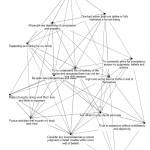
a method of mapping moral commitments as networks

I have been developing a method for representing moral beliefs as networks of ideas. Various friends have also been contributing to the development of this approach. So far, we have asked individuals to name their own beliefs, given them back their lists, asked them to note which pairs of beliefs seem connected, and generated network maps of their beliefs and connections. I’ve also asked individuals to share their maps with peers and to consider making changes in response to other people’s arguments. I have mapped the ideas of multiple people as one network. Instead of using surveys, one could interview people or groups about their moral thinking on a given topic and identify the beliefs and connections implied by their speech–or use a rich text, such as a poem, to discover an implicit network map. Major moral theories also have network shapes that can be diagrammed. Virtues, for instance, are important nodes in Aristotle’s conceptual network, and he says that the virtues are all connected by way of one central concept, practical wisdom.

I do not see this network approach as a model of moral thought, an empirical theory about how we actually think, or a normative theory about how we should think. Instead, I see it as a technique of analysis that is relatively neutral with respect to models and theories, yet it does have certain substantive implications.

According to the Stanford Encyclopedia of Philosophy, there is little clarity or consensus about what defines a theory versus a model. But let me propose two analogies:

  1. A Lego car is a model of a real car. It can be used to develop and test theories about the performance of actual cars. These theories prove true or false when tested in real cars; the Lego model is reliable to the degree that the theories pan out. Making Lego models is a technique that is more or less helpful for engineering. Its value depends on the context and the available alternatives. For instance, Lego is almost certainly a better material than soap for making models of cars. It is a less precise medium than 3D printing, but it is also cheaper and easier. A good theory is true; a good model is valid and reliable; and a good technique is useful.
  2. In economics, I would call each equation a theory and use the word “model” to mean a whole set of equations, along with definitions and explanations of the hypothesized mathematical relationships. Working with equations is a technique. It is pretty obviously an essential technique for economics, but some have argued that it has been valued to the exclusion of other techniques, such as collecting better data, looking for natural experiments, or identifying important topics. Paul Krugman wrote recently: “It has been all too obvious that there are people with big reputations who can push equations around but don’t seem to have any sense of what the equations mean.” Like building with Legos, mathematics is a technique whose value varies with the context.

Likewise, I would propose that mapping moral networks is a technique with which one can build models and test hypotheses. It is fairly flexible and can accommodate a range of substantive views from both psychology and philosophy. But its relative value (compared to other techniques) varies depending on some assumptions about morality. I’ll compare it to two prevalent alternatives.

First, some moral philosophers construct systematic views. An example would be the sophisticated utilitarianism of Henry Sidgwick (which we could call “utilitarianism 3.0,” if Bentham’s was 1.0, was Mill’s was 2.0). Sidgwick held that there is just one ultimate moral principle: maximizing human happiness. But it generates a set of important moral rules, such as being kind and telling the truth. These precepts, in turn, imply many ordinary moral judgments, such as telling the truth to your mother.

Sidgwick’s structure was mainly philosophical, not empirical. He did not say that everyone is a utilitarian (in fact, he explicitly denied that), but that everyone’s judgments should be consistent with the results of utilitarian reasoning. There was, however, an element of empiricism is his view. He doubted that we can directly apply the utilitarian principle to real cases, which is why subsidiary rules are valuable.

Sidgwick’s structure can be diagrammed as a tree-like network, and that is somewhat illuminating. Individuals’ actual moral networks could also be mapped and compared to Sidgwick’s diagram, as a form of moral assessment. However, if Sidgwick was right, then network analysis has limited value. After all, his proposed network is quite simple, and some of the power of network modeling (e.g., detecting subtle clusters in large fields of data) would be wasted. Thus …

P1. Network techniques become more useful if we presume that real people hold many different structures of moral thought, that a theoretically driven structure like utilitarianism is not necessarily ideal, that some structures are much more complex than Sidgwick’s, and that comparing structures is illuminating.

Second, the moral psychologist Jonathan Haidt currently proposes six “moral foundations,” although his theory is subject to testing and improvement, and he is open to finding more than six foundations. One technique he uses is factor analysis. Many individuals are asked many questions about moral topics, and Haidt and colleagues look for unobserved variables (“factors”) that can explain a lot the variance in the answers. In developing statistical models that predict the actual results as a function of a few variables, they seek parsimony and fit. “Parsimony” means that fewer factors are better, but “fit” means that the unobserved variables should explain the actual survey answers without too much error.* Once the data yield statistical factors, Haidt and colleagues consider whether each one names a psychological instinct or emotion that 1) would have value for evolving homo sapiens, so that we would have developed an inborn tendency to embrace it, and 2) are found in many cultures around the world. Now bearing names like “care” and “liberty,” these factors become candidates for moral foundations.

Network analysis could represent Haidt’s model, just as it can represent Sidgwick’s very different conception. Each of Haidt’s foundations would be a central node connected to many concrete beliefs by one-way arrows. However, if Haidt is right, then network analysis is not as valuable a technique as the one he uses, factor analysis. First, network analysis is not nearly as parsimonious. A network map may show hundreds of beliefs clustered to varying degrees. Instead of generating six nameable foundations, a network map might yield fifty somewhat vaguely defined and partly overlapping clusters.

Second, the network method presumes that people’s explicit connections are meaningful. I diagram subjects’ networks using their assertions that their own beliefs are linked–for example, I link A to B when someone thinks that A gives her a reason to think B. But Haidt and colleagues argue that we do not know which beliefs are meaningfully connected. We reach conclusions because of unconscious biases and use reasons as mere rationalizations, gerrymandering our arguments to fit what we want to believe because of the underlying foundations. Sidgwick (like most philosophers) held that in morality, “as in other departments of thought, the primitive spontaneous processes of the mind are mixed with error, which is only to be removed gradually by comprehensive reflection upon the results of these processes.” But Haidt et al. believe that such reflection is basically ineffective, for only the primitive spontaneous processes of the mind really count. If that is the case, than the very items that matter most (the unobserved foundations) will be missing from a network map that is derived from people’s explicit connections. Thus …

P2 Network techniques become more useful if people have many clusters of moral ideas, if important information is lost by seeking parsimonious statistical models, and if reflection on explicit, conscious ideas and connections is valuable.

*Graham, Jesse et al. “Mapping the Moral Domain.” Journal of personality and social psychology 101.2 (2011): 366–385. PMC. Web. 1 Dec. 2014.

“the self is moral”

Summarizing a body of empirical research, the Duke psychologist Nina Strohminger argues that what constitutes our identity is our moral character, not (for instance) the memories that we have stored so far. Asked what characteristics a soul would hypothetically carry into another body, subjects choose the soul’s moral character. Asked which psychological changes would make someone into a new person, subjects select moral changes above total amnesia or an inability to recognize moral features. Given a chance to improve their own moral character with an imaginary pill, people say they would decline because that would mean abandoning their selves.

According to Strohminger, “moral features” constitute “the most important type of information we can have about another person.” She continues:

So we’ve been thinking about the problem precisely backwards. It’s not that identity is centred around morality. It’s that morality necessitates the concept of identity, breathes life into it, provides its raison d’être. … What is it to know oneself? … When we dig deep, beneath our memory traces and career ambitions and favourite authors and small talk, we find a constellation of moral capacities. This is what we should cultivate and burnish, if we want people to know who we really are.

I would like to connect this discussion to psychological research on how we perceive the identities of ordinary objects, such as apples and chairs. (This link may have been made already; I have not looked.) According to experiments by Sloman, Love, and Ahn, people perceive as integral or essential those features of an object that could not change without affecting many other features. Therefore, a network model is useful. Think, for instance, of the many features of an apple (its crunchy texture, sweet taste, origins on a tree, function of protecting seeds, color, size, role in Greek myths, etc). These features can be seen as nodes in a conceptual network. The nodes that we see as more definitive of appleness are the ones that have higher network centrality.

Likewise, I would model any person as holding many ideas in his or her head at any time. The individual ideas are all subject to change. Some are linked to others, forming a large, complex, and evolving conceptual network. Some of the nodes are moral ideas, however you define morality. When we think of another person’s identity, we should not cite just one or a few clear-cut principles or virtues. That would reduce the complex person to an abstraction. But we should have in mind a cluster of connected–although not always mutually consistent–nodes that are relatively central to that person’s whole network. These nodes cannot change without setting off a cascade of other changes that may be sufficient to alter the person’s whole character.

In short, as Strohminger writes, “the self is moral”–and I would add that the moral self is a network of ideas defined by the cluster(s) of relatively central nodes. That is what our souls would take with us into new bodies or a new life.