Category Archives: notes on poems

Jack Gilbert, A Brief for the Defense

The poet Jack Gilbert died this week. One of his most famous poems is “A Brief for the Defense,” from which I quote a couple of excerpts:

Sorrow everywhere. Slaughter everywhere. If babies
are not starving someplace, they are starving
somewhere else. With flies in their nostrils.
But we enjoy our lives because that’s what God wants.
Otherwise the mornings before summer dawn would not
be made so fine. …

If we deny our happiness, resist our satisfaction,
we lessen the importance of their deprivation.
We must risk delight. We can do without pleasure,
but not delight. Not enjoyment. We must have
the stubbornness to accept our gladness in the ruthless
furnace of this world. To make injustice the only
measure of our attention is to praise the Devil.

The charge against us is that we enjoy life despite others’ suffering. Does the defense (quoted above) make a good case on our behalf? Does it depend on the mention of God? Or is there a secular, ethical case for relishing life despite suffering?

Some years ago, I would have said that the best way to live is not to count one’s own happiness more than anyone else’s. My welfare or happiness should (ideally) represent about one seven-billionth of my concern. Now I am not so sure. I think that subjective happiness is only roughly correlated with objective conditions, such as prosperity and freedom. As Gilbert puts it in this poem, “There is laughter / every day in the terrible streets of Calcutta.” On the other hand, people are generally bad at being happy, we cannot make each other happy, and a world in which we all strove for each other’s happiness would be strangely empty. Everyone would be taking in other people’s laundry. Emerson and Nietzsche put the point too strongly, but they has an insight. Not only demanding justice for others but also achieving happiness for ourselves is a worthy moral objective. (See also my posts on “all that matters is equanimity, community, and truth,” “unhappiness and injustice are different problems,” and “Mill’s question: If you achieved justice, would you be happy?.”)

Notes on Gerard Manley Hopkins’ Spring and Fall

Spring and Fall
by Gerard Manley Hopkins

to a young child

Márgarét, áre you gríeving
Over Goldengrove unleaving?
Leáves, like the things of man, you
With your fresh thoughts care for, can you?
Ah! ás the heart grows older
It will come to such sights colder
By and by, nor spare a sigh
Though worlds of wanwood leafmeal lie;
And yet you will weep and know why.
Now no matter, child, the name:
Sórrow’s spríngs áre the same.
Nor mouth had, no nor mind, expressed
What heart heard of, ghost guessed:
It ís the blight man was born for,
It is Margaret you mourn for.

Synopsis: The speaker observes, imagines, remembers, or actually addresses a young girl who is sad to see leaves falling off trees. He tells her that as she grows older, she will no longer care for falling leaves but will still “weep and know why.” The underlying reason will be the same; it was always “Margaret [she] mourn[ed] for.”

Some contested or open questions:

1) What does the last line mean? Perhaps the adult Margaret mourns because she sees that her heart has hardened and she no longer mourns the falling leaves. Or perhaps she was sorrowful as a child for a reason that she only understands later: the autumn leaves were evidence of mortality, and so she has always wept for the same cause, her own fragility and death.

2) Who and where is the speaker? Is he (or she) talking to the little girl? To the adult Margaret? Just to us, and Margaret is a memory or fantasy? Is the speaker the ghost in line 13? Could the speaker be the older Margaret?

Form: With 15 rhymed lines, this is like a sonnet in which one pivotal couplet has been turned into a tercet. But it is an unusual sonnet because Hopkins imitates old English poetry. Two clues are the alliteration and the invented words with Anglo-Saxon ring, like “wanwood leafmeal.” More pervasively, Hopkins uses “sprung rhythms”–the form that is common to Anglo-Saxon poetry, nursery rhymes, and rap. In conventional English verse since the Renaissance, the lines have regular numbers of syllables, but the number and pattern of stresses is varied. In sprung rhythms, on the other hand, each line has the same number of stresses and takes the same amount of time to speak, but the number of syllables is varied. (E.g., each line of this nursery rhyme consumes the same amount of time and has three accented beats: “Hickory dickory dock / The mouse ran up the clock / The clock struck one / And down he run / Hickory dickory dock”). Hopkins starts this poem with couplets of one sentence each that alternate regularly between seven and eight syllables, but then he moves to pure sprung rhythm at the end.

Specific notes:

“gríeving / Over”: the usual preposition would be “for,” but “over” is appropriate for grief over a dead body, as at a wake.

“unleaving”: an Anglo-Saxonish coinage, and also a pun. The trees are unleaving as a person undresses–shedding their leaves. Also, the Goldengrove is not leaving: it is unchanging. Does that mean that the essence of the wood remains even as the leaves fall? Or that the girl’s sad experience in Goldengrove is permanent?

Line 3-4, in paraphrase: Because you are young and naive, you can care for leaves and the “things of man.”

“Though worlds of wanwood leafmeal lie”: I read this as: “even though years of leaves have piled up as dirt (leafmeal).” The implied comparison is to generations of people piling up as dead. I have seen notes, however, in which “leafmeal” is read more as verb: a tree “leafs” by losing its leaves. “Wan” seems to mean “pale,” which could be odd for an autumn wood, but áwannian is Anglo-Saxon for “to become livid or black.” And ámeallod is “to be emptied out.”

“And yet you will weep and know why”: But the question is exactly why will she weep. For her growing callousness? For her mortality?

“Sórrow’s spríngs are the same”: An important pun. “Springs” means origins, and the origins of her sorrow are loss and death. “Springs” are also the antidotes to autumns, as implied by the title. Margaret is in the springtime of her life. The trees will “leaf” again and new Margarets will be born. (Alexandra Keegan sees a reference to the Book of Job: “For sorrow cometh not forth from the dust, Nor from the ground springeth up misery.”)

“Nor mouth had …” Now the rhythm and syntax are getting tangled, agitated, difficult, reflecting the speaker’s state of mind. This sentence could be paraphrased as: “The heart and spirit already guessed the truth that was not yet explicit in the child’s mind or speech.” But Hopkins turns that idea upside-down and begins with the negatives, “Nor … no nor …”

“Ghost” could mean “spirit,” in contrast to reason or articulate thought. (Hopkins, a Catholic priest, would use “ghost” as in the phrase “Holy Ghost.”) But the word also makes one wonder about the speaker. He or she is a ghostly presence observing the little girl. In fact, the speaker could be Margaret, much later in life or after death.

“The blight man was born for”: vulnerability to loss? Growing callousness? Dying like a falling leaf?

For comparison: my own sonnet to Hopkins (inspired by “Spring and Fall”) and my notes to Philip Larkin’s “Aubade,” which is also about mortality.

mapping a moral network: Auden in 1939

We can think of a person’s moral mentality as a network. The nodes are ideas or values; the links are various kinds of connections among the ideas: implications, explanations, influences, and meaningful tensions. For instance, I believe that all human beings have exactly equal value, yet I also believe that my primary obligations are to my own family. These are two nodes in my personal moral network, connected not by a contradiction but by a tension.

A good moral mind comprises important and correct nodes. For instance, it is better sincerely to endorse a principle of equality than to advocate hating some of one’s fellow human beings. That example shows that a single node can affect–even determine–a person’s character. But it is hard to argue for any given idea all by itself. (Why equality, for instance?) And it is not enough to have the right principles; they must also be well organized.

Those two considerations lead us to think not merely about which principles are right or good, but also about the overall shape of a person’s moral network. Does it include enough ideas to handle the actual complexity and variety of human affairs? Are weighty and serious ideas central to the network? Do ideas just stand by themselves, or are they linked together in meaningful ways?

I’ve been thinking about these questions introspectively–but that is a somewhat private matter. Another way to demonstrate this kind of analysis is to examine the moral network map of a famous person.

A full personality would be an immensely complicated thing to map, since it comprises all kinds of principles, desires, aversions, memories, virtues, vices, memberships and identifications, hopes, plans, skills, and facts. It changes constantly and is inconsistent, replete with thoughts that are only half-endorsed, only half-sincere. But if we are interested in moral questions–What should we do? How should we live?–we can simplify the analysis to a person’s moral ideas.

Most people (including me) are not sure what those are; we would have great difficulty explaining our moral premises adequately to other people. We are not terribly clear or articulate. Fortunately, some writers describe moral ideas cogently and concisely, not merely listing them but putting them in a formal arrangement that reflects appropriate amounts of tension, irony, ambivalence, and ambiguity. Whether the resulting text reflects the author’s sincere, inner motivations doesn’t matter; we are not interested in psychoanalysis, but in finding a moral worldview to analyze. It is the text, not the writer, that we will use for analysis.

Morally conscious lyric poets are especially helpful for this purpose because their writing is concise and is concerned with form and organization as well as discrete ideas. Also, poetry can accommodate abstract concepts, concrete stories, personalities, reasons, and emotions–as the poet sees fit. I don’t believe we should screen out any of these kinds of ideas in advance but should see how they work together in a particular mentality.

Recently, I offered a brief reading of a great and influential moral poem, W.H. Auden’s “September 1, 1939.” I explored the complexities of Auden’s pronouncements, some of which we know he did not mean literally. For instance (as he himself said later), the line “We must love each other or die” is false, since we will die even if we do love each other. So its place in the poem is more complicated than just a proposition that Auden endorsed. The setting–a gay bar on the first night of World War II–may be as important as some of the abstract themes.

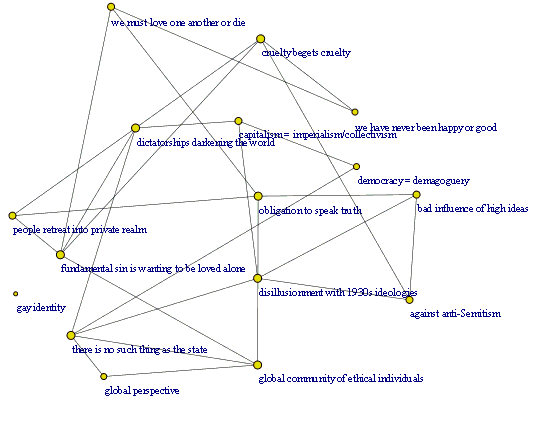
One way to think of the structure of the poem is as a literal network map. See the top of this post for an example. To make that image, I selected ideas (and in some cases, quotes) from the poem. I used software to place them in literally random locations on a blank plane, connected the ones that seemed related–using dotted lines for nodes that are in mutual tension–and then applied an algorithm that moves the nodes around as if they were billiard balls connected by springs, until the diagram stabilized at an equilibrium. That yielded a picture of the relationships among Auden’s ideas as presented in this (partly fictional) poem.

An important disclaimer: the labels of those nodes are simplistic; they reduce subtle and ambivalent ideas to slogans. So you must actually read the poem. Nevertheless, the network analysis brings out certain points:

Auden presents a rich view in just a few pages. I found 16 nodes and 52 links, and I’m sure I could have found more. None of these nodes can be collapsed into others, but a few separate areas of emphasis emerge. As shown at the bottom-left of the map, Auden is anti-collectivist: against the state, mass society, and ideologies (including corporate capitalism). He admires personal conscience–but not the retreat into private life.

Another important ideal for him is disinterested love, which is threatened by the universal desire to be loved exclusively.

I put “gay identity” on the map because the setting is known to have been a gay bar, and Nijinsky/Diaghilev (mentioned in the poem) formed a same-sex couple, as did Auden/Kallman. But I can’t connect that node to others because Auden is not explicit about homosexuality. This is a case where what is unstated is also part of the map.
notes on Auden’s September 1, 1939

These are notes on W.H. Auden’s “September 1, 1939,” a poem that can be read in full here. (My notes on several other poems are collected here.)

The poem begins, “I sit in one of the dives / On Fifty-second street. …” That would be a gay bar, probably the Dizzy Club, to which Auden had been introduced by his American lover Chester Kallman. But “I” implies that the writer sits alone. There’s a gay couple in stanza 6,  Nijinksy and Diaghilev, who are introduced in contrast to the “normal heart.” Auden is asking whether his own love is “normal”–and also whether human love (in general) is a source of evil or a solution to it.

Kallman and a few others would recognize this particular bar, and maybe they knew or could imagine what Auden really did on the evening when Hitler invaded Poland. In that sense, the poem was a private communication. But it was destined for The New Republic and written in an accessible style about events in the world. Thus it was also an effort to communicate to a public of strangers. Even if Auden’s original readers missed the reference to a gay bar, they would know what a “dive” is. It’s a place for solitary drinking or for secretive, sometimes shameful encounters. In that sense, it is private: a place one goes not to be seen. At the same time, it’s public in that it’s no one’s home and anyone can walk in: in fact, the British might call it a public house (a “pub”). Throughout the poem, Auden wants us to consider the relationship between private and public.

A related question is the role of lyric poetry, which can be private, subtle, and confessional, or transparent, impersonal, and political–or both. Auden later repudiated “September 1, 1939,” along with four other political poems, requiring that a note be added whenever they were anthologized: “Mr. W. H. Auden considers these five poems to be trash which he is ashamed to have written.” I think that’s because he later decided that the explicit, hortatory, public slogans of these poems (for instance, “We must love one another or die”) were false to his own experience. But to communicate effectively in the public sphere requires a degree of simplification and even falsification.

Continue reading

Philip Larkin, Aubade

Larkin’s “Aubade” begins:

I work all day, and get half-drunk at night.
Waking at four to soundless dark, I stare.
In time the curtain-edges will grow light.
Till then I see what’s really always there:
Unresting death, a whole day nearer now,
Making all thought impossible but how
And where and when I shall myself die.

The rest is here. It doesn’t need annotation, except that an “aubade” is a song or poem spoken by a man to his forbidden lover at daybreak, when he must flee her bed. (Yet there’s only one person in this bed.)

Also, it might be relevant that the man who published this poem was a 55-year-old Englishman, single, reputed to be grouchy and alcoholic; an academic librarian in the Northern industrial city of Hull who would publish just a few more poems before his early death. Knowing that information, we might be tempted to place the “room [that] takes shape” as “light strengthens” in Yorkshire in 1977–rather than, say, Boston in 2012. In fact, we may think we can identify the room as the one behind the upstairs window in this building, which was Philip Larkin’s home:

105 Newland Park, Hull

I was a small American boy in England around that time. My family lived in a series of furnished, rented homes and stayed in bed-and-breakfast hotels and friends’ houses, so I recall many English bourgeois homes in those years. I can picture the “curtain-edges” and room “plain as a wardrobe” that are named in the poem and can supply other details left unmentioned: the thickly-painted electrical wires stapled to big baseboards, the framed prints of village life, the hinged windows, and the aroma of cigarettes, mothballs, and rising damp.

But look: this isn’t really the statement of a “half-drunk” middle-aged Englishman, talking to us from his bed as dawn breaks on an overcast day in 1977. He would have no means to communicate his morbid thoughts to a global audience 35 years hence. What we are actually reading is a poem, very carefully constructed over many hours or perhaps months and published in the Times Literary Supplement. Fear didn’t really make “all thought impossible,” because the author conveyed subtle thoughts in intricate verse. Despite the overwhelming volume of poems published in journals like the TLS, this one remains a staple of anthologies and seminars not because it reports the early-morning panic of a middle-aged bachelor, but because of its form.

The poem is written in a consistently natural, vernacular voice, yet it fits neatly in five 10-line stanzas with the rhyme scheme ABABCCDEED. The A, B, and C lines are of ten syllables each: regular iambic pentameter. The D lines of each stanza have 9 syllables, and the E lines are of irregular length to emphasize a phrase that occupies a whole line in each stanza: “Of dying, and being dead,” “Not to be anywhere,” “Nothing to love or link with,” “Lets no one off the grave,” and “Work has to be done.”

Reading those five lines in order reveals that work is of almost equal weight to death in the poem, which begins “I work all day,” and ends with postmen going from house to house. The real Philip Larkin worked as a senior university administrator, so he may have had one of those “locked-up office[s]” where “telephones crouch, getting ready to ring.” The telephone is an instrument of human connection–potentially a tool “to love or link with”–but for a bureaucratic worker, it mostly threatens chores, complaints, and orders.

Yet the real Philip Larkin also worked as a poet. Unlike the narrator of the poem, the author had a gift, an audience, and a life mission. It cost him labor and care to write and publish verse that used familiar forms to report common experiences. When he refers in “Aubade” to “what we know,  / Have always known, know that we can’t escape,” he is addressing a group, a “we.” He is building a community to which he will also belong. Although the telephone and the postman convey the messages of an “uncaring / Intricate rented world,” the poem demonstrates care and demands sympathy.

The narrator mixes two rhetorical modes: confessional (“I … get half-drunk at night”) and didactic. Sometimes he sounds like an atheist preacher, insisting that religion is just “That vast moth-eaten musical brocade / Created to pretend we never die.” But this isn’t a sermon or a treatise about the fear of death in a godless universe. It matters that “brocade” rhymes with “afraid,” and “die” with “try.” (Notice the contrasting senses of each pair.) The depressed doctrines of a grouchy old man would hardly matter, but it took skill and hope to turn those thoughts into an intricate and coherent poem.