Category Archives: civic theory

my remarks introducing Civic Studies at the American Political Science Association

(Chicago) According to the official definition of the American Political Science Association, “Political science is the study of governments, public policies and political processes, systems, and political behavior.” In other words, it is a generally impersonal and positivistic investigation into how certain kinds of processes (labeled “politics”) actually work. It is not a discussion of what you and I should do to make the world better.

This modern definition may seem obvious but it reflects a shift. In 1901, President Arthur Hadley of Yale had argued for “political education” that would enhance the motivations, virtues, skills, and knowledge that people needed to be good citizens. He wrote, “A man may possess a vast knowledge with regard to the workings of our social and political machinery, and yet be absolutely untrained in those things which make a good citizen.” But by 1933, University of Chicago President Robert Hutchins announced, “‘education for citizenship’ has no place in the university.”

This shift at the university level also had implications for how we teach children and adolescents. From the 1920s through the 1960s, most high school students took courses entitled “civics” or “problems of democracy” that investigated the students’ role in community life and how they could address public problems together. The assigned textbooks tended to address the students as “you” and invited consideration of what you, the citizen, should do. Both courses have now almost vanished from the curriculum, but a third class, “American government,” remains highly prevalent, reaching nearly 90 percent of all high school graduates. This course mimics college-level political science in its impersonal treatment of institutions and processes.

At times, the APSA has actually been hostile to forms of civic education that are normative and concerned with the role of citizens. A 1971 report by argued that the job of political education was to provide “knowledge about the ‘realities’ of political life.” According to this report, most high school civics teachers imparted “a naïve, unrealistic, and romanticized image of political life which confuses the ideals of democracy with the realities of politics.” Understanding and teaching the realities of politics would be another apt definition of mainstream political science.

I think the impact on k-12 civic education has been harmful. And the APSA’s definition implies a misguided view of politics that distorts even the most advanced scholarship in the discipline. My colleagues and I are using the phrase “Civic Studies” to describe a nascent discipline that would put citizens back at the center and combine empirical, normative, and strategic analysis. The flourishing of Civic Studies would have consequences for civic education at the k-12 level. It would reorient political science and the other social sciences. And it would connect academic work to global movements for civic renewal. Continue reading

the role of political science in civic education

James Ceasar has published an interesting and provocative essay through the American Enterprise Institute entitled “The role of political science and political scientists in civic education.” I disagree with part of it–and with that aspect of Ceasar’s overall thought. He rests a great deal on the idea of a regime (roughly per Montesquieu). The United States is said to have had one regime or deep structure since the founding era, regardless of subsequent changes in policies. The goal of civic education should be to maintain this regime and transmit its values. Political education, on the other hand, aims to transform the regime. Today, “progressivism, multiculturalism, and cosmopolitanism” are “hostile” to the regime and seek to change it.

I think the American regime has changed profoundly several times and has always been a field of debate about its purpose and values. I see progressivism, multiculturalism, and cosmopolitanism as just examples of the usual hurly-burly of public debate in the American republic, not threats to it. Today, purist liberatarianism seems to me the most radical challenge to mainstream civic education. I note that Ceasar offers no  examples of progressivism, multiculturalism, and cosmopolitanism, and I suspect that he would find the actual proponents to be more complex, more varied, and generally less radical than he wants to portray them. Could, for example, a cosmopolitan like Martha Nussbaum or a multiculturalist progressive like Meira Levinson really be described as hostile to the regime?

That said, I cite the paper because I am wholly in agreement that political science ought to be supportive of civic education, and it is not. Ceasar notes:

The current official definition of political science from the American Political Science Association deliberately casts a wide net while avoiding giving undue offense (or providing any focus): ‘Political science is the study of governments, public policies and political processes, systems, and political behavior.’ … Civic education no longer occupies the central place that it did under the Aristotelian conception. The subject is of relatively minor interest in political science today, even allowing for a recovery of some its questions and concerns within the modern subfield known as ‘political socialization.’

Political science aims to be an empirical investigation into institutions and mass behavior, not an inquiry into what citizens should do. Investigating what citizens should do would require a combination of empirical evidence about how the world works, normative theory about how things ought to be, and strategic guidance about how to improve it (given the resources one has). Ceasar emphasizes the study of regimes, describing that as normative as well as empirical. I would agree, except that I am interested in investigating all scales of human action, of which the regime is only one. (Here I draw on the idea of “polycentrism,” developed by Vincent and Elinor Ostrom.)

In any case, I’ll be leading a discussion about the role of political science in civic education at the APSA:

August 29, 2013 @ 8:00 AM
Hilton Chicago

1. Theme Panel: “Power and Persuasion from Below: Civic Renewal, Youth Engagement, and the Case for Civic Studies,” Aug 30, 2013, 4:15 PM-6:00 PM
Chair: Peter Levine, Tufts University. Participants: Paul Dragos Aligica, George Mason University; Carmen Sirianni, Brandeis University; Karol E. Soltan, University of Maryland; Filippo A. Sabetti McGill University; and Meira Levinson, Harvard University


keeping the state close or at a distance

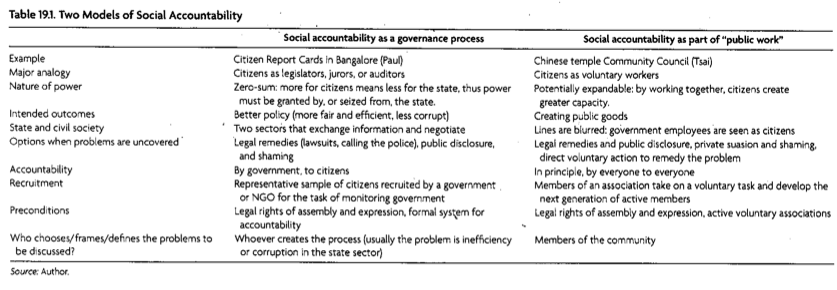
(Salem, MA) This is a table from a chapter of mine entitled “Social Accountability as Public Work.”* (You can click to expand it.)

Screen Shot 2013-08-04 at 4.01.10 PM

The table refers to two examples from the same volume. In his chapter, Samuel Paul describes how nongovernmental organizations in Bangalore surveyed representative citizens to develop “report cards” for municipal agencies. When the press publicized the results of the surveys, government officials took action to remedy the problems that the citizens had identified. Sometimes, processes like these are actually launched by governments to fight corruption. The Obama Administration’s transparency initiatives (now forgotten because of the NSA surveillance story, but actually quite significant in their own way) reflect a similar model–information is supposed to activate and inform citizens to improve government.

In her chapter, Lily Tsai describes Chinese village temple community councils that organize religious and communal activities. Members directly produce public goods through their own hands-on work. Local governmental officials are discouraged from leading the councils, which are religious bodies, “but as ordinary members of the temple group, they diligently fulfill their obligations to contribute to the good of the group.” Tsai also describes government officials involved in a similar group who “used their personal connections with higher level officials to secure a bank loan” for the organization.

In both stories, citizens influence the state. But the relationship is very different: detached in one case, highly cooperative in the other. I think persuasive arguments can be made for both kinds of relationship, and both have perils (alienation on one hand, corruption and bias on the other). The two stories also represent divergent models of citizens, who are seen as monitors in the Bangalore case and as producers of public goods in the Chinese temples. Ultimately, I think we need a bit of both; I doubt that transparency measures will make much difference  unless people are also organized and active in groups that provide direct services.

*in Sina Odugbemi and Taeku Lee, eds, Accountability through Public Opinion: From Inertia to Public Action (Washington, DC: The World Bank, 2011), pp. 291-306

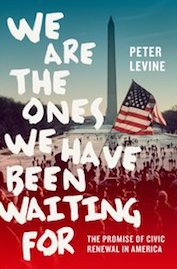
first review of We Are the Ones We Have Been Waiting for

“Political philosopher and activist Levine (The Future of Democracy) argues that global problems can best be addressed by a targeted increase in deliberative democracy and citizen action. But the U.S. is currently marked by a decline in civic engagement, Levine notes, resulting largely from structural changes since the mid-20th century that have eroded many working-class organizations. Wielding an impressive command of research and statistics, as well as finer points of moral and political philosophy, Levine’s discussion of the benefits and contours of public engagement draw on lucid analogies and real-world examples (like the annual budget summits convened by Washington, D.C., mayor Anthony Williams, which empowered groups of citizens to deliberate on an area of central import to the whole community). Throughout, the message is that deliberative action among diverse networks of citizens goes beyond injecting public influence into the formal policy apparatus. The necessary goal, Levine writes, “is to democratize the whole process of shaping our common world.” Free market libertarians and others wary of civic engagement–especially where it impinges on market forces or the operation of business–will raise objections, although Levine anticipates these arguments to some degree. Broad in scope yet eminently practical, this book should be an enduring contribution to the study of democratic theory and social action.” –Publishers Weekly

do we live in a republic or a democracy?

You all knew that some things are worth dying for. One’s country is worth dying for, and democracy is worth dying for, because it’s the most deeply honorable form of government ever devised by man. — President Ronald Reagan, Normandy, June 6, 1984

From World War I until recently, leaders of both major political parties routinely claimed that the United States was a democracy. Politicians often called us “the greatest democracy on earth” and asserted that the purpose of both world wars, Korea, Vietnam, and the Cold War had been to defend democracy. The main debate was whether we had attained a democracy or were still struggling to be one, with the strongest skeptics on the left. A perennial argument pitted left critics–who asserted that our domestic and foreign policies were anti-democratic–against conservative defenders of our credentials as a real democracy.

This consensus about goals has broken down because the hard right now says that we were not founded as a democracy and should not be one.

For example, when Rush Limbaugh reprinted Reagan’s 1984 Normandy speech on his website, he ended the long excerpt just before the invocation of “democracy” that I quoted above. (The words “BREAK TRANSCRIPT” mark where that passage would start.) If the sainted President Reagan said that our men died at Normandy for democracy, Limbaugh would have to agree. But a current right-wing talking point holds that we are a republic and not a democracy. So Reagan’s speech is truncated.

I have been involved in writing a new voluntary framework for state social studies standards. A conservative blogger named Shane Vander Hart reviewed a draft, writing, “I noticed that on pg. 29 it is mentioned we live in a constitutional democracy when in fact we live in a constitutional republic. It is troubling that those writing this document couldn’t get something as basic as that right.”

It is debatable whether the United States is a democracy, but you aren’t making a factual error if you use the word that was preferred by virtually all 20th century presidents.

First of all, even if the US was not founded as a democracy, the 15th, 17th, 19th, and 24th amendments to the Constitution, the state constitutions, two centuries of legislation, and Lincoln’s interpretation of the Civil War as a struggle for government “by the people” have made us a representative government on the basis of one person/one vote, which is a reasonable definition of a democracy.

Second, it is not clear that the founders intended a republic in contrast to a democracy, if we look past the words (whose meanings vary depending on the writer and the time) and think instead about the underlying ideas.

Madison wrote of a “pure democracy, by which I mean a society consisting of a small number of citizens, who assemble and administer the government in person.” He was thinking of Athens and other Greek city states. He did not recommend this model: “Such democracies have ever been spectacles of turbulence and contention.”

Note that Madison says “such democracies,” referring to the “pure” type, which is small and direct. That doesn’t rule out the possibility of other types of democracy. He calls his own preferred form of government a republic, which is (a) representative and (b) very large. He considers both features as definitive and essential to success. If a republic’s representatives were directly chosen by the people on the basis of one person/one vote (as ours are today), that would fit most definitions of a “democracy,” although it would no longer be the pure and original type. It would still meet Aristotle’s criterion that “the partnership (koinonia) of democracy is based on numerical equality” (NE 1241b). Thus we could say that Madison co-founded a republic that became a democracy with the passage of the 17th Amendment.

Jefferson is more favorable than Madison to popular rule. He does not use the word “democracy,” but “the core of [his] thought is a project for democracy.”* Like Madison, he prefers the word “republic,” but he uses it to name the very system that Madison would call a democracy:

Indeed, it must be acknowledged, that the term republic is of very vague application in every language. Witness the self-styled republics of Holland, Switzerland, Genoa, Venice, Poland. Were I to assign to this term a precise and definite idea, I would say, purely and simply, it means a government by its citizens in mass, acting directly and personally, according to rules established by the majority; and that every other government is more or less republican, in proportion as it has in its composition more or less of this ingredient of the direct action of the citizens. — Jefferson to John Taylor, 1816

His idea of a republic is not a constitutional system, because the majority not only governs but establishes the rules and can alter them at will. Jefferson goes on to say that a real republic must be small, and he cites the New England township as a model. But, he adds, one can mix the “ingredient of the direct action of the citizens” with other ingredients to produce hybrid systems at larger scales. They may incorporate elected or appointed offices as well as popular votes. “The further the departure from direct and constant control by the citizens, the less has the government of the ingredient of republicanism.”

Madison and Jefferson jointly founded the Democratic-Republican Party in 1791. It was often simply called the Republican Party, although the terminology was unofficial and varied. It rested on democratic/republican societies, which variously chose the words “Democratic,” “Republican,” “True Republican,” “Constitutional,” “United Freeman,” “Patriotic,” “Political,” “Franklin,” and “Madisonian” in their names. They were the opponents of the Federalists. Once the French Revolution turned bloody, “the very name ‘Democracy’ was used as part of the Federalist attack on [these] societies. ‘Democracy’ was carefully distinguished from ‘republicanism,’ and the former was equated with French Jacobinism. A poem entitled ‘Democracy,’ published in 1794, linked democracy with lawless confusion.”** Yet the Federalists were badly beaten in the election of 1800, and the party that Madison and Jefferson founded dominated American politics for a generation.

The word “democracy” still had partisan overtones in Lincoln’s day. Although deeply democratic himself, he often often used the word pejoratively to mean rule by his opponents, the capital-D Democrats. His Republican successor Teddy Roosevelt, however, called our system a “democratic republic” in his inaugural address of 1905. That was about the time when a bipartisan consensus formed that our aspirations ought to be democratic.

Today, we have a mixed form of government with a strong element of popular or majority rule.  Jefferson would call that element “republican”; many people today would call it “democratic.” No one, then or now, would assert that we have a pure democracy. In the social studies framework, we called our system a “constitutional democracy” to indicate that the powers of the people are checked. The government is not in “direct and constant control by the citizens.” [Likewise, the powers of the federal government are limited.]

How did this semantic ambiguity arise? The word “democracy” is of Greek origin. It literally means “rule of (or by) the people.” One could hold that the sovereign power in the US is the people–and hence we have a democracy in the etymological sense. Like all old words, however, “democracy” has accumulated resonances beyond its etymological origins. It may invoke the Greek city-states (whether seen as ideals or as disasters) or mass modern societies.

“Republic” comes from the Latin. My Latin dictionary says that “publicus” means “belonging to the people.” Thus “res publica” means the “thing belonging to the people,” whereas “democracy” is the “people’s rule.” If there is a significant difference in the etymological sense of these words, it is the difference between something that the people have (a republic) versus a power they wield (democracy). A better translation than “the public thing” is “commonwealth.” The words “republic” and “commonwealth” invoke the Roman regime before Caesar Augustus, the Cromwellian state, the early American colonies, and the ante-bellum US system. The meaning of “republic,” however, is malleable, because it depends on which features of the Roman republic and its descendents one considers definitive.

Ultimately, the United States can be called republican and democratic. The two words have interestingly different origins and resonances but are not sharply distinguishable. Nor do we have either a pure republic/democracy. Some limitations on the republic/democratic element are wise, but our current system is flawed by most standards. Although our democratic/republican aspirations are only partly realized, they remain beacons.

*Michael Hardt,  “Jefferson and Democracy, ” American Quarterly, Vol. 59, No. 1 (Mar., 2007). **Sheldon Foner, The Democratic-Republican Societies, 1790-1800: A Documentary Sourcebook of Constitutions, declarations, Addresses, Resolutions, and Toasts (Greenwood, 1976). p. 25