Category Archives: civic theory

Where we vote affects how we vote. So where should we vote?

According to a summary article by Ben Pryor in The Conversation/Scientific American, people’s votes are affected by the voting location. Voting in a church “prime[s] significantly higher conservative attitudes—and negative attitudes toward gay men and lesbians.” On the other hand, “individuals voting in Arizona schools were more likely to support a ballot measure that increased the state’s sale tax to finance education.”

Pryor draws the conclusion that we should vote by mail–which, for most people, would mean voting at home. One objection is that home isn’t a neutral place. It will bring its own biases. I don’t know whether voting at home has been experimentally compared to voting at (say) a school, but let’s imagine that being home makes people more resistant to taxes. Why is that the most authentic, or most rational, or most autonomous perspective? To prefer the home seems to assume a rather contentious view of the relation between the public and private sphere. In political theorists’ terms, it’s a hyper-liberal view as opposed to a republican or communitarian one. Arguably, you should vote where you are primed to think about other people.

But isn’t it problematic that a church, for instance–with all the deliberate persuasive power of its iconography and architecture–should be the required context for voting in a secular republic? Well, maybe. But I don’t accept the view that citizens can be or should be disembodied and culture-free. The Progressive movement that achieved the secret ballot envisioned the ideal voter as a rational calculator of best interests (either his own interests or the nation’s). Progressive voting reforms were probably helpful, on the whole, but the guiding ideal seems both naive and a little unattractive. What, after all, is in our interests once we strip away values and group-memberships?

The opposite view–just for the sake of argument–is that we construct communities that are redolent of values. That’s why they are full of religious buildings, public structures with inscriptions and allusive architectural styles, businesses that promise various versions of the good life, and even natural spaces that we interpret as having moral significance. Communities govern themselves by making decisions, and a vote is one important moment for decision-making. Each person’s vote is profoundly influenced by the community context. Yet individuals push back. While the average voter may be influenced in a conservative direction by voting in a church, some are probably alienated by the context and pushed in the opposite way.

On every day, not just on Election Day, the community changes as people build, alter, and decorate its physical spaces and communicate in more ephemeral ways. For instance, the church in which a polling place may be located was built by people who wanted to change  local values and commitments. They were not satisfied with whatever religious structures and institutions already existed, but chose to make a new one. That was part of an endless process of community-formation. The material with which we reason and choose is given to us by the community so far, but we can change it one piece at a time. The real me doesn’t emerge when I am inside the home that my family has privately decorated. I am really “me” everywhere I go, and that means that I am always being shaped by my context and often pushing back.

See also: on voting by mail and voting and punishment: Foucault, biopower, and modern elections.
the long march through institutions–for civic renewal

(Baltimore, MD) I am here for a panel on “Systems Change and Culture of Health” at the Robert Wood Johnson Foundation’s Culture of Health conference. My great fellow panelists were Sonal Shah (Georgetown), Derwin Dubose (New Majority Community Labs), and Karen Matusoka (Centers for Medicare & Medicaid Services). The audience seemed to be composed mostly of health practitioners and policymakers who were already strongly committed to three goals:

  1. Doing a better job of understanding the needs, priorities, and circumstances of truly diverse people by engaging them in influencing health interventions and policies. For instance, instead of telling a specific group of new immigrants how to improve their health, pay attention to what they already know and want.
  2. Supporting solutions that require collective action by residents. Dubose brought up a situation in which individuals couldn’t exercise in a local park because it was too dangerous, but a group started tai chi exercises there every day at noon. Only a coordinated strategy would work, and coordination requires organization, trust, leadership, and skill. This point is related to the previous one, because community members would be the first to know about the danger of the park and the popularity of tai chi. Not only is a coordinated strategy essential, but only the participants are likely to be able to invent it.
  3. Recognizing and enhancing the civic capacity of whole communities to achieve better  health. For instance, Robert Sampson’s major book Great American City shows that Chicago neighborhoods achieve better outcomes for their children if the adults are organized and active in civic life.

Several participants noted that these were shared principles in the room–but none of the ideas are really new. In fact, a roughly similar discussion could have occurred 50 years ago, during the 1960s movement to make health (and research) more “community-based.” That impulse still remains marginal, which can be discouraging.

I would note that some relevant practices and networks have grown and strengthened over the past half century. (See, e.g., Community-Campus Partnerships for Health and the networks it represents.) But I would also acknowledge the powerful hold of a technocratic model in which solutions are developed at the “bench” and implemented at the “bedside.” That model is deeply rooted in modern epistemology and reinforced by the prestige of technology. It serves both governmental and corporate bureaucracies. So it is not easy to shake, and may even be worse than it was in the 1960s.

Policy changes can help. If–as one example–the National Institutes of Health funds community-based research, we get community-based research. But even the best-intentioned policies don’t implement themselves. They require dedicated and persistent work, everywhere from the national or state agency to the street level.

Civic engagement by communities can help. Why do Chicago neighborhoods get better outcomes–regardless of race and class–if they are organized and active? I would propose that this is partly because they support and compel local institutions, such as schools, police districts, and hospitals, to engage with them better. Every Chicago neighborhood has the same police chief, school superintendent, and mayor, but some neighborhoods receive more responsive government at the local level. Note that residents are not organized in specific policy domains, such as health or public safety. They are organized in multi-purpose civic and religious associations and networks. Those are essential for driving change through institutions.

Finally, we need effective organizing within the professions, a strategy that my friends Harry Boyte and Albert Dzur have advocated–and practiced–effectively for years. Like any good organizing effort, this strategy begins with recognizing the assets and interests of the people in question. Physicians, health administrators, and academic researchers are people, too. Lecturing them that they should be less arrogant and more sensitive to diversity may fail for the same reasons that it usually fails to lecture people to eat more vegetables.

But health professionals have interests that can be tapped–for instance, interests in getting better results and escaping social isolation. Most of all, they can develop genuine skills for engaging the public better. That is hard, complex, challenging work. It requires evidence and analysis. When we tell professionals to be less professional–to diminish their sense of expertise and authority–I think it goes over like asking people to eat their broccoli. Even if they want to comply, all the incentives work against it. But when we reward them for exercising advanced professional skills in community engagement, we treat them as assets and give them ways to excel. Combined with policy changes and grassroots pressure from outside, this organizing effort within professions may begin to change systems at a large scale.

on the original meaning of democracy

We call ourselves a democracy and a republic. There’s a current right-wing talking point that we are only the latter, but I’ve argued that this claim deviates from a long bipartisan consensus that the US aspires to be a democratic republic. But what do these two terms mean?

This definitional question is challenging because the words come, respectively, from Greek and Latin, and they were coined to name specific regimes that had lots of eccentric features (huge juries in Athens; a host of executive officials in Rome) that no one considers definitive. The words have subsequently been used by many writers in many languages to name a wide variety of regimes–and sometimes as terms of abuse.

For instance, a “republic” presumably must name a regime that has something in common with the original, the ancient Roman res publica. One defining feature of the Roman republic was simply that it wasn’t a monarchy. Thus people who want to remove Queen Elizabeth II as the titular monarch of Australia (or Britain) call themselves “republicans.” Their proposal would change virtually nothing about the power structure; it would be almost entirely symbolic. But they have precedent for calling a regime without a monarch a “republic.”

In a very different vein, Jefferson defined a republic “purely and simply” as “government by its citizens in mass, acting directly and personally, according to rules established by the majority; and … every other government is more or less republican, in proportion as it has in its composition more or less of this ingredient of the direct action of the citizens.” For Jefferson, a “republic” is what others would call a direct and participatory democracy. Yet the original Roman republic was composed of legislative bodies and officers who represented various classes and interests. Some were elected and others were appointed. All were limited by various laws (albeit unstably so). Thus, for some, a republic is a government that avoids direct and participatory democratic elements.

Still other writers have noticed the ancient Roman penchant for civic duty and public service and have used the word “republic” for a regime that demands a great deal from its citizens and that encourages public engagement as a positive good. It is an alternative to the kind of liberalism that favors individual rights. Meanwhile, another tradition takes seriously the etymology–“res publica” means “public thing [or good]”–and translates the phrase as “commonwealth.” A “commonwealth,” in turn, could mean all the things that are commonly owned by the people. And if the people’s wealth extends to the land, then a certain kind of agrarian socialism emerges as the definition of republicanism.

That’s all about “republic,” but I’d like to address the term “democracy,” relying on a fascinating article by Josiah Ober.* Ober notes that if the Greeks had wanted a word that meant rule of the many (or the common people), they would have used pollo- as the suffix prefix. To name a regime in which all rule, they could have used “panocracy.” If they had wanted to emphasize the equality of all, they would have used iso-. For instance, isegoria meant an equal right to participate in deliberations in the agora. But they chose demo-, which refers to the whole people as one, without sociological distinctions.

Meanwhile, if they had wanted to specify who governed, in the sense of casting votes or holding offices, they would have used the suffix -archy. A monarchy has one ruler, an oligarchy has a few, and anarchies have none. The suffix -kratia is different. It does not imply an office or action but rather power, in the sense of capacity or an ability to make things happen.

Thus, in its original form, a democracy is a regime in which the whole population has the power to make things together. By the way, this definition comes close to uses of the word “republic” that emphasize the public’s role in making the res publica. So perhaps “democracy” means “republic” after all.

*Josiah Ober, “The Original Meaning of ‘Democacy’: Capacity to Do Things, Not Majority Rule,” Constellations, vol. 15, no. 1 (2008)

we are for social justice, but what is it?

Schools and colleges, daily newspapers and broadcast television channels, and certain civic associations are prone to present themselves as neutral about politics. They say that they provide information, spaces for discussion, and opportunities to learn skills. Their students, readers, or citizen-members are free to form their own opinions.

Activists in social movements observe that these organizations are not truly neutral (but rather full of implicit values) and argue that grave current injustices require all organizations to take explicit stands.

In response, at least some of the ostensibly neutral organizations declare that they are actually against specific injustices and committed to a better society. Nowadays, they often name their positive objective as “social justice” (a phrase whose deepest historical roots are in Catholic thought). In past decades, they might have talked instead about democracy or freedom.

But although some things are obviously unjust, reasonable people disagree profoundly about what constitutes a positive vision of social justice, and why. Thus–I contend–virtually all of the valuable debate that occurred under the aegis of self-described neutral organizations recurs within organizations that declare themselves for “social justice” without providing a detailed definition of that phrase.

The return of debate is not in itself a bad thing; politics is about persistent disagreement, which responsible citizens can embrace and even enjoy. But it is somewhat naive to expect that a commitment to a vague ideal of social justice will bring consensus. And it is a shame if that expectation leads to disillusionment.

In our current time, this is the main pattern I observe: educational, journalistic, and civic associations strongly proclaim neutrality in response to what appears an uncivil and polarized political debate, and then activists demand that they take a stand in response (mainly) to climate change or domestic US racism. Those are matters of grave concern and they have generated social movements that are particularly effective at influencing schools and colleges, the media, and local associations (much more so than governments or corporations). In decades past, opposition to US foreign policy and war played similar roles in challenges to neutrality.

But if there is any doubt that people can be committed to something called “social justice,” abhor the same specific injustices, and yet disagree about the very definition of “justice,” consider the current debates between #BlackLivesMatter and Sen. Sanders, #BlackLivesMatter and Secretary Clinton, or Clinton and Sanders.

Those three people/movements place themselves on the left, but the debate about social justice is certainly broader than that, even if the phrase currently has leftish resonances. In an interview with Eric Liu for a project that Eric and I conducted together, Mark Meckler, who had founded Tea Party Patriots, called the police presence in Ferguson “outrageous.” He acknowledged the salience of racism but mainly viewed police violence as an example of a government depriving individuals of liberty. “The state has a lot of power and only recently it is outwardly manifesting that power in costumes and equipment that demonstrate military might. … That is not of society, by and for society; that is against society.” A democratic socialist might agree with much of that and yet read Ferguson more as a story of disinvestment in industrial cities and the failure of our economy to value workers. I’ve quoted Julius Jones of #BlackLivesMatter as a proponent of a third view: that anti-Black racism is a fundamental chord in American history. Note that all of these positions could simultaneously be true, yet the proponents must disagree about solutions. More government? Less government? Remedies targeted at race? At class? Any of those could constitute “social justice.”

To have a theory of justice, you need principles and a way of ranking or adjudicating among them. Maybe equality is one of your principles, but equality of what? (Opportunity, status, power, welfare?) Equality for whom? (All the students who are already in your classroom or at your college? All major demographic groups within America? All American individuals? All human beings?)

And even if equality–defined in a particular way–is a very high principle for you, what about freedom (which comes in at least six different and incompatible forms), sustainability, security, creativity, innovation, community, rule of law, tradition, diversity, prosperity, and efficiency? A reasonable view of social justice is surely an amalgam of many of these principles, reflecting tradeoffs and rankings. We develop such views in part by reflecting on what is bad about the status quo and what we have learned about practical solutions that work. (For instance, we wouldn’t advocate equality of education if we thought that schools were a waste of time.) Thus a theory of justice typically rests on a narrative about the failures and the successes of our society so far. All of that–the narrative, the assessment of actual institutions, the abstract principles, and their ranking–is contestable.

An organization can claim that it is thoroughly neutral, just a platform for its members to debate what is right. Or it can assert that it is for social justice, and then its members will debate what is right. The difference matters–a bit. A claim of perfect neutrality is inevitably false and distracting. A commitment to social justice can usefully raise the question, “What is justice?”

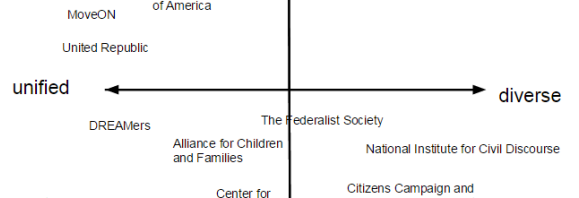
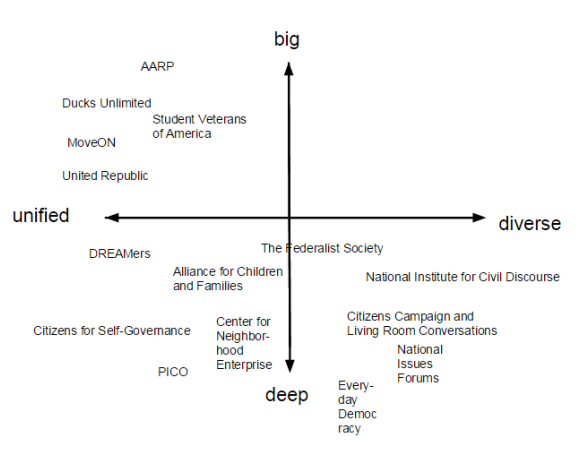
The choice remains how specifically to define the content of social justice. Organizations face choices between ideological diversity and unity and between scale (attracting lots of people) and depth (intensively relating to their members). The more precisely an organization defines its objective, the less hospitable it is to diversity but the more it can achieve unity and advance an agenda. The smaller it is, the better it can work through disagreements, but the bigger it is, the more influence it can have.

I think that organizations that strive to be ideologically diverse and also relatively big are relatively weak and scarce today. Universities and schools and large civic associations can fill that quadrant. It won’t hurt for them to declare themselves for “social justice,” but they would be wise to invite a genuinely diverse debate about what social justice is.

European Institute of Civic Studies, 2016

Summer Institutes of Civic Studies have been held annually at Tufts University since 2009. They are open to applicants from all countries, and the 2016 version will take place from June 13-23. In 2015, Tanja Kloubert, Karol Soltan, and I also organized a version of the Institute in Chernivtsi, Ukraine. Thanks to support from the German Academic Exchange Service (DAAD), we will be able to repeat that European Institute in 2016. It is open to individuals from Ukraine, Belarus, Poland and Germany and will take place in Augsburg, Germany, from July, 25th to August 5th 2016 (at the Augsburg University).

What is the DAAD-supported Summer Institute of Civic Studies?
It is is an intensive, two-week, interdisciplinary seminar bringing together advanced graduate students, faculty, and practitioners from diverse fields of study

Who can apply?
Ukrainian scholars and practitioners are strongly encouraged to apply. We will also consider the applications from Germany, Belarus and Poland. We are especially interested in applicants who have a long term interest in developing the civic potential of Ukraine, and the region.

How to apply?
All application materials must be submitted in English. The application must include the following:

  • A cover letter telling us why you want to participate in the summer institute and what you would contribute (maximum 2 pages)
  • A curriculum vitae

All application materials can be sent as an email attachment in DOC or PDF format to tetyana.kloubert@phil.uni-augsburg.de.

Deadline: For best consideration apply by March 31, 2016.

Expenditures: The Summer Institute of Civic Studies is being funded by the DAAD (German Academic Exchange Service). Selected participants will be provided with travel costs, visa expenses, accommodation, meals and full event access.

Contact: For more information about the Summer Institute of Civic Studies please contact tetyana.kloubert@phil.uni-augsburg.de