Category Archives: civic theory

we are for social justice, but what is it?

Schools and colleges, daily newspapers and broadcast television channels, and certain civic associations are prone to present themselves as neutral about politics. They say that they provide information, spaces for discussion, and opportunities to learn skills. Their students, readers, or citizen-members are free to form their own opinions.

Activists in social movements observe that these organizations are not truly neutral (but rather full of implicit values) and argue that grave current injustices require all organizations to take explicit stands.

In response, at least some of the ostensibly neutral organizations declare that they are actually against specific injustices and committed to a better society. Nowadays, they often name their positive objective as “social justice” (a phrase whose deepest historical roots are in Catholic thought). In past decades, they might have talked instead about democracy or freedom.

But although some things are obviously unjust, reasonable people disagree profoundly about what constitutes a positive vision of social justice, and why. Thus–I contend–virtually all of the valuable debate that occurred under the aegis of self-described neutral organizations recurs within organizations that declare themselves for “social justice” without providing a detailed definition of that phrase.

The return of debate is not in itself a bad thing; politics is about persistent disagreement, which responsible citizens can embrace and even enjoy. But it is somewhat naive to expect that a commitment to a vague ideal of social justice will bring consensus. And it is a shame if that expectation leads to disillusionment.

In our current time, this is the main pattern I observe: educational, journalistic, and civic associations strongly proclaim neutrality in response to what appears an uncivil and polarized political debate, and then activists demand that they take a stand in response (mainly) to climate change or domestic US racism. Those are matters of grave concern and they have generated social movements that are particularly effective at influencing schools and colleges, the media, and local associations (much more so than governments or corporations). In decades past, opposition to US foreign policy and war played similar roles in challenges to neutrality.

But if there is any doubt that people can be committed to something called “social justice,” abhor the same specific injustices, and yet disagree about the very definition of “justice,” consider the current debates between #BlackLivesMatter and Sen. Sanders, #BlackLivesMatter and Secretary Clinton, or Clinton and Sanders.

Those three people/movements place themselves on the left, but the debate about social justice is certainly broader than that, even if the phrase currently has leftish resonances. In an interview with Eric Liu for a project that Eric and I conducted together, Mark Meckler, who had founded Tea Party Patriots, called the police presence in Ferguson “outrageous.” He acknowledged the salience of racism but mainly viewed police violence as an example of a government depriving individuals of liberty. “The state has a lot of power and only recently it is outwardly manifesting that power in costumes and equipment that demonstrate military might. … That is not of society, by and for society; that is against society.” A democratic socialist might agree with much of that and yet read Ferguson more as a story of disinvestment in industrial cities and the failure of our economy to value workers. I’ve quoted Julius Jones of #BlackLivesMatter as a proponent of a third view: that anti-Black racism is a fundamental chord in American history. Note that all of these positions could simultaneously be true, yet the proponents must disagree about solutions. More government? Less government? Remedies targeted at race? At class? Any of those could constitute “social justice.”

To have a theory of justice, you need principles and a way of ranking or adjudicating among them. Maybe equality is one of your principles, but equality of what? (Opportunity, status, power, welfare?) Equality for whom? (All the students who are already in your classroom or at your college? All major demographic groups within America? All American individuals? All human beings?)

And even if equality–defined in a particular way–is a very high principle for you, what about freedom (which comes in at least six different and incompatible forms), sustainability, security, creativity, innovation, community, rule of law, tradition, diversity, prosperity, and efficiency? A reasonable view of social justice is surely an amalgam of many of these principles, reflecting tradeoffs and rankings. We develop such views in part by reflecting on what is bad about the status quo and what we have learned about practical solutions that work. (For instance, we wouldn’t advocate equality of education if we thought that schools were a waste of time.) Thus a theory of justice typically rests on a narrative about the failures and the successes of our society so far. All of that–the narrative, the assessment of actual institutions, the abstract principles, and their ranking–is contestable.

An organization can claim that it is thoroughly neutral, just a platform for its members to debate what is right. Or it can assert that it is for social justice, and then its members will debate what is right. The difference matters–a bit. A claim of perfect neutrality is inevitably false and distracting. A commitment to social justice can usefully raise the question, “What is justice?”

The choice remains how specifically to define the content of social justice. Organizations face choices between ideological diversity and unity and between scale (attracting lots of people) and depth (intensively relating to their members). The more precisely an organization defines its objective, the less hospitable it is to diversity but the more it can achieve unity and advance an agenda. The smaller it is, the better it can work through disagreements, but the bigger it is, the more influence it can have.
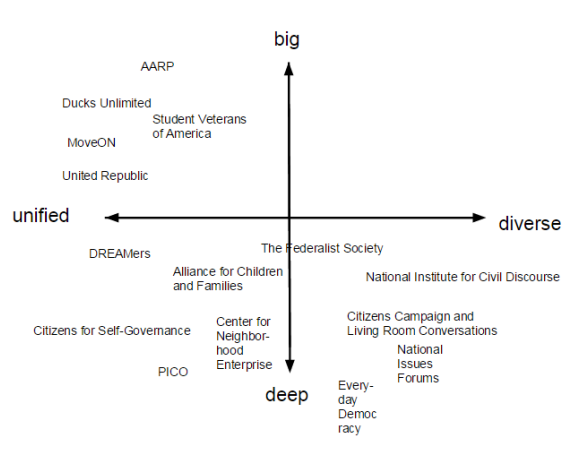
I think that organizations that strive to be ideologically diverse and also relatively big are relatively weak and scarce today. Universities and schools and large civic associations can fill that quadrant. It won’t hurt for them to declare themselves for “social justice,” but they would be wise to invite a genuinely diverse debate about what social justice is.

European Institute of Civic Studies, 2016

Summer Institutes of Civic Studies have been held annually at Tufts University since 2009. They are open to applicants from all countries, and the 2016 version will take place from June 13-23. In 2015, Tanja Kloubert, Karol Soltan, and I also organized a version of the Institute in Chernivtsi, Ukraine. Thanks to support from the German Academic Exchange Service (DAAD), we will be able to repeat that European Institute in 2016. It is open to individuals from Ukraine, Belarus, Poland and Germany and will take place in Augsburg, Germany, from July, 25th to August 5th 2016 (at the Augsburg University).

What is the DAAD-supported Summer Institute of Civic Studies?
It is is an intensive, two-week, interdisciplinary seminar bringing together advanced graduate students, faculty, and practitioners from diverse fields of study

Who can apply?
Ukrainian scholars and practitioners are strongly encouraged to apply. We will also consider the applications from Germany, Belarus and Poland. We are especially interested in applicants who have a long term interest in developing the civic potential of Ukraine, and the region.

How to apply?
All application materials must be submitted in English. The application must include the following:

  • A cover letter telling us why you want to participate in the summer institute and what you would contribute (maximum 2 pages)
  • A curriculum vitae

All application materials can be sent as an email attachment in DOC or PDF format to tetyana.kloubert@phil.uni-augsburg.de.

Deadline: For best consideration apply by March 31, 2016.

Expenditures: The Summer Institute of Civic Studies is being funded by the DAAD (German Academic Exchange Service). Selected participants will be provided with travel costs, visa expenses, accommodation, meals and full event access.

Contact: For more information about the Summer Institute of Civic Studies please contact tetyana.kloubert@phil.uni-augsburg.de

citizens at work: how small groups address large-scale problems

(Orlando) I am on my way home from a meeting of the Florida Partnership for Civic Learning. I’d like to argue that it exemplifies citizens’ work. To be sure, it has a specific mission: improving civic education in Florida’s k-12 schools. And it enlists a specific kind of person: professionals in k12 schools, ed schools, and state agencies, all of whom participate in the effort as part of their jobs. It thus differs in significant ways from a group of miners forming a union or volunteers fixing a neighborhood park. (I can spot k12 teachers and ed-school professors from 500 yards away, due to some ineffable mix of demographics, fashion/accessories, and ways of navigating the physical world). Still, the essential features of this group would apply to different issues and different people.

Using the terms I summarize in this 10-minute video, groups of effective citizens seriously ask the question, “What should we do?” That question implies a deep consideration of values, of facts and constraints, and of strategies. The group not only discusses (deliberates), but also takes collective action (collaborates) and learns from the results of its own actions. Finally, it is attentive to relationships both within the group and with outsiders. It specifically promotes civic relationships, which imply certain values–such as mutual respect and accountability–without relying on personal friendships or financial ties. Because the fundamental question is “What we should do (about some large question)?” the group is satisfied neither with just doing something by itself that has limited effects nor with wishing or hoping that someone else acts. It finds leverage over larger systems.

Without going into details about the Florida Partnership or its current work, I would argue that it embodies all the key words in the previous paragraph. The question for the Partnership is “What should we do to improve civic learning for all Florida students?” The main value-questions include: “What is important for a citizen to learn and know?”, “What rights/obligations do schools have to educate citizens?” and “What constitutes just outcomes for the population of students across the state?” Participants discuss extensive factual information: 7th grade civics test scores for every student in the state, detailed survey data on students’ values and behaviors, and information on the effectiveness of various programs. At this particular meeting, we looked at regression models that predicted test scores, elaborate maps of schools that surpassed expectations, toplines from surveys, and qualitative reports from some of those schools. Participants spent time building relationships among themselves and with other actors. Finally, the group considered a whole range of strategies, from working with elementary reading organizations to changing course requirements in state colleges.

Nothing is perfect, but I think we did a good job of avoiding these classic pitfalls:

  1. Turning everything into a communications problem, a problem of “getting the word out.” In an era of constant marketing and propaganda, it seems to come as second nature to focus on “messaging.” But rarely is the main problem that lots of people believe the wrong things. And even when they do, communicating is challenging in a very crowded media environment. Smart groups communicate as they need to but don’t overemphasize its importance.
  2. Imagining phantom agents. It’s a constant temptation to imagine–or hope–that someone else will solve a problem. Someone else’s actions may indeed be essential. For instance, it may take the state legislature to improve civics. But then the question becomes: How can we influence the legislature? The “we” has to be concrete and real: an actual list of individuals who know what to do next. We are the ones we have been waiting for.
  3. Oscillating between the trivial and the utopian. I have often observed groups jump back and forth between the ends of a spectrum of practicality. At one moment, they will convince themselves that a given problem cannot be solved without changing the whole political/economic system. At another moment, they will talk about making one presentation at someone else’s small-scale meeting. To make a substantial difference, you have to find space between those extremes.
  4. Operating at only one level of power. According to the train of thinking inaugurated by Steven Lukes and John Gaventa in the 1970s, power operates at several levels. There is explicit power: the power to do something (such as require a statewide civics test or grade an individual kid). There is the power to set agendas. There is power over other people’s preferences and values. And there is power to affect who uses the other forms of power. Truly effective citizen groups think at all these levels.
  5. Losing the moral questions in data. We have civics test scores for every 7th grader in Florida, and my colleagues have analyzed those data in several illuminating ways (geospatially, demographically, even qualitatively). But it is fundamentally a moral question what to measure on a 7th grade civics test. It is also a moral question whether the state should test students, and what consequences should follow from success or failure on a test. Finally, given a distribution of real test scores, it is a moral question what to do next. Should you devote all your resources to serving the lowest-scorers? Raise the median? Reward the high-scorers? In an age of positivism, we tend to be better at analyzing the data than at reasoning about what the data imply morally. But good groups hold philosophically diverse and productive explicit discussions of the moral issues.
  6. Losing sight of either the short-term or the long-term. Really effective citizen groups achieve short-term victories with an eye to building momentum and winning longer-term victories later. The two mistakes to avoid are looking only for easy “wins” that don’t create momentum or working directly on long-term problems without having enough people or money to sustain the effort.

thinking like a citizen–about schools

In Education, Justice & Democracy, edited by Danielle S. Allen and Rob Reich, all the chapters address the topic of educational equality in the US. The section headings are “ideals,” “constraints,” and “strategies.” In a longish review essay for Theory & Research in Education, I argue that good citizens explore just these three issues whenever they consider any important topic. In fact, you might define good citizens as people who take  ideals, constraints (or, I would say, “facts”), and strategies seriously and act accordingly. However, the three issues are badly segregated in modern intellectual life, with whole disciplines given over to the assumption that one should seek value-free facts, other disciplines happy to explore values without thinking about strategies, and some professional programs focused on strategies with a narrow conception of ideals. What we call “Civic Studies” is a deliberate effort to reintegrate thinking about social concerns from a citizen’s perspective, which inevitably combines ideals, constrains, and strategies. I chose to review this volume because it exemplifies Civic Studies, although I offer some critical thoughts about parts of the book.

My review is in Theory and Research in Education, July 2015, vol. 13, no. 2, pp. 235-238, or on Academia.edu.

save the date for Frontiers of Democracy 2016

Please save the date for Frontiers of Democracy: June 23-25, 2016 at Tufts University’s downtown Boston campus.

Frontiers is an annual conference that draws scholars and practitioners who strive to understand and improve people’s engagement with government, with communities, and with each other. The format of Frontiers is highly interactive; most of the concurrent sessions are “learning exchanges” rather than presentations or panels. We welcome proposals for learning exchanges for 2016. Please use this form to submit ideas.

We aim to explore the circumstances of democracy today and a breadth of civic practices that include deliberative democracy, civil and human rights, social justice, community organizing and development, civic learning and political engagement, the role of higher education in democracy, Civic Studies, media reform and citizen media production, civic  technology, civic environmentalism, and common pool resource management. See more about past years here.

You can enter your information here to let us know that you are interested in attending and to ensure that you receive additional information about the agenda and registering for Frontiers.

All are welcome at Frontiers, a public conference that follows immediately after the Summer Institute of Civic Studies, a 2-week seminar for scholars, practitioners, and advanced graduate students. The Summer Institute requires an application, and admissions decisions are usually made in May. Prospective applicants should sign up here for more information.