Category Archives: civic theory

mini-conference on Facts, Values, and Strategies

We are about to begin discussions of the papers listed below, in draft form. They are destined for The Good Society journal. The conversations are at the Tisch College of Civic Life at Tufts

For me, the underlying rationale goes like this. A good person is always asking “What should I do?” That question must become plural–“What should we do?”–for two reasons: we cannot accomplish enough alone, and we must reason together to improve our opinions. Both questions integrate facts and values. Something that works but isn’t good is not what we should do. Likewise, we want to avoid something that is good but doesn’t fit the circumstances of the time and place.

The structure of intellectual life in modernity frustrates asking these questions, for several reasons. One major reason is that matters of value are assigned to certain disciplines in the humanities, while matters of fact go to disciplines that widely imitate science and present themselves as value-free.

It’s easy to call for a reintegration of facts and values (and strategy), but very hard to pull that off. Fortunately, we have traditions of thought–always contributed by many thinkers and practitioners rather than a single luminary–that do reintegrate facts, values, and strategies. Names that stand for these traditions include Gandhi, Pope Francis, Hannah Arendt, William James, Amartya Sen, Elinor Ostrom, and Jurgen Habermas. These names recur in interesting combinations in the following papers. So do certain themes: the limitations of human cognitive abilities and the positive potential of certain kinds of affect; the value of institutions for structuring deliberation; the link between work and reflection; and the value of deep, responsive uncertainty–wonder.

“Public Entrepreneurship, Civic Competence, and Voluntary Association: Self-Governance Through the Ostroms’ Political Economy Lenses” — Paul Dragos Aligica, George Mason University

“Giving Birth in the Public Square: Dialogue as a Maieutic Practice” — Lauren Swayne Barthold, Endicott College and Essential Partners

“William James’s Psychology of Philosophizing: Selective Attention, Intellectual Diversity, and the Sentiments in Our Rationalities” — Paul Croce, Stetson University

“Democracy as Group Discussion and Collective Action:Facts, Values, and Strategies in Rural Landscapes” — Timothy J. Shaffer, Kansas State University

“Social Media, Dismantling Racism and Mystical Knowing: What White Catholics are Learning from #BlackLivesMatter” — Mary E. Hess, University of Toronto

“Institutions, Capabilities, Citizens” — James Johnson, University of Rochester, and Susan Orr, SUNY College at Brockport

“Forgiveness After Charleston: The Ethics of an Unlikely Act” — Larry M. Jorgensen, Skidmore College

“Facts, Values, and Democracy Worth Wanting: Public Deliberation in the Era of Trump” — David Eric Meens, University of Colorado Boulder

“The Praxis of Amartya Sen and the Promotion of Democratic Capability” — Anthony DeCesare, St. Louis University

“A Civic Account of Justice” — Karol Edward Soltan, University of Maryland

was the Civil Rights Movement successful because of the Cold War?

It’s widely argued that the federal government made concessions on civil rights between 1945 and 1970 because blatant racial oppression was embarrassing during the global struggle against communism. Doug McAdam illustrates this argument by noting the “stark contrast” between FDR and Truman on issues of racial justice. FDR was an extraordinarily powerful president who tended toward liberal personal attitudes on race and drew overwhelming support from Black voters in the North, yet he did virtually nothing for civil rights–not even endorsing anti-lynching bills that were pending in Congress. Truman held more ambiguous views and faced political peril, yet he took substantial steps to desegregate the military and civil service. McAdam, following other authors, attributes the difference to the onset of the Cold War.

This explanation has two slightly dispiriting implications (not for McAdam, but for other observers). One is that White American leaders didn’t respond to moral arguments, principles, or empathy; they simply wanted to win a geopolitical struggle. The other is that the Civil Rights Movement succeeded thanks to a fortunate circumstance, not due to its own courage and excellence.

What those inferences overlook is the skillful and principled ways that the Movement took advantage of openings to shift Whites’ hearts and minds.

First, Movement leaders intentionally provoked responses that would look ugly on national TV. After the setback experienced in Albany, GA, where local authorities behaved civilly but refused to budge, the Movement rushed to Birmingham, AL to confront Bull Connor during his lame-duck period because they knew he could be counted on to respond with brutality. The Cold War made the US vulnerable, and the movement took full advantage.

Second, the protesters wrapped themselves in the flag, the constitution, and other symbols of American patriotism. I am sure this was sincere–I read thinkers like King and Rustin as genuine patriots. But it was also smart.

As McAdam concludes: “the extraordinary string of civil rights victories achieved in the 1950s and 1960s (and beyond) has to be accounted as owing at least as much to the creativity and courage of movement forces as to favourable environmental circumstances.” Stephen Jones argues that successful social movements almost always need both “luck and pluck.”

The skill and success of the Civil Rights Movement then echoed in unexpected ways. In Communist states such as Czechoslovakia and Poland, television footage of brutal American racism was widely aired to discredit the US. These regimes also broadcast antinuclear protests from Western Europe. At least some viewers identified themselves with the protesters–and the communist state with the oppressors. They learned that nonviolent social movements could succeed against powerful governments like their own.

Aldon D. Morris writes, “in the early days of the Solidarity movement in Poland, Bayard Rustin, a major tactician of the civil rights movement, was summoned to Poland to give a series of colloquia and speeches on how nonviolent direct action worked in the civil rights movement.” Later, the Tiananmen protesters in China learned “that King’s methods of non-violence and civil disobedience had helped the blacks win civil rights in the United States. They were also impressed by King’s interactions with American presidents in that effort, which offered them a model to follow when they requested a meeting with China’s leaders.”

A movement for universal human rights embarrassed a government ostensibly committed to those values. Foreign dictatorships then tried to exploit this embarrassment, only to inspire similar movements against themselves. This is a story of some luck and lots of pluck.

Sources: Doug McAdam, “The US Civil Rights Movement: Power from Below and Above, 1945-70,” Merle Goldman, “The 1989 Demonstrations in Tiananmen Square and Beyond: Echoes of Gandhi,” and Stephen Jones, “Georgia’s ‘Rose Revolution’ of 2003: A Forceful Peace,” all in Adam Roberts and Timothy Garton Ash (eds.), Civil Resistance and Power Politics: The Experience of Non-violent Action from Gandhi to the Present (Oxford: Oxford University Press, 2009); Aldon Morris, “A Retrospective on the Civil Rights Movement: Political and Intellectual Landmarks,” Annual Review of Sociology vol. 25, no 1 (Nov. 2003), pp. 517-539.

Habermas, Ostrom, Gandhi (II)

(Santa Monica, CA) On Monday, I posted an argument that three traditions of theory and practice provide what we need for a civic theory, which is a theory of what we should do. It is different from a political theory that asks what should be done or how things should be.

I can elaborate by suggesting what it would mean to put the three traditions together, using each to compensate for the limitations of the others.

We might begin with a classic situation for the Bloomington School: a group of people is trying to manage a common-pool resource, which may be as traditional and tangible as a fishery or as current and abstract as protocols for the Internet. They should consider the whole list of design principles enumerated by Elinor Ostrom and her colleagues, including clear boundaries, graduated sanctions, shared monitoring, rules congruent with the context, and efficient mechanisms for conflict-resolution.

However, inspired by Habermas, we will elevate one design principle above the rest–participation–and will define it to be basically synonymous with public deliberation. People should deliberate about which of the other principles to employ, and how. This is because deliberation is our best mechanism for deciding what is right and wrong. Further, talking and listening with other people about public matters is an important aspect of the good life for human beings; it enriches our inner lives. While deliberating, people should strive for an ideal speech situation, one that is devoid of coercion and constraint, so that the only power is the power of the best argument.

Now the theory is beginning to sound fully Habermasian, but the Bloomington School puts deliberation in an essential context. After all, it is easier not to attend a discussion in the first place and let others do the work of governance. Thus the very existence of a discussion implies at least a partial prior solution to a free-rider problem. What’s more, the fact that the group has something to manage implies that they have already done some work together. To be sure, they may have taken the resource that they govern from others or exploited others’ labor. The founders of the United States, for example, governed a commonwealth that had been seized from indigenous nations and enriched by enslaved people’s labor. This was fundamentally unjust and evil. Nevertheless, it had taken common action to achieve this dominance; the colonists had to form local governments, create and enroll in militias, and sustain the Continental Army that wrested control from the British Crown. The general point is that a group that is in a position to govern a resource has usually managed to coordinate its members’ work already. Discussion rarely precedes governance; it is more typically a moment in an ongoing process of governance.

Moreover, the norms that allow groups to approach an ideal speech situation–norms like civility, reasonable trust, and openness–are fragile common resources that groups must build and sustain. Almost all real discussions are imperfect, by these criteria: some people are missing because they chose to free-ride, some participants undermine civility and trust in the way they talk, and time usually runs out before consensus can be reached, necessitating a vote. Thus the degree to which groups meet the Habermasian ideal of reasonable discourse depends on how well they have addressed core collective-action problems.

And not everything can be thrown open to discussion. The Bloomington School advises that boundaries must be clear and rules must be congruent with local circumstances and traditions in order for people to coordinate. In theory, boundaries and traditions could be freely discussed. Citizens could deliberate about who should be included in the group and what norms they should hold dear. But since a discussion already requires a reasonably functional group, and forming a group requires boundaries and congruence with local traditions, it is not literally possible to start from a neutral place. Instead, a group with some kind of boundary and set of traditions can consider modifying them in the interests of justice or practicality. They can rebuild their ship at sea, but they cannot start from scratch. The group comes first; then the discussion.

Although moments of explicit deliberation have special normative value, they need not be frequent. Ostrom analyzes a water management regime near Valencia, Spain, that was last deliberated almost six centuries ago and still functions today. Discourse should not be allowed to overshadow other kinds of contribution to the commons; people also contribute with their emotions, their labor, and their bodies.

In this combination of Habermas plus Ostrom, we have the nucleus of a satisfactory theory, but it doesn’t tell us what to do when some other group feels itself fundamentally different and sees no obligation to join a deliberation or share resources fairly. That is when we need the distinctive contributions of nonviolent social movements.They can force changes in the underlying rules and norms that govern a situation. They can force people to deliberate and to cooperate.

However, nonviolent social movements need insights from the schools of Habermas and of Ostrom, for three important reasons.

First, not every nonviolent social movement has desirable or worthy ends. The only way for human beings to test and reconsider whether their own values are worthy is to deliberate with people who do not agree with them (see Habermas).

Second a successful social movement requires people to coordinate their sacrifices, and that happens only when they already belong to, or can create, functional self-governing entities (see Ostrom).

Finally, a social movement cannot move forever. It must pursue a relatively stable or even permanent outcome as its objective. Participants in the Civil Rights Movement did not imagine that the Civil Rights Act of 1964 would remove racism from the United States, but they pursued that legislation as a meaningful target during the early 1960s. An objective such as the Civil Rights Act should incorporate good institutional design (see Ostrom) and should allow or even require ongoing deliberation (see Habermas).

This does not mean that citizens are only fully active and responsible when they’re participating in a nonviolent social movement that urges a reform like the Voting Rights Act. But that example does bring out the main dimensions of citizenship, which can be combined in many other ways.

Ostrom, Habermas, and Gandhi are all we need

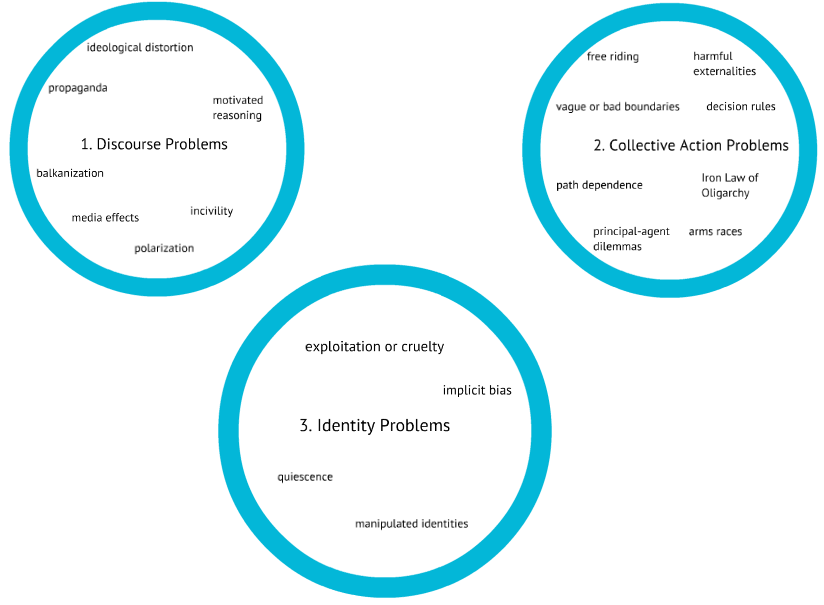
(Rancho Palos Verdes, CA) Back in 2014, I argued: [Elinor] “Ostrom plus [Jürgen] Habermas is nearly all we need.” I define a good citizen as anyone who seriously asks the question “What should we do?” Citizens face a dizzying variety of hard issues, but underlying them are general categories of problems. As of 2014, I thought these were the two basic categories:

  1. Problems of discourse make our thoughts and conversations go badly, so that we believe or desire the wrong things. Example include our susceptibility to propaganda and our strong tendency to “motivated reasoning,” or picking facts and theories because they yield the results we want.
  2. Problems of collective action cause us to get results that we do not desire, even when we agree about goals and values. An example is the temptation to “free ride” on other people’s contributions, or the tendency of small groups of specialists to dominate even democratic organizations (“The Iron Law of Oligarchy”).

Habermas and the postwar Frankfurt School provide a robust theoretical tradition, linked to practical experimentation, about how to address problems of discourse. Elinor Ostrom and the Bloomington School provide an equally robust theory/practice tradition about how to address problems of collective action. That was my basis for saying that Ostrom and Habermas nearly sufficed for a civic theory.

But I now think there is a third general category:

  1. Problems of identity and exclusion arise when some people simply won’t deliberate or collaborate with other people because they regard the latter as fundamentally different and inferior. Relatedly, sometimes people feel that they themselves don’t deserve to deliberate or collaborate because they are inferior.

The theoretical resources of Habermas and Ostrom are not sufficient for that third category, and we can learn more from theorists and practitioners of nonviolent social movements. That is the tradition that tells us what to do about problems of identity and exclusion if we choose to take violence off the table.

Therefore, I now believe that Ostrom, Habermas, and Gandhi are all we need–assuming that each name is synecdoche for a whole tradition of theory and practice.

Ostrom Habermas Gandhi
Fundamental problem People fail to achieve what would be good for them collectively People manipulate other people by influencing their opinions and goals. People fail to view others (or themselves) as fully human
Exemplary case of the problem We destroy an environmental asset by failing to work together Government or corporate propaganda distorts our authentic values One national or ethnic group exploits another
Characteristic starting point People know what they want but can’t get it People don’t know what they want or want the wrong things Some people won’t recognize other people
Essential behavior of a citizen Working together to make or preserve something. Talking and listening about controversial values. Using nonviolent sacrifice to compel change
Instead of homo economicus (the individual who maximizes material self-interest) we need … Homo faber (the person as a maker) Homo sapiens (the person as a reasoner) or homo politicus (the participant in public assemblies). A Satyagrahi (the person as a bearer of soul force)
Role of the state It is a set of nested and overlapping associations, not fundamentally different from other associations (firms, nonprofits, etc.) Citizens form public opinion, which should guide the state, which makes law. The state should be radically distinct from other sectors A target of demands
Modernity is … A threat to local and traditional ways of cooperating, but we can use science to assist people in solving their own problems A process of enlightenment that liberates people, but it goes wrong when states and markets “colonize” the private domain (for Gandhi) an imperialist imposition, undermining swaraj
Main interdisciplinary combination Game theory plus observations of indigenous problem-solving Normative philosophy (mainly achieved through critical readings of past philosophers) plus system-level sociology. Critical theology plus military strategy

the New Social Movements of the seventies, eighties, and today

(Oxford, OH) By the 1980s, a large literature distinguished the “New Social Movements” from older strands of politics. Jürgen Habermas chose to list the following New Social Movements then active in Germany: “the anti-nuclear and environmental movements,” “the peace movement”; “the citizens’ action movement”; the “alternative” movement that included urban squatters and new rural communities; movements of “minorities (the elderly, homosexuals, disabled people, etc)”; support groups and youth sects; “religious fundamentalism”; the “tax protest movement”; “school protests” by parent associations; “resistance to modernist reforms”; and “the women’s movement” (1981, p. 34).

Some of these might be classified with the left, and others (notably, tax protests and religious fundamentalism), with the right. In retrospect, it is debatable whether they formed a meaningful category or could be distinguished sharply from the “Old” social movements, such as labor unionism and civil rights in the USA.

My view is that these movements did represent a new stage of politics in the wealthy democracies. That stage has passed, however, as new problems have come to the fore and as the social movements of ca. 1968-1985 have become institutionalized in the nonprofit sector, thus losing their emancipatory role. These changes mean that it’s important to compare our time with the 1970s and early 1980s and to envision productive combinations of the Old and New Social Movement forms.

Continue reading