My remarks last week at a small conference on “Tolerance, Citizenship, and the Open Society” at the Tisch College of Civic Life …
We human beings did not evolve to take a broad view of justice, to collect information from diverse sources, to reason impartially, and to be responsive to other people who differ from us. These acts do not come naturally to us.
But we are capable of building prosthetics. For instance, we did not evolve with the skill to tell time precisely, which is now useful for coordinating behavior in mass societies. So we wear wristwatches, hang clocks on our walls, and display the current time on most of our electronic devices. A clock or a watch is a prosthetic device that extends our natural capacities.
An invention (in this case, a clock) will not suffice on its own. Many people must use it. That requires some kind of system that creates incentives or requirements for producing the devices and using them widely. A market with supply and demand can work; so can a state mandate. Either one is an institution.
We have created institutions that extend our ability to deliberate about justice. An example was the metropolitan daily newspaper from ca. 1910 to ca. 1990. Always very far from perfect, it nevertheless delivered important, mind-broadening information to about 80% of Americans every day in the year 1970. They (and advertisers) paid for the local press because it also provided sports, classified ads, comics, and whole package of goods–but with the most important news on the front cover, where it could not be missed.
A university is another institution that supports inquiry and discussion about important matters. It is more complex than a newspaper. Its revenues may include tuition, government aid, grants, gifts, intellectual property transfers, and clinical fees, among other sources. The goods it produces include skills and knowledge of value to each learner; virtues and skills that have public value; the pure public goods of basic knowledge and culture; monetizable forms of knowledge, such as patents; services, such as meals, art exhibitions, and clinical care; and credentials and entry to the middle class.
The skeptical view of such institutions is that their underlying economic motivations determine the ideas and discussions that they support. For example, newspapers are owned by tycoons or faceless corporations that just want to maximize profits. Universities sell social stratification and individual advancement. This analysis always merits attention and explains some of the phenomena. But it is one-sided, because these institutions are also the result of human artisanship–of people creating the means to sustain better thinking at a large scale.
For instance, the metropolitan daily newspaper can be interpreted as the product of the media industry, but it should also be seen as the product of the press. Traditional newspapers tried to distinguish the two by separating the newsroom from the publisher’s suite, but those subsystems were connected. For instance, plenty of publishers were former shoe-leather reporters. Their motives were mixed. That is good because mixed motives produce scalable public goods.
Too simple a theory would yield two predictions about newspapers that both proved incorrect. In 1900, you might predict that millions of people would never spend their own money voluntarily to purchase relatively impartial and challenging daily news. But they did–in part because they were also buying comics and box scores. In 1970, you might predict that we would always have a press, because it meets a social need. But the press has collapsed (half as many people work as reporters today compared to ten years ago) because the Internet has killed its business model.
As with other forms of artisanship, nothing is for certain. Ingenuity, commitment, and perseverance are required. The institutional structures that support broadened understanding depend on intentional work.
The results are always flawed. The recent scandals with college admissions just bring home the flaws of universities, for instance. We should have a free, open, informed, and consequential discussion about how to improve them. But no discussion can occur outside of a viable forum that depends on an institution. We don’t spontaneously gather to discuss; the discussion always happens in a university or a school, an op-ed page of a privately-owned newspaper, Facebook, a union hall, a church basement, a party convention, the state legislature–somewhere that draws resources and assembles users.
These institutions then structure and limit the discussion. There is no view from nowhere, only a permanent struggle to discuss as wisely as we can in various forums. We don’t create these forums deliberatively; most of them arise as the result of accident, power, or leadership. Because they are all flawed and limited, it is essential to have many of them, with diverse forms, competing and checking one another.
This is a “civic” perspective because it emphasizes our ability to shape the world of discourse through artisanship. And it broadens our attention so that we consider not only the rules for speech within an institution (e.g., campus speech codes) but also–and usually more importantly–the underpinnings of the institution itself.
We are accepting application for the APSA Institute for Civically Engaged Research (ICER) at Tisch College until March 31. In preparation for the Institute, I am looking for good writing about civically engaged research that is relevant for political scientists, although not necessarily about political science per se.
Incidentally, ICER will not be mainly devoted to reading and discussing papers; it will be more like a workshop. But readings are useful for the organizers at least, and a few texts may be assigned.
A diversity of perspectives and agendas, methodologies, topic areas, and authors’ backgrounds and social identities is important.
I’ve got these but would welcome additional suggestions. (This post is a bleg.)
Ackerly, Brooke, and Jacqui True. “Reflexivity in practice: Power and ethics in feminist research on international relations.” International Studies Review 10.4 (2008): 693-707.
Burawoy, Michael. “For public sociology.” American sociological review 70.1 (2005): 4-28. (His ASA Presidential Address)
Flyvbjerg, Bent. “Social science that matters.” Foresight Europe 2 (2005): 38-42.
O’Meara, K., Timothy Eatman, and Saul Petersen. “Advancing engaged scholarship in promotion and tenure: A roadmap and call for reform.” Liberal Education 101.3 (2015): 52-57.
Ostrom, Elinor. “Beyond markets and states: polycentric governance of complex economic systems.” American economic review 100.3 (2010): 641-72. (Her Nobel Lecture)
Struminska-Kutra, Marta. “Engaged scholarship: Steering between the risks of paternalism, opportunism, and paralysis.” Organization 23.6 (2016): 864-883.
Tickner, J. Ann. “On the frontlines or sidelines of knowledge and power? Feminist practices of responsible scholarship.” International Studies Review 8.3 (2006): 383-395.
Wallerstein, Nina B., and Bonnie Duran. “Using community-based participatory research to address health disparities.” Health promotion practice 7.3 (2006): 312-323.
I argued in a recent post that libertarians, social democrats, American liberals, and most US Constitutional scholars share a sharp distinction between the state and the private sector–but this distinction does not reflect our actual experience of the social world.
One result is a certain way of thinking about freedoms of speech, the press, assembly, religion, and petition (the Five Freedoms of the First Amendment, which are also important rights in other democracies).
A typical first step is to identify which institutions are public or state bodies. They should be prevented from interfering with other people’s speech and assembly, and they should be constrained from expressing themselves in certain ways. For instance, the US government may not express support for any specific religion, although anyone else in the society may.
The next step is to safeguard the freedoms of non-public groups, including their freedom to discriminate and exclude. For instance, the Catholic Church is not required to ordain non-Catholics (or women) as priests. Such requirements would violate its freedom of assembly and religion.
Then we face two recurrent debates. One is whether various private associations (universities, web platforms) should act like states, even though perhaps they don’t have to under the Constitution. For instance, should a private university accord its students untrammeled freedom of speech? The other debate is whether hybrid institutions (state universities, political parties, public broadcasting services) are more state or private. Do they have First Amendment rights or must they safeguard others’ rights, or both?
The debate about the role of speech in our democracy thus centers on questions like comment-moderation, inviting or disinviting speakers, speech codes, hate speech–all of which have a legalistic flavor. The question is who has a right to say what, where.
If I actually had any influence, I would not seek to upset the apple cart of American constitutional thought. The categories that we have drawn (public/private, freedom/restriction) reflect some accumulated wisdom and offer some practical advantages. I would give a Burkean justification for how we employ the First Amendment: it is how we have learned to operate.
But the distinction between state and private sphere is at odds with the reality of how institutions work. They are almost all hybrids, partly public and partly private, exercising power but also allowing voice, including some and excluding others.
So what if we started instead with a population of people–individual human beings–who come together in a wide range of organizational forms to define, discuss, and address problems? I think these are the important points for them to consider in relation to freedom of speech:
They need structured, reflective discussions that encompass a diversity of views and respond to good reasons or insights, not to power. They don’t need consensus, but they must continuously learn from others.
Good discussions take institutional forms, from op-ed pages to seminars to town meetings. All institutions have rules, norms, resources, and incentives. Incentives are necessary because participation in a discussion has costs. It takes time and energy to discuss, and the conversation may cause discomfort. Individuals don’t have to participate. Successful institutions for communication or discussion find ways to lure people in. A classic example was the package of the local daily newspaper: comics and sports to encourage subscriptions, and a sober front page to direct your attention to serious matters. The demise of this business model is an important example of what we should worry about.
Any good discussion is a common-pool resource. It requires voluntary contributions, it serves all who participate, but it is easy for individuals to ruin. There are principles for the management of fragile common-pool resources.
On the list of principles you will not find a requirement to discuss all the rules and incentives all the time. On the contrary, groups must economize on disagreement. They can’t handle too much of it. And any discussion assumes a prior solution to a problem of collective action. People didn’t automatically want to show up and talk; they were drawn in. This means that discussions generally rely on founders, small groups of leaders, or past generations of participants. We don’t make our own discussions; we join them. The structure of the institution constrains the discussions that take place within it, but there is no such thing as an unstructured discussion.
Given the fragility of institutions for discussion and the importance of building institutions that match various needs and interests, they must be plural. We need lots of overlapping but heterogeneous forums–face-to-face, online, big, intimate, ideologically coherent and ideologically diverse. Each one will set rules for what speech it allows, but the rules will also determine who participates, the costs and benefits of participation, the scale, and a range of other issues. No set of rules is ideal; it’s the whole ecosystem that matters.
None of this is original. It reflects well-developed lines of argument from the sociology of communication and other fields. But it is an alternative to the US discourse of free speech, which is all about rights and restrictions. It focuses instead on the design of multiple institutions for communication–their resources, boundaries, rules, and norms.
At Tisch College, we have a Civic Science initiative, which has roots in an NSF-funded effort under the same name. Here is my own personal working definition of “Civic Science.”
The word “science” in this phrase is relatively clear, although there may be significant questions about whether Civic Science should extend to the social sciences (in which there are other movements for greater civic relevance) and whether Civic Science has different implications for science and mathematics as compared to technology and engineering—the four components of “STEM.”
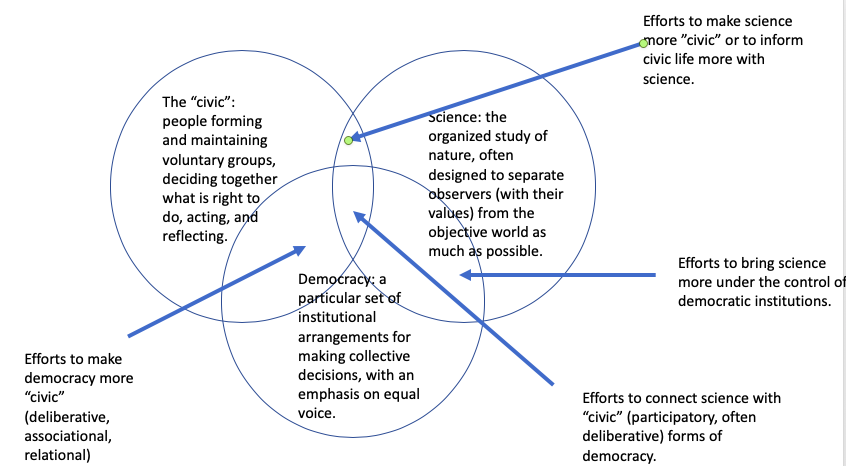
The word “Civic” is more contested, having assumed many meanings since the Roman Republic. We find the following definition useful. To be civic means to ask the question: “What should we do?” (Shaffer 2013). (Apologies for some self-plagiarization in the next three paragraphs.)
This question ends with “do” because a civic life requires acting: changing or preserving things in the world, not just forming opinions about them. The word “should” in the question signifies that the civic perspective is an ethical one. Civic agents must identify right or good goals and decide which means are proper.
The subject of the question is “we”: a real, identifiable group to which one can belong. The subject is not “I,” because any individual lacks sufficient capacity to change the world and has too narrow a perspective to be wise. Although individual ethics is important, a civic perspective requires working in groups. Importantly, the subject is “we” rather than some entity outside the group. The civic question is not “What should be done?” or “What should the government do?” but “What should we do?” Sometimes other people bear the primary responsibility for addressing an injustice, but we must still clarify that obligation to them. Communicating a critique or a demand is an action that groups take. Because the question is about “we,” it reflects a fundamental “feeling of responsibility for the world” (Havel 1992) that is definitive of civic life.
People who ask the civic question face myriad concrete challenges (climate change, racial injustice, and many more). They will also confront three general questions just as a result of trying to take civic action:
How to form groups that actually work? Specifically, what structures, incentives, and rules allow groups to accomplish their goals, sustain their activities, and coordinate the efforts of their individual members? Functioning groups include associations, organizations, institutions, firms, and networks, any of which can be designed well or badly.
How to deliberate contested questions of value? Since the civic question is “What should we do?” civic actors necessarily confront matters of value. As human beings, our best method for addressing such matters is to discuss them with other people who hold different perspectives. (Here we use the term “discussion” very broadly, to include reading an ancient text or watching a film from a distant land to learn other perspectives). Discussions can promote learning, but they can also fail because of propaganda, ideology, group-think, motivated reasoning, and many other dysfunctions. So the question is: How to make discussions go relatively well?
How to gain access for excluded groups? Even a well-functioning group with a good internal discussion may erect unjustifiable barriers to outsiders. A clear example would be a system of de jure racial segregation or apartheid, but there are many subtler cases, in which some people have official rights to participate but are placed at systematic disadvantage. Civic action is then about gaining inclusion on fair terms and without triggering a cycle of violence. (A related goal may be peaceful separation, as, for example, in a movement for national independence.)
Science is deeply involved with each of these three questions.
First, science is a set of functioning institutions. It consists of laboratories, training programs, credentials, titles, journals, societies, government agencies, grants, contracts, data, and intellectual property, among other components. Science employs distinctive organizational techniques, such as blind peer review and an obligation to cite previous work. These techniques may reflect high ideals, such as Robert Merton’s CUDOS norms (1942):
Communism: a scientific discovery is given away to all, as quickly as possible, along with all the necessary background information, procedures, data, etc.
Universalism: the quality of the work, not the nationality or race or gender of the researcher, counts
Disinterestedness: no pay for particular results; academic freedom. Blind reviewing keeps those under review from currying favor with the powerful
Organized Skepticism: every theory is taken to be falsifiable.
At the same time, science may be deeply influenced by indefensible norms, such as deference to authority within a lab or the motives of funders.
Science is not a democracy: there are no popular votes on what constitutes scientific knowledge. And science is not a market: basic knowledge is not for sale. However, both democratic governments and markets are thoroughly implicated with science. The question for Civic Science is whether the organizational forms that science takes today are satisfactory for a public that seeks to ask, “What should we do?”
Second, contested questions of value—which constantly arise for civic actors—often have scientific dimensions. There are no purely empirical answers to such questions as, “At one point do developing human beings gain intrinsic value?” or “How much pollution should we allow to enable economic growth?” Yet these questions do have complex empirical aspects that can be challenging for non-specialists to understand. The logical positivists of the early 1900s made a sharp fact/value distinction and held that science could—and should—be value-free. Values were opinions; scientists produced facts. Although many professionals in STEM disciplines still hold that view implicitly, it is not philosophically defensible. So the civic questions are: How can scientists be part of good conversations about contested values that involve science? And how can the broader public have good conversations about science?
Third, questions of exclusion constantly arise in science. For example, LGBTQ Americans were largely excluded from decision-making about research on AIDS when the epidemic began. Their highly effective organizing changed science—its priorities, its demographics, and even the details of how clinical trials were designed and interpreted. It is not an exaggeration to say that “a strong and internally differentiated activist movement along with various organs of alternative media, including activist publications and the gay press” actually created scientific knowledge about HIV/AIDS by interacting with “immunologists, virologists, molecular biologists, epidemiologists, physicians, and federal health authorities” (Epstein, 1995). ACTUP was a classic example of a contentious or adversarial social movement that made demands on target authorities (Tilly 2004), but in this case, one of its outcomes was new scientific knowledge and medical treatments. This is an example of how the third generic problem faced by civic groups (how to gain access) can play out in science.
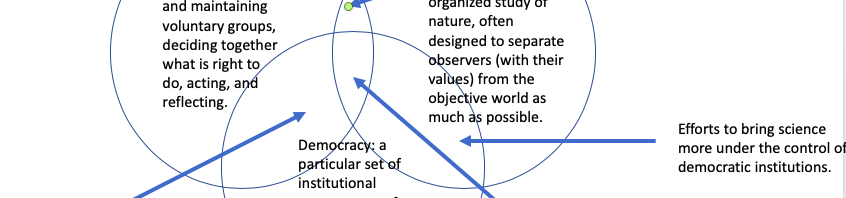
Civic Science works at the intersection of these three circles, and especially where “the civic” overlaps with science.
Civic Science in Relation to Other Movements
Given the definition developed in the previous section, it is clear that Civic Science does not stand alone but relates importantly to other fields and movements, both intellectual and practical.
Science, Technology and Society (STS): This is the interdisciplinary research field devoted to understanding science as a set of institutions in society and its relationship to other institutions, such as states and markets. It is ideologically pluralist and encompasses valuable disagreements, but the goal is not knowledge for its own sake. STS promotes understanding of science so that scientists and others can improve science. Feeding into STS are specific sub-disciplines such as the sociology of science and the philosophy of science.
Citizen Science: At its core, Citizen Science means enlisting laypeople to collect scientific data, such as environmental samples or observations of wildlife. Its goals can be to harvest more and better data or to give amateurs interesting tasks, but there is also sometimes an implicit reform agenda: to reduce status hierarchies that might otherwise keep laypeople out of science.
Community-Based Participatory Research: Particularly strong in the health sciences is the development of partnerships between credentialed scientists and community-based groups (usually nonprofits) that jointly shape research questions and methods and collect and interpret data together (Minkler 2002). Sometimes the goal is to generate better knowledge or to make sure that activists will be ready to use scientific findings, but (as with Citizen Science), there may also be an agenda of reducing status differentials between scientists and laypeople.
Civic renewal: Many organizations have arisen and come together in coalitions to advance “civic renewal” in the United States. This tends to mean efforts to strengthen deliberation, collaboration, and relationship-building in civil society (Levine, 2013). One signal moment was the National Commission on Civic Renewal in the late 1990s, but today such groups convene in the Bridge Alliance and other settings. Sirianni and Friedand (2005) map a Civic Renewal Movement.
Civic Studies: Launched with a manifesto by three past or future presidents of the American Political Science Association, a future Nobel Laureate in economics, and others (Boyte et al 2017), Civic Studies is a nascent field and intellectual movement that aims to study civic life with a combination of empirical, normative, and strategic methods (Levine 2014).
Dialogue and Deliberation: Such major political theorists as Jürgen Habermas (1987) and John Rawls (1997) have defended a role for public deliberation, meaning a relatively fair and reasonable discussion (the precise criteria vary) that influences government and public policy. Meanwhile, a large number of practical nonprofits actually organize dialogues or deliberations in various formats (Gastil & Levine 2005). There is a burgeoning literature on the impact of these efforts, creating a rich scholar/practitioner community.
Social movements that target science: In the tradition of ACTUP, citizens may come together to demand changes in the priorities, methods, and dominant paradigms of science. [Current examples? Gun violence? Climate?]
Boyte, H., Elkin, S., Levine, P., Mansbridge, J., Ostrom, E., Soltan, K., & Smith, R. (2007). Summer institute of civic studies—Framing statement. Tufts University Summer Institute of Civic Studies, 28.
Epstein, Stephen. 1995. the construction of lay expertise: AIDS activism and the forging of credibility in the reform of clinical trials. Science, Technology, & Human Values, 10/4 408-437
Gastil, John & and Peter Levine. 2005 (The Deliberative democracy handbook: strategies for effective civic engagement in the twenty-first century. San Francisco: Jossey-Bass
Habermas, Jürgen. 1987. The Theory of Communicative Action, translated by Thomas McCarthy Boston: Beacon Press.
Havel, Vaclav. 1992 Address at Wroclaw University, Wroclaw, Poland, December 21, http://old.hrad.cz/president/Havel/speeches/1992/2112_uk.html
Levine, Peter. 2015. We are the ones we have been waiting for: the promise of civic renewal in America. Oxford University Press
Levine, Peter 2014. The Case for civic studies. In Peter Levine and Karol Soltan, Civic studies (Washington, DC: AAC&U/Bringing Theory to Practice
Minkler, Meredith & Nina Wallerstein. 2002. “Introduction to community based participatory research.” In Minkler & Wallerstein (eds.) Community based participatory research for health. San Francisco: Jossey-Bass, 3-26
Rawls, John. 1997. The idea of public reason revisited. University of Chicago Law Review. 64/3, 765-83.
Shaffer, Timothy J. 2013. What should you and I do? Lessons for civic studies from deliberative politics in the New Deal. The Good Society, 22(2), 137-150.
Sirianni, Carmen & Lewis A. Friedland. 2005. The civic renewal movement: community-building and democracy in the United States. Dayton, Ohio: Kettering Foundation Press, 2005
Tilly, Charles. 2004. Social movements: 1768-2004. Boulder/London: Paradigm
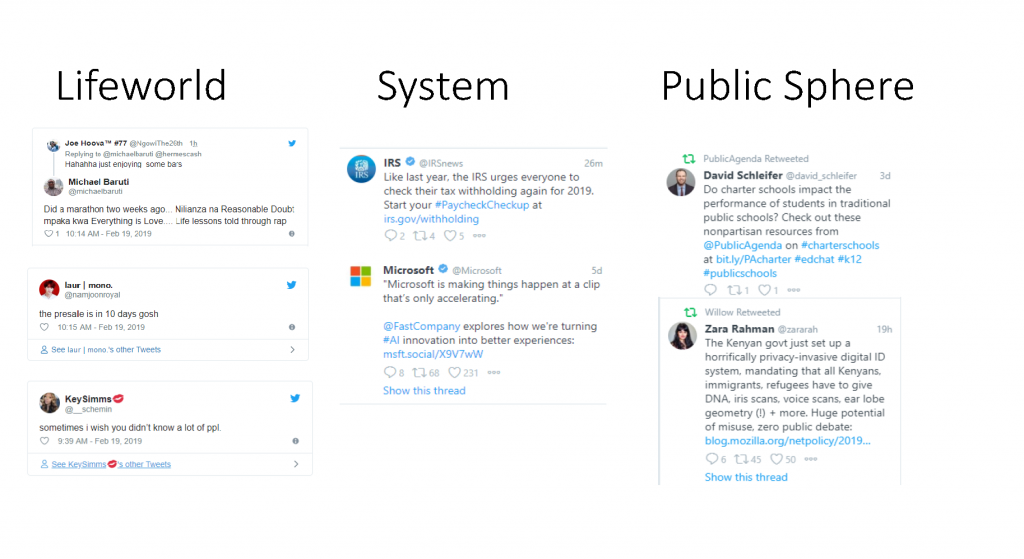
I’ve categorized a bunch of recent tweets by putting them in Jürgen Habermas’ three buckets:
In the first column, the tweets are literally legible–I can read them–but I don’t know much about their significance. That is because they are meant for friends, people who share experiences with the authors. Because so much common experience is assumed, these are essentially private messages in a public space. In Habermas’ terminology, they represent the Lifeworlds of the authors and their friends.
In the second column, employees of formal organizations are doing their jobs–telling people to file their taxes, encouraging them to buy products. For Habermas, these are Systems. They have pre-determined goals that they are openly pursuing–power and profit.
In the third column, people are expressing views to audiences that include strangers about matters of common or public concern. These authors have emerged from their respective Lifeworlds to say something about how Systems should change. Their goal is to educate or influence. This is the Public Sphere.
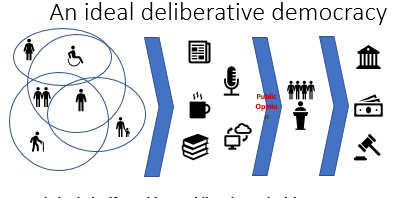
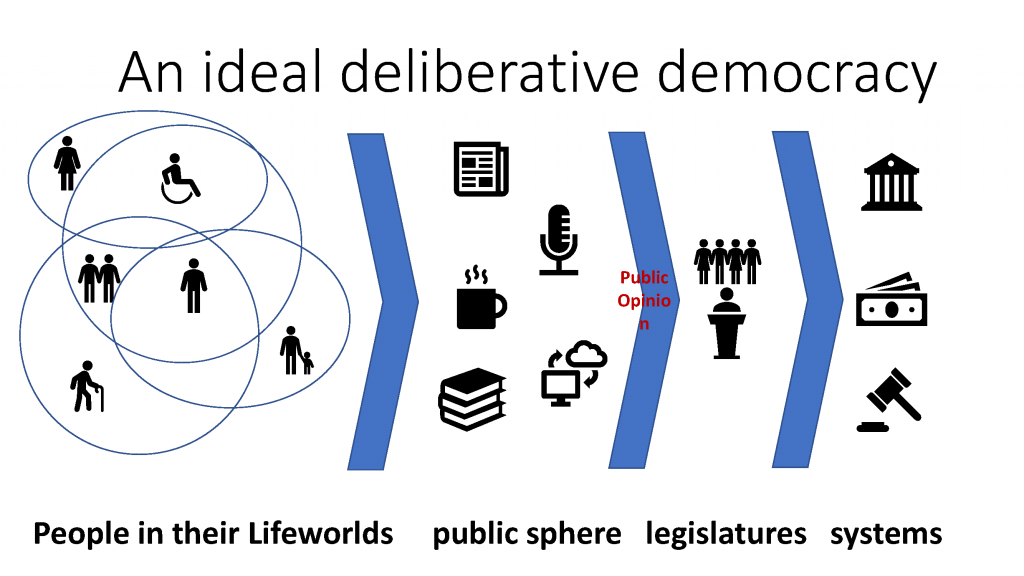
Below is a diagram of how it should work. People should enjoy their Lifeworlds. They have a right to them. I show each person’s horizon of experience and assumptions as unique but overlapping with those of other people, to allow shared meaning.
Individuals should emerge into the public sphere to advocate for changes, addressing other people as free subjects who will respond to good reasons. Together, they create public opinion.
Since opinion always involves disagreement, a deliberative and representative legislature should take their input and make decisions, which should affect the Systems of law, market, and government.
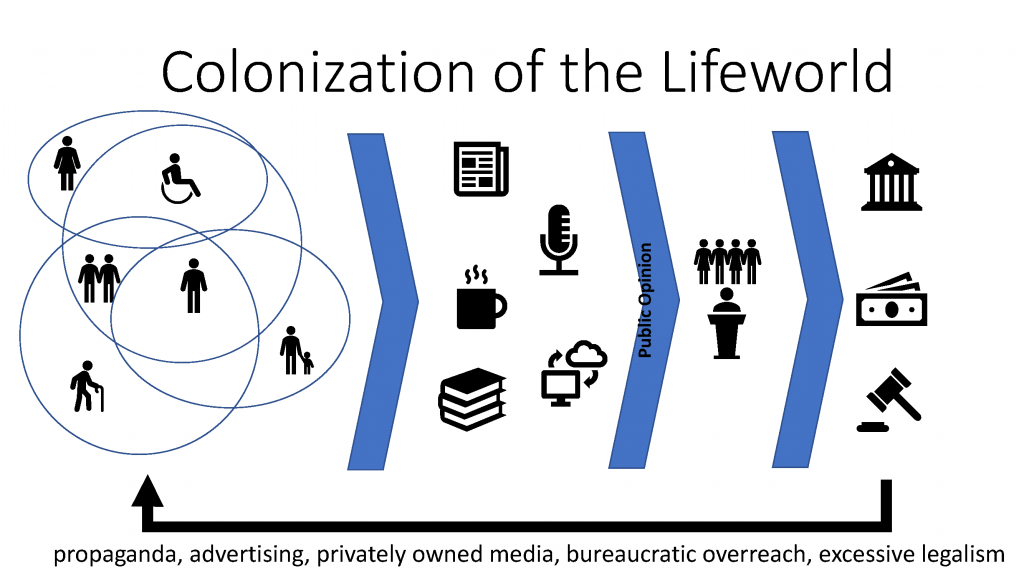
This is how it often actually works:
The systems of money and power influence public opinion by infiltrating people’s Lifeworlds.
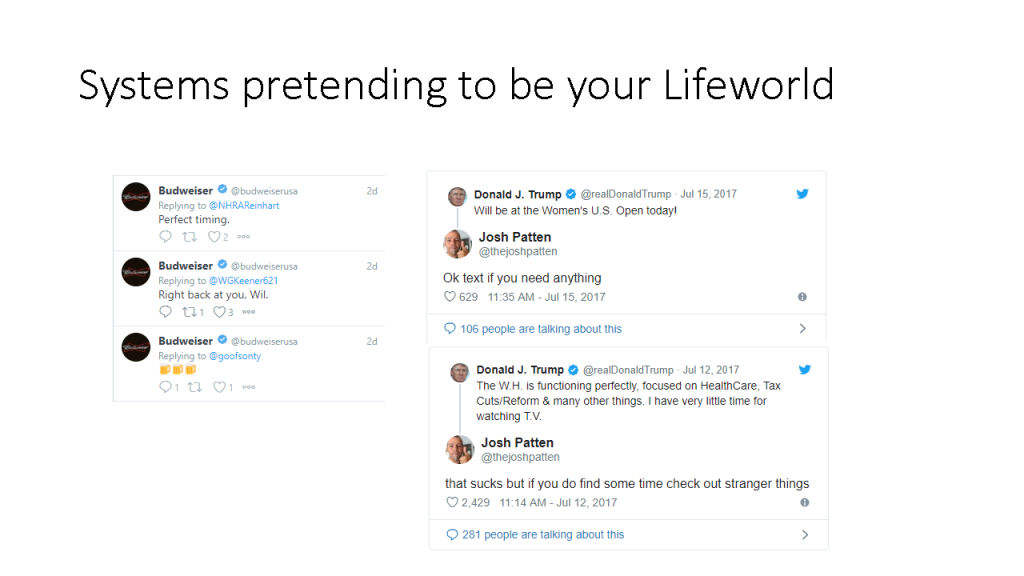
One particular mechanism is a message from a System that pretends to be your friend. Budweiser tweets all day with private individuals who drink its beer. And Donald Trump sends tweets to 58 million people that look like messages from a buddy at loose ends around his house. Josh Patten brilliantly satirizes them by responding in kind.