Category Archives: civic theory

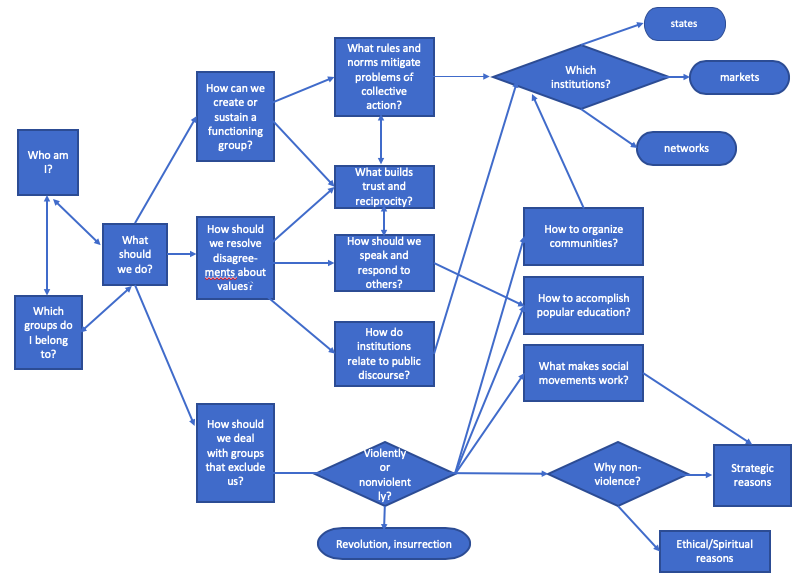
a Civic Studies flowchart

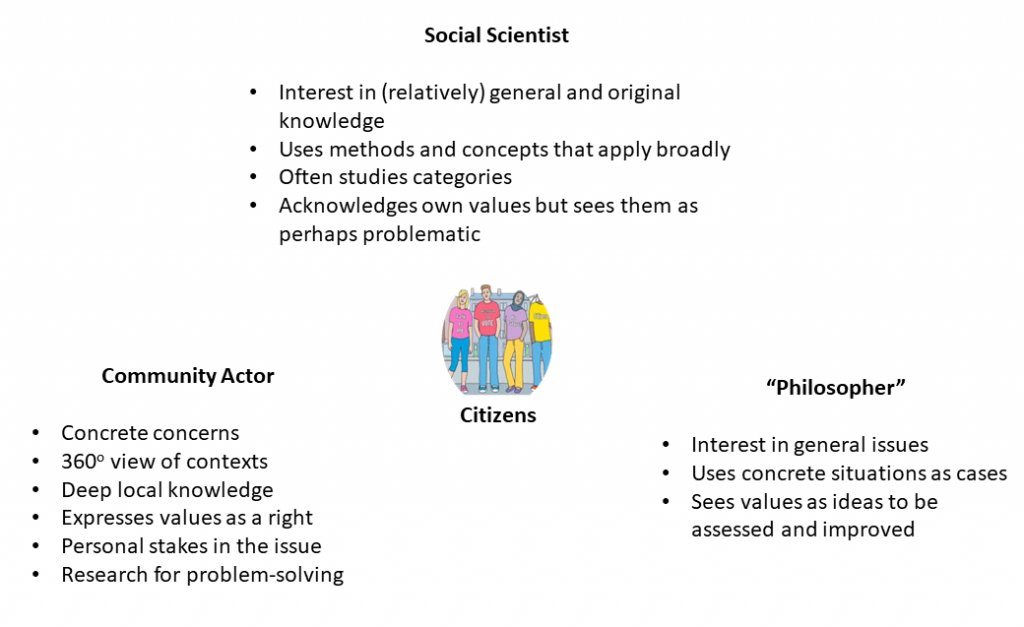
This is an agenda for research and education. It’s a way of organizing the major topics of our Introduction to Civic Studies course for undergraduates. It isn’t intended directly as a flowchart for civic actors (activists, leaders) because their problems are more concrete and more varied. But I hope that by addressing these topics in cumulative research, and by teaching the results (interactively), we can build a base of knowledge useful for activists. (See also the page about Civic Studies on the Tisch College website.)

pay attention to movements, not just activists and events

Let’s say you work in a school or college, a newsroom, a city government, or a firm. You may encounter a social movement when it makes demands on you. Regardless of your opinion of its demands, you probably see it as different in kind from the organization where you work. Your organization has a bank account, a board, and a mission statement. The social movement may appear to you mainly in the guise of individuals who participate in events or episodes—people you call protesters, boycotters, strikers, or voters. Or you may think of the movement as the name for people who share beliefs or goals. For instance, you could notice that many of your students have become environmentalists, or anti-racists, or neo-fascists. To you, they are a movement.

I want to encourage a different view. Any “movement” that is worthy of that name persists over multiple events and episodes (McAdam, Tarrow & Tilly 2001). It recruits active members and supporters and collects resources, which it uses in more or less strategic ways. Its members may not agree about anything in particular, not even about the marquee slogans of the movement. Ziad Munson has found that many anti-abortion protesters do not start with strong opinions about that issue but are recruited into activist networks from which they derive their anti-abortion views while they act (Munson 2010).

“Opponents of abortion” is the name for a segment of the population, who can be identified with a survey that asks opinion questions. The Pro-Life Movement, on the other hand, is a social entity that has resources and membership that persist over time; some of its members are not even against abortion. This is typical of movements in general.

Once you distinguish between individuals (activists, radicals, protesters) and a movement, you will notice that the movement resembles your own organization in some respects. It may encompass several autonomous components, but it still constitutes a larger whole with a real presence. For example, the American Civil Rights Movement encompassed many churches networked together in organizations like the Southern Christian Leadership Council, classic membership associations like the NAACP and the Urban League, a political party (the Mississippi Freedom Democratic Party) and a union (the Brotherhood of Sleeping Car Porters), among their entities, but we can still tell the movement’s history and describe its central tenets and tendencies at each point in the story

You should not only ask: What political opinions do I hold and which categories of citizens do I agree or disagree with? You should also ask: What do I think of the social movements of the day? Are they drawing diverse people together for generative conversations? Are they inventing new forms of political action that are valuable? Are they bringing out the best in their members? Do they create “Free Spaces,” forums in which their members discuss and learn (Evans & Boyte 1986)? Examples from the past include Grange Halls in Populism, Freedom Schools in the Civil Rights Movement, Talk-Ins against the Vietnam War, consciousness-raising circles in Second Wave Feminism, the “human microphones” of the Occupy Wall Street movement, and the uses of hashtags like #BlackLivesMatter and #MeToo to organize conversations online.

On the other hand, do the social movements of the day promote norms and habits that damage their members or other people? Do they tend toward extremism, nihilism, cynicism, a cult of personality, group-think, or other pathologies? How good are they at SPUD?

A movement can be worthy of support even if you disagree in part with its current agenda, if it provides a forum for learning, growth, and solidarity. We can’t accomplish much alone, so it can be your civic responsibility to participate in a movement that you don’t endorse 100% if you think it’s better than nothing and has the potential to improve. On the other hand, you may find that you agree with every demand of a social movement but choose to avoid it because of its internal dynamics. The point is to pay attention to the movement, not just the claims that it makes at the moment.

See also: a better approach to coalition politicsHabermas with a Whiff of Tear Gas: Nonviolent Campaigns and Deliberation in an Era of Authoritarianismthe value of diversity and discussion within social movementsa sketch of a theory of social movements; and against methodological individualism

Sources: Evans, Sara M & Boyte, Harry C., 1986. Free Spaces: The Sources of Democratic Change in America. New York : Harper & Row; McAdam, Doug, Tarrow, Sidney and Tilly, Charles, 2001. Dynamics of Contention (Cambridge: Cambridge University Press); Munson, Ziad W. 2010; The Making of Pro-Life Activists: How Social Movement Mobilization Works. Chicago: University of Chicago Press.

identities, interests, and opinions

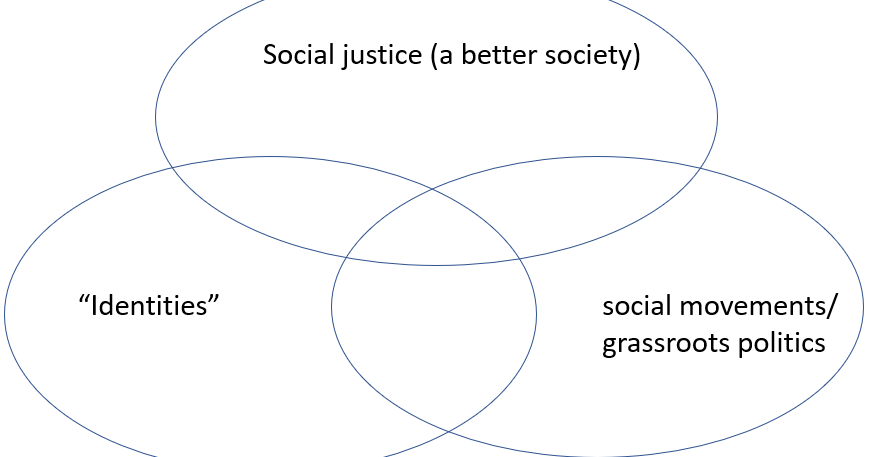
In our Introduction to Civic Studies course, this is the zone we’re currently in:

We all need some account of what would make a good–or at least a better–society. This idea can be provisional and open-ended; we still need something to orient us. If you think that it’s easy to define “social justice,” consider that it was the name of Father Coughlin’s antisemitic and pro-Nazimagazine in the 1930s.

We must consider the potential of bottom-up, participatory, social movements to promote justice, because the powerful won’t reliably offer justice. However, reasonable people disagree about how important bottom-up politics is. Maybe top-down leadership or impersonal forces are much more significant.

Finally, we must consider how identities (what we are, as opposed to what we think) fit in. Is all politics identity-politics? Or should we distinguish between “old” social movements, which made universalist claims, and “new” ones, which are identity-based? If the distinction holds, is the change good or bad? Also, does justice require fair treatment of identities? And what is an identity? For example, religion: an identity or a set of beliefs?

As always, it’s our students’ job to navigate their own way through these shoals; I don’t offer answers. But I do think it is interesting to distinguish:

  • An identity: “Speaking as a …”
  • An interest: “I want …”
  • An opinion: “We should …”

I’ll stipulate that we all use all of these forms of speech, and they are all protected under the First Amendment. Which ones are allowed is not a good question. But we might ask:

  • Which of these can be right or wrong?
  • Which can/should be subject to compromise?
  • Which does one have a moral right to? (Relatedly, which ones do other people have an obligation to honor in various ways?)
  • Which should we be open to changing, and why?

Here is an example of a view, although I am not wedded to it:

People have a right to their identities. Sometimes we should change our identities in response to new understandings. For instance, some people didn’t used to see sexual orientation as an identity, especially if they happened to be straight; now they should see heterosexuality as an identity. We should not, however, compromise our identities as part of a deal with others. We are usually right about our own identities, but not inevitably. We can lie or even lie to ourselves about who we are.

We should be open to compromising our interests in order to share the world with others. Whether to compromise depends in part on the moral standing of the other party. We should also be open to changing our interests in response to principled arguments, but that is a different process from compromise. We have a right to certain basic interests, but we can claim interests that we do not have a right to. You can disagree that something is my legitimate interest. I may even owe you an argument that it is.

Our opinions can be right or wrong. We should be open to changing them on the basis of evidence and arguments. We shouldn’t easily compromise them (in the sense of splitting the difference), although there are times when that is wise. Opinions should be sincere, so if you do compromise them, you should mean it.

See also: the New Social Movements of the seventies, eighties, and today; don’t confuse bias and judgment; and why study social justice?

Interfaith Studies, Civic Studies

In a talk yesterday at Tufts, Eboo Patel, the founder and President of the Interfaith Youth Core, said that the guiding question of the field of Interfaith Studies is how to build a religiously diverse democracy. He defined a democracy as a place “where people can make their personal commitments public.” He said that diversity “is not just the differences you like.” It means being able to deal with people who disagree with you about important matters, including politics. And he defined religion as being “about ultimate concerns.”

Eboo made an explicit connection to Civic Studies, for which the defining question is “What should we do?” How to live democratically with religious diversity is an important branch of Civic Studies. It raises empirical questions (What are the roles of religious congregations in civil society? How will they change? How do human beings react to out-groups?) and normative questions (What is the place of faith in public deliberation? How should we respond to beliefs that are intolerant? When should we treat the transmission of practices from one tradition to another as appropriation?)

In January, I got a dose of Interfaith Studies–meaning the theory, the everyday practices, and the committed people–at a conference of the Pluralism Project. I’m eager to work with our chaplaincy and others to build a stronger strand of Interfaith Studies as a complement to Civic Studies.

See also: when political movements resemble religions; the political advantages of organized religion; are religions comprehensive doctrines?; on religion in public debates and specifically in middle school classrooms; churchgoing and Trump; and is everyone religious?

what sustains free speech?

My remarks last week at a small conference on “Tolerance, Citizenship, and the Open Society” at the Tisch College of Civic Life …

We human beings did not evolve to take a broad view of justice, to collect information from diverse sources, to reason impartially, and to be responsive to other people who differ from us. These acts do not come naturally to us.

But we are capable of building prosthetics. For instance, we did not evolve with the skill to tell time precisely, which is now useful for coordinating behavior in mass societies. So we wear wristwatches, hang clocks on our walls, and display the current time on most of our electronic devices. A clock or a watch is a prosthetic device that extends our natural capacities.

An invention (in this case, a clock) will not suffice on its own. Many people must use it. That requires some kind of system that creates incentives or requirements for producing the devices and using them widely. A market with supply and demand can work; so can a state mandate. Either one is an institution.

We have created institutions that extend our ability to deliberate about justice. An example was the metropolitan daily newspaper from ca. 1910 to ca. 1990. Always very far from perfect, it nevertheless delivered important, mind-broadening information to about 80% of Americans every day in the year 1970. They (and advertisers) paid for the local press because it also provided sports, classified ads, comics, and whole package of goods–but with the most important news on the front cover, where it could not be missed.

A university is another institution that supports inquiry and discussion about important matters. It is more complex than a newspaper. Its revenues may include tuition, government aid, grants, gifts, intellectual property transfers, and clinical fees, among other sources. The goods it produces include skills and knowledge of value to each learner; virtues and skills that have public value; the pure public goods of basic knowledge and culture; monetizable forms of knowledge, such as patents; services, such as meals, art exhibitions, and clinical care; and credentials and entry to the middle class.

The skeptical view of such institutions is that their underlying economic motivations determine the ideas and discussions that they support. For example, newspapers are owned by tycoons or faceless corporations that just want to maximize profits. Universities sell social stratification and individual advancement. This analysis always merits attention and explains some of the phenomena. But it is one-sided, because these institutions are also the result of human artisanship–of people creating the means to sustain better thinking at a large scale.

For instance, the metropolitan daily newspaper can be interpreted as the product of the media industry, but it should also be seen as the product of the press. Traditional newspapers tried to distinguish the two by separating the newsroom from the publisher’s suite, but those subsystems were connected. For instance, plenty of publishers were former shoe-leather reporters. Their motives were mixed. That is good because mixed motives produce scalable public goods.

Too simple a theory would yield two predictions about newspapers that both proved incorrect. In 1900, you might predict that millions of people would never spend their own money voluntarily to purchase relatively impartial and challenging daily news. But they did–in part because they were also buying comics and box scores. In 1970, you might predict that we would always have a press, because it meets a social need. But the press has collapsed (half as many people work as reporters today compared to ten years ago) because the Internet has killed its business model.

As with other forms of artisanship, nothing is for certain. Ingenuity, commitment, and perseverance are required. The institutional structures that support broadened understanding depend on intentional work.

The results are always flawed. The recent scandals with college admissions just bring home the flaws of universities, for instance. We should have a free, open, informed, and consequential discussion about how to improve them. But no discussion can occur outside of a viable forum that depends on an institution. We don’t spontaneously gather to discuss; the discussion always happens in a university or a school, an op-ed page of a privately-owned newspaper, Facebook, a union hall, a church basement, a party convention, the state legislature–somewhere that draws resources and assembles users.

These institutions then structure and limit the discussion. There is no view from nowhere, only a permanent struggle to discuss as wisely as we can in various forums. We don’t create these forums deliberatively; most of them arise as the result of accident, power, or leadership. Because they are all flawed and limited, it is essential to have many of them, with diverse forms, competing and checking one another.

This is a “civic” perspective because it emphasizes our ability to shape the world of discourse through artisanship. And it broadens our attention so that we consider not only the rules for speech within an institution (e.g., campus speech codes) but also–and usually more importantly–the underpinnings of the institution itself.

See also a civic approach to free speech; Sinclair and Bezos: media ownership and media bias; don’t let the behavioral revolution make you fatalistic; prospects for civic media after 2016; China teaches the value of political pluralism; polycentricity: the case for a (very) mixed economy.