Category Archives: verse and worse

The Anachronist in the Florida Review

(Korcula, Croatia) I am in Europe for a mixture of work–in Ukraine and Germany–and vacation. Meanwhile, the Florida Review has published The Anachronist as a multimedia feature. It begins:

The Argument

A woman is bound to the stake to be burned:
No hope of using the secrets she’s learned.
A sagacious doctor awaits his fate,
Captive in the Tower behind Traitor’s Gate.
His student could strike to make justice prevail.
Righteous is he, but his judgment may fail.
Over the sea comes a painter who sought—
Not the dark cellar in which he is caught.
In the midst of these four, a lady is torn.
She must choose just one, leave the rest forlorn.
Time’s arrow flies; let us find where it lies. 

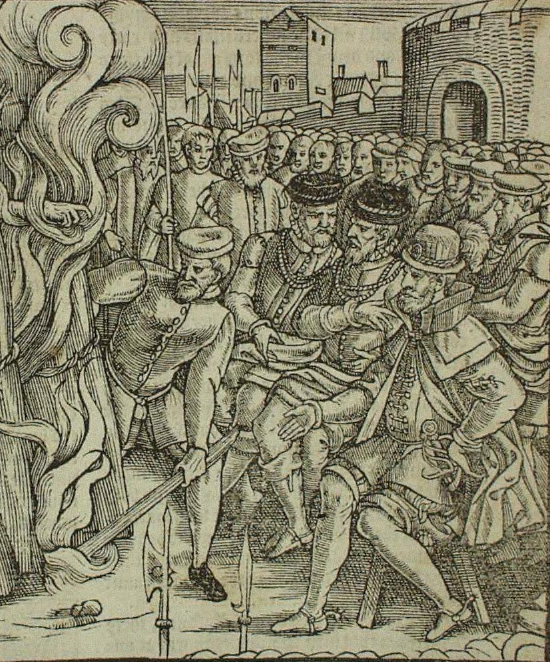
A woman stands to her waist in a mound of logs and neatly bundled furze kindling. The split logs beneath her feet cut into her bare soles. A rope winds around her body from her thighs to a triple knot at her chest. The stray hairs on the knot’s surface shake in the wind.

She thinks: You watch small, harmless things like this every day of your life. If I were a child, I would play with this rope, pull its strands apart, or drag it behind me like a tail.

The words she hears in her head are Dutch, her native language. Although her body is trussed, she can turn her face. On her left she sees seated clergymen and dignitaries. The name “Thomas Lucy”—“Sir Thomas”—comes into her mind as she identifies a bearded, red-faced gentleman with a heavy gold chain over his furs. Look how calm he seems now, she thinks. Look at his fat hands, how relaxed they are, clasped over his fat belly. When he questioned me in the castle, those hands were always twitching, scratching, accusing ….

what it looks like to live

She’s all cheekbones, lashes, emotions
Conveyed in rapid succession, practiced.
Cut to his reaction, the impact on his famous
Face, bathed in a warm and flattering light.
Then they’re running athletically away,
Silhouettes diving before the fireball.
This is living. This is doing something.
It plays on long rows of screens suspended
Above the welded seats, the wall-to-wall,
The strewn paper bags and strewn human forms.
Slumped, plump, pursued by a slower fire,
None watch the screens deployed for our relief.
We find darkness in that old space behind our lids,
Or gaze out, or stare down at smaller screens
Where more looks and loves, kisses and missiles
Remind the living what it looks like to live.

(Dallas, June 4)

Philip, Hannah, and Heinrich: a Play

“[Philip] Roth, who passed away last week, will be spending a lot of time with Arendt now, as he will be buried near her in the Bard College cemetery. According to an anecdote related by Bard’s President, Leon Botstein, Roth requested to be buried in the Bard cemetery so we would be able to talk to Arendt in perpetuity.” — Roger Berkowitz 

Philip: Hannah? Hannah? Dr. Arendt? Let’s talk about Irving Howe, can we? I was thinking maybe we could start with him. In 1972, he accused me “thinness of culture, … of ressentiment [and] freefloating contempt and animus.” He said that your Eichmann book demonstrated “surging contempt” and “the supreme assurance of the intellectual looking down” on others. Now, was that fair? Where did he get off accusing us of contempt in such a contemptuous way?

Heinrich [Blücher, Hannah Arendt’s husband, buried to her right]: Wer spricht das? Wer ist da?

Hannah: English, please, Heinrich. You still need to practice your English. It’s just Philip. Philip Roth–the young novelist? Although he actually doesn’t look so young any more. He’s buried on the other side of me now.

Heinrich: What? Forever? Did you agree to this?

Philip: How about Gershom Scholem, Hannah? He accused us both of being self-hating, anti-Semitic Jews. Who made him the arbiter?

Heinrich: Could we talk to Leon about getting this fellow moved somewhere else?

Philip: Hannah, tell me about Berlin in the twenties. [Wistfully] You guys didn’t have to wait ’til the sixties for the sexual revolution, did you? Talk about putting the id back in Yid–you Weimar intellectuals already took care of that. Cafes, cabarets, it must have been great. But Heidegger? What did you see in that old Nazi?

Hannah: Ach, please, both of you. “Death not merely ends life, it also bestows upon it a silent completeness, snatched from the hazardous flux to which all things human are subject.” Can we try a little of that silent completeness for a while?

(See also: The House of Atreus: A Play; and for Gerard Manley Hopkins)

echoes

In home movies and fading Polaroids,
They look funny, their lapels wide and garish,
Their facial hair risible, movements jerky.
They look naive–fools, ignorant of what came next.
But I report: the grass felt just the same
When you raked your fingers though its crisp stems.
On a suddenly warm January day,
Wafting over sodden drifts, the air smelled
The same, and laughter sounded the same
Filtered through traffic thrum and cicadas.

[edited on Feb. 4, 2018]