Category Archives: democratic reform overseas

civic engagement in post-revolutionary Egypt

My CIRCLE colleagues met with an Egyptian youth delegation yesterday and report having a very interesting conversation about how to sustain engagement in that country as the revolution moves into the rear-view mirror.

potentially revolutionary strategies that honor people’s wisdom and power

Yesterday, I attended a meeting with the Positive Deviance Institute, which happens to be a center (like mine) at Tufts University. Their approach is to work with partners in a community to identify the individuals, institutions, or families who avoid the problems that everyone else is suffering from. For example (see PDF), in a poor Vietnamese community, child nutrition was rampant, but some children from extremely poor families were well nourished. The Positive Deviance people used their community-based research strategy to help residents find out why. It turned out:

In every instance where a poor family had a well-nourished child, the mother or father was collecting tiny shrimps or crabs or snails (the size of one joint of one finger) from the rice paddies and adding these to the child’s diet along with the greens from sweet potato tops. Although readily available and free for the taking, the conventional wisdom held these foods to be inappropriate, or even dangerous, for young children.

[Also:] most families fed their young children only twice a day, before parents headed to the rice fields early in the morning and late afternoon after returning from a working day. Because these children under three years of age had small stomachs, they could only eat a small percent of the available rice at each sitting. The PD families, however, instructed the home babysitter (an older sibling, a grandparent or a neighbor) to feed the child regularly.

The intervention dramatically cut malnutrition.

PD reminds me, in some very general ways, of the work of our friends at The Right Question project, who have achieved remarkable results by training service-recipients to ask a few key, critical questions about the decisions that affect them.

And it reminds me of “social accountability” measures, which reduce corruption and improve services by giving citizens detailed information about public spending.

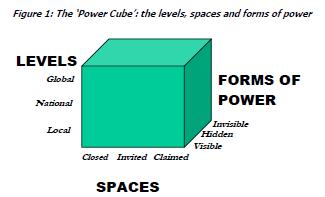
And it reminds me of John Gaventa’s Power Cube analysis, a simple but potentially transformative tool for analyzing and challenging power relations.

And it reminds me of asset-mapping, which was developed by John McKnight and John Kretzmann and used in many communities to create a strong foundation before outside aid is used.

These techniques have important common features:

  • They show a high respect for poor people’s knowledge and ability
  • They require training, but dramatically less training than it takes to become, say, a school teacher or a physician. The Positive Deviance Institute’s main training program takes 12 days.
  • They are equally appropriate for many types of setting–schools, villages, hospitals–and for a variety of purposes.
  • They run counter to the norms, assumptions, and incentives in most big institutions and professions.
  • They have a different theory of how to go to (large) scale than is implicit in randomized experiments.

I think we need to understand which ones work, when, why, how well, for whom, for what purposes, and in what combinations. And then we need strategies for expanding them.
the World Bank and active citizenship

The World Bank has published a book entitled Accountability Through Public Opinion: From Inertia to Public Action. Its premise: governments perform better when citizens hold them accountable by seeking information, deliberating, and acting politically. Anyone who holds strongly negative stereotypes about the Bank–as a bastion of neoliberalism and the Washington Consensus–may be surprised to see, for instance, Marshall Ganz’ chapter on “Public Narrative, Collective Action, and Power.” (Ganz is a leading figure in the American left.)

My chapter is entitled “‘Social Accountability’ as Public Work.” I address the increasingly common practice of governments asking citizens to evaluate, influence, or inform policy. I see merit in this strategy, but also limitations …

  • Motivational: Most people lack sufficient reason to devote substantial time and energy to improving the performance of government. If governments provide incentives to participate, then citizens’ engagement is dependent on government.
  • Epistemic: If you are merely asked to assess the government, without having deep experience in addressing public problems, you may not know enough to evaluate well. You may have information but not deeply held, considered, experience-based values.
  • Political: Public forums and meetings are what John Gaventa calls “invited spaces.” The officials who issue invitations can revoke them. Power remains with the government.

I suggest an alternative, drawing on Harry Boyte’s concept of “public work.” Many millions of people are already at work addressing public problems, either as part of their jobs or as unpaid efforts. Work is motivating, educational, and empowering. If we see public consultations, deliberations, and input as aspects of public work, we can reframe these processes somewhat. In particular, we can embed them more thoroughly in jobs, professional roles, and volunteer activities.

John Gaventa on invited and claimed participation

Today, I will be interviewing John Gaventa at a Tisch College forum to which all are welcome. Gaventa has been a major figure in democracy and popular education since his student days in the early 1970s. One of his recent contributions is the PowerCube, a simple device that activists can use for analysis and planning:

I am especially interested in the dimension that runs from “closed” to “invited” to “claimed.” Much of my work has involved trying to get powerful institutions to “invite” public participation by, for example, reforming elections to make them more fair, enhancing civic education, advocating changes in journalism, or recruiting citizens to deliberate about public policy. Increasingly, I believe that democratic processes must be claimed, not invited, if they are to be valid and sustainable.

For instance, in 2009, angry opponents of health care reform deliberately disrupted open “town meetings” convened by Democratic Members of Congress. The Stanford political scientist James Fishkin published an argument for randomly selecting citizens to discuss health care instead of holding such open forums. That was a classic proposal for “invited” democracy. The New York Times chose to give his essay the headline, “Town Halls by Invitation.” I would now say that democratic participation cannot be by invitation–it must be a right claimed or created by ordinary people, whether elites like it or not.

On the other hand, when officials do invite participation, that is often in response to public pressure or demand. In such cases, formally “invited” spaces are actually claimed ones. One of the most important innovations is Participatory Budgeting (PB). As I understand it, the Labor government of Porto Allegre, Brazil, invented PB to reduce political pressure on itself as it faced hard budget choices. But PB became so popular that it survived changes of party control in Porto Allegre and spread to many other municipalities around the world. In such cases, reform begins with an invitation but becomes an expectation.

participatory budgeting in Recife, Brazil wins the Reinhard Mohn Prize

The best civic engagement process in the world is participatory budgeting in Recife, according to 11,600 German citizens who voted for their favorite among a set of impressive nominees. In “participatory budgeting,” large groups of citizens deliberate and vote to allocate municipal capital budgets. Many evaluations have found juster decisions, much lower corruption, and higher levels of democratic legitimacy as outcomes.

I consulted on the Reinhard Mohn competition and also nominated Hampton, VA for the prize. Hampton came in fourth (in the world) with 1,935 votes. I liked Hampton because the city has systematically embedded deliberation and public participation in most of its systems–education, policing, budgeting, parks and recreation, and planning–for decades. Hampton now also uses participatory budgeting.

On the other hand, I understand what the German voters were thinking. Brazil is the birthplace of participatory budgeting, which is one of the most impressive democratic innovations of the last quarter century. Recife seems to be the best example–notable (among other things) for having a separate youth participatory budget. As one astute voter wrote, “In this project I was particularly impressed by the children’s citizen budget. This makes it possible for people to experience and learn about the basic principles of democracy from a very young age. Anyone growing up with that experience will naturally engage in democratic processes as an adult.”