Category Archives: democratic reform overseas

what happens if EU members overturn their democracies?

I’ve had several moving conversations recently with democratic reformers from southeastern Europe. They are near despair about their respective countries. Instead of quoting their confidential assessments, I’ll cite this summary by Tamas Dezso Czigler of LSE:

I have previously written a great deal about Hungary; the latest development is that the government has changed the election rules once more, and introduced the anti-democratic pre-registration of voters, which further heavily distorts the election system. The government also continues to fire judges, even though the act which made this available was annulled by the Constitutional Court. In Romania, the problems are similar and obvious – the government simply does not respect democratic institutions like the Constitutional Court or the President.

Both Hungary and Slovakia have seen the possibly racially motivated murders of Roma in recent years (including children). In addition, Slovakia has introduced a heavily anti-democratic language act, which bans Hungarians from speaking Hungarian in government offices, even if the client and the officer both belong to the Hungarian minority. … There are also fears as to whether Croatia will be able to stay stable, since it has had an even darker history compared to the others. And we hear news about extreme corruption in Bulgaria every day.

Czigler does not happen to mention the strongly anti-Semitic rhetoric in Hungary and Romania. That isn’t the primary issue; I think Jewish residents will be safe against outright violence, and they are few. He is right to highlight the murders of Roma. However, given the historical role of anti-Semitism in this region, it is distressing that explicitly anti-Semitic parties can capture large shares of the vote. This is a sign of deeply anti-democratic and illiberal tendencies.

I would be the first to recognize that US states have also passed “anti-democratic pre-registration” provisions and laws targeting language minorities. But the question is not whose democracy is better. The question is what to do about anti-democratic threats in Europe, given the fragility of the continental system and the importance (to the whole world) of making it work.

Thus I wonder:

A nation must be a democracy to get into the EU. Once it’s in, what happens if it backtracks so that it would no longer meet the specific political criteria for membership? And what happens if a member drops all pretense of democracy and goes the way of Belarus?

EU members face judicial review at the European level. But the governments in Romania and Hungary are contemptuous of their own nations’ courts. What happens if EU members simply ignore the European Court of Human Rights?

I am told that some Hungarian Jewish families have fled to Austria. If true, it implies that there are already refugees of one EU nation in another one. How would the EU handle larger flows of political refugees?

The anti-democratic parties are mostly far-right and nationalistic. That may make coordination somewhat difficult, because a Greek nationalist doesn’t intrinsically care about Hungarian nationalism, for instance. In the 1930s, the attempt to build a Fascist International “was marred by serious conflicts between the participants.” Yet the far right of the various EU member states have common enemies and can do a lot of mischief together. Will they unite?

At least in Romania and Bulgaria, an underlying cause appears to be corruption, meaning the political power of economic oligarchs. Can European economic policy constrain them?

Will the EU ultimately make its weakest members more democratic and liberal, or will those states make the EU as a whole more authoritarian and illiberal?

How do members with deep civic traditions but poor current systems of government (Italy, Belgium) fit into the picture?
keeping the state close or at a distance

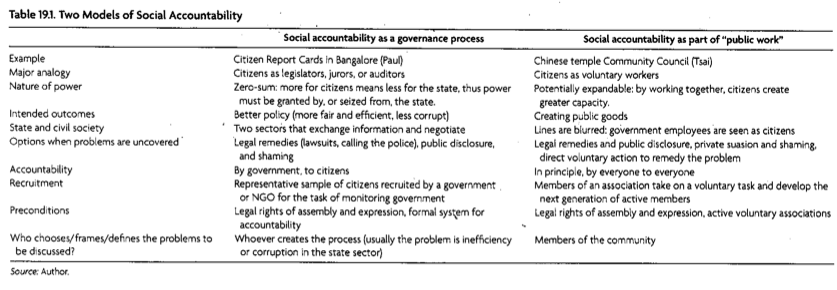
(Salem, MA) This is a table from a chapter of mine entitled “Social Accountability as Public Work.”* (You can click to expand it.)

Screen Shot 2013-08-04 at 4.01.10 PM

The table refers to two examples from the same volume. In his chapter, Samuel Paul describes how nongovernmental organizations in Bangalore surveyed representative citizens to develop “report cards” for municipal agencies. When the press publicized the results of the surveys, government officials took action to remedy the problems that the citizens had identified. Sometimes, processes like these are actually launched by governments to fight corruption. The Obama Administration’s transparency initiatives (now forgotten because of the NSA surveillance story, but actually quite significant in their own way) reflect a similar model–information is supposed to activate and inform citizens to improve government.

In her chapter, Lily Tsai describes Chinese village temple community councils that organize religious and communal activities. Members directly produce public goods through their own hands-on work. Local governmental officials are discouraged from leading the councils, which are religious bodies, “but as ordinary members of the temple group, they diligently fulfill their obligations to contribute to the good of the group.” Tsai also describes government officials involved in a similar group who “used their personal connections with higher level officials to secure a bank loan” for the organization.

In both stories, citizens influence the state. But the relationship is very different: detached in one case, highly cooperative in the other. I think persuasive arguments can be made for both kinds of relationship, and both have perils (alienation on one hand, corruption and bias on the other). The two stories also represent divergent models of citizens, who are seen as monitors in the Bangalore case and as producers of public goods in the Chinese temples. Ultimately, I think we need a bit of both; I doubt that transparency measures will make much difference  unless people are also organized and active in groups that provide direct services.

*in Sina Odugbemi and Taeku Lee, eds, Accountability through Public Opinion: From Inertia to Public Action (Washington, DC: The World Bank, 2011), pp. 291-306

Egypt and the model of the French Revolution

Hegel remarks somewhere that all great world-historic facts and personages appear, so to speak, twice. He forgot to add: the first time as tragedy, the second time as farce. … Men make their own history, but they do not make it as they please; they do not make it under self-selected circumstances, but under circumstances existing already, given and transmitted from the past. The tradition of all dead generations weighs like a nightmare on the brains of the living. And just as they seem to be occupied with revolutionizing themselves and things, creating something that did not exist before, precisely in such epochs of revolutionary crisis they anxiously conjure up the spirits of the past to their service, borrowing from them names, battle slogans, and costumes in order to present this new scene in world history in time-honored disguise and borrowed language.

Karl Marx, The Eighteenth Brumaire of Louis Bonaparte.

We cannot know whether the Egyptian revolution will prove a tragedy, a satisfying epic, or a farce, but the similarities to the French model are already notable:

  1. Scattered tumultuous days of action begin with some kind of popular upheaval or violence and change the course of the revolution. Les grandes journées of the French Revolution included July 14, 1789 (the storming of the Bastille), August 10, 1792 (the monarchy overthrown), and 18 Brumaire, 1799 (Napoleon’s coup), among many others. In the Egyptian revolution, Jan. 25, 2011 (the Day of Anger), Feb. 11, 2011 (the Friday of Departure–Mubarak’s resignation), and July 3, 2013 (the coup against Morsi) play similar roles.
  2. A mobilized urban populace in the huge capital city can bring down the government, but the urbanites may be at odds with the much more numerous rural population.
  3. The constitution is problematic–both in content and origin–but it offers the “rule of law.”
  4. The revolution is international. (Compare the Brabant Revolution of 1789 and Syria in 2012-13). The reaction is also international. (Today, Bashar al Assad plays the role of Holy Roman Emperor Leopold II; Benjamin Netanyahu is William Pitt the Younger.)
  5. The ancien regime still has its supporters, who are perceived as threats to the revolution.
  6. Military leaders express support for the revolutionary constitution but are capable of taking over at will.
  7. Outside the government and official parliament, strongly ideological groups (Jacobins and Montagnards, Muslim Brothers and Salafis) debate and organize collective action.

To be sure, there are differences. For example, the most radical French revolutionaries were anti-clerical deists, but one form of radicalism in Egypt is ultra-religious and clerical. Another difference: the reactionaries outside Egypt are not massing on its borders.

Professor Joseph Mossad says the term “Arab Spring” is “part of a US strategy of controlling [the movement’s] aims and goals” in favor American-style liberal democracy. The phrase alludes to the “Prague Spring” liberal revolutions across Europe in 1848 (which prompted Marx’s article cited above). I don’t know if Mossad is right, but certainly analogizing current and past events has political significance. At the same time, Marx was right that the “tradition of all dead generations weighs like a nightmare on the brains of the living,” and revolutionaries “anxiously conjure up the spirits of the past to their service.” So analogies are inevitable. The question is whether the Egyptians will borrow from Paris, 1789, Saint Petersburg, 1917,  Cairo, 1952, Tehran, 1979, or some other model.

I would recommend Prague, 1989. The Velvet Revolution (imitated by the various “color” revolutions of 2009) was not only nonviolent, but the revolutionaries were intentionally self-limiting. (See Timothy Garten Ash’s analysis.) But clearly, a whole substantive view of politics is built into that view.

the Deliberative Democracy Handbook in Chinese

This is the cover of the Deliberative Democracy Handbook, edited by John Gastil and me, in Chinese. It was published in Taiwan, and the back cover says (according to Google’s translation, as edited by me):

“Twenty years after the lifting of martial law, we are still on the bumpy road to democracy. We  need to reconstruct the relationship between citizens and the state and think about more possibilities for citizens to participate. This book will open our imagination to democratic deepening. “- Tie-chi (political commentator) …

Let people who hold different beliefs and values be in dialogue– from listening to the formation of consensus–and produce better, more specific and viable policy options. The new global wave of democratic reform, “deliberative democracy,” is breaking through the dilemmas of democracy in advanced countries such as Denmark, Germany, the United States, Australia, and Brazil.

It’s interesting that the cover shows a fist, whereas the English-language version shows hands clasping in agreement. I like the confrontational imagery of the Taiwanese edition–for even deliberative forms of democracy involve power. (A Japanese edition is in progress as well.)

foreign policy, ideology, and the election

At their final debate, the two major party candidates seemed to converge on a doctrine that might be called cautious amoralism. All that counts are the economic interests of the United States and the security interests of the US and Israel–but we won’t promote those interests through large-scale, unilateral, military actions, because that is too expensive and risky.

This may not be either candidate’s real position. Bill Clinton tried to justify US intervention in Bosnia on the grounds of economic self-interest, and that was a classic example of virtue trying to pass as vice. Likewise, in their different ways, Obama and Romney may be more idealistic than they sounded on Monday night. (Or less so.) But they chose to converge on a rhetoric of cautious amoralism.

Polls show that most Americans don’t care much about foreign policy, but among those who do, two groups should strongly dissent from this consensus. I will name them together without suggesting an equivalence of worthiness or influence. It’s just that in political terms, they are rivals and foils.

Neoconservatives profess to believe in muscular, Wilsonian interventionism, “toughness” in support of American security and “democratization” overseas. They are relatively eager to use on-the-ground military intervention.

The peace movement thinks that American military and intelligence power is not a solution; it is a problem. Guantanamo, drone strikes, US invasions, West Bank settlements, and even the sanctions against Iran are threats to world peace and American values.

Both of these groups “lost” on Monday night, because neither one had a supporter on the debate stage. But the political situation is different for each.

Despite getting no explicit support from Moderate Mitt, neoconservatives have written enthusiastic reviews of his performance. Kevin Drum has a summary. Why would they react so positively? I propose: 1) They think that Romney will actually support their positions, or at least the expansion of military spending, and they want him to win. 2) They are somewhat chastened by reality and don’t believe that we will actually invade Iran, so they will settle for Romney’s recent positions 3) They hope for jobs in a Romney administration–for themselves or their friends–and that depends on his winning. And 4) Even though they disagree in part with Obama, they never believed the Tea Party talking points about “apology tours” and anti-Americanism in the White House, so they don’t mind Romney’s dropping those points to look moderate.

At least some on the peace side of the spectrum have been far more critical. Glenn Greenwald called the debate “horrid,” “wretched, with almost no redeeming qualities.” He live-blogged:

US foreign policy actually does have a significant relationship to the economy- namely, the massive military, the constant aggression, war and occupation, the hundreds of military bases around the world all drain resources away from far more constructive purposes – but neither of these two candidates will dare to question any of those imperial premises, so they can’t actually address the prime economic impact of US foreign policy. … Obama boasts of the massive amount of military spending under his presidency. Romney then says he wants to spend more.

Greenwald argued that Obama was playing George W. Bush to Romney’s John Kerry on Monday night.

Neoconservatives have far more influence than people in Greenwald’s camp, regardless of the current political situation. Neoconservatives always retain their ties to the military, their binders full of experienced individuals who can step into senior administration roles, and their platforms in the US media (rather than the Guardian, where Greenwald blogs). Being more powerful and more in synch with actual policy–even under a Democratic president–they can afford to tolerate a little laxness in their nominee’s rhetoric.

But that doesn’t mean that Obama should ignore the peace camp. There are always people to the left of an incumbent Democratic president; the Median Voter Theorem suggests that’s pretty much inevitable. As someone who’s not very radical on most issues, I don’t especially mind seeing the president outflanked. But this is going to be a close election in which turnout will be key. Obama needs the people to his left to vote. My social network connections tell me that a bunch of them do not intend to turn out. Many were already mad about the president’s economic policy, but I sense they would vote for him–or at least against Romney–if economics were all. Right now, it’s not the lack of a public option in the health bill that concerns them; it’s the drone strikes. They may only represent 2% of the electorate, but that’s about the margin in this election. I think it would be smart politics to give them some respect.