Category Archives: democratic reform overseas

heading to Ukraine

I am on my way tomorrow to Lviv and Chernovitsi in Ukraine, to co-teach the Summer Institute of Civic Studies and Civic Education there. This will be an immeasurably small contribution to what I think is a great cause: the work of the Ukrainian people in constructing a true civil society as the basis of a true democracy. If they can achieve that task in a portion of the former Soviet Union–after a period of kleptocracy and violent repression–they will be a beacon for the whole region.

I won’t blog while traveling but will report afterwards.

By the way, an AP wire story yesterday used my trip as its opening example of US “scholars drawn to conflict zones.” I must emphasize that Lviv and Chernovitsi are far from any violent conflicts. Many colleagues at Tufts (and elsewhere) actually meet this description: “people who should be getting on a plane to go to a country that’s in crisis.” When I said that phrase, I had in mind professors who fly to Sudan or Iraq and really make a difference there. I wasn’t talking about myself going to Western Ukraine to help lead a political theory seminar for a few days. But I am excited and grateful to be going.

how to respond to a leader’s call for civic renewal

During the 2008 presidential campaign, then-Senator Barack Obama spoke at length, consistently, and passionately about renewing citizenship in the US. I collected many of the key quotes here. There was a depth to these comments because Obama had worked for a faith-based organizing network, had studied Asset Based Community Development, had served on Robert Putnam’s Saguaro Seminar, and was married to the leader of a youth engagement nonprofit. He knew what he was talking about. And although he sought to lead the Democratic Party, he explicitly included Republicans and Independents in his call for civic renewal. However, the press ignored his citizenship theme, both during the campaign and later on (examples here). Policy wonks and Democratic Party elites also ignored it. I served on both the Education and Urban Policy committees of the campaign, and neither group generated strong policy proposals for enhancing civic engagement. Thus the administration–of which I am a defender, when it comes to mainstream matters of domestic and foreign policy–has done little to support enhanced citizenship in the US. A president cannot accomplish much alone, and if even his allies don’t hear his call for something as abstract as civic renewal, nothing will happen.

This summer, Pope Francis has made an impassioned call to the peoples of the world to organize from the bottom up to combat environmental crises. Like Obama’s call in 2008, this one is rooted in experience and theory–in the Pope’s case, extending back to his sainted namesake in the 13th century, but also including sophisticated modern theology. The Pope is the leader of Catholicism, yet he has explicitly included non-Catholics and non-believers in his call for global organizing. But again, the theme of civic agency has been lost on the punditocracy. The Pope’s speech at the Second World Meeting of Popular Movements was all about popular organizing, and yet the New York Times largely ignored that theme, summarizing his visit in these words: “Pope Francis met Thursday with President Evo Morales of Bolivia and apologized for the church’s ‘sins’ during Latin America’s colonial era. … But if Francis again called for change, he also offered no detailed prescription.”

Leaders alone cannot create social movements, but their words can be useful resources. Barack Obama gave us an opportunity in 2008; I do not think we (or he) took adequate advantage of it. The Pope is giving us another chance. How–concretely and practically–should we respond this time?

alienation from politics in Europe

I have been invited to speak in Spain on “youth alienation from politics” this June. I have no doubt that if you ask young people in any of the wealthy democracies what they think of politics, you will get negative responses. But the question remains whether that is a special phenomenon of youth in the present moment, of youth at all times, or of all people in the present moment.

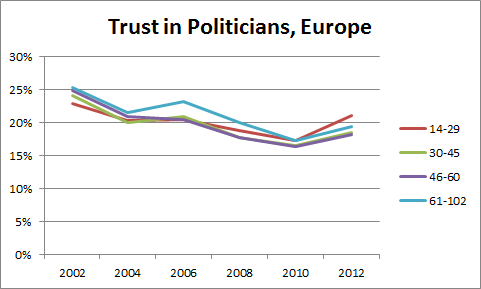
The European Social Survey asks respondents whether they trust politicians. Respondents are offered a 10-point scale, and after some experimentation, I have divided the subjects into those who gave scores between 0-5 and those who said 6-10. The available data come from even-numbered years between 2002 and 2012:

Eurotrust2

Note, first, that not many people rate politicians 6 or higher on a 10-point scale. That is not exactly startling news. Second, all age groups were more positive in 2002, less so by 2010, and somewhat more trusting again in 2012. Finally, the four major age groups show the same trends. If you wanted to identify a generational difference, you might note that seniors lost less trust between 2002 and 2004–possibly buffered from the recession by national retirement programs. The young are currently the most trusting, albeit not by much.

This graph is evidence that there isn’t really a phenomenon of youth distrust in politics in Europe. The distrust is shared. That said, I should note two caveats. First, the span of years shown above is short; it would be interesting to know how a similar question would have been answered in 1988 or 1966. Second, I didn’t track the same birth cohorts over time. People aged 14-29 in 2002 were 24-39 a decade later. It is conceivable that tracking birth cohorts would reveal a significant difference between those born in 1982 versus 1992–but that seems unlikely given the lack of a relationship between age and trust.

the age of the strongman

China: Xi Jinping is “a president who has ruthlessly centralised power while embarking on an ambitious project to revitalise Communist rule and to secure the party’s future. … One of his major themes is a war on ‘western values’, including a free press, democracy and the constitutional separation of powers, all of which he believes pose an insidious threat to one-party rule. … Xi considers himself the antithesis of the ‘weak man’ who turned out the light on the Soviet empire.”

India:  A “cult of personality is slowly building around” Prime Minister Narendra Modi. “No surprise, then, that he rules firmly. … Many fear that unchallenged by a weakened opposition, Mr Modi will help turn the world’s largest – and most diverse – democracy into a Hindu nationalist state. There’s trepidation over a lack of tolerance among many of Mr Modi’s supporters, particularly on social media, to any criticism.”

Russia: “The elevation of Mr Putin as a father of the nation, a man who may be elected in a nominal political process but is in fact apart from and above politics, is a symptom of Russia’s ‘deep demodernising trend’, according to Andrei Zorin, a historian at Oxford University.”

Turkey: Prime Minister Recep Tayyip “Erdogan’s achievements are now shadowed by his undeniable lurch toward autocracy. Over the last year, he has initiated a harsh crackdown against peaceful protesters, political opponents, and independent media outlets.”

This is a radically incomplete list, but it includes the leaders of countries with nearly 3 billion subjects and great international influence. How profoundly disappointing that the ascendant ideology of the 1930s should again confront us.

Of course, the momentum in the direction of macho, nationalist, centralizing authoritarianism is not unstoppable. This trend is of fairly short duration–so far–and could still be checked. The question is whether we can develop a sufficiently cohesive, energetic, optimistic, and truly global democratic movement to resist it.

See also: postcolonial reaction;  why is oligarchy everywhere? and why is oligarchy everywhere? (part 2).

Greece and Germany and getting to yes

The situation involving Greece and the European Union is a complex game, with numerous players and potentially many phases. Just as an example, voters in Spain are players who will have a chance to choose the new government in December; they may opt to support Podemos, the relatively left-wing Spanish party, if they think that the Greeks did well by choosing Syriza last week.

Nevertheless, we can dramatically simplify the game to have two key players: Greek Prime Minister Alexis Tsipras and German Chancellor Angela Merkel. Tsipras can accept some level of debt relief, from zero to 100%, or walk out of the Euro. Merkel can support some level of debt relief, or let Greece walk.

There are principles on both sides. My sympathies lie much closer to Syriza, on the grounds that: austerity is generally bad economics; Greek residents count for as much (morally) as Northern Europeans; and the Greek meltdown, although abetted by poor national governance, was mainly a consequence of neoliberal economic policies driven by Germany and other Northern economies in their interests. However, a German Christian Democrat or a British Tory could make a sincere case against leniency, based on moral hazard, the virtues of fiscal responsibility, Greeks’ responsibility for Greek debt, and other such arguments.

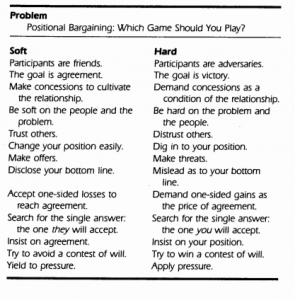
My suggestion of the day is based on Getting to YES: Negotiating Agreement Without Giving In, the 1981 best-seller by Roger Fisher and William L. Ury. It is a popular and breezy book but based on some serious analysis. Fisher and Ury present two forms of positional bargaining in this table:
FisherandUry

In this case, Mr. Tsipras could opt to be hard or soft in his approach to the European Central Bank and other key European players. Fisher and Ury would predict that either approach will yield a bad outcome for Greece and for Europe as a whole, because people have systematic weaknesses that make positional bargaining go badly, whether the players opt to be nice or tough. By the way, that prediction holds even if Mr. Tsipras is completely correct on all matters of principle: this is a game, not a seminar.

Instead, Fisher and Ury propose “negotiation on the merits,” which has four key features:

  1. “Separate the people from the problem.” Create settings in which negotiators who have not publicly defined one another as adversaries are asked to address the problem and propose solutions.
  2. Interests: Drop the debate about principles (ban words like “neoliberalism” and “fiscal responsibility”) and just try to maximize the outcomes for the various parties.
  3. Multiply options: Don’t be satisfied with the choices that seem to confront the players right now, e.g., Greece either leaves or stays in the Eurozone. Instead, deliberately brainstorm a whole range of options. Could a massive new EU investment in some public good, such as climate mitigation, be designed especially to benefit Greece? Could a new loan package be offered simultaneously to Portugal, Spain, and Greece? (etc.)
  4. Criteria: bring in a neutral party to establish concretely measurable objectives.  Don’t ask how much each player must (or should) give up, but rather whether the agreement maximizes these objectives.

There is much more in the book, but this offers a flavor.