Category Archives: democratic reform overseas

the public supports women’s rights in US foreign policy

We released a new survey today that finds strong support for gender equity as a foreign policy goal. For instance,

  • 85% rated the rights of women and girls as a very high priority.
  • 74% agreed that the U.S. government should actively work to promote human rights in other countries.
  • When given a choice among the rights that the U.S. should promote, 51% ranked women’s rights as first or second, second only to “free and open elections” and ahead of freedom of religion, freedom of the press, and the rights of workers and unions.
  • Two-thirds agreed that more participation by women would make the world more peaceful.
  • Most respondents would support women’s rights overseas even if that meant less consumer choice from international trade, fewer exports, or more disagreement with America’s friends and allies.

Click for more detail from this survey of 1,000 Americans conducted in early September 2017 by the Department of Political Science and the Tisch College of Civic Life. Credit to my colleagues Professor Richard Eichenberg in the Political Science Department, Dr. Kei Kawashima-Ginsberg and Noorya Hayat of CIRCLE, and student Anna Jacobson.

working on civic education in Ukraine

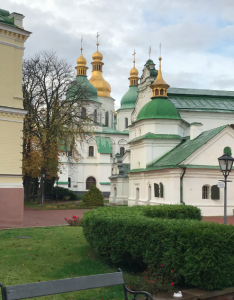
(Kyiv, Ukraine) I am here for just a few days, working with Ukrainian civic educators and my American colleagues at Street Law, Inc. I’ve served on Street Law’s board for more than a decade, but this is my first time directly helping with a project. Ukraine’s plans to revamp democratic education in their primary and secondary schools seem highly promising, and I’m pleased to be able to participate. This effort also connects to another project I’ve done with Ukrainian colleagues since 2014: the European Institute of Civic Studies (which is aimed at adults). Finally, it’s nice to be back in this handsome city as the leaves turn yellow and the air is cool and damp.

“Leadership is Female, Is African, Is Muslim Women”

Tisch College is thrilled to host a special event on Wednesday, October 25, entitled “Leadership is Female, Is African, Is Muslim Women” in honor of Saïda Oumulkhairy Niasse, the inaugural recipient of Tisch College’s Global Humanitarian Citizen Award.

Please join us for this celebration, which will take place from 12 – 1:15 p.m. in the Distler Auditorium of the Granoff Music Center on Tufts’ Medford campus. The award ceremony will honor the impact of Mama Kiota’s leadership, feature Tufts Professor Pearl Robinson’s research on Mama Kiota’s movement, and celebrate the Sufi musical and cultural traditions with a live performance.

Known by her followers as Mama Kiota, Saïda Oumoulkhaïry Niasse is the leader of a Sufi Muslim women’s movement with over 200,000 members across West Africa. Trained by scholars in the Niassine Tijaniyya Sufi tradition,  Mama Kiota is a tireless advocate for women’s rights, education, and peace, and she has spent more than 50 years establishing schools, mentoring female leaders, and promoting religious tolerance in a region plagued by Boko Haram. Tisch College is honored to award its inaugural Global Humanitarian Citizen Award to Mama Kiota in recognition of her outstanding leadership and service to the global community in pursuit of a more just, equitable and peaceful society.

For more information and to register online, visit: https://tischcollege.tufts.edu/content/leadership-female-african-muslim-women

religion and politics in the US versus many other countries

Here is a thesis that experts can evaluate better than I: The issue of religion in politics is fundamentally different in the US from many other countries. In the US, it is mainly about majority opinions versus minority rights. In countries from Mexico to Myanmar, it is about the social functions of a single organized body, the clergy. This difference matters for everyday politics.

The US has always had a religious majority that has been divided among many Christian denominations, with other faiths also represented. The Constitution gives individuals the right to exercise their religions freely. It also prevents any religion from being “established.”

The classic questions of religion and politics in the US involve majorities versus minorities. Sometimes, a coalition composed of many denominations supports a policy (e.g., banning abortion) for reasons that include religious ones. Then the questions become: 1) Does the desired policy impinge on constitutional rights? and 2) Are religious reasons for the policy acceptable or desirable in the public sphere? At other times, the majority becomes adverse to a particular religion–Mormonism in the 1800s being a clear example. Then the same two questions arise, but now the majority threatens the minority’s free exercise.

In nations with a single dominant religion that is organized in a hierarchical fashion (Catholic countries, but also, perhaps, some Muslim, Orthodox, Buddhist, Lutheran, and Anglican countries, plus in some respects, Israel), the issue is different. These countries have an organized, institutionalized body: the clergy. Typically, the clergy has a history of delivering some public services to the nation as a whole. For example, there may have been a time when the Catholic Church ran and staffed almost all of the state-funded schools in a given country. Sometimes, there is also a history of violent reaction against the clergy as an institution. Priests were executed in the French and Mexican revolutions, for instance.

In these countries, the question is not directly about whether to enact laws consistent with religious values. The question is whether to entrust an organized group of people, the clergy, with particular social functions. At the anti-clerical end of the spectrum, the clergy or priesthood is seen as a bane on society. At the clerical end, it is seen as a bulwark. These positions are, in principle, separate from one’s opinions of theology and of policy issues. A person could agree with the Church on most topics but distrust the clergy, or vice versa.

Here are some practical consequences of the difference:

  1. In the US, when debates over policy have religious components, they are deeply divisive and feel existential. At least some other countries treat such debates as fairly routine. The divisive issues for them concern the prerogatives of the clergy as an institution. An interesting hybrid case is Ireland, where the ballot victory on same-sex marriage was greeted with joy, at least in Dublin. I think voters were pro-equality, they celebrated because they had defeated the Irish clergy, a (currently unpopular) institution.
  2.  In the US, religious involvement in politics is usually mediated by officially secular political parties. The parties strive to assemble majorities by drawing people from several denominations. They typically recruit believers, not churches, into their ranks. In many other countries, each political party has a relationship with the main denomination, ranging from a formal partnership (e.g., for the Christian Democratic parties) to official hostility. Indifference may also be an option, just as a party can be neutral on other issues, but it will face questions about the clergy.
  3. In the US, it doesn’t really make sense to ask a candidate what she thinks of “the clergy.” You can ask her about abortion, God, her own faith, or the First Amendment, but there is no national clergy to have an opinion about.

See also: a typology of denominationsthe political advantages of organized religionreligion and politics in the Muslim world and the USA; and on religion in public debates and specifically in middle school classrooms.
a civic studies perspective on European citizenship

In “A Civic Studies perspective on European citizens: in search for potential in the conflict surrounding TTIP” (European Politics and Society, Aug 2017, pp. 1-27), Nora Schröder provides a learned and insightful overview of Civic Studies–consistent with the core ideals of the Summer Institutes of Civic Studies–and applies it to the case of European grassroots protests against the Transatlantic Trade and Investment Partnership (TIPP).

The anti-TIPP protesters hold a view of global trade and tariffs. They also hold related opinions of what citizenship should mean in the European Union context: they favor democratic control of markets and oppose neoliberalism as a political/economic philosophy. As Schröder notes, public policy research would seek to clarify these issues, assess the impact of the protests, and perhaps provide advice to the activists. Civic Studies is different because it is explicitly normative (concerned with evaluating what is right) and because it aims to expand citizens’ capacity to influence the world for the better. It doesn’t stop with assessing whether the protesters have influence and are on the right side of the issue; it strives to increase their influence for the good. Schröder argues that Civic Studies must therefore be “bottom-up” and closely related to practice, a case also made by Sanford Schram in this volume about Civic Studies. I admire such engaged research but believe there’s also room for relatively abstract and general theory in Civic Studies–a point that Karol Soltan makes in the same volume. In any case, Schröder provides one of the best available summaries of Civic Studies, en route to offering some valuable thoughts about the anti-TIPP protests.