Category Archives: fine arts

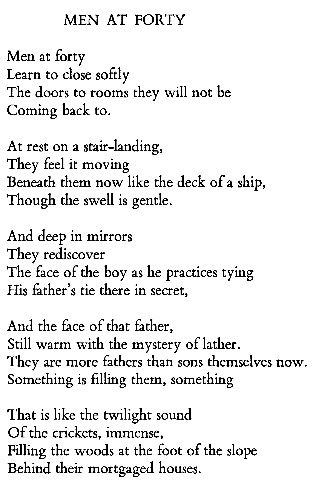
Donald Justice, Men at Forty

I don’t read to see myself reflected on the page. I read primarily to learn how someone else thinks and to analyze and appreciate the formal characteristics of a carefully constructed work. But if I were going to cite a poem that simply speaks to me and my condition, it would be this one, from Poetry magazine, 1966.

I’ve written more detailed notes on two other poems about mortality written by middle-aged men: Gerard Manley Hopkins’ “Spring and Fall,” and Philip Larkin’s “Aubade.” They strike me as more complicated and richer than this work–although it’s worth noting the pattern created by the four-line stanzas, each of which introduces a central verb and a new setting:

1. Closing doors in rooms
2. Feeling motion on staircases
3. Rediscovering a face in a mirror
4. Aging (implied)
5. Sounds filling space

But what I admire is how Justice discovers wonder in the most terrifying intimations of middle age.

(See also Donald Justice, “About My Poems.”)

moral network mapping and literary criticism: a methodological proposal

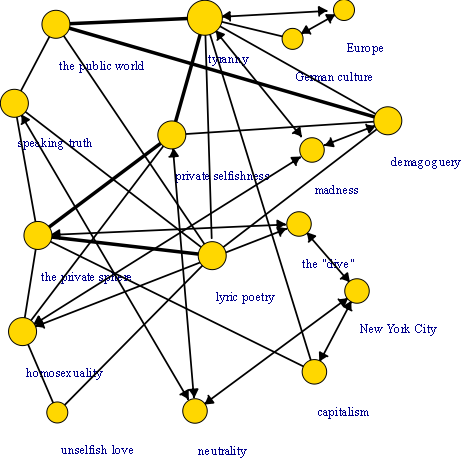
A moral worldview is a set of beliefs or values connected by various kinds of relationships. For instance, one belief may imply another, or may subsume another, or may be in tension with another even though both are truths. If analyzed that way, a whole worldview can be mapped as a network, with the beliefs viewed as nodes, and the relationships as ties.

Using that method, we can map the moral network implied by a work of literature, such as a lyric poem. Previously, I wrote some notes on W.H. Auden’s poem “September 1, 1939” (notes here; full text here.) I then mapped the moral network of that work. I think my first effort was a bit off, so here is a revised map:

What assumptions underlie this method?

1. The moral evaluation of literature is a valid and useful mode of criticism. It is not just about judging the values of the text (pro or con), nor is it merely a matter of elucidating what the author meant or what the text implies about moral issues. It is rather a critical engagement with the moral perspective of the work, a kind of joint investigation into what is really good and right that is informed by both the text and the reader’s critical response. Although I think that remains a rare mode of literary criticism, it has prominent defenders.*

2. Formal network analysis, a branch of graph theory, offers insights about the structure of any system that is composed of objects and relationships. Tools from network analysis, such as calculating the centrality of nodes or the density of relationships, can help to elucidate and assess the moral worldview of a work of literature.

Underlying this premise is a deeper assumption that moral worldviews should not be assessed only (or mainly?) by evaluating the correspondence between their separate ideas and truths about the world. It’s also (or more?) important to ask how the whole worldview hangs together. The question is not whether Auden should be against tyranny, but how that stance fits into his overall thinking. When people argue for assessing a whole worldview instead of individual principles, their next step is usually to look for internal consistency. But consistency is not the main virtue of a well-structured worldview. Better a mentality that incorporates valid and fruitful tensions than one that avoids all inconsistencies at the cost of narrowness or oversimplification.** Network analysis reveals density and other virtues that are more helpful than consistency. (See also “ethical reasoning as a scale-free network.”)

3. Abstract and general principles are overrated. I do not claim that they should be expunged from one’s moral thinking (that would be an over-radical form of “particularism”), but rather that there is no good reason to assume that a well-ordered moral mentality can be arranged like an organizational chart, with the abstract principles at the top and all one’s concrete beliefs and commitments as mere implications. That would be one kind of moral network map, and some people do think that way. Other people are much more concrete, or they mix concrete particularities with abstract generalities in interesting and complex networks. For instance, I think New York City and the “dive” bar where Auden sits in this poem are just as important to his moral vision as tyranny or selfishness.

One reason not to try to make the abstract principles fundamental to one’s whole network is that certain crucial ideas, such as love, will then be distorted. These ideas have the feature that they are sometimes good and sometimes bad, depending on the circumstances. If you try to organize your thinking around abstract and general principles, you will be compelled to divide love into the good and bad kinds, and that is false to the experience of what love is.***

Turning the map above back into a written analysis of “Sept 1, 1939” would take some space, but I think a few key points emerge:

  • Auden has a dense moral network, not dependent on just one or two ideas. It’s robust. For instance, he later came to hate the line, “We must love one another or die.” But the poem does not rest on that.
  • Love, art, and politics are densely interconnected.
  • Homosexuality is not mentioned in the poem but is alluded to at least twice. It is hard to know whether Auden would connect it to “unselfish love.” I would. So I am either in disagreement with the poem or sympathetic with Auden (a gay man in the 1930s) because he could not draw that connection openly.
  • Much depends on a polarity between public and private, but poetry occupies an uneasy space between. Consider declamatory statements like this: “There is no such thing as the State /  And no one exists alone.” Are they incursions of public demagoguery into a poem, which should be private? Or should the poem speak truth to power?

*See David Parker, Ethics, Theory and the Novel (Cambridge: Cambridge University Press, 1994); Todd F. Davis and Kenneth Womack, Mapping the Ethical Turn: A Reader in Ethics, Culture, and Literary Theory (Charlottesville, University Press of Virginia, 2001), Amanda Anderson, The Way We Argue Now: A Study in the Cultures of Theory (Princeton, 2006)

** Simon Blackburn, “Securing the Nots,” in W. Sinnott-Armstrong and M Timmons, eds., Moral Knowledge (New York, Oxford University Press, 1996), p. 95

*** This is basically my thesis in Reforming the Humanities: Literature and Ethics from Dante through Modern Times (Palgrave Macmillan, December 2009).

Hilary Mantel, Bring Up the Bodies

My favorite book of 2012 is hardly an original choice, since it also won the Booker Prize and has been extravagantly reviewed. But Mantel deserves all the praise she’s received for the second volume of her Thomas Cromwell series, Bring up the Bodies. The first volume, Wolf Hall, was my favorite book of 2010. Of course, I don’t read all that many novels–but many more than I blog about, and twice, Mantel’s were the best.

Below is a typical sample of her vivid imagination and fresh writing. Stephen Gardiner, the Bishop of Winchester, is Cromwell’s nemesis. Although he plays a small role in this volume, he makes an impression when he arrives in an early scene:

Gardiner, the Bishop of Winchester, blowing up like a thunderstorm, when for once we have a fine day.

When Stephen comes into a room, the furnishings shrink from him. Chairs scuttle backwards. Joint stools flatten themselves like pissing bitches. The woolen Bible figures in the king’s tapestries lift their hands to cover their ears.

To the right is a Tudor joint stool pictured in front of a woolen tapestry. It’s the kind of furniture that Shakespeare’s Fool cites when he says to Goneril, “Cry you mercy, I took you for a joint-stool.” If its top moved away from the Bishop of Winchester in consternation, its legs would bend to rightward exactly like a female dog urinating.

Of course, that doesn’t literally happen when Gardiner walks into the room; it is Cromwell’s perception. The whole book is told in the third-person present tense from a vantage point very close to Cromwell’s. “When for once we have a fine day,” is Cromwell’s implied voice, describing the actual weather–unremitting rains have ruined England’s crops–while  expressing his jaundiced view of the Bishop. Cromwell is “he” throughout the book. Mantel works hard to avoid using his proper name, thus making the “he” almost the same as an “I.”

The immense challenge she undertook was to restore the perspective of a man who lived long ago, who left few illuminating personal records, and who has figured mainly as the ruthless villain in the biographies of more famous people whom he sent to the block, especially St. Thomas More and Anne Boleyn. We know that he was an effective, reforming statesman who rose from humble origins; that is enough to make him intriguing. But to make him sympathetic is a tremendous achievement.

For the first volume-and-a-half, we see things from Cromwell’s perspective and learn to appreciate his humor, his efficiency and hard work, his unpretentious observations, and his love of family. He has survived a violent father, street brawls, wars, and the fall of his master, and we want him to survive at court. But I think the last part of Bring Up the Bodies shifts the moral center of the book. I will explain what I mean below the fold in order not to spoil the conclusion (which comes straight from history, but you can’t predict where Mantel will choose to end this volume).

Continue reading

Donald Justice, About My Poems

Donald Justice, “About My Poems,” from Poetry magazine, March 1965:

The poet appears as a critic of his own “early” (immature) verse that is “fashionably sad” and whose regular rhymes and meters “paralyze.” Nonetheless, he offers a rhymed, rhythmically regular poem composed of nothing but sad metaphors. They are so sad, in fact, that they overwhelm the wryness of the opening. This poem is the opposite of a shaggy-dog joke: not a humorless story that ends with a funny twist, but a punchline that introduces a moving story.

“Fashionable” has at least three senses. It can mean faddish, of temporary appeal. Nothing depicted in the poem is fashionable in that way, and some of the objects are precisely the opposite. For instance, a naked mannequin is a human figure without anything temporary and new to clothe it. A second meaning is “popular.” Moths swarming under streetlamps represent fashion, in that sense. A third meaning is contrived, artificial, or fashioned. The aesthetic of a small town is fashionable, by that third definition. Justice asks in what sense his own poem is “fashionable.” Is it artificial (with its heightened poetic forms)? Does it manipulate its readers into predictable emotions, like moths by a streetlamp? Is it modish in some way?

To what, exactly, does Justice compare his “early poems”? They have clipped lawns, porches, and streets. Under their porches, children sprawl; in their streets at night, mannequins wait. No single thing has both lawns and display windows. The poems are not analogous to one object, but all resemble small-town, bourgeois, American life in a mode of stillness and languor.

It is not so bad to be a bored child on a rainy Sunday morning: that might evoke nostalgia. It is worse to be a naked mannequin waiting to be desired. But either way, one is paralyzed and inactive, caught in a “long silence.”

The poem, however, is not silent. It speaks of these things. And people walk the poem’s streets–we do, when we read it. The poem is not like the mannequins; it absorbs the attention. Just when we are fully absorbed (perhaps “paralyzed” by the mood), the poet says, “Now the beginning again.” We’re sent back to his opening line about his own “fashionably sad” poems. We have been reading modern lyric verse in a conventional way. But then it is hard not to keep reading and become nostalgically sad again.

Jack Gilbert, A Brief for the Defense

The poet Jack Gilbert died this week. One of his most famous poems is “A Brief for the Defense,” from which I quote a couple of excerpts:

Sorrow everywhere. Slaughter everywhere. If babies
are not starving someplace, they are starving
somewhere else. With flies in their nostrils.
But we enjoy our lives because that’s what God wants.
Otherwise the mornings before summer dawn would not
be made so fine. …

If we deny our happiness, resist our satisfaction,
we lessen the importance of their deprivation.
We must risk delight. We can do without pleasure,
but not delight. Not enjoyment. We must have
the stubbornness to accept our gladness in the ruthless
furnace of this world. To make injustice the only
measure of our attention is to praise the Devil.

The charge against us is that we enjoy life despite others’ suffering. Does the defense (quoted above) make a good case on our behalf? Does it depend on the mention of God? Or is there a secular, ethical case for relishing life despite suffering?

Some years ago, I would have said that the best way to live is not to count one’s own happiness more than anyone else’s. My welfare or happiness should (ideally) represent about one seven-billionth of my concern. Now I am not so sure. I think that subjective happiness is only roughly correlated with objective conditions, such as prosperity and freedom. As Gilbert puts it in this poem, “There is laughter / every day in the terrible streets of Calcutta.” On the other hand, people are generally bad at being happy, we cannot make each other happy, and a world in which we all strove for each other’s happiness would be strangely empty. Everyone would be taking in other people’s laundry. Emerson and Nietzsche put the point too strongly, but they has an insight. Not only demanding justice for others but also achieving happiness for ourselves is a worthy moral objective. (See also my posts on “all that matters is equanimity, community, and truth,” “unhappiness and injustice are different problems,” and “Mill’s question: If you achieved justice, would you be happy?.”)