Category Archives: fine arts

aphorisms, proverbs, maxims, and the purpose of this blog

If you search the Internet for “aphorisms,” you’ll find a mix of authors, from Lao Tze to Jean Baudrillard.

Some are literary figures who are eminently quotable–good at writing short, memorable passages that stand on their own even if they were originally composed for longer poems or continuous narratives. Oscar Wilde, Dorthy Parker, and Emerson are just a few examples of people called “aphorists” because they are pithy and witty.

Other books of aphorisms are lists of sentences or very short passages that are intended to be serious and wise. The biblical books of Proverbs and Ecclesiastes, the Greek collections of accumulated sayings attributed to Pythagoras and the Delphic Oracle, and the sutras of the Hindu tradition are examples. When these statements take the form of imperative sentences (“Enter not into the path of the wicked, and go not in the way of evil men”), they can be called maxims. When they sound more like generalizations about the world (“To every thing there is a season, and a time to every purpose under the heaven”), they are better named proverbs.

A philosophy professor friend of mine once disclosed his profession to the person sitting next to him on an airplane. “Oh, you are a philosopher,” the neighbor said. “What are your sayings?” He was thinking of traditions in which philosophy means explicit wisdom, and wisdom is succinct and quotable. Needless to say, that is not what professional philosophy is today.

Once collections of short, pithy sayings are treasured as wisdom (a thesaurus means a “treasury”), it becomes possible to write collections that look like proverbs but are more idiosyncratic, personal, and perhaps ironic or subversive. La Rochefoucauld exploits the subversive potential of the genre when he writes in the format of the biblical Book of Proverbs but gives advice like, “If we had no faults we should not take so much pleasure in noting those of others.”  Erasmus collects real wisdom in some of his books (Adagia, Apophthegmata), but he puts strings of quotable falsehoods in the mouth of the Fool in the Praise of Folly. It is never clear where the author stands. James Geary collects current examples of aphoristic writers in this tradition.

By the way, the root of “aphorism” is the Greek verb for dividing, defining, or setting limits (ultimately from horos, boundary). In the New Testament, the verb aphorizo is used for dividing the damned from the saved and for excommunicating sinners. I think “aphorism” means division because each one is disconnected from the next (not because their content is necessarily about distinctions). In contrast, the Sanskrit word sutra means “string” or “thread.” Both traditions refer to distinct fragments of text that are loosely strung together without explicit transitions. The Greek word emphasizes the distinction among these items; the Sanskrit stresses their connectedness.

Francis Bacon and Friedrich Nietzsche epitomize a different tradition. They are highly critical empiricists who use the aphoristic form to shake their readers’ assumptions and demand their readers’ creative attention.

Bacon begins his book Novum Organum (“or, true suggestions for the interpretation of nature”) by decrying two categories of thinkers. On one hand, some have “presumed to dogmatize on Nature,” inventing or borrowing a theory, trying to explain everything in terms of that theory, and “bringing others to their [preconceived] opinion.” On the other hand, some have succumbed to the “despair of skepticism” and are known only for their “complaints and indignation at the difficulty of inquiry.” The third course is to observe and experiment with nature, one piece at a time, striving always to challenge our prior assumptions. Having proposed that course, Bacon then offers a series of numbered “Aphorisms on the Interpretation of Nature and the Empire of Man.”

Why aphorisms? Arguably, because Bacon is highly suspicious of grand theories that organize everything neatly and prevent us from noticing what is actually happening. So he is suspicious of the logical connective tissue that would turn individual propositions into larger arguments. He prefers to list specific propositions and encourage the reader to consider each one on its merits and to put them together only tentatively. We must stop to think about the logical relationship, if any, among Bacon’s thoughts. The form thus befits its substance.

Nietzsche’s earliest works are essays distinguished by their highly quotable passages yet also connected into rhetorically powerful wholes, with beginnings, transitions, and conclusions. With Human All Too Human (1878) Nietzsche shifts to a new genre that then occupies almost all of his energy for the rest of his life: collections of aphorisms. Like all his later books except ZarathustraHuman All Too Human is a set of numbered passages that range from a single sentence to a few pages in length.

Although Nietzsche’s style is influenced by aphoristic authors after Bacon (La Rochefoucauld, whom he cites in aphorism #35; Pascal; Lichtenberg, and others), the opening of Human, All Too Human takes us back to Bacon. Nietzsche, too, wants to shake his readers out of their “habitual opinions and approved customs.” He too is fascinated by people’s cognitive biases and limitations and suspicious of generalizations. In the very first aphorism of his first aphoristic volume, Nietzsche writes: “in fact, I myself do not believe that anybody ever looked into the world with a distrust as deep as mine.” I think he is hinting why his book will not offer a connected argument. A string of distinct ideas avoids the pretentiousness or naïveté implied by a larger whole.

Here Nietzsche almost sounds like one of the skeptics whom Bacon decries for dropping the effort to understand nature because they understand our limits all too well. But they are just complainers. Nietzsche, echoing the distinctions of Novum Organum, insists that he takes “pleasure in externals, superficialities, the near, the accessible, in all things possessed of color, skin and seeming.” That is not the same as Bacon’s path–striving to understand the phenomena–but Nietzsche sees it as the next step. He is moving beyond Baconian empirical science into his own “gay science.” (And in Ecce Homo, Nietzsche insists, “We do not know half enough about Lord Bacon—the first realist in all the highest sense of the word—to know what he did, what he willed and what he experienced in his inmost soul.”)

A final tradition consists of authors who have left collections of numbered and loosely connected passages–string-like sutras–because death or some other contingency prevented them from pulling these fragments into more coherent works. An inspiration for Bacon may have been Hippocrates, the ancient physician who called for close observation. Hippocrates’ writings (other than the Hippocratic Oath) read like aphorisms for a contingent reason: he didn’t write them. They are collections of fragmentary Greek texts about medicine wrongly attributed to him.

I am not sure to what degree Novalis wanted to write connected arguments, but we have his fragmentary notes in the condition that he left them when he died of consumption; both his tragic youthful death and his aphoristic style seem to match the content of his thought. A century later, Kafka also died of TB, leaving 109 aphorisms on philosophical topics.

And then there’s Wittgenstein, all of whose major works consist of short numbered passages without explicit connections. After he died, Elizabeth Anscombe and Georg Henrik von Wright published

a collection of fragments made by Wittgenstein himself and left by him in a box-file. They were for the most part cut from extensive typescripts of his, other copes of which still exist …

Often fragments on the same topic were clipped together; but there were also a large number lying loose in the box. …

We … came to the the conclusion that this box contained remarks which Wittgenstein regarded as particularly useful and intended to weave into finished work if places for them should appear. Now we know that his method of composition was in part to make an arrangement of such short, almost independent pieces as, in the enormous quantity that he wrote, he was fairly satisfied with.

They published this book under the title Zettel, which I think it an unpretentious work for snippet or cutting. But a cutting is also what an aphorism is. A clipped-together packet of snippings from typescript also bears a distant resemblance to a string of beads, a sutra. 

The word “cutting” could also have a more organic sense. In his 1948 poem “Cuttings,” Theodore Roethke evokes their generative potential:

Sticks-in-a-drowse over sugary loam,
Their intricate stem-fur dries;
But still the delicate slips keep coaxing up water;
The small cells bulge;

One nub of growth
Nudges a sand-crumb loose,
Pokes through a musty sheath
Its pale tendrilous horn.

To be sure, Roethke wrote a much darker second poem with the same title, emphasizing the pain of growth and rebirth. April is the cruelest month, and all. But I’d like to stress the latent promise of things that are clipped and piled together in conditions favorable to regeneration. In fact, that hope explains why I have been moved to write 3,123 posts on this blog (which is yet another word to compare with aphorism, sutra, maxim, and the others cited here). If I believe anything, it’s that we are too strongly influenced by grand conceptions that simplify and block our progress, yet we do need ambitious ideas. So let’s let them emerge from close, responsive, joyful engagement with people and their creations, taken one at a time.

cultural mixing and power

 Screen Shot 2016-04-04 at 9.20.51 PM

These two objects were juxtaposed during a wonderful Tisch Talk in the Humanities yesterday, with Maria Magdalena Campos-Pons from the School of the Museum of Fine Arts and Lisa Lowe from Tufts’ Department of English.

On the left, an 18th century desk made in colonial Mexico that’s now in the Boston Museum of Fine Arts. Lowe noted that the shape derives from the Northern European Renaissance. The geometric patterns on the outside are reminiscent of Moorish Spain. But, as Lee Lawrence writes, “With the desk flap lowered and the bookcase doors open, … the gold-on-red interior screams China—until, that is, you take a closer look. The artist has depicted a hacienda with palm trees and deer, not a landscape with willows and oxen, and the figures wear sombreros, not conical hats.” Some of the figures appear to be Africans, slaves or freemen.

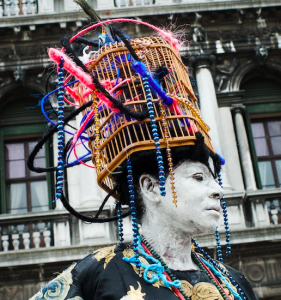
On the right is a photo of Campos-Pons in the Piazza San Marco, Venice. She is an Afro-Cuban artist with some Chinese-Cuban ancestry. She was responsible for the Cuban Pavilion at the 2013 Venice Biennale, a remarkable installation built partly of bird cages. Here she is dressed in an elaborate costume that has Cuban, Chinese, and Yoruba elements, claiming the piazza as a kind of town crier.

Both objects mix Chinese, New World, European, and African content. Both are made by Hispanic artists of color.

It might seem that power and agency is different in these two cases. Campos-Pons is an internationally recognized and successful artist. She makes images that mix specific cultural elements of her choice, and she is honored for the results. The anonymous (to us) artisans who made the desk combined a specific set of cultural elements because Spain had occupied Mexico and turned its indigenous people into subjects. The Empire also forcibly combined the decorative art of the conquered Mudéjars, Chinese porcelain (via the Manila-Acapulco galleon route), and the cultures of Africans who’d been transported as slaves.

But that contrast negates the creativity and agency behind the beautiful desk. Some person or group chose to make it look as it does. If a Spanish-descended patrón had a lot of say in the matter, he or she had vision and talent. And if a native artisan conceived the object, that person was highly creative and–for all I know–well rewarded. As for Campos-Pons, her ethnic and cultural heritage is due to the same Empire. And now she produces goods prized by powerful patrons: museums, collectors, and foundations. Her clients seek a cultural mix or synthesis, as did the original owner of the desk.

One can push the analogy too far, until it seems to make no difference whether an artist has political and economic rights. Campos-Pons faces different objective circumstances from the maker(s) of the desk, and it’s important to improve all people’s circumstances. Still, we can find agency and artistry everywhere, and often it’s by mixing disparate inheritances that we create the objects that represent us best.

See also: when is cultural appropriation good or bad? and upside-down Foucault

Maoist chic as Orientalism

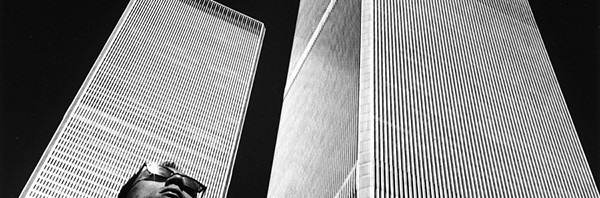
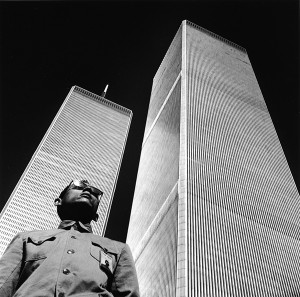
tseng kwong chiWhile visiting the excellent Tufts University Art Gallery exhibition, “Tseng Kwong-Chi: Performing for the Camera,” my colleagues and I heard the following story. Tseng was the child of Chinese anticommunist refugees. He moved to the East Village in the 1970s, where he worked and played with people like Keith Haring and Andy Warhol. When his parents visited from their home in Vancouver, they wanted to take him to Windows on the World, the fancy restaurant that used to be at the top of the World Trade Center. It required a jacket, and the only jacket Tseng owned was a Chinese Communist uniform that he had bought in a second-hand store in Montreal. The restaurant not only let him in but fawned over him, assuming that he was a Chinese dignitary. This reception gave Tseng the idea of posing in front of iconic monuments all over the North America and Western Europe, dressed in his Mao jacket, Ray-Bans, and an ID badge that reminds me of the X-Files. He always donned the serious, distant look of the Chairman inspecting the Red Army’s triumphs.

Tseng had studied art in Paris, so Richard Wolin’s book, The Wind from the East: French Intellectuals, the Cultural Revolution, and the Legacy of the 1960s provides some helpful background. Wolin writes that Communist China was all the rage in Paris in 1967. That year,

Mao-collared suits–“les cols de Mao“–had become immensely fashionable. Try as they might, the clothing boutiques in Paris’ tony sixteenth arrondissement could not keep them in stock. … Lui, the French equivalent of Playboy, decided to jump on the pro-Chinese bandwagon by featuring an eight-page spread of scantily clad models in straw hats, red stars, and Red Guard attire. The accompanying captions were culled from The Little Red Book. One striking image portrayed a young woman, unclad and equipped with an automatic rifle, emerging from an enormous white cake. “The revolution is not a dinner party,” read the legend.

Tseng might not have seen this Lui issue, but he lived in Paris soon after Chinese communism had inspired everything from softcore porn to an insurrection. Meanwhile, in the actual China, during the year 1967 alone, some 237,000 citizens were killed and 730,ooo permanently disabled as a result of the Cultural Revolution.

Tseng was a Canadian citizen, a gay man, an East Village artist, and an Asian immigrant to North America. In these pictures, he is role-playing the most powerful Asian man of the time, one whose victims–almost all Asians–may number 65 million. By passing as a Communist official instead of an East Village immigrant artist, he was able to experience social recognition in his adopted land. He also parodied the appropriation of serious matters for profitable pop culture and made serious art out of the parody.

See also:  French post-War intellectuals: some generalizations and when is cultural appropriation good or bad?

game theory, naval warfare, and Derek Walcott

I am in Washington, DC but remembering our winter vacation in Les Saintes, near Guadeloupe, because I am reading Derek Walcott’s astoundingly good epic, Omeros.

In the channel with three islets christened “Les Saintes”
in a mild sunrise the ninth ship of the French line
flashed fire at The Marlborough, but swift pennants

from Rodney’s flagship resignalled his set design
to break from the classic pattern … (XV)

Walcott is referring here to a major naval battle in 1782. When we saw the dioramas of the battle in the local history museum, I wondered why the “classic pattern” was for enemy fleets to form neat parallel lines and blast away at each other.

BattleOfVirginiaCapes

Was this some kind of courtly custom of the Baroque era? (Walcott writes, “the young midshipman … thought there was no war  /as courtly as a sea-battle.”) I think game theory offers a better explanation. The opposing players chose the best available strategies, each on the assumption that his opponent would make the best choice for him–which is what game theorists call a Nash Equilibrium.

Recall that sailing vessels cannot maneuver with perfect control because they are driven by the wind. Most of their lethal fire is directed from their sides. If they independently choose their own courses during a battle, they can easily get in each others’ way. In principle, each could be given complex directions from some central point, but inter-ship communication was badly limited before radio. It therefore made the most sense to set one simple rule that would guarantee coordination. The inflexible rule of the Royal Navy was to form a line of evenly spaced vessels.

Lord Howe’s Explanatory Instructions (1799) explained, “The chief purposes for which a fleet is formed in line of battle are: that the ships may be able to assist and support each other in action; that they may not be exposed to the fire of the enemy’s ships greater in number than themselves; and that every ship may be able to fire on the enemy without risk of firing into the ships of her own fleet.”

If one fleet had a good reason to form a line of evenly spaced ships, so did its opponent. Both wanted to sail in front of the other’s line, or “cross the T,” so as to be able to rake the enemy’s ships without receiving fire in return. But if two fleets are both trying to cross in front of each other, what you get is a pair of parallel lines.

The result of such a battle was pretty predictable, a function of the number of guns on each side. That meant that a clearly smaller fleet had a strong incentive to avoid battle or, if forced into it, to break the line and take a chance at prevailing in a chaotic melee. A melee could also develop by accident as a result of weather conditions, geographical obstacles, or sheer chaos. At the Battle of the Saintes (1782), the lines got mixed up. Walcott says this was Admiral Rodney’s plan, his “set design.” Wikipedia says the reason was a gusty wind that broke up the lines. Whether by chance or design, the Royal Navy ended up killing 8,000 French to their own losses of just 243 men.

Trafalgar (1805) was another famous counterexample. Nelson deliberately swooped in to break the enemy line, despite the grave risk of being raked by their broadsides, because he had a much greater incentive than the Franco-Spanish fleet to achieve a decisive result that day and was willing to take his chances. Nelson played the chicken game and didn’t swerve, for which he paid with his life but gets to stand on top of a huge column in central London to this day.

In 1913, when he was First Lord of the Admiralty, Winston Churchill faced the accusation that he had impugned the traditions of the Royal Navy. He replied: “And what are they? Rum, sodomy and the lash.” Maybe he should have said, ” … and the Nash.”

See also the gift economy of Beowulf and some thoughts about game theory.

remembering Melisto

MellistoThis is Melisto, a daughter of Ktesikrates from Sounion, which is now a day-trip from Athens. I think her name means “Melody,” unless it’s related to the word for “honey.”* Melisto lived for a few years (six, perhaps?) around 340 BCE. The Macedonian King Phillip II was dominating Greece at the time, and his son Alexander was soon to conquer a vast empire. Ktesikrates and perhaps other members of the family were sad enough to lose Melisto that they had a very handsome marble stele carved for her, with her name at the top. She is showing a live bird to her fluffy lapdog and smiling at the results. The figure in her other hand may be a votive object rather than a doll, according to the museum label. A nice little classical building shelters her and announces her name to us, 2,350 years later, in Cambridge, MA.

*Is it from melisma (song) or melisseios (honey)?